ICD-10 Code V09.01XS: Pedestrian injured in nontraffic accident involving military vehicle, sequela
ICD-10 Code V09.01XS: Code description and clinical meaning ICD-10 code V09.01XS...

Last Updated: Oct 26, 2026
Billable Code Specific Code
Z72.0 is the billable ICD-10-CM code for tobacco use.
According to the CDC ICD-10-CM Official Guidelines, the code applies only when the record documents current use. The provider must also have stopped short of diagnosing dependence.
Let Pabau's smart automation suggest the right codes, reduce claim denials, and keep your practice compliant—effortlessly.
Automate repetitive tasks and focus on what matters most—your patients.
Reduce coding errors and ensure compliance with the latest regulations.
Clean claims, fewer denials, and faster reimbursements.
Powerful insights and reporting to help your practice thrive.
HIPAA compliant SOC 2 certified GDPR-compliant Trusted by 4,000+ clinics worldwide

ICD-10 code Z72.0 is a billable FY2026 diagnosis code for current tobacco use that does not meet the clinical criteria for dependence.
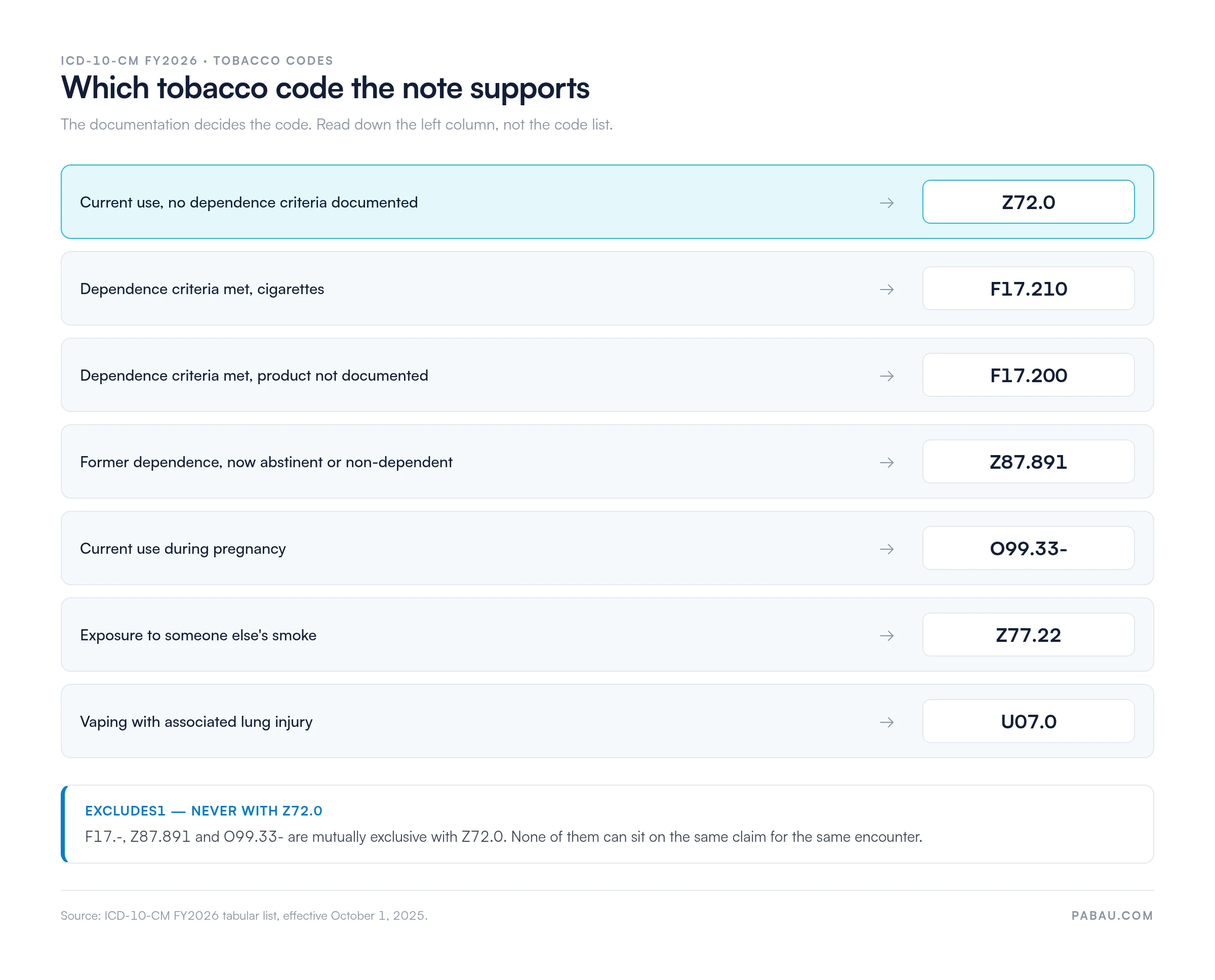
Z72.0 carries Excludes1 notes for nicotine dependence (F17.-), history of tobacco dependence (Z87.891) and tobacco use in pregnancy (O99.33-).
None of those three codes can be assigned alongside Z72.0 at the same encounter.
Assigning Z72.0 when F17 criteria are met is a documented audit risk, so screen for DSM-5 dependence criteria before coding.
Pabau’s claims management software pairs Z72.0 with tobacco cessation CPT codes at point of care and flags thin documentation before submission.
Z72.0 describes current tobacco use with no dependence. It belongs to the Z72 category, “Problems related to lifestyle.” The category sits in the ICD-10-CM tabular list maintained by the CDC and the Centers for Medicare and Medicaid Services (CMS).
The code is specific and billable, meaning it can be submitted directly for reimbursement without requiring a more detailed code. The FY2026 edition became effective October 1, 2025 and carries no structural changes from FY2025.
ICD-10 code Z72.0 covers a broader range of tobacco products than coders sometimes assume. The following synonyms are recognized in the ICD-10-CM index and are all correctly captured by Z72.0, provided the patient does not meet dependence criteria.
Electronic cigarettes and vaping are less settled. Some ICD-10-CM index references route vaping to Z72.0 where no dependence is established. Lung injury associated with vaping is coded separately, under U07.0. Check the current FY2026 CDC tabular notes before you claim vaping coverage under Z72.0.
The most consequential coding decision in tobacco documentation is choosing between Z72.0 (use, no dependence) and the F17.- category (nicotine dependence). Getting this wrong in either direction creates claim exposure. Using Z72.0 when dependence criteria are met understates clinical severity and may miss higher-reimbursement cessation services. Using F17.- without adequate documentation invites audit scrutiny.
The Excludes1 note is a hard stop. Z72.0 and any F17.- code cannot appear on the same claim for the same encounter. When cigarettes are the documented product and dependence criteria are met, F17.210 is the code to assign. Make sure the note supports whichever one you submit.
Every exclusion note attached to Z72.0 is an Excludes1 note. Each excluded code is mutually exclusive with Z72.0, so a payer edit fires when both land on the same encounter.
Excludes1 edits work the same way elsewhere in ICD-10-CM, and the blocking note is not always filed under the code being billed. ICD-10 code Q43.7 carries no exclusion notes of its own, yet it cannot be reported with Q52.2, because the Excludes1 note sits under Q52.2.
Three codes are excluded from Z72.0, and none of them may be assigned alongside it at the same encounter:
Which code the encounter supports comes down to what the note documents, not to which code is quickest to reach for.
Z72.0 sits within Z72, “Problems related to lifestyle.” Z72 in turn sits in the Z69-Z76 block, which covers persons encountering health services in other circumstances. All of it belongs to the Z00-Z99 chapter for factors influencing health status.
Tobacco coding rarely sits on its own. These related codes turn up in the same encounter or the same record, and knowing when each one applies keeps the documentation complete.
Payers audit tobacco codes because they gate access to cessation counseling reimbursement. Lean documentation gets claims kicked back. The provider note must contain specific language to support Z72.0.
Template tobacco screening into the annual wellness visit documentation. That way the Z72.0 entry never sits in the note unsubstantiated.
Run a quarterly audit of Z72.0 claims against the underlying notes. Flag any encounter whose note mentions failed quit attempts or withdrawal symptoms. Those encounters usually warrant F17.- instead, and catching them internally costs far less than a payer audit.
Tobacco cessation counseling delivered at the same encounter as Z72.0 is reimbursable under Medicare and most commercial plans. Two dedicated CPT codes carry it, and correct pairing is what gets the counseling time paid.
Older guidance pointed facilities at HCPCS codes G0436 and G0437. CMS deleted both on September 30, 2016, so Medicare now takes 99406 and 99407 in every setting, hospital outpatient departments included.
Medicare covers up to eight cessation counseling sessions a year, as two quit attempts of four sessions each, per CMS Physician Fee Schedule guidance. That benefit reaches every beneficiary who uses tobacco, whatever their disease status. Still check the patient’s coverage before you submit.
Tobacco coding generates a disproportionate share of documentation-related claim edits. Three patterns account for most of the risk.
Clinicians sometimes default to Z72.0 because it is the simpler code. That happens even when the note describes failed quit attempts, withdrawal symptoms, or continued use despite documented respiratory harm. Payers trained on this pattern flag it.
The rule: If the note supports two or more DSM-5 substance use disorder criteria for tobacco, use F17.- and document accordingly.
Submitting 99406 or 99407 alongside Z72.0 without time-stamped documentation is a denial trigger. Both CPT codes require face-to-face counseling with start and stop times recorded in the note. “Counseling provided regarding smoking cessation” without a time is not enough.
Capturing counseling time at the point of care, rather than at the end of the day, removes most of this risk.
Z72.0 is excluded outright for tobacco use during pregnancy, and the Excludes1 note against O99.33- is direct. If the patient is pregnant and uses tobacco, route to O99.330 through O99.335 as appropriate for the trimester and encounter type.
A pre-submission check on pregnancy status against the tobacco code catches this before the claim goes out.
A clean tobacco claim comes down to three checks before submission:
When one of those checks fails, the claim tends to come back with one of a handful of denial codes. The fix usually sits in the note rather than on the claim form.
Picking tobacco codes by hand at the end of a busy day is where errors accumulate. An integrated EHR and billing platform removes that friction at two points, documentation capture and claim submission.
Practice management software like Pabau handles both. Pabau’s claims management software surfaces ICD-10 code Z72.0 alongside its CPT pairing suggestions at the point of care. When a provider documents current use with no dependence language, it can propose Z72.0 with 99406 or 99407 from the counseling time recorded.
Claims then route through the Claim.MD clearinghouse, which validates them against thousands of US payers before submission. Electronic remittance advice comes back into the same record for reconciliation.
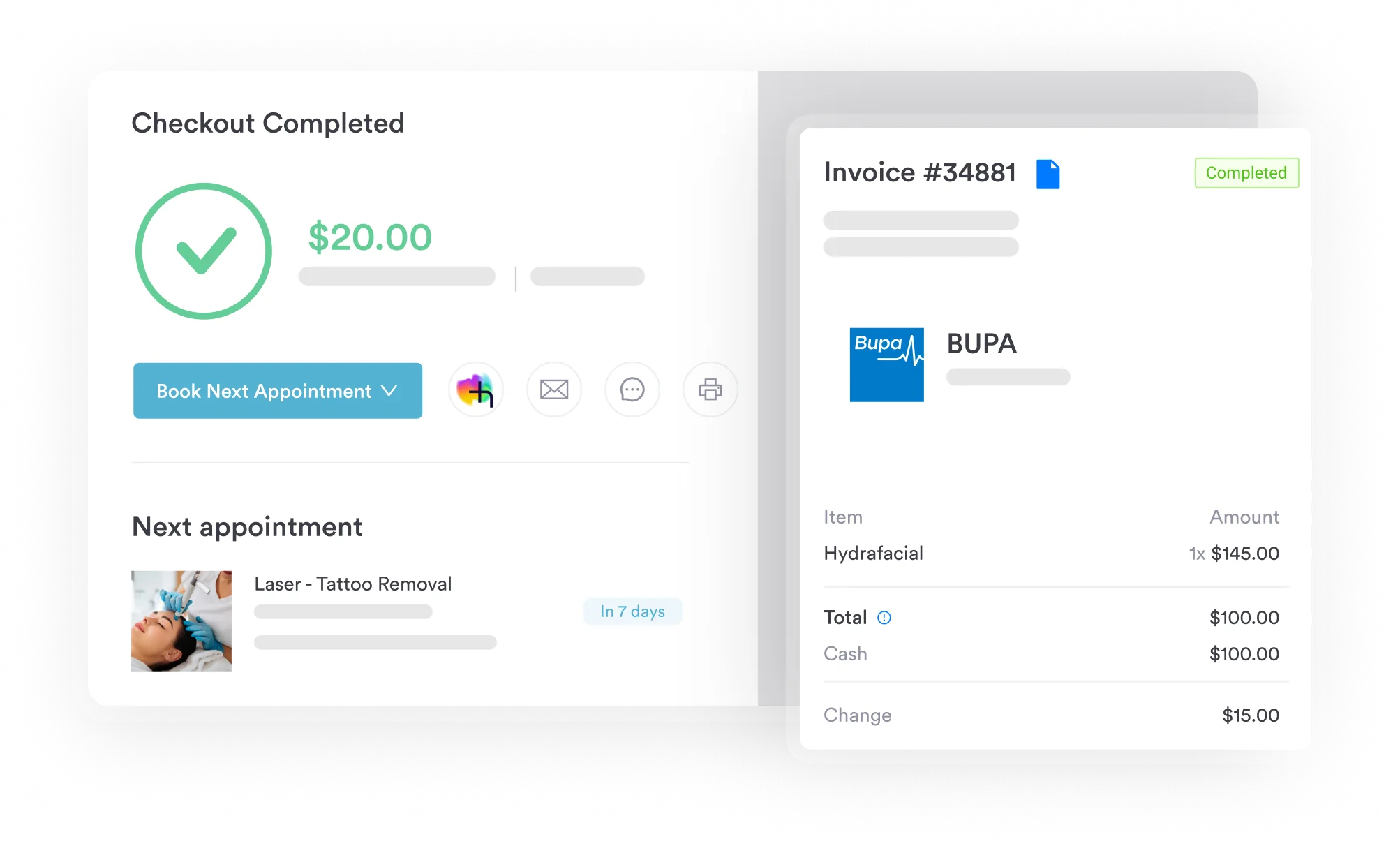
For practices running USPSTF-recommended tobacco screening, Pabau’s digital forms can embed the screening prompts in the wellness visit workflow. That leaves a structured documentation trail tied to the diagnosis code, with no separate coding step.
Claim.MD also supports real-time eligibility checks, so staff can confirm cessation counseling coverage before the patient leaves the room.
Practices tracking denial patterns on tobacco codes can read the electronic remittance advice from Claim.MD to see which CARC reason codes keep recurring. From there you fix the template that produced the thin note, rather than reviewing claims one at a time.
Audit your annual wellness visit template for tobacco documentation. If the template produces a note that says only ‘tobacco use: yes,’ it will not substantiate Z72.0 under payer review. Add a field for product type and a checkbox confirming no dependence criteria, and link it to the CPT counseling time field.

Pabau’s claims management tools pair Z72.0 with CPT 99406 or 99407 at the point of care. Thin documentation gets flagged before submission, and claims route through Claim.MD for US payer processing.

Z72.0 looks like a housekeeping code, which is exactly why it gets assigned on autopilot. The code is a statement about what the note does not say, so it is only as strong as the screening behind it.
Build the check into the visit rather than into the coding queue. Screen for dependence criteria at the point of care, and record the product and the counseling time. Do that and Z72.0 stops being the code you defend after the fact.
Book a demo to see how Pabau ties tobacco screening, code selection and claim submission into one workflow.

Need to understand how clearinghouse claim validation works? Claim.MD vs Office Ally compares two major US clearinghouses on payer network size, real-time eligibility, and ERA processing.
Coding a patient who used to be dependent? ICD-10 code Z87.891 covers personal history of nicotine dependence and when it takes the place of Z72.0.
Looking for a broader billing workflow guide? Best medical billing software for US practices evaluates platforms on ICD-10 support, clearinghouse integration, and reporting.
ICD-10 code Z72.0 is a billable diagnosis code for documenting current tobacco use in a patient who does not meet clinical criteria for tobacco dependence. It is commonly assigned during preventive visits and annual wellness checks. Any encounter noting current use in the social history qualifies, as long as there is no dependence or withdrawal.
Z72.0 applies when a patient currently uses tobacco but does not meet dependence criteria (no withdrawal, no compulsive use, no continued use despite documented harm). F17.- codes apply when the patient meets two or more DSM-5 substance use disorder criteria for nicotine. The Excludes1 note on Z72.0 prohibits coding both at the same encounter.
Yes. Z72.0 is a billable, specific ICD-10-CM code valid for reimbursement purposes in FY2026, effective October 1, 2025. It can be submitted directly on a claim without requiring a more granular code.
CPT 99406 covers face-to-face tobacco cessation counseling of 3 to 10 minutes, and CPT 99407 covers sessions longer than 10 minutes. Both require start and stop times in the provider note. Medicare uses these two codes in every setting, including hospital outpatient departments. CMS deleted the old facility codes G0436 and G0437 on September 30, 2016.
Z87.891 is the code for personal history of tobacco dependence. It applies when a patient formerly met dependence criteria and is now abstinent or no longer dependent. Z87.891 carries an Excludes1 note with Z72.0, so the two cannot be coded together at the same encounter. Assign whichever one the note supports.
Z72.0 covers smokeless tobacco (chewing tobacco, snuff) when no dependence criteria are met. E-cigarette use may route to Z72.0 in some ICD-10-CM index references, but vaping-related lung injury should be coded separately with U07.0. Verify against current FY2026 CDC tabular notes for vaping-specific guidance before asserting coverage.
Z72.0 is typically coded as a secondary diagnosis alongside the principal reason for the encounter. It may function as a primary code during preventive visits, cessation-focused encounters, or annual wellness visits. Those are the encounters where tobacco documentation is the main clinical activity. Payer policies on primary vs. secondary designation vary; check your specific payer’s LCD before assuming primary use is reimbursable.