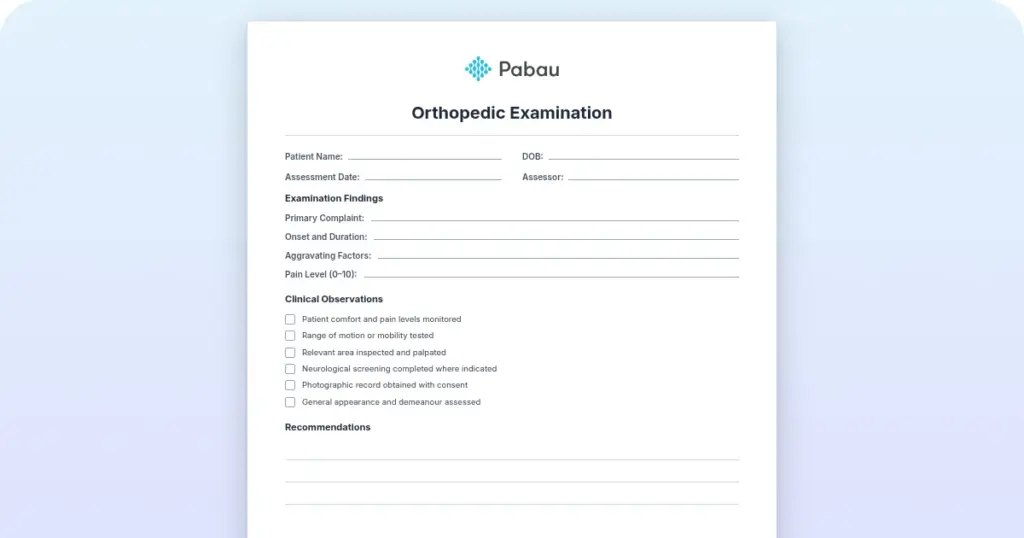
Orthopedic examination template: Free 6-stage form (PDF)
An orthopedic examination is a structured physical assessment of the bones, join...

2
Last Updated: Oct 16, 2026

The Whipple test screens for supraspinatus tears and subacromial pain syndrome (SAPS) inside a wider shoulder exam.
Position the arm at 90 degrees of forward flexion, adducted so the hand sits opposite the other shoulder, palm down.
Pain or weakness against steady downward pressure counts as positive, and weakness without pain is the more telling finding.
A 2019 arthroscopy study of 61 patients (PMID 31691179) found 88.6% sensitivity but only 29.4% specificity, so false positives are common.
Practice management software like Pabau stores every shoulder assessment in the client record, so findings stay comparable between visits.
Shoulder pain that flares on overhead reaching usually starts in the rotator cuff, and the supraspinatus tends to go first. The hard part isn’t spotting a sore shoulder, but rather telling a torn tendon from an irritated one without sending every patient for an MRI.
The Whipple test is one way to answer that question. It loads the supraspinatus in a position the tendon can’t dodge, so pain or weakness under pressure means something is genuinely wrong.
Almost no tear gets past it, which is the good news. The catch is that plenty of healthy shoulders test positive too, so reading the result matters just as much as running the test.
The Whipple test is an orthopedic special test for supraspinatus tendon integrity and subacromial pain syndrome, or SAPS. Orthopedic surgeon Terry Whipple first described it, and the logic is straightforward. Put the arm where the supraspinatus has to carry the load alone, then press down and see what happens.
In a standard shoulder screen, it sits alongside the Neer, Jobe (empty-can), full-can, and drop-arm tests, and each one loads the joint a little differently. The Whipple test combines forward flexion, adduction across the body, and internal rotation, so the supraspinatus gets almost no help from the deltoid or cuff.
Quick disambiguation: This guide covers the orthopedic shoulder test, not Whipple’s triad or Whipple’s disease. The comparison table further down sorts out which is which.
The supraspinatus runs from the supraspinous fossa of the scapula to the greater tuberosity of the humerus, passing under the coracoacromial arch along the way. It’s the most superior of the four rotator cuff muscles, which means it absorbs the most mechanical load during overhead work.
A torn tendon then does two things that make clinical testing possible.
First, it loses tensile strength, so resisted loading in the right position exposes weakness. Second, the damaged tissue crowds the subacromial space and catches against the acromion above it, which provokes pain.
Positioning decides what the test actually measures. Move the arm just a few degrees off the described position, and you’re loading a different structure, which changes what a positive result is worth.
Run through the checklist below before you touch the patient’s arm:
Place one hand on the patient’s distal forearm or wrist, then press down steadily and ask them to hold the arm exactly where it is. The challenge should feel like a controlled isometric hold, never a sudden jerk.
Use your free hand on the shoulder or trunk, so the patient can’t lean away from the pressure.
Consistency is what makes the result useful later, since examiner variability is a documented weakness of shoulder special tests. Keep the force the same on both sides, and at the next visit too.
Record the finding in the same field every time, whether that lives in your physical therapy EMR or on paper.
Most misleading Whipple test results come from technique rather than from the test itself. These are the slips worth watching for in your own hands, and in a student’s:
A positive Whipple test means pain, weakness, or both under pressure, and the pain usually sits over the front or side of the shoulder. Weakness with little pain is the more useful finding, since it suggests the tendon itself is failing, not just the patient guarding.
A positive result raises the odds of supraspinatus pathology or subacromial impingement, but on its own it confirms nothing. Imaging is what settles the question: MRI has sensitivity above 90% for full-thickness tears, while musculoskeletal ultrasound is quicker, cheaper, and available inside physiotherapy-led services.
Here’s how that plays out in practice: a 54-year-old swimmer arrives with six weeks of lateral shoulder pain. Her Whipple test reproduces the pain, the empty-can test does the same, and her strength holds against both.
That pattern fits an irritated tendon rather than a torn one, so she starts loaded rehabilitation and comes back in six weeks. Change one detail, though, say a clear loss of strength with little pain, and imaging moves to the front of the queue.
Coding follows the same trail. When imaging confirms a complete, non-traumatic tear, the diagnosis codes to M75.121 on the right or M75.122 on the left.
The most cited evidence for the Whipple test comes from a prospective study by Ackmann and colleagues. It ran online in November 2019 in Musculoskeletal Surgery, indexed on PubMed (PMID 31691179).
The team examined 61 patients booked for arthroscopic shoulder surgery, then checked every test result against what the surgeon actually found inside the joint.
The study compared three tests: the Whipple, the empty-can (Jobe), and the full-can. The Neer test wasn’t among them. Here’s how each one performed against arthroscopic confirmation of full and partial supraspinatus tears.
So the Whipple test rarely misses a torn supraspinatus, but the weakness sits in the other direction. At 29.4% specificity, it comes back positive in roughly seven of every ten shoulders whose supraspinatus is intact.
The authors concluded that the Whipple test was less specific than both comparators, so it carries a real risk of false positives.
Figures shift between studies depending on the population, the reference standard, and whether partial tears count as positive. Treat these as one well-controlled snapshot, not a fixed value.
The practical reading holds: a negative Whipple test is reassuring. A positive one needs support from other tests, plus imaging if the picture suggests a tear.
Run the Whipple test alongside at least two other shoulder special tests every time. A cluster of positive findings, say Whipple plus drop arm plus a painful arc, carries far more weight than any single result on its own. Record each test separately in the patient record, so you can track change across appointments.
The Whipple test belongs to a wider family of shoulder tests. Knowing how they differ helps you pick the right one for the question in front of you. The table below sets them side by side.
The Neer test picks up subacromial impingement more broadly, while Jobe and full-can load the supraspinatus in abduction instead of flexion. Full-can also tends to provoke less pain when the AC joint is sore.
Drop arm belongs at the severe end, where muscular control has gone. Pair the Whipple test with one abduction test and the drop arm test, and you cover that whole range in under a minute.
Clusters beat single tests everywhere in musculoskeletal practice, and that’s the same logic behind the Ottawa ankle rules. Once the shoulder starts loading again, structured progressions like return-to-running protocols show how to stage functional milestones alongside repeat testing.
Not every sore shoulder needs it. Knowing when to include the test saves examination time and spares the patient unnecessary pain.
In a busy physiotherapy or sports medicine practice, that decision gets made dozens of times a week.
Use the Whipple test when:
Go straight to imaging, without waiting on test results, when:
Knowing the onward pathway also helps you set expectations at the first visit. Most patients improve with loaded rehabilitation, but a confirmed massive tear that fails to settle heads for a surgical opinion.
In an older shoulder with cuff arthropathy, that can mean arthroplasty under 23472. Anyone running a physiotherapy practice should agree that referral route before it’s needed.
The test is a screen, and screens have limits. These are the ones that change what you do next.
Documentation is where those limits get managed. Note the position used, the force applied, and the patient’s exact response, so the next clinician reads the same test you ran. A shared phrase bank helps here, and a therapy progress notes cheat sheet gives the team one wording to work from.
State rules add another layer, since physical therapy practice standards set what has to be recorded and for how long. Consistent clinical record management keeps those results comparable between assessment dates and keeps the audit trail intact.
Students and early-career clinicians mix these up constantly, and search engines do not help. Here is the short version.
Different specialties, different patients, same surname. If you came here for the shoulder examination, you are in the right place.
A special test only earns its place if the result survives past the appointment. Often it does not. Findings land in a free-text note, written in whatever wording the clinician reached for that day.
Six weeks later, nobody can tell whether the Whipple test produced pain, weakness, or both.
Practice management software like Pabau handles that with structured digital forms. You build one shoulder assessment template, with each special test as its own field, and the whole team then records findings the same way. The completed form sits in the client record beside the treatment note, the consent, and any photos.
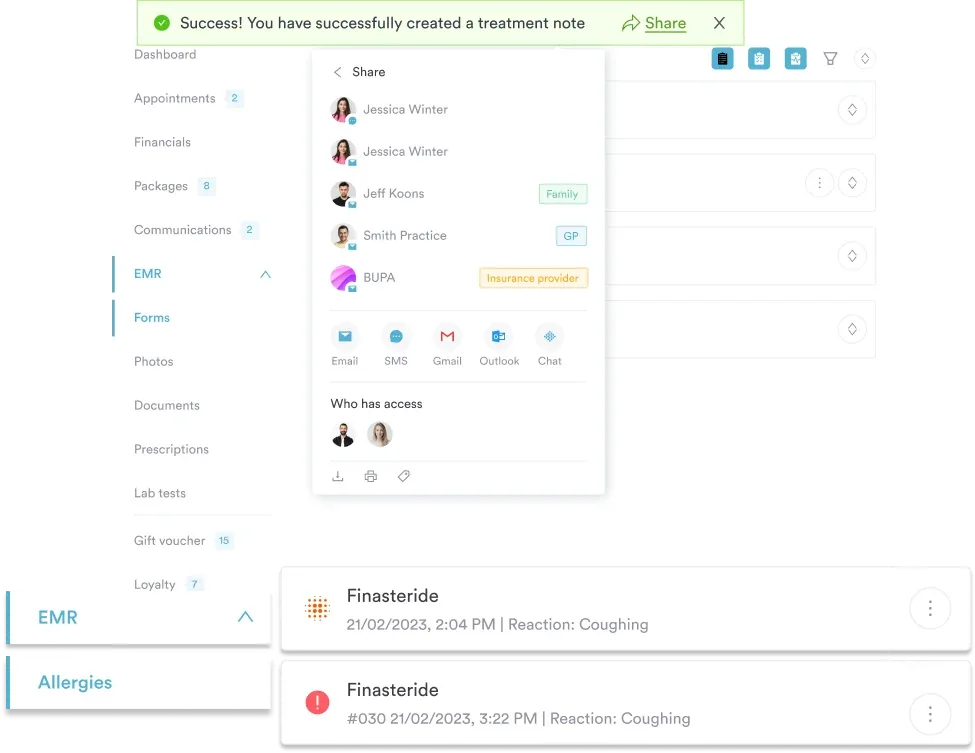
The payoff is a clean view of one shoulder across an episode of care, plus an audit trail of what was tested and when. Rebooking, recalls, and outcome tracking run from the same record, so patients on longer rehabilitation pathways do not quietly drop off the list.
Physiotherapy practice software that ties assessment to scheduling saves the front desk that chase.

Physiotherapy and sports medicine practices use Pabau to capture special test findings in structured clinical notes. Track shoulder progress across appointments, and store consent and intake forms in the same client record.

Treat the Whipple test as a filter, not a verdict. It’s worth running because a negative result genuinely lowers your suspicion of a supraspinatus tear, but a positive one only tells you to keep looking. And the specificity figures say you’ll be looking at a lot of intact tendons along the way.
So the value comes from what you build around it. That means standard positioning, a cluster of tests, a clear note on pain versus weakness, and imaging when the picture calls for it. Get all of that right, and the same shoulder can be compared fairly at week one, week six, and discharge.
Pabau’s digital intake forms and structured client records give physiotherapy and sports medicine teams one place to record those findings every time. Book a demo to see how it fits your shoulder assessment workflow.

Scoring another musculoskeletal assessment by hand? Modified Ashworth Scale walks through the grades and how to record them consistently.
Sending a patient home after treatment? Acupuncture aftercare guide A ready-to-print resource covers post-treatment care, expected sensations, hydration, activity guidance, and recovery timelines.
Documenting informed consent before treatment? Acupuncture consent form A ready-to-use form covers treatment description, risks and benefits, patient rights, and authorization signature blocks.
Comparing systems for a sports medicine service? Sports medicine software ranks the main platforms and what each one suits.
Sometimes. Surgeons report positive Whipple tests in superior labral (SLAP) lesions as well as cuff tears. The test cannot separate the two, so pair it with a labral test such as the O’Brien active compression test.
The orthopedic surgeon Terry Whipple described it, and his original account linked a positive result to tears of the anterior supraspinatus. That’s a narrower target than the whole cuff.
It can be, since the position loads an irritated tendon under the acromion. Warn the patient first, apply pressure gradually, and stop at sharp pain. Reproducing familiar pain is enough, so pushing harder adds nothing.
No, not on its own. Special tests form part of the physical therapy evaluation, coded 97161 to 97163 in the US, or part of the physician’s visit. Record the finding in the note instead.
Repeat it at each formal reassessment, which is usually every four to six weeks in a shoulder rehabilitation plan. Compare the result against the first one, and use the same position and force each time.