Exilis patient treatment record: Free PDF for RF sessions
An Exilis patient treatment record is the session log for BTL’s radiofrequ...

3
Last Updated: Oct 23, 2026

A Utah cosmetology license takes 1,250 training hours, not the 1,600 hours most guides still quote.
The Division of Professional Licensing issues every license, and applicants pass the NIC theory and practical exams at 70%.
S.B. 330 closed the standalone esthetician and barber licenses on January 1, 2026 and replaced them with permits.
Licenses renew every two years and expire on September 30 of odd years, and Utah requires no continuing education.
Utah licenses individuals and schools only, so there is no salon license and compliance sits with each practitioner.
Utah cosmetology license requirements come down to hours, two exams and an online application. The Division of Professional Licensing, known as DOPL, issues every credential in the field. A Utah cosmetology license takes 1,250 hours of school or registered apprenticeship, then the NIC theory and practical exams at 70%. Aesthetic practices that pay licensed cosmetologists on commission can compare staff commission tools in our ranking of software for med spas.
That 1,250 figure is where most pages on this subject are now wrong. S.B. 330 cut the requirement from 1,600 hours, effective January 1, 2026. A second bill, S.B. 117 2nd Sub., amended the same chapter again on July 1, 2026.
The same rewrite closed two licenses outright. Utah no longer issues a standalone esthetician license, and the old cosmetology/barbering license is now legacy. The sections below work from the statute as it reads today, with the citation on each figure.
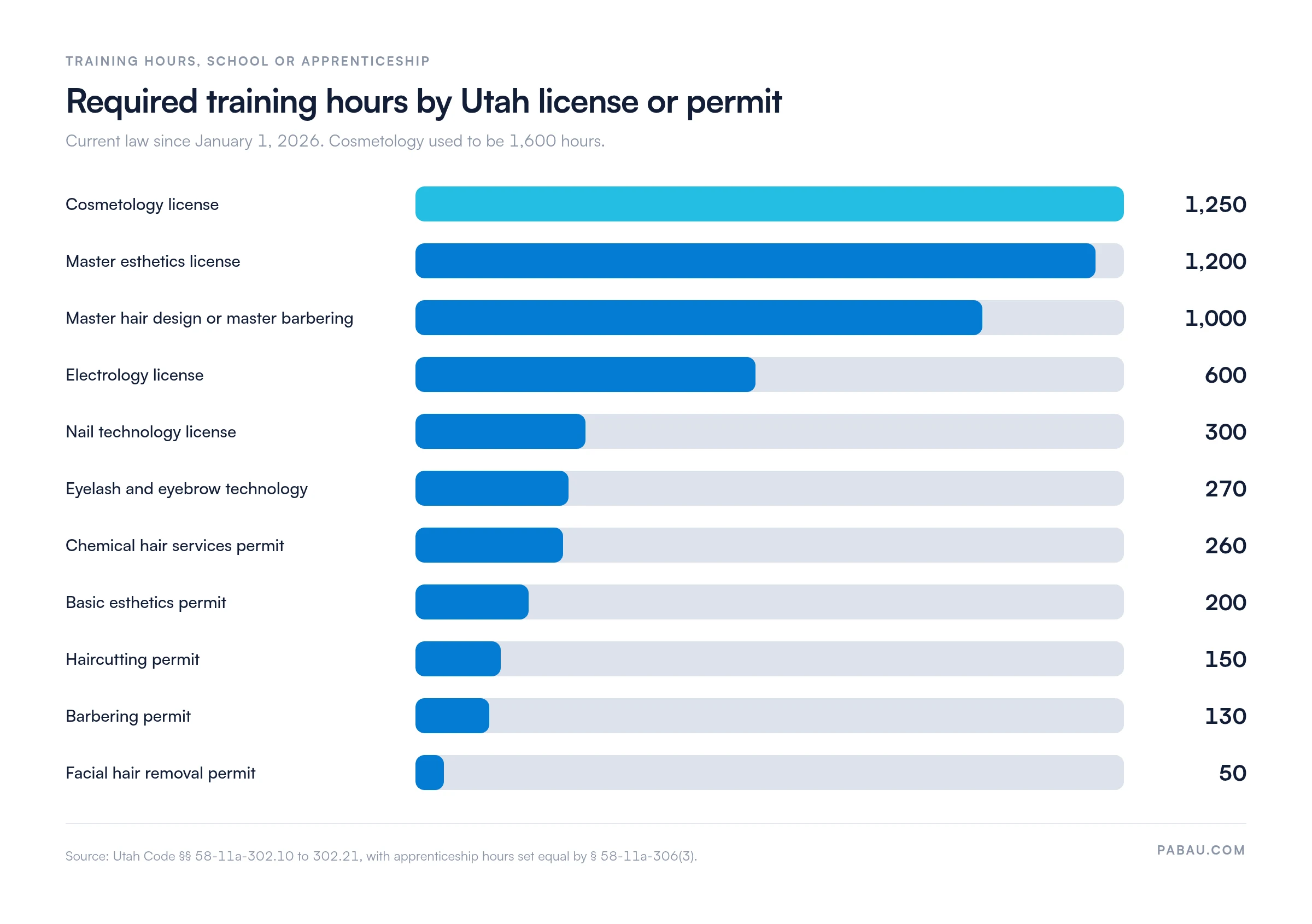
Utah asks for 1,250 hours for a cosmetology license and 1,200 for master esthetics. The permits run far shorter, from 260 hours for chemical hair services down to 50 for facial hair removal. Apprenticeship hours match school hours in every current category, under § 58-11a-306(3). Oklahoma’s cosmetology license requirements, by contrast, set apprenticeship at roughly twice the school hours.
The table crosses each category against the hours the statute sets now, the figure it replaced, and whether DOPL still issues it to new applicants.
Source: Utah Code Title 58, Chapter 11a, Part 3, as amended by S.B. 330 in 2025 and S.B. 117 2nd Sub. in 2026.
Ranked against each other, the spread is wider than the phrase “cosmetology license” suggests. A facial hair removal permit is 4% of the cosmetology hour count.
The Division of Professional Licensing issues it, inside the Utah Department of Commerce. Its advisory body is the Cosmetology and Associated Professions Licensing Board.
If you have been searching for a Utah state board of cosmetology, that board is what you found, and it does not issue licenses. It advises DOPL. Under § 58-11a-201(1) the board has 10 members. They include licensed practitioners, school representatives, a supervisor as defined in § 58-1-505, and two members of the public.
Cosmetology in Utah runs on two documents. The statute is the Cosmetology and Associated Professions Licensing Act, Title 58, Chapter 11a. The rule underneath it is Utah Administrative Code R156-11a.
One detail is worth knowing before you open either. R156-11a has not been updated since S.B. 330, so it still lists the pre-2026 license names. Read the statute for hours and categories, and the rule for exams, acids, devices and renewal mechanics.
Utah cosmetology hours fell from 1,600 to 1,250 on January 1, 2026, the day S.B. 330 took effect. The bill was called Cosmetology Modifications, and it landed as chapter 491 of the 2025 session laws. The new 1,250-hour figure matches the school hours behind a Pennsylvania cosmetology license.
S.B. 330 repealed and re-enacted §§ 58-11a-102, -301, -302 and -306. It then enacted §§ 58-11a-302.10 through -302.25, which is where the permit ladder and the apprenticeship route now live. Here is what that did in practice.
S.B. 117 2nd Sub. then amended the chapter on July 1, 2026. It added the legacy sections and confirmed that a cosmetology license holder may be known as a cosmetologist or a barber, under § 58-11a-302.13(5).
Two January 2026 dates get run together online, and they are separate events. S.B. 330 took effect on January 1, 2026. DOPL’s switch to online-only cosmetology applications through My License One took effect on January 31, 2026.
Nobody who trained under the old rules is stranded. Utah kept three legacy licenses: cosmetology/barbering at 1,600 school hours (§ 58-11a-302.26), esthetics at 600 (§ 58-11a-302.23), and barbering at 1,000 (§ 58-11a-302.24).
DOPL may not issue those three to new applicants, and current holders renew as normal. One credit crosses over. A legacy cosmetology/barbering holder may count 600 hours toward the 1,200 needed for master esthetics, under § 58-11a-302(2)(b).
Six steps take you from choosing a category to holding a license number.
Two requirements that competing guides argue about are simply absent from Utah law. The statute sets no minimum age for a Utah cosmetology license and no high school diploma requirement (§ 58-11a-302(1)).
The diploma obligation sits on the school instead. A licensed school may admit a regular student only if that student holds a recognized diploma or equivalent, or is past compulsory-attendance age (§ 58-11a-302.22(2)(a)(i)).
If you are working out how to become a licensed hair stylist here, two credentials do that job. The cosmetology license covers hair at 1,250 hours, and the master hair design license sits above it at 1,000 hours of specialist training.
Utah no longer issues a standalone esthetician license, so Utah esthetician license requirements now point at two different credentials. A Utah esthetician license is not a category DOPL can grant.
The entry route is the basic esthetics permit at 200 hours (§ 58-11a-302.11). It covers skin care done for cosmetic purposes, and expressly not for the treatment of medical, physical, or mental ailments.
Above it sits the master esthetics license at 1,200 hours (§ 58-11a-302.18). That is a flat minimum, not 600 hours plus another 1,200. Master esthetics is the only cosmetology-family credential that reaches devices and deeper peels.
The 600-hour esthetician license Utah used to issue is now a legacy category (§ 58-11a-302.23). It closed to new applicants on January 1, 2026, so any page still quoting 600 hours is describing a license you cannot apply for.
Utah barber license requirements now split across two credentials: a 130-hour barbering permit (§ 58-11a-302.10) and a 1,000-hour master barbering license above it (§ 58-11a-302.19).
A Utah barber license at permit level is the fastest route into a chair in the whole chapter. The master credential shares its section with the master hair design license, which is why the two names appear together in the statute.
Cosmetologists do not need either one. Under § 58-11a-302.13(5) a cosmetology license holder may be known as a cosmetologist or a barber. The barber license Utah issued at 1,000 school hours before 2026 is now legacy and closed to new applicants (§ 58-11a-302.24).
Utah nail tech license requirements are 300 hours of school or apprenticeship under § 58-11a-302.20, plus the NIC theory and practical examinations at 70%.
A Utah nail technician license is its own category, so it does not carry any esthetics scope. Skin treatments belong to the basic esthetics permit or the master esthetics license.
The nail license Utah issues follows the standard route: the hours, the two exams, then an online application. Apprenticeship hours are again identical to school hours, at 300.
Utah cosmetology instructor license requirements are 75 clock hours of instructor training plus six months of work experience, under § 58-11a-302.21(1)(d). The NIC Instructor examination applies on top.
The instructor credential behaves differently from the rest. It is a one-time certificate that does not expire while the underlying license stays current, so there is no separate instructor renewal cycle (R156-11a-303).
Utah cosmetology license renewal runs on a two-year cycle, and every license in this family expires on September 30 of odd years. Utah requires no continuing education at all (§ 58-11a-303; R156-11a-303; R156-1-308a Table 1). The next expiry date is September 30, 2027.
DOPL mails a renewal notice at least 60 days before the license expires (§ 58-1-308). Cosmetology license renewal has been online only since January 31, 2026, through My License One.
Source: DOPL’s cosmetology renewal page and its division-wide fee schedule.
Application fees live on a separate schedule, and only the barber figure is published in a readable form. Check DOPL’s fee schedule for your own category before you budget, because it carries no printed effective date.
An out-of-state license comes in by endorsement under § 58-1-302. DOPL shall issue one where your license covers a similar scope of practice. You also need a year of practice under it, and it has to be in good standing.
DOPL may also act on a substantial-similarity finding, and may grant a limited supervised training permit while it evaluates you. You still sit the NIC theory and practical exams. That section overrides any conflicting endorsement provision elsewhere in Title 58.
The operative limit is written into the definitions. Basic esthetics and legacy esthetics cover procedures done for cosmetic purposes, “and not for the treatment of medical, physical, or mental ailments” (§§ 58-11a-302.11(1) and -302.23(2)).
A master esthetician is held to the same boundary. They may not perform their listed services to treat a medical, physical or mental ailment (§ 58-11a-302.18(1)(b)).
Past that line, two other regulators own the work. The Medical Licensing Board sits under the Utah Medical Practice Act, Title 58, Chapter 67 (§ 58-67-201). The Board of Nursing and Certified Nurse Midwives sits under the Nurse Practice Act, Title 58, Chapter 31b (§ 58-31b-201).
Source: Utah Code Title 58, Chapters 1, 11a and 67, with Utah Administrative Code R156-11a-610 and R156-11a-611.
Read as a ladder, the pattern is easier to hold. Each credential adds treatments, and one statute decides where a supervisor has to appear.
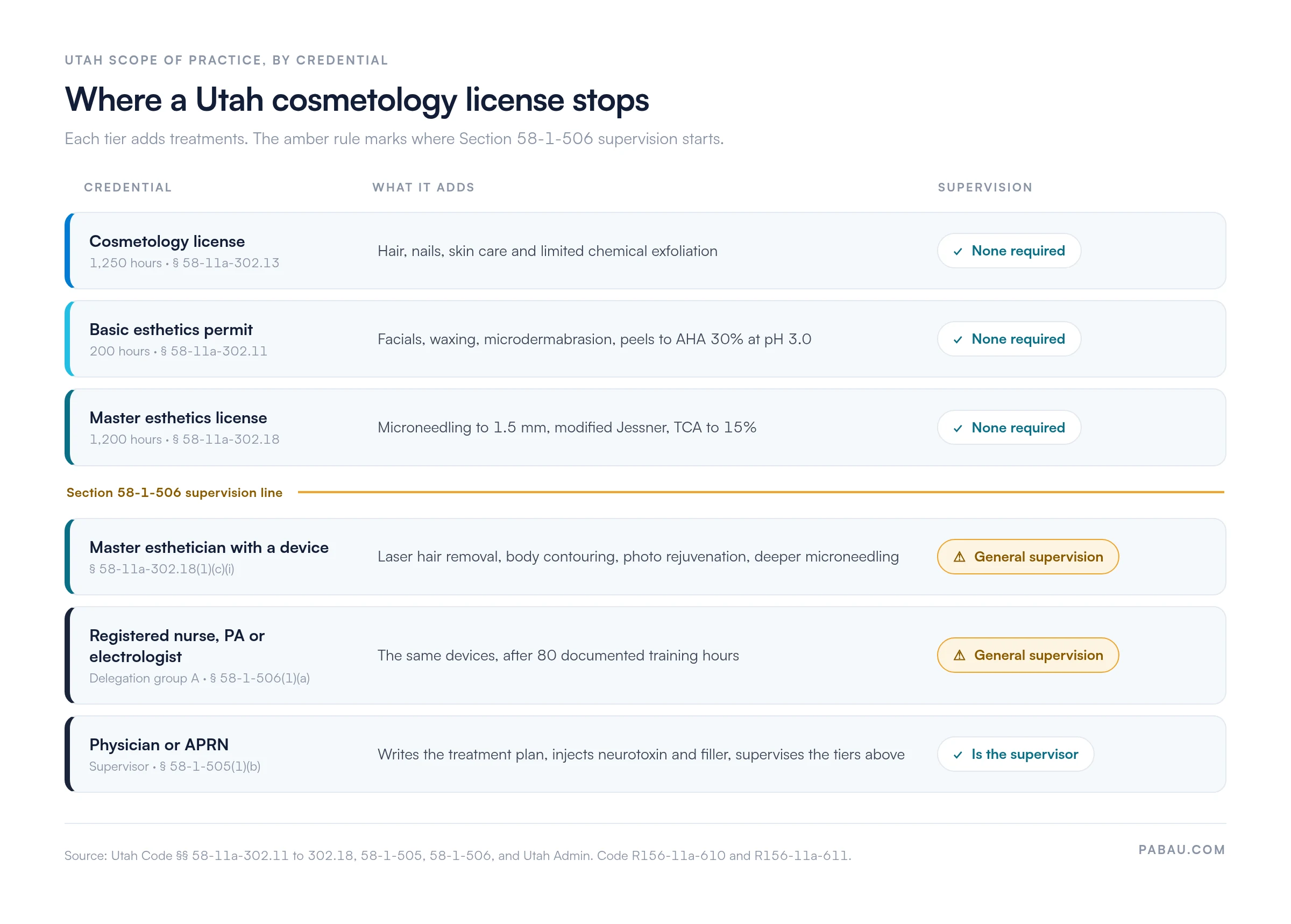
Section 58-1-506 is where the compliance risk sits. Only a physician with an unrestricted license under Chapter 67 or 68, or an APRN under Chapter 31b, may act as the supervisor (§ 58-1-505(1)(b)).
Delegation then splits into two groups. Group A is a registered nurse, a master esthetician, a physician assistant, and an electrologist for laser hair removal. Group B is an LPN, an esthetician, and a medical assistant (§ 58-1-506(1)).
For laser hair removal the supervisor writes the medical treatment plan and runs a “hair removal review”. That review is a face-to-face interview against a prepared history, with contraindication screening and a referral back if the patient deviates from the plan (§ 58-1-506(2)).
The supervisor must also verify at least 80 documented hours of the delegate’s education and experience. The list runs from skin physiology and laser physics through to complication management and CPR (§ 58-1-506(2)(f)(iii)).
Then the supervision level depends on the group. Group A works under general supervision, meaning the supervisor is within 60 minutes or 60 miles. Group B works under indirect supervision, with the supervisor physically inside the facility.
Nonablative work that is not hair removal follows a different sequence. A physician, nurse practitioner or PA writes the plan and evaluates the patient first, in person or by live telemedicine (§ 58-1-506(3)).
Injectables never enter this chapter. “Cosmetic medical procedure” includes injecting a neurotoxin or a filler for cosmetic purposes. The practice of medicine, in turn, includes performing cosmetic medical procedures (§§ 58-67-102(11)(a)(ii) and (19)(a)(i)). No section of Chapter 11a puts injection in a cosmetology-family scope.
Utah writes its depth limits as numbers, which makes them easy to audit. A master esthetician may use a microneedling device alone, up to 1.5 mm of needle penetration. Deeper than that, the same procedure needs general supervision by a licensed health care practitioner (R156-11a-611(5)).
Microdermabrasion has its own ceiling. Normal use of an approved machine may not remove the epidermis beyond the stratum corneum (R156-11a-611(4)(c)). The acid limits work the same way.
Devices are defined by class rather than by brand. A “cosmetic medical device” means an ANSI Class IIIb or Class IV laser, an IPL device, a radio-frequency device or a lipolytic device (§ 58-11a-102(3)).
Two duties apply to every peel series. A patch test comes first, and the client has to be told the procedure is cosmetic rather than medical (R156-11a-612). That second duty is also your best evidence that the treatment stayed inside scope.
Utah has no flat corporate-practice-of-medicine ban, so a layperson may open a med spa here. What the Medical Practice Act restrains is interference, not ownership.
Section 58-67-501(1)(c) and (d) prohibit substantially interfering with a licensee’s competent practice of medicine. That applies to any person or entity that manages, owns or holds a financial interest in the practice. It also prohibits a contract limiting a physician’s ability to advise patients fully.
The safe harbors matter as much as the prohibition. Employment supervision, employment requirements, and compensation incentives unrelated to a particular patient are all permitted. So is other lawful conduct that leaves independent professional judgment intact (§ 58-67-501(2)(f) and (2)(i)).
Corporate form is a separate question. Under the Professional Corporation Act, Title 16, Chapter 11, a PC’s officers, directors and shareholders must be licensed to render the same service. A non-licensee may still serve as secretary or treasurer (§ 16-11-8).
PC form is also optional. Section 16-11-15 leaves professional persons free to incorporate under the Revised Business Corporation Act instead. Management-services structures are common in this market, but they are market practice rather than a Utah statute.
The binding constraint is the room, not the shareholder register. Cosmetic medical procedures may only happen in a “cosmetic medical facility” (§ 58-1-505). That means a physician’s office, or a facility with a supervisor who performs § 58-1-506 supervision.
So Utah never uses the phrase “medical director”, yet functionally requires one. Anyone hiring a medical director in Utah is really appointing a supervisor, whose name is posted and whose license is displayed on site.
Utah licenses people and schools, not salons, so there is no establishment license to hang on the wall (§ 58-11a-301; R156-11a-604). The compliance burden is per practitioner instead, which changes what an owner has to hold.
Missing any of those posting duties is unprofessional conduct, which puts the supervisor’s own license at stake as well as the practice’s standing. A cosmetology board license lookup is therefore not a one-time hiring task. Run it again each renewal season.
Owners running device treatments alongside hair and nails carry two rule sets at once. Our med spa compliance checklist covers the wider documentation set. Purpose-built med spa EMR software keeps those records attached to the right practitioner.
The paperwork above is per person, per renewal cycle and per treatment. Practice management software like Pabau holds it beside the schedule, so a license category travels with the person you are booking. That is also why software for med spas tends to start with staff records rather than the calendar.
Staff profiles carry the license category, the expiry date and the training documents. Per-staff services and permissions decide who can be offered which treatment, so a basic esthetics permit holder is never booked for a device procedure.
Treatment notes, consent forms and before-and-after photos then sit on one client timeline, against the practitioner who performed the procedure. When someone asks who treated a patient under whose supervision, that answer is one screen away.
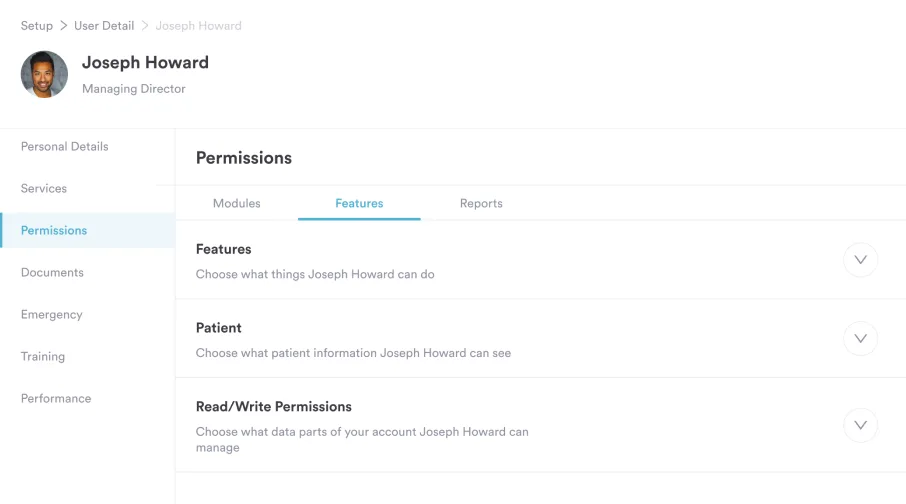

Pabau stores each practitioner’s license category and expiry on their staff profile. Every treatment note, consent form and photo stays tied to the person who performed it, so audit questions have one answer.

Decide your category before you count hours, because the 2026 rewrite moved the numbers under several of them. If a school or a blog quotes 1,600 hours, it is quoting a license Utah closed.
For an owner, the license is the straightforward part. The exposure sits in § 58-1-506: the supervisor, the hair removal review, the 80 documented hours, and the postings that go with them.
Get the roster right and the paperwork follows it. Book a demo to see how Pabau keeps license categories, expiry dates and treatment records in one place for a Utah practice.

Hiring across state lines? New Jersey cosmetology license requirements sets out the 1,200-hour route and how that state treats transfers.
Comparing hour counts with a bigger market? Texas cosmetology license requirements covers the 1,000-hour route and the exams Texas sets.
Looking at the West Coast next? California cosmetology laws explains the hours, exams and renewal rules California applies.
Working out who may own the business? Who can open a medical spa walks through ownership structures and the supervision that comes with them.
Building out your skin team? How to hire estheticians for a med spa covers credentials, interviews and scope questions worth asking.
Complete 1,250 hours at a licensed school or in a registered apprenticeship. Pass the NIC theory and practical exams at 70%, within the year before you apply. Then file for a Utah cosmetology license through My License One with the fee. Utah sets no minimum age and no diploma requirement.
Use the Licensee Lookup and Verification System at secure.utah.gov/llv/search. It returns the license number, the category and the status. A cosmetology license lookup takes seconds, so run one on every candidate before their first shift and again each renewal season.
Yes, and online is now the only route. Since January 31, 2026, cosmetology license renewal in Utah runs through My License One rather than on paper. Licenses expire on September 30 of odd years, and late renewal adds $20 to the fee.
No. Neither Utah Code 58-11a-303 nor Utah Administrative Code R156-11a imposes a continuing education requirement. Any page quoting CE hours for a Utah cosmetologist is importing another state’s rule. You renew by filing and paying, on the two-year cycle.
No. Chapter 11a licenses individuals and schools only, so Utah issues no salon, barbershop or spa license. Your obligations are per practitioner: current licenses, correct categories, and the posting duties that apply once you offer cosmetic medical procedures.
Yes, by endorsement under Utah Code 58-1-302. DOPL shall issue where your out-of-state license covers a similar scope, you hold a year of practice under it, and it stands in good standing. You still pass the NIC theory and practical exams first.