Pedicure and manicure service menu template
A pedicure manicure treats the nails, cuticles, and skin of both hands and feet ...

Last Updated: Oct 13, 2026

A Pennsylvania cosmetologist license needs 1,250 school hours or a 2,000-hour apprenticeship, plus the state theory and procedural exam.
State and exam fees come to $119, made up of a $26 application fee and $93 to the testing organization.
Licenses run two years and cost $97 to renew. Pennsylvania asks for no continuing education.
Check your own license for its expiration year, because cosmetologist licenses sit in both the odd-numbered and even-numbered renewal cycles.
A cosmetology license covers hair, skin, and nails. Lasers and injectables answer to the State Board of Medicine instead.
Pennsylvania cosmetology license requirements start at 1,250 hours of training and one written exam. The State Board of Cosmetology issues the license. Getting it costs $119 in state and exam fees before tuition.
The rules live in the Cosmetology Law, the act of May 3, 1933, codified at 63 P.S. §§ 507–527. The board’s own regulations sit in 49 Pa. Code Chapter 7. Older sources still call the statute the Beauty Culture Law, and it is the same act.
Cosmetology license requirements are set state by state, so hours you earned elsewhere don’t carry over automatically.
This guide also answers a second question the board’s own pages leave open. A Pennsylvania cosmetology license covers hair, skin, and nail work. Lasers and injectables answer to two different boards. That boundary decides who can legally run a laser device or inject in a Pennsylvania practice.
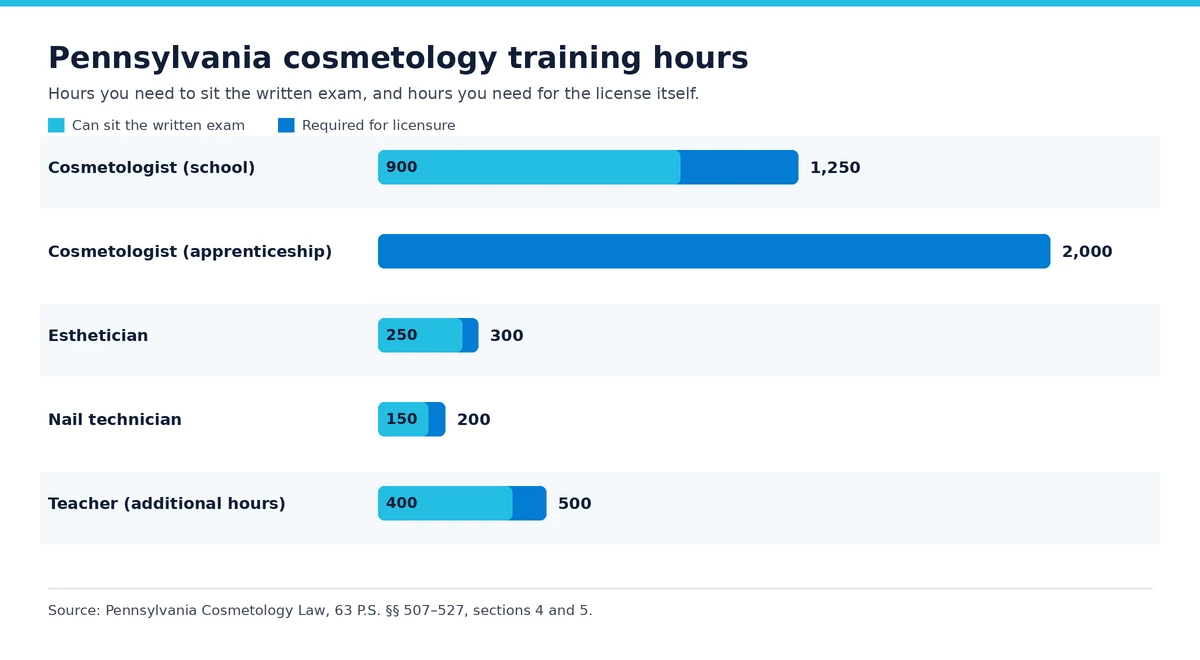
Pennsylvania issues one full cosmetologist license and three limited licenses. Each carries its own hour count and its own renewal cycle. The table below sets the PA cosmetology license requirements out side by side.
The Pennsylvania State Board of Cosmetology regulates the profession. It sits inside the Bureau of Professional and Occupational Affairs, which is part of the Pennsylvania Department of State.
The board licenses cosmetologists, estheticians, and nail technicians. It also licenses teachers in each of those disciplines, plus salons and cosmetology schools. Enforcement against unlicensed practice is the board’s job too.
Applications, renewals, and reactivations all run through PALS, the Pennsylvania Licensing System, at pals.pa.gov. Exams are administered by Pearson VUE.
One point worth knowing before you email the board with a scope question. Board staff and counsel will not give advisory opinions or interpret the Cosmetology Act for you. You are expected to read the statute and the regulations yourself.
You must be at least 16 years old, of good moral character, and have completed the 10th grade or its equivalent. Those three conditions come from section 4 of the Cosmetology Law.
Two exemptions apply to the education requirement:
Every applicant also files a criminal history records check from each state where they lived, worked, or trained in the past five years. Pennsylvania checks come from epatch.pa.gov, and the report must be dated within 180 days of your application. Volunteer checks are rejected.
Pennsylvania gives you two routes to the same license. You either complete 1,250 hours at a licensed school of cosmetology, or you serve 2,000 hours as a registered apprentice in a licensed salon.
Schooling has a minimum duration as well as an hour count. Day students must spread the 1,250 hours over no fewer than eight consecutive months. Night students need at least 15 consecutive months.
The apprenticeship route needs a permit before you start. You apply to the board, and the salon cannot put you to work until the apprentice permit is issued. Your supervising cosmetology teacher certifies the hours.
Pennsylvania also lets you test early. You can apply to sit the written examination at 900 hours, well short of the 1,250 you need for the license itself.
Passing early does not shorten the program. Licensure still needs three things: the passed written exam, the full 1,250 hours, and your school’s certification that you finished every program requirement.
Pennsylvania asks for state theory and procedural examinations, both delivered as written tests through Pearson VUE. There is no hands-on practical exam for cosmetologists, which sets Pennsylvania apart from most states.
The procedural questions do the work a practical exam does elsewhere. Section 4 of the Cosmetology Law requires the examination to include theoretical and procedural skill questions, so you are tested on method without performing it.
When you register, you need your school code. That is the board-issued license number of the school you attended, and your school can give it to you. Candidates trained outside Pennsylvania use school code CS00000.
If you test early, two documents finish the job. Your school uploads a final affidavit, then the final transcript once you complete the program. The license does not issue until both arrive.
Every application runs through PALS. The board no longer takes paper applications for initial licensure, so the six steps below are the whole process.
Keep the email address on your PALS account current. Renewal notices and board correspondence go to the most recent address you reported, and the Postal Service does not forward licenses.
Licensure costs $119 in state and exam fees. Tuition sits on top of that and varies by school. Renewals and the other license types carry their own figures.
Pennsylvania licenses renew every two years on January 31, and a cosmetologist renewal costs $97. The state requires no continuing education for any cosmetology license type.
Published guides routinely say cosmetologist licenses renew in odd-numbered years. The board’s own fee schedule says otherwise. Cosmetologist appears under both the odd-year and even-year groups, and the board tells licensees to check their own license.
The limited licenses are split more predictably. Estheticians and salons renew in odd-numbered years. Nail technicians, teachers, and schools renew in even-numbered years.
Ask the board in writing to place your license in escrow. That option lives in 49 Pa. Code § 7.44, and it applies to a licensee who has stopped performing licensed activities.
An escrowed license comes back on written application and payment of the renewal fee in § 7.2. Escrow is the cheap, tidy route, and it beats simply letting a license lapse.
Under five years, you reactivate in PALS. Sign in, find your license number, click the green pencil icon, then choose reactivate and follow the prompts. Payment is card only, and the license arrives by mail in seven to 10 business days.
Over five years is a different matter. The Cosmetology Law requires you to retake the examination before the license can be reactivated. Pearson VUE handles those applications through its processing center.
Practicing on an expired license is not a paperwork slip. Section 20 of the Cosmetology Law makes unlicensed practice a summary offense. The board can add a civil penalty of up to $1,000 on top.
Yes, you can transfer, and Pennsylvania now offers three separate routes. Which one fits depends on where you hold your license and how long you have worked on it.
Reciprocity needs a current license plus at least two years of licensed work experience. You download an employer’s certification for each employer you list, and the completed form must carry your start and end dates.
Pennsylvania holds reciprocity agreements with every state except eight. If your license comes from Connecticut, Colorado, Florida, Hawaii, New Jersey, New Mexico, Rhode Island, or Utah, this route is closed to you.
Applicants from those eight states are not stuck. They take the Pennsylvania examination, or they apply through one of the two routes below.
Act 41 of 2019 obliges the board to license you if your home jurisdiction’s standards are substantially equivalent to Pennsylvania’s. It is codified at 63 Pa.C.S. § 3111 and took effect on August 30, 2019.
You also have to show current competency and a clean disciplinary record. Applications are reviewed case by case, usually by a board subcommittee, and the fee matches reciprocity at $89.
Pennsylvania joined the Cosmetology Licensure Compact in July 2026, becoming the 13th member state. Senate Bill 331 became Act 43 of 2026 when the governor signed it.
The compact creates an optional multistate license. You keep your single-state license if you prefer, and the multistate version only reaches other member states.
Four of Pennsylvania’s neighbors are already in it: Ohio, West Virginia, Maryland, and Delaware. The other members are Alabama, Arizona, Colorado, Kansas, Kentucky, Tennessee, Virginia, and Washington.
The act also protects cosmetologists in active-duty military families, so a posting to another compact state does not restart their licensing from scratch.
Pennsylvania calls these limited licenses, and each one authorizes a narrower practice than full cosmetology. Section 5 of the Cosmetology Law sets the hours.
A full cosmetology license already covers the limited scopes. Under 49 Pa. Code § 7.14, a cosmetologist may work as an esthetician or nail technician without a second license. The reverse does not hold.
Natural hair braiding left the system entirely. Act 100 of 2024 removed braiders, braider teachers, and braiding salons from licensure, effective 60 days after October 16, 2024. The board stopped taking those applications.
Salons hold their own license, renewed at $144 every two years. Estheticians and nail technicians may each operate a salon limited to their license type.
Section 4.4 of the Cosmetology Law puts three duties on the owner. Designate someone in charge for your absences, post that person’s name conspicuously, and keep them available to bureau inspectors during business hours.
Chapter 7 also governs the premises. Section 7.76 sets minimum floor space, and you can request a variance through the salon application. Section 7.77 bars any part of the salon from being used for another purpose.
A Pennsylvania cosmetology license covers hair, skin, and nail work, and stops there. Lasers, intense pulsed light, and injectables are treated as medical practice. They answer to the State Board of Medicine and the State Board of Nursing.
The scope is drawn in 49 Pa. Code § 7.1. Esthetics there means massaging the face and applying cosmetic preparations, tonics, lotions, and creams. It also covers removing superfluous hair by tweezers, depilatories, or waxes, and perming or dyeing lashes and brows.
No part of that definition reaches through the skin. That limit is what separates a Pennsylvania esthetician’s work from a medical procedure.
The board has enforced the boundary in practice. In a 2018 consent agreement, case number 17-45-06196, a licensee accepted that microblading falls outside the scope of cosmetology. Performing it in a cosmetology salon breaches 49 Pa. Code § 7.77.
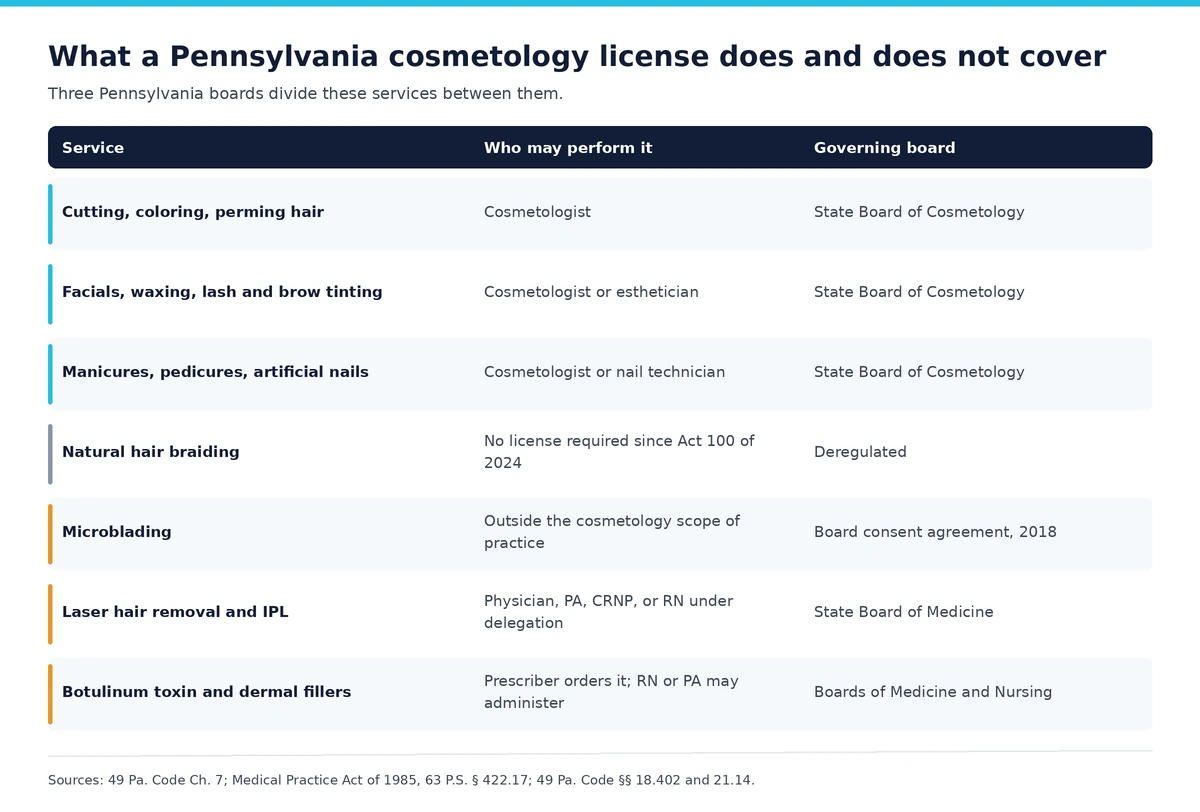
Pennsylvania issues no laser operator license, so there is no credential a cosmetologist can add to run a laser independently. Authority runs instead through the Medical Practice Act of 1985, at 63 P.S. § 422.1 and following.
Under 63 P.S. § 422.17(a), a physician may delegate a medical service to a practitioner or technician. The conditions are set out in 49 Pa. Code § 18.402, and all six have to be met.
Two limits sit underneath those conditions. Section 18.402(b) bars delegating a service where performing it, or spotting its complications, needs knowledge nonphysicians do not ordinarily have. Section 18.402(c) bars delegating what the physician cannot competently perform.
Practically, that puts the decision on your medical director rather than on a certificate. The physician owns the delegation, documents the competency behind it, and carries the responsibility if a treatment goes wrong.
Botulinum toxin and dermal fillers are prescription products, so somebody with prescriptive authority has to order them for a named patient. A cosmetology license never confers that authority.
The State Board of Nursing regulates the injector. Its rules sit in 49 Pa. Code Chapter 21, where § 21.14 governs administration of drugs. Chapter 21 defines professional nursing to include executing medical regimens prescribed by a licensed physician or dentist.
That phrase is the hook a registered nurse injects under. The RN carries out a prescriber’s order. Assessment, diagnosis, the treatment plan, and the product order stay with the physician, physician assistant, or certified registered nurse practitioner.
Pennsylvania does not grant nurse practitioners full practice authority. A CRNP works under a collaborative agreement with a physician, executed and filed with the board through PALS before practicing or prescribing, per 49 Pa. Code §§ 21.285 to 21.287.
Pennsylvania enforces the corporate practice of medicine doctrine, so a business offering medical aesthetics has to be owned by licensed medical professionals. Hiring a medical director does not substitute for that ownership.
The doctrine comes from case law rather than a single statute. In Neill v. Gimbel Brothers, 199 A. 178 (Pa. 1938), the Pennsylvania Supreme Court held that a department store could not employ optometrists in an optometry practice it owned.
The court’s reasoning still governs. A licensed professional may not practice among the public as the servant of an unlicensed person or corporation. The concern was allegiance. A salaried professional answers to the employer rather than to the patient.
Corporate law reinforces it. Look at 15 Pa.C.S. § 2923(a) for professional corporations, and § 8996(b) for restricted professional companies. Both require the owners of a professional entity to hold a license in that profession.
The workaround the industry uses is a management services organization. A non-licensed owner runs the business side through an MSO, while a physician-owned entity delivers the medical services. Get PA-licensed healthcare counsel to structure it.
The practical upshot for a licensed cosmetologist is simple enough. You can own the hair, skin, and nail side of a Pennsylvania business outright. The medical side needs a different owner and a different board.
A Pennsylvania practice selling facials, laser hair removal, and filler reports to three boards at once. Cosmetology covers the estheticians. Medicine covers the laser delegation. Nursing covers the injector and the order behind every syringe.
Practice management software like Pabau keeps the paperwork behind those boundaries in one client record. Consent forms attach to the treatment they belong to. Treatment notes tie to the provider who performed the service.
Scheduling is where the license boundary gets enforced day to day. In software for med spas, service and provider setup means a laser appointment only reaches a provider you set up to deliver it. Your front desk stops guessing who is credentialed for what.
That matters most under 49 Pa. Code § 18.402, where the physician has to know the person performing a delegated service is competent to do it. A booking system that enforces the same rule keeps your records and your delegation in step.
If you are still shortlisting systems, our roundup of medical spa EMR software sets out what each platform covers.

Pabau ties each service to the providers set up to deliver it. Consent forms and treatment notes file against the person who did the work, so a Pennsylvania board audit finds one record per treatment.

Getting licensed in Pennsylvania is the straightforward half. Put in your 1,250 hours, sit the theory and procedural exam at Pearson VUE, pay your $119, and diary January 31 of your renewal year.
Check that renewal year on the license itself rather than assuming. Cosmetologist licenses fall in both the odd-numbered and even-numbered cycles, and a lapse costs more than the $97 you were avoiding.
The harder half is knowing what the license authorizes once you hold it. Hair, skin, and nails are yours. A laser needs a physician’s delegation under § 18.402, and an injectable needs a prescriber’s order.
If you are hiring across both sides of that line, your record-keeping is what proves you stayed on the right side of it. Book a demo and see how consent, notes, and provider records hold up in one system.

Licensed in New York instead? New York cosmetology license requirements: fees and renewal covers that state’s hour counts and renewal cycle.
Holding a New Jersey license? New Jersey cosmetology license requirements is worth reading first, because Pennsylvania excludes New Jersey from reciprocity.
Thinking about adding medical treatments? Who can open a medical spa? State ownership rules shows how other states draw the ownership line.
Already a nurse looking to launch? How to open a med spa as a nurse walks through the supervision and setup decisions step by step.
You need 1,250 hours at a licensed school of cosmetology, or 2,000 hours as a registered apprentice. Estheticians need 300 hours and nail technicians need 200. You can sit the written exam at 900 school hours.
$119 before tuition. That is a $26 application fee to the State Board of Cosmetology plus $93 to the testing organization. Renewal is $97 every two years, and reciprocity or Act 41 endorsement applicants pay $89.
No. Pennsylvania requires state theory and procedural examinations, both written and delivered through Pearson VUE. The procedural questions test method in writing, so there is no hands-on practical assessment.
No. The State Board of Cosmetology sets no continuing education requirement for any of its license types. You renew every two years by paying the fee and confirming your details in PALS.
Yes, by reciprocity with two years of licensed work experience, by Act 41 endorsement, or through the Cosmetology Licensure Compact. Reciprocity excludes eight states: Connecticut, Colorado, Florida, Hawaii, New Jersey, New Mexico, Rhode Island, and Utah.
Under five years, you reactivate through PALS by paying the renewal fee. Over five years, the Cosmetology Law requires you to retake the examination. Practicing unlicensed is a summary offense, and the board can add a civil penalty of up to $1,000.
Bureau of Labor Statistics figures for May 2023 put Pennsylvania’s annual mean wage for hairdressers, hairstylists, and cosmetologists at $38,070, or $18.31 an hour. Pennsylvania employed 19,120 people in the occupation. The national median was $34,970.
No. Both are treated as medical practice. A laser needs a physician’s delegation under 63 P.S. § 422.17 and 49 Pa. Code § 18.402. Injectables need a prescriber’s order, and the State Board of Nursing governs who administers them.