Patient financing: How to offer it and stay compliant
Patient financing lets patients spread the cost of treatment over weeks or month...

Last Updated: Oct 7, 2026

Oklahoma cosmetology license requirements start at age 16 with at least an 8th-grade education, per the Oklahoma State Board of Cosmetology and Barbering (OSBCB).
The OSBCB licenses page states 2,250 apprenticeship hours and publishes no school-hour figure at all. Third-party guides put school hours at 1,000, 1,250 or 1,500, so confirm the number with the Board before you enroll.
Two exams are required, one written and one practical, and both sources that state a passing score put it at 75%.
OSBCB publishes $50 for the exam, $20 to apply and $80 for a two-year apprentice renewal. A lapse of about two months adds $10.
OSBCB still shows a one-year license term renewed on your birth-month anniversary. HB 2141 sets biennial renewal from November 1, 2025, so verify the cycle directly with the Board.
Oklahoma cosmetology license requirements are set by the Oklahoma State Board of Cosmetology and Barbering (OSBCB), and the baseline is short. You need to be at least 16 and to have finished the 8th grade. From there, complete an approved training path and pass two exams.
The trouble is the numbers. Oklahoma reworked its licensing rules through HB 2141, and the published figures have not settled. The OSBCB licenses page states 2,250 apprenticeship hours and a one-year renewal term. The bill and two licensing guides point to different hour counts and a two-year renewal cycle.
So every figure below carries its source and a status. Confirmed means the sources agree. Contested means they don’t, and you get both numbers with their dates. We call that table the Current Requirements Snapshot. Where a figure is contested, check it against the Oklahoma cosmetology state board’s own licenses page before you enroll or pay anything.
The Oklahoma State Board of Cosmetology and Barbering licenses nine separate categories, and a cosmetology license is only one of them.
The Oklahoma State Board of Cosmetology rules and regulations treat each of the nine as its own credential. Each carries its own hours and its own exam. The categories listed on the OSBCB licenses page are:
When someone searches for a cosmetology license, they almost always mean the general cosmetologist credential. Three of the nine are instructor licenses. Hour requirements for those appear on one third-party page only. That page flags its own instructor figures as inconsistent, so they are not repeated here.
HB 2141 also created three specialty certificates, and the bill took effect on November 1, 2024. They are Eyelash Extension Specialist at 120 hours, Blow-Dry Styling at 12 hours, and Makeup Artist at 8 hours. Those hours come from the bill summary published by Associated Skin Care Professionals. The OSBCB licenses page still lists none of the three.
Two more scope points are worth knowing. Makeup artists need either an esthetician or a cosmetologist license, depending on the services they perform (elitebeautysociety.com). Shampooing and hair braiding no longer require a license at all under HB 2141, per beautylicenseguide.com.
None of the nine categories authorizes injectables or medical-grade lasers. Those services sit under medical supervision rules instead, which our med spa compliance checklist works through.
The table below is the Current Requirements Snapshot. Every row carries the published figure, the source that published it, and whether the four sources behind this guide agree on it.
The Current Requirements Snapshot pairs every published figure with its source and status, so a contested number stays visible instead of looking settled.
Oklahoma sets two eligibility floors for a cosmetology license. You must be at least 16 years old and have completed at least the 8th grade.
Both figures sit on the OSBCB licenses page, in its apprentice requirements section, and all four sources behind this guide repeat them. That makes eligibility the most solid part of Oklahoma cosmetology licensing right now.
Meeting the floors is not the whole test. OSBCB also requires one of three training routes:
Individual schools can set admission rules above the state floor, and many do. Broken Arrow Beauty College, for example, asks for a high school diploma or its equivalent plus age 16, per its own admissions policy. Check the school’s bar as well as the Board’s.
One eligibility route is easy to miss. Military spouses and veterans qualify for expedited licensing under Oklahoma Title 59, sections 4100 to 4100.8. The application fee and the first license fee are waived. That detail comes from beautylicenseguide.com alone, so ask OSBCB to confirm it applies to you.
Both routes end at the same two exams. They differ in how you pay for the hours, how long they take, and who supervises you.
School suits someone who wants a fixed timeline, a set curriculum, and access to financial aid. Broken Arrow Beauty College, for instance, builds two practice state-board exams and twice-weekly test prep into its program. That structure is what you are paying tuition for.
An apprenticeship suits someone who needs to earn while training and can find a licensed sponsor. Under HB 2141, apprentices may be paid, and one establishment may now take two apprentices rather than one (beautylicenseguide.com). The trade-off is time. Every reported figure puts the apprenticeship path at roughly twice the school hours.
Sources disagree on Oklahoma’s current school-hour figure, so verify it with OSBCB before you enroll. Published numbers run from 1,000 to 1,500 hours.
The OSBCB licenses page states no school-hour figure at all. Three third-party pages fill that space differently:
None of the three cites a rule number or a statute section. That is why this row is contested rather than confirmed. A decision worth 1,000-plus hours of your life deserves a direct answer from the Board, in writing, not a third-party page.
For context on the other two routes, elitebeautysociety.com reports 600 classroom hours or 1,200 apprenticeship hours for esthetics and for nail technology. Those figures are single-sourced too.
The OSBCB licenses page requires 2,250 hours of study before an apprentice may sit the exam, and that is the figure to plan against today.
Two third-party pages date that number to July 1, 2025 and say it replaced a 3,000-hour requirement. The OSBCB page carries no date at all, so the change is reported rather than documented by the authority itself. Either way, 2,250 is what the Board publishes now.
Apprentice training happens under a licensed instructor, or a master cosmetologist or barber, at an approved establishment. The same age and education floors apply.
Oklahoma requires two exams for a cosmetology license, one written and one practical. You may re-sit either exam after a failure.
OSBCB labels an exam requirements section on its licenses page, but it does not publish the mechanics there. Three of the four sources behind this guide describe the format the same way, which makes the two-exam structure itself solid.
Two of them put the passing score at 75% on both exams (beautylicenseguide.com, babeautycollege.com). That number is absent from the OSBCB page, so treat it as reported rather than official.
Only beautylicenseguide.com describes the written test in detail. It credits the NIC written exam, from the National-Interstate Council of State Boards of Cosmetology, administered by the vendor Prov:
All four details come from that one page. Check them against your own exam bulletin when you register, because a content weighting is the sort of figure a vendor updates quietly.
Registration for the Oklahoma exam is the step between finishing your hours and sitting the test. A $35 registration fee is reported by beautylicenseguide.com, paid by cashier’s check or money order within 10 days of course completion. The OSBCB licenses page does not list that fee, so budget for it and confirm the deadline with the Board.
OSBCB splits its fees across two lists on the licenses page, and neither one is a complete schedule. OSBCB publishes these figures itself:
Add the two upfront figures and a first license costs $70 in Board fees, before any tuition. That $70 is the floor you can trace straight to the OSBCB page.
Two third-party pages add the $35 registration fee at course completion (beautylicenseguide.com, babeautycollege.com). If that applies to you, the upfront total becomes $105. One competitor page publishes a total-cost range twice at two different numbers, so no range from it appears here.
Tuition is the biggest expense, and none of the four sources publish an Oklahoma school figure. Ask every school on your shortlist for its current clock-hour rate and what the quote includes. Kit, books and exam prep are often separate lines.
Two practical notes on paying. OSBCB accepts renewal payments by cashier’s check, money order or business check only. And beautylicenseguide.com reports that a lapsed license can be renewed with back fees for up to five years, after which you retake the full exam.
OSBCB currently publishes a one-year Oklahoma cosmetology license renewal term, due on your birth-month anniversary, with no continuing-education hours required.
The statute says that changed. HB 2141, signed in May 2024, moves Oklahoma cosmetology and barbering licenses to a two-year renewal cycle from November 1, 2025, at $80. Both elitebeautysociety.com and beautylicenseguide.com report the same shift.
That date has passed, and the OSBCB licenses page still describes a one-year term. The Board has not published the change on its own site. So the cycle is an open question in practice, whatever the statute says. It is the one figure on this page to check before you act on it.
The $80 has the same problem. OSBCB attaches $80 to a two-year apprentice renewal. Meanwhile beautylicenseguide.com attaches the same $80 to a general biennial renewal fee starting November 2025. The two may describe one policy from different angles, but neither page reconciles them.
The timeline below plots what changed, when, and how well each milestone is sourced.
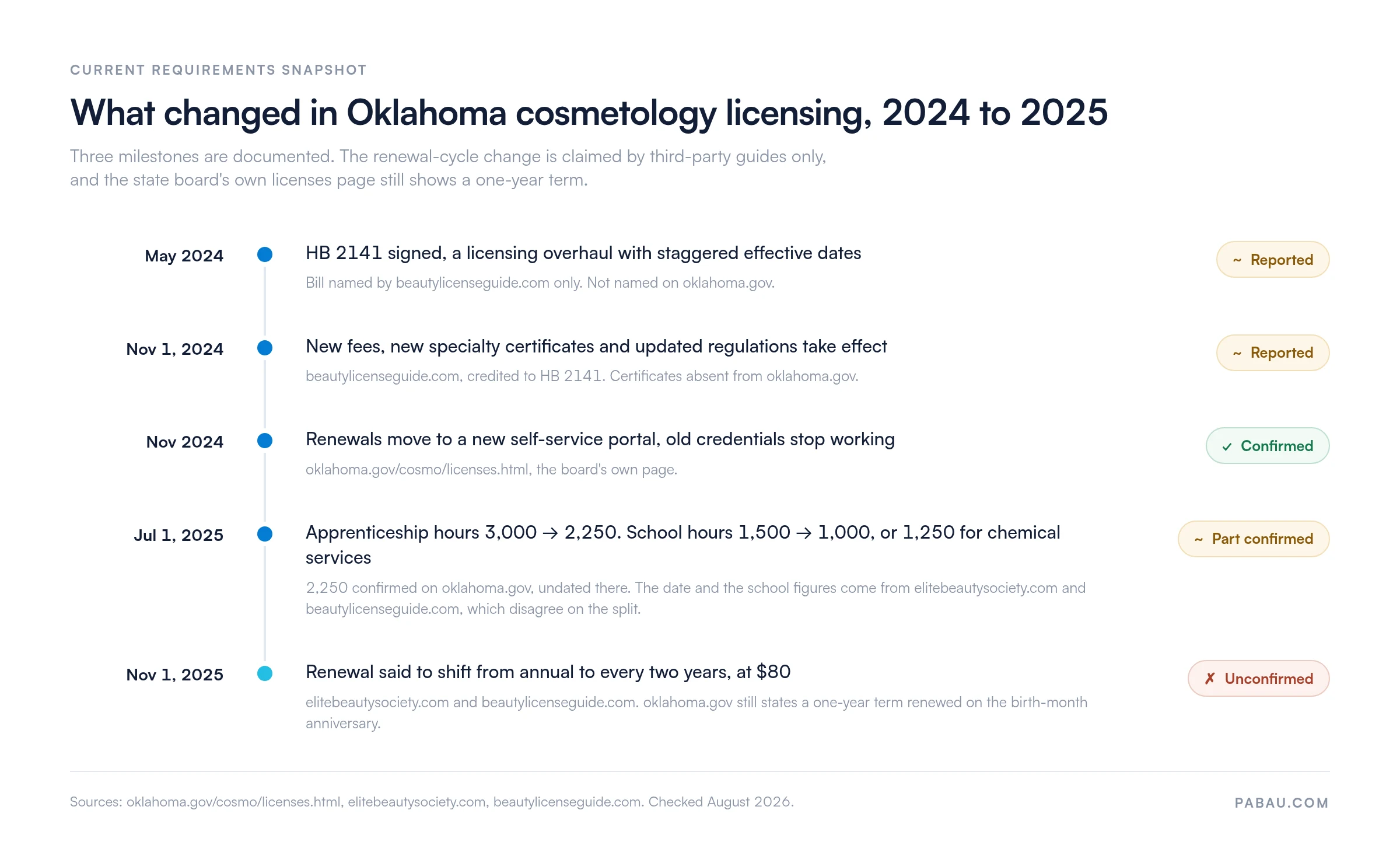
Before you rely on either cycle, read the Oklahoma Board of Cosmetology license renewal page directly. Then confirm your own expiry date in the Licensee Portal. Your record is the answer that matters, not the general rule.
Renewing has a step people trip over. OSBCB moved renewals to a new self-service portal in November 2024, and old credentials stopped working. Existing licensees have to register on the Applicant Portal first, before the Licensee Portal will let them renew or print a license. Establishment-level access was still listed as coming soon.
In the med spas and salons we onboard, renewal dates usually live in someone’s head or on a wall calendar. A $10 penalty is survivable. A lapsed practitioner sitting on the schedule during an inspection is a different problem. OSBCB inspects licensed establishments at least twice a year.
On continuing education, nothing is required today. SB 532, introduced in the 2025 session, proposes 12 continuing-education hours per 24-month cycle. SB 532 is a proposal and not law, so no CE hours are owed unless it passes.
Oklahoma grants cosmetology reciprocity if your training was substantially equivalent, your license is active and in good standing, and you pass Oklahoma’s rules exam.
Both sources that cover reciprocity agree on those three conditions (elitebeautysociety.com, beautylicenseguide.com). Neither cites a rule number, and neither publishes a list of states Oklahoma has agreements with, because reciprocity here is judged case by case.
That answers the Texas question the search results keep raising. A Texas license does not carry over on its own. A Texas cosmetologist is the ordinary reciprocity case, needing comparable hours, active status and an Oklahoma rules test. Our guide to Texas cosmetology license requirements sets out the hours you would be matching.
Only beautylicenseguide.com carries the paperwork, and it lists six steps. The parts worth knowing before you start:
All five items come from that single page. Ask OSBCB which forms it currently wants before you pay a notary. Form numbers change.
One in-state transfer is worth flagging too. Per elitebeautysociety.com, barber and cosmetologist holders can cross over, subject to added training and exams.
A cosmetology license is a personal credential, but the compliance exposure sits with the establishment. OSBCB inspects licensed establishments at least twice a year for safety, sanitation and licensure. Licenses and work permits have to be posted in public view, with a current photo attached.
Practice management software like Pabau keeps that record where the schedule already lives. Pabau stores each practitioner’s license type, number and expiry date on their staff profile. A credential about to lapse surfaces before an inspector asks about it, so you can chase the renewal instead of pulling someone off the calendar.
In the practices we onboard, the detail that goes stale first is the expiry date, not the license number. Owners copy numbers into a hiring spreadsheet once and never revisit it. Pabau’s software for med spas keeps cosmetology and medical credentials on the same staff record. That matters when injectables and cosmetology services run from one front desk.
Still comparing platforms? Our roundup of the best aesthetic clinic software weighs them on client records, booking and staff compliance tracking.

Pabau stores each practitioner’s license type, number and expiry date on their staff profile, alongside the schedule and the client records. Expiring credentials surface early, so a lapsed license never reaches an inspection or a booked appointment.

The confirmed baseline is short enough to act on today. Be 16, finish the 8th grade, complete an OSBCB-approved school course or a 2,250-hour apprenticeship, pass both exams, and pay $70 in Board fees.
Two numbers need your own verification. The school-hour figure has no home on the OSBCB page. Third parties claim a biennial renewal cycle while the Board still shows one year. Email OSBCB, ask for both in writing, and keep the reply. A page that states one figure with no date is guessing.
Once you are licensed and hiring, license tracking stops being your paperwork and becomes the establishment’s. Book a demo to see how Pabau keeps every practitioner’s license number and expiry date on the record your schedule already runs on.

Licensed in Texas and looking at Oklahoma? Texas cosmetology license requirements sets out the hours and exams you would be matching for reciprocity.
Comparing another state’s clock-hour rules? How to get a cosmetology license in California walks through a much longer training requirement and a different exam route.
Adding injectables to a salon or med spa? Medical spa compliance checklist covers the supervision and documentation rules a cosmetology license does not reach.
Working out which credential a treatment needs? Aesthetic qualifications explains what each practitioner role is trained and permitted to do.
Hiring across state lines? Med spa laws by state rounds up ownership, supervision and licensing rules state by state.
Yes. Oklahoma accepts an approved apprenticeship instead of a school course, and the OSBCB licenses page sets it at 2,250 study hours before the exam. You train under a licensed instructor, or a master cosmetologist or barber, at an approved establishment. Apprentices may be paid, per beautylicenseguide.com.
Not on its own. A Texas credential qualifies you for Oklahoma reciprocity if the training was substantially equivalent and the license is active and in good standing. You then pass Oklahoma’s state rules exam. That is reported as a 34-question open-book test, with no theory or practical retake, per beautylicenseguide.com.
OSBCB runs online license verification and a Licensee Search tool on its own site, and both return current status. Use the Board’s tool rather than a third-party directory. A suspension, a lapse or an unpaid back fee shows on the Board’s record first.
None of the sources behind this guide publish an Oklahoma wage figure, and OSBCB sets no pay floor. For a current number, use the Bureau of Labor Statistics Occupational Employment and Wage Statistics for hairdressers, hairstylists and cosmetologists in Oklahoma. Commission structures vary widely by salon.