All about me worksheet for adults
An all about me worksheet for adults is a guided self-reflection form that maps ...

4
Last Updated: Oct 14, 2026

The life checklist is a one-page form that captures your current life status, your current aspirations, and one life aspect at a time.
The three rating options are I have yet to do this, I need to do this more often, and I do this well.
Each rating points to a different next step, so the comments box matters as much as the rating itself.
The sheet holds a single aspect, so print one copy per aspect. Fill in a fresh copy later to see what has shifted.
Practice management software like Pabau sends the form to a client before a session and files the completed answers in their record.
A one-page self-assessment form with space for your current life status, your current aspirations, and one life aspect rated on a three-point scale. Print a copy for each aspect you want to review, in session or as homework between sessions.
Download templateSitting down to sort your life out usually goes the same way. You open a notebook, try to grade health, money, work, and relationships at once, and close it again twenty minutes later.
A life checklist gets around that by asking for less. It’s a one-page form that looks at one part of your life at a time. You note where things stand, what you’re aiming for, and how honestly you’d rate yourself on a single life aspect.
That narrowing is the whole point. One page, one aspect, one honest rating, and a date on it so the next copy has something to compare against.
A life checklist is a short self-assessment that records how you’re doing on one chosen part of your life. It pairs a written snapshot of your situation with an honest rating of a single habit, routine, or commitment.
People often confuse it with a bucket list. A bucket list collects experiences you hope to have one day. This form looks at what you’re doing now, names one thing you’d like to change, and asks how close you already are.
Writing it down is what makes it work. A rating on paper is harder to argue with than a vague sense that things are fine, or that everything is a mess. It also leaves you something to compare against next time.
Everything sits on a single printable page. Here’s each field and the job it does.
That’s the whole form. One aspect line per sheet is deliberate. If you want to look at several aspects, print several copies and give each one its own page.
Give the first sheet about fifteen minutes. Later copies go faster, because the wording is already familiar.
Then put the finished sheet somewhere you’ll see it again. A folder, a client file, or a photo on your phone all work. What matters is that you can find it on the next review date.
Many practices log scores like these in measurements tracking software, so progress charts update the moment a reassessment is saved.
The form doesn’t tell you which aspect to choose, which is the hardest part of the page. A good aspect is a behavior someone could watch you do, or not do, across a week.
These prompts usually produce something workable:
Notice that each one is a verb rather than a heading. You cannot rate health honestly, because part of it is going well and part of it isn’t. Walking twenty minutes a day takes seconds to rate.
If several areas feel unclear at once, map them before you narrow down. A wellness wheel worksheet scores multiple areas side by side. The weakest score usually names your aspect for you.
The three options are not a score. Read each one as a prompt for what to do next, and put that in the comments box.
That last one is easy to skip. If an aspect is already going well, something about the setup is working. It might be a fixed time, a person who expects you, or a low barrier to starting. Copying that setup across to a stalled aspect beats leaning on willpower.
None of these are dramatic errors. They just make the second sheet impossible to read against the first.
Catching them takes seconds. Read the page back before you file it, and fix anything that would confuse you in a month.
Therapists, coaches, and wellness practitioners tend to use the sheet one of two ways. Some hand it out at the start of a session and fill it in together. That suits clients who freeze in front of a blank page. Others send it as homework, so the reflection happens away from the room. A psychology practice running several assessments needs them scored and stored the same way each time.
Either way, the useful conversation comes after the rating. Ask what made the client choose that aspect over any other. Then ask what would have to change for the rating to move up a level by the next appointment.
The one-aspect format also splits work neatly across sessions. One sheet per session keeps the focus narrow, and the dated stack becomes a record of what the client has worked on. In a therapy practice.
Coaches often pair the sheet with a session log, so ratings and agreed actions sit together.
One completed sheet is a snapshot. Several dated sheets on the same aspect show a direction, which is far more useful.
A workable rhythm is monthly for an aspect someone is actively working on, and quarterly for a general check-in. Some people prefer a fixed date, such as a birthday or the start of a quarter, so the review doesn’t depend on motivation.
When you revisit an aspect, read the old sheet before you fill in the new one. Two things are worth looking for. Did the rating move? And does the current life status box describe a different life than last time? The second often changes before the first.
If the same obstacle turns up in the comments box month after month, it’s worth looking at the thinking underneath it. A thought record worksheet is built for exactly that.
Paper works fine until there are forty sheets. At that point the printed form becomes a scanning job. The answers end up in a folder rather than anywhere you can act on them.
Practice management software like Pabau turns the same form into a digital intake form you build once and reuse. Clients get it by email or through their online booking portal, then complete it on a phone before they arrive.
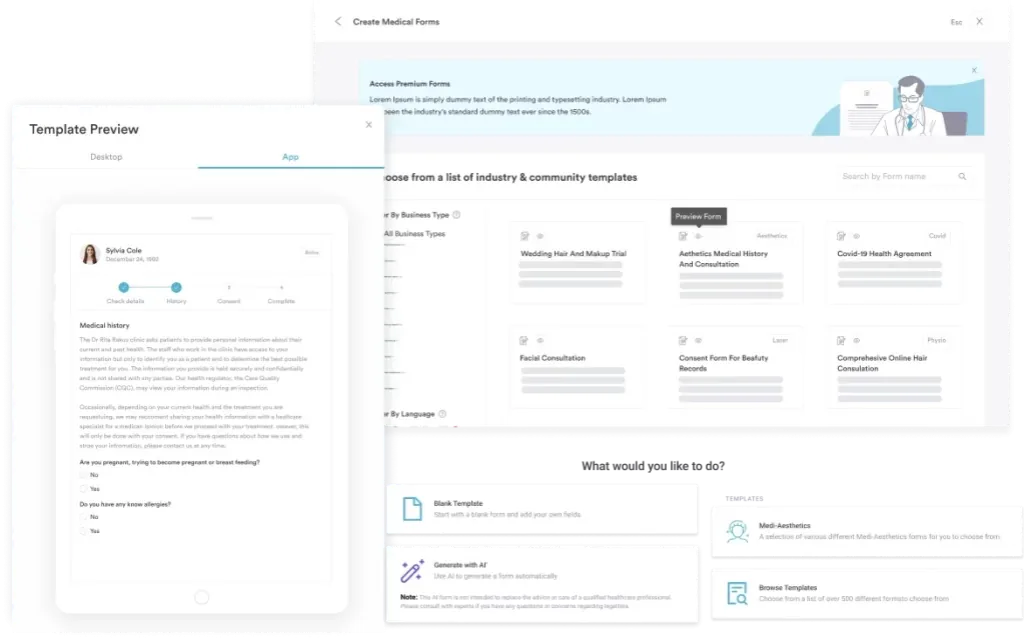
Completed answers save straight into the client record, next to notes and appointment history. When the same client fills the form in three months later, both versions sit side by side. You can see what shifted without digging through a filing cabinet.

Build the form once in Pabau and send it to clients ahead of their appointment. Every completed answer is waiting in the client record when they arrive.

The life checklist earns its keep by asking for less than you think it should. It wants one aspect, one honest rating, and one date. None of that is impressive on its own.
What makes it work is the second copy. A single sheet only tells you how one day felt. Two sheets, a month apart, show whether the thing you said mattered has moved.
If you hand this form to clients rather than filling it in yourself, the paper version gets old quickly. Book a demo to see how Pabau sends the checklist ahead of the appointment and files every answer in the client record.

Want a view of several life areas at once? The life balance wheel scores eight domains on one page and pairs well with this form.
Screening for cognitive changes as well? ACE test assesses attention, memory, fluency, language, and visuospatial ability.
Running these reviews as a coach? A coaching log records what was agreed each session, so you can compare ratings over time.
Using an ACT-based approach with clients? ACT Hexaflex template maps six core processes, including acceptance, defusion, and committed action.
Want a lighter exercise for between sessions? A kindness worksheet gives clients something short to complete on their own.
A life audit reviews every area of your life in one sitting, often across eight or more domains. The life checklist takes one aspect at a time, so it’s quicker to finish and easier to repeat.
Yes. Nothing about the form needs paper, and many people keep it on screen. Practitioners usually send a digital version, because typed answers are easier to store and search later.
That’s your call, and the form works either way. Sharing it gives a practitioner your own words on where things stand, which is usually faster than reaching the same point through conversation.
No. It’s a reflection tool with no diagnosis or score behind it. If the answers point to something serious, such as persistent low mood, speak to a qualified professional.
It does, with one adjustment. Teenagers often name school or friendships as the aspect, so ask for the specific behavior underneath it. The three ratings work unchanged.