The best TheraNest alternatives in 2026 are Pabau (the practice management platform we build), SimplePractice, TherapyNotes, Carepatron and Counsol. The right one depends on your practice size and how you bill.
Pabau is our top pick for growing and multi-specialty practices. SimplePractice is the easiest switch for solo therapists, and TherapyNotes leads on insurance billing. Carepatron is the cheapest way in, while Counsol suits solo counselors who choose their tier carefully.
Choosing well matters, because a switch moves every patient record, note and open claim. Nobody wants to do that twice. Below, we compare features, first-party pricing and which plans include telehealth, then share a checklist for the move.
Key takeaways
1. Pabau — best for growing and multi-specialty practices that want records, scheduling and billing in one system.
2. SimplePractice — the easiest switch for solo therapists, with telehealth on every plan.
3. TherapyNotes — the strongest insurance billing for behavioral health group practices.
4. Carepatron — the lowest cost of entry, with a free plan that includes basic telehealth.
5. Counsol — a simple counseling platform, with telehealth from its Premium tier.
Found our content helpful?
Why therapists start looking for TheraNest alternatives
TheraNest has been part of Ensora Mental Health since April 2025, and G2 now lists it as TheraNest by Ensora Health. Therapists who leave it usually name one of three triggers. Prices have gone up, newer platforms have added features faster, or the practice has grown past what the setup handles well.
In practitioner forums, the same complaints come up again and again. Multi-clinician scheduling feels rigid, telehealth needs workarounds, and billing trails tools built for insurance-heavy practices. Solo therapists also watch per-clinician costs closely, so every price rise stings.
Knowing your own trigger shortens the shortlist fast. If billing is the pain point, TherapyNotes is built around it. If you want simplicity and telehealth, SimplePractice is a strong fit. If you offer services beyond therapy, Pabau gives you a broader clinical and operational toolkit.
How we judged each platform
We scored each platform on six criteria that therapists name most often when they switch from TheraNest.
HIPAA compliance: Does the vendor sign a Business Associate Agreement (BAA)? Per HHS HIPAA guidance, software handling protected health information needs a BAA with the covered entity. Every platform here offers one.
Telehealth: Is video built into the platform, and which plan includes it? We flag tier-gated telehealth wherever the vendor’s pricing page shows it.
Billing: Does it handle insurance claims, ERA/EOB processing and clearinghouse submission? We note where a tool suits private-pay work best.
Clinical documentation: How good and how flexible are the note templates, SOAP notes, treatment plans and intake forms?
Pricing model: Is it priced per clinician, per tier or per location? We flag free plans and what they leave out.
Practice-type fit: Is the platform optimized for solo, small group or multi-specialty practices?
TheraNest alternatives side by side
The table gives you the quick version. Starting prices come from each vendor’s own website, and ratings come from Capterra.
Name
Best For
Standout Feature
Starting Price
Rating
1Pabau
Multi-specialty and growing practices
Unified EHR, scheduling, billing, and automation
From $62/month
★ 4.7(650+)
2SimplePractice
Solo therapists and small group practices
Built-in HIPAA telehealth on every plan, plus a client portal
From $49/month
★ 4.6(2,800+)
3TherapyNotes
Insurance-heavy group practices
Deep insurance billing, ERA/EOB workflows and built-in telehealth
From $69/month
★ 4.7(970+)
4Carepatron
Price-sensitive solo practitioners
Free tier available; low-cost paid plans
Free; paid from $31/month before promotions
★ 4.4(850+)
5Counsol
Solo counselors who want a simple, counseling-first tool
Four clear tiers, with telehealth from the Premium plan
From $49.95/month (current sale price)
★ 4.7(830+)
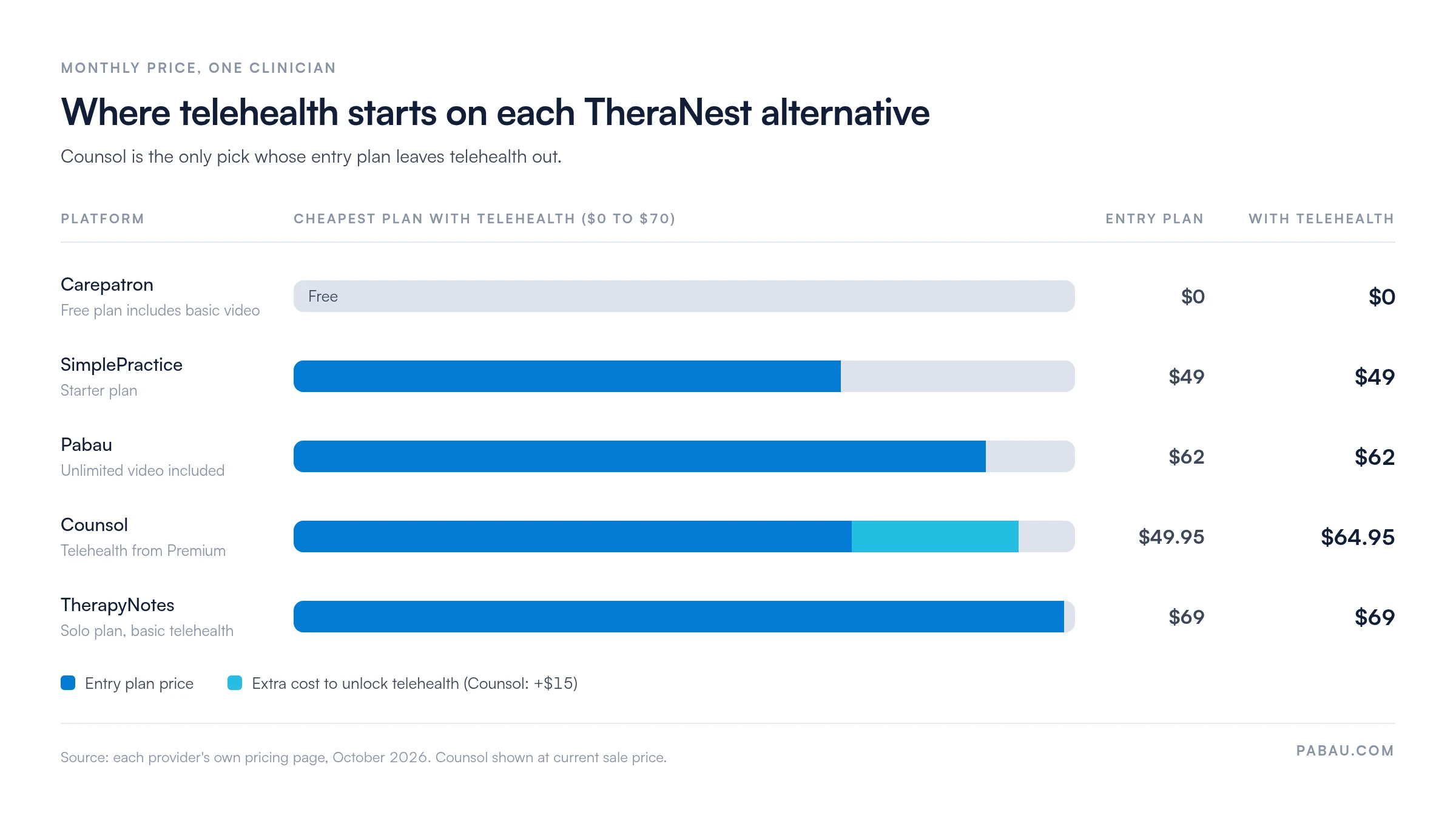
Starting price only tells half the story, because telehealth is not on every entry plan. Here is what the cheapest plan with video costs on each platform.
Pabau includes unlimited video from $104 a month, while Counsol’s video plan costs $15 more than its own entry plan. Prices are from each vendor’s pricing page in October 2026, with Counsol at its current sale price.
1. Pabau suits growing and multi-specialty practices
Rating4.7/5★★★★★Top pick
The bottom line
Pabau keeps therapy, other clinical services and billing in one system as your practice grows.
Scheduling, notes, forms and billing in one record
Automated reminders and online booking
What doesn’t
US insurance billing is less deep than TherapyNotes
Therapy note templates need setup at the start
Pabau is a unified practice management and EHR platform for practices that need more than a single-specialty tool. It covers therapy practice management, mental health documentation, scheduling and invoicing in one system. That makes it a good fit if you offer therapy alongside other clinical services.
For therapists, Pabau provides customizable clinical notes, including SOAP format, plus digital intake forms and treatment plans. Patients use the Client Portal for secure messages and documents, and integrated video consultations cover remote sessions. Every subscription includes every feature, so no core clinical tool sits behind a higher plan.
Key features
Clinical documentation: Customizable note templates, SOAP notes and structured treatment plans that work across specialties
Digital forms:Paperless intake forms and consent documents that patients complete before their appointment
Scheduling: Multi-clinician calendar, online booking, automated reminders and waitlist management
Telehealth: Unlimited video consultations inside the platform, included free on every plan
Billing and payments: Invoicing, online payments and billing linked to the clinical record
Client Portal: Secure messaging, document access and appointment management for patients
Multi-location support: Scheduling, records and reporting across several sites from one account
Automation: Recall workflows, follow-up sequences and reminders that cut no-shows and manual admin
Where Pabau shines
Multi-specialty practices: Therapy runs alongside wellness, dermatology or functional medicine in one system, so you don’t add a second platform as you diversify
Scaling from solo to team: Adding clinicians, locations or services doesn’t mean migrating to a different product
Automation depth: Recalls, follow-ups and reminder sequences take admin off small teams with busy calendars
No feature gating: Pricing scales with users and locations, not with which tools you can access
Where Pabau falls short
US insurance billing depth: TherapyNotes has more mature ERA/EOB processing for insurance-heavy US practices
Therapy-only templates: Therapy-only platforms ship with more therapy note templates out of the box. Pabau needs more setup for a therapy-only workflow
Solo entry price: Solo therapists can start for less on SimplePractice or Carepatron
Customer reviews
According to Capterra reviewers, Pabau earns 4.7 out of 5 from over 650 verified reviews. Reviewers highlight easy scheduling, the depth of features for multi-clinician practices, and the Client Portal. The most common critique is a learning curve when configuring it for one specialty.
Who Pabau is best for
Multi-specialty practices that offer therapy alongside wellness, aesthetics or other clinical services
Group practices that want scheduling, clinical records and billing in one place
Practices that have outgrown a single-specialty EHR
Therapy practices that want to cut manual admin with automation and online booking
Pricing
Plan
Price
Key inclusions
Starter
From $62/month
One user, up to 100 patients, full platform
Solo
Published on Pabau’s pricing page
One user, unlimited patients, full platform
Team, Medium and Group
Based on locations and users
Team for 2–3 users, Medium for 4–5, Group for 6–15, all with unlimited patients
Enterprise
Based on locations and users
16+ users, multiple locations, full platform
Every Pabau plan includes the full platform, and annual billing saves up to 20%. You can see the breakdown on Pabau’s pricing page.
2. SimplePractice is the easiest switch for solo therapists
Rating4.5/5★★★★★Best for solo therapists
The bottom line
SimplePractice gets a solo therapist live quickly, with telehealth and a polished client portal on every plan.
SimplePractice is one of the best-known therapy EHRs, with more than 2,800 Capterra reviews. It’s built for private practice therapists, counselors and psychologists, and reviewers praise its clean design and quick setup.
Native HIPAA-compliant telehealth and a polished client portal make it the default comparison point for solo therapists. If you’re weighing it against Pabau, our side-by-side SimplePractice comparison covers the differences.
Key features
Built-in telehealth: HIPAA-compliant video sessions inside the platform, with no Zoom link required
Client portal: Self-scheduling, document signing and payments on every plan, with secure messaging from the plans above Starter
Insurance billing: Electronic claims at $0.39 per claim and ERA recording on all three plans, Starter included
Note templates: Pre-built therapy templates, including SOAP, DAP and treatment plan formats
Scheduling: Online booking and a calendar optimized for solo practice, with automated reminders on the plans above Starter
Measurement tools: Outcome measures and progress tracking inside the clinical record
Where SimplePractice shines
Solo practice UX: Reviewers often praise how quickly a one-therapist practice can get set up
Telehealth quality: Native video is reliable and HIPAA-compliant, with no third-party link to manage
Patient experience: Reviewers say the client portal cuts phone calls and speeds up document collection
Where SimplePractice falls short
Price trajectory: Reviewers note that costs rise noticeably as you upgrade plans or add clinicians
Limited customization: Complex documentation or multi-specialty workflows are hard to configure beyond its therapy defaults
Group practice scaling: Group features exist, but the platform is clearly optimized for solo therapists
Customer reviews
According to Capterra reviewers, SimplePractice earns 4.5 out of 5 from over 2,800 verified reviews. That makes it one of the most-reviewed therapy EHRs on the site. Praise centers on ease of use, the client portal and telehealth reliability, while complaints focus on price and rigid workflows.
Who SimplePractice is best for
Solo therapists, counselors and psychologists in private practice
Practitioners who put a polished patient experience ahead of operational depth
Pricing
Plan
Price
Notes
Starter
$49/month
Promo $24.50/mo first 3 months; 30-day free trial
Essential
$79/month
Promo $39.50/mo first 3 months
Plus
$99/month
Promo $49.50/mo first 3 months
Add-on: ePrescribe
$49/month
+ $89 one-time setup fee
Solo plans run from $49 to $99 a month. New accounts get 50% off for three months if they start paying within seven days. Our SimplePractice pricing breakdown covers add-ons and group rates.
3. TherapyNotes handles insurance billing best
Rating4.7/5★★★★★Best for insurance billing
The bottom line
TherapyNotes is the safest pick for behavioral health groups that live on insurance claims.
TherapyNotes built its reputation on clinical documentation and insurance billing. It suits group practices that run high volumes of insurance-covered sessions and want an EHR built for behavioral health.
Its note templates are purpose-built for behavioral health. Its billing workflows, including ERA/EOB processing and clearinghouse integration, are mature and well regarded by billing staff.
Clinical notes: Pre-built DSM-aligned templates designed for behavioral and mental health documentation
Scheduling: Calendar management with appointment reminders, functional but more basic than rivals
Telehealth: Basic HIPAA-compliant video free on every plan, with Premium Telehealth at $15 a month per clinician
Patient portal: Self-scheduling, document sharing and payments for patients
Where TherapyNotes shines
Insurance billing workflows: Claims, ERA and eligibility checks sit in one place for practices that bill insurance regularly
Mental health note templates: DSM-aligned templates cut documentation setup time for behavioral health providers
Support quality: Reviewers consistently describe support as responsive and knowledgeable
Where TherapyNotes falls short
Interface design: Reviewers describe the interface as functional but dated next to newer platforms
Scheduling limitations: Practices with complex scheduling needs may find it limiting
Multi-specialty use: It’s built for behavioral health, so other service lines need a separate system
Customer reviews
According to Capterra reviewers, TherapyNotes earns 4.7 out of 5 from more than 970 reviews. Reviewers highlight billing workflows, clinical note templates and support. Interface design and scheduling are where they most want improvement.
Who TherapyNotes is best for
Group practices with high insurance billing volume
Behavioral health practices that need DSM-aligned documentation out of the box
Pricing
Plan
Price
Key inclusions
Solo
$69/month
One clinician, notes, insurance billing and basic telehealth
Group
$79/month for the first clinician, plus $50/month per additional clinician
Unlimited non-clinical users, notes, insurance billing and basic telehealth
Insurance billing adds per-claim fees: 14 cents per e-claim, ERA or eligibility request, and $1 per mailed claim. Premium Telehealth adds $15 a month per clinician.
4. Carepatron gets you started for free
Rating4.4/5★★★★★Best budget pick
The bottom line
Carepatron is the cheapest way to replace TheraNest, as long as you mostly bill patients directly.
Carepatron targets practitioners who need a working EHR at the lowest cost. Its free plan includes telehealth, a client portal, 1GB of storage and up to 100 appointments. A solo therapist can test it properly before paying.
The platform covers scheduling, clinical notes, a client portal and telehealth. That makes it a practical starting point for newly independent practitioners and very lean practices.
Key features
Free plan: Scheduling, notes, telehealth and a client portal at no cost, with 1GB of storage and up to 100 appointments
Scheduling: Online booking and calendar management, with appointment reminders on paid plans
Client portal: Secure messaging, document sharing and self-booking for patients
Telehealth: Basic telehealth on the free plan, with group telehealth on paid plans
Clinical notes: Standard note templates with basic customization
Where Carepatron shines
Affordability: The free plan and low paid pricing suit practitioners not ready for a bigger monthly bill
Onboarding simplicity: Reviewers consistently mention fast setup and a short learning curve
Where Carepatron falls short
Billing depth: Insurance billing is limited compared to TherapyNotes or SimplePractice
Integrations: A smaller integration ecosystem means less flexibility if you rely on other tools
Reporting: Reporting and analytics are lighter than on mid-tier and premium platforms
Customer reviews
According to Capterra reviewers, Carepatron earns 4.4 out of 5 from more than 850 reviews. Reviewers like its price, ease of use and the free plan for new practitioners. Those who need deeper billing or integrations tend to move to bigger platforms as they grow.
Who Carepatron is best for
New solo practitioners looking for a zero-cost starting point
Private-pay therapists who don’t need complex insurance billing
Pricing
Plan
Price
Key inclusions
Free
$0
Scheduling, notes, client portal and telehealth, with 1GB of storage and 100 appointments. No reminders or e-claims.
Plus
$31/month per user
Unlimited storage, group telehealth, group scheduling, ERA and electronic claims from $0.25 per claim
Advanced
$39/month per user
Plus features, roles and permissions, electronic claims from $0.25 per claim
Carepatron’s promotional pricing changes often, so check its website for the current offer and budget for the regular price. Our Carepatron pricing guide walks through what each plan leaves out.
5. Counsol keeps counseling simple, if you pick the right tier
Rating4.7/5★★★★★Best for solo counselors
The bottom line
Counsol is a straightforward counseling platform, but telehealth starts on its Premium plan.
Who it’s for
Solo counselors
Private-pay counselors who want video
Practices that prefer clear, fixed tiers
PricingFrom $49.95/monthStandard plan sale price, no telehealth
Counsol is a counseling-focused platform with four plans. Standard covers scheduling, a patient site, notes and invoicing, but it leaves out telehealth and insurance claims.
Premium adds secure video and live chat, and Standard Plus adds insurance claims instead. Premium Plus includes both. Counsol has a smaller user base than SimplePractice or TherapyNotes, yet its counseling-first design keeps daily work simple.
Key features
Telehealth: Secure video sessions and live chat on the Premium and Premium Plus plans
Client site: Scheduling, form completion, secure messaging and payments for patients
Scheduling: Online booking and calendar management with automated reminders
Intake forms: Customizable online intake forms and consent documents
Billing: Invoicing on every plan, with electronic claims and ERA on Standard Plus and Premium Plus
Where Counsol shines
Clear tiers: Each plan lists exactly what it includes, with no setup fees or long-term contract
Counseling focus: Defaults and templates are tuned to how counselors work
Where Counsol falls short
Telehealth costs extra: The Standard plan has no video, so telehealth means paying for Premium
Smaller community: Fewer peer reviews and community resources than SimplePractice or TherapyNotes
Reporting: Analytics and reporting are lighter than on larger platforms
Customer reviews
According to Capterra reviewers, Counsol earns 4.7 out of 5. Reviewers praise the built-in telehealth, the straightforward pricing and the client site. Most critiques mention the limited reporting and the small peer community.
Who Counsol is best for
Solo counselors who want a simple platform and know which tier they need
Private-pay counselors who want telehealth without insurance billing
Pricing
Plan
Price
Key inclusions
Standard
$49.95/month (regular $69.95)
Core practice management, no telehealth or insurance claims
Standard Plus
$59.95/month (regular $79.95)
Adds electronic insurance claims and ERA
Premium
$64.95/month (regular $84.95)
Adds secure video sessions and live chat
Premium Plus
$69.95/month (regular $89.95)
Telehealth plus insurance claims
Each extra counselor adds $35 to $45 a month, depending on the plan. Those are Counsol’s current sale prices, $20 below its regular rates, so confirm them when you sign up.
Five features decide whether a switch works
Every platform on this list covers the basics. The differences show up in five areas, which are also where most therapists report their frustration with TheraNest.
Feature
Why it matters for TheraNest switchers
What to verify
HIPAA compliance and BAA
Non-negotiable for any US therapy practice. A missing BAA is a compliance exposure.
✓Get the signed BAA before you import any patient data. Ask whether it covers backups and the vendor’s subcontractors.
Telehealth
Native vs. integrated matters. Third-party links add friction for patients and therapists alike.
✓Is telehealth built in or a third-party redirect? Is it on the entry plan, or does it need an upgrade?
Insurance billing
ERA/EOB processing and clearinghouse submission are the difference between a billing tool and a billing system.
✓Which clearinghouse does the platform use? Is ERA/EOB included or an add-on?
Clinical documentation
Pre-built behavioral health templates save hours of initial setup. Custom templates matter as you document edge cases.
✓Does the platform ship with mental health or DSM-aligned templates? How much customization is available?
Pricing model
Per-clinician pricing scales up fast for group practices. Flat-rate models offer more predictability.
✓How does cost change as you add clinicians? Are there add-ons for features that feel standard?
Pro Tip
Before you commit to a TheraNest alternative, get the BAA in writing and confirm which plan includes telehealth. Both are easy to miss in a demo and hard to fix after you’ve moved patient records.
Solo therapists should start with the billing question
Solo practitioners weigh things differently from groups. Price matters more, there’s no admin team, and the platform has to do the front desk’s job.
SimplePractice is a well-established choice for solo practitioners. Its client portal, native telehealth and clean interface keep admin time low. Choose it if reliability matters more to you than price.
Carepatron is the right choice when cost comes first. The free plan covers the basics for a solo private-pay practice, but reminders and e-claims need a paid plan. It suits therapists who invoice patients directly.
Counsol suits solo counselors who want a simple, counseling-first tool. Telehealth starts on its Premium plan at a sale price of $64.95 a month, so pick the tier before you sign.
So, do you bill insurance? If yes, any SimplePractice plan files electronic claims at $0.39 each, and Counsol’s Standard Plus handles them too. If not, Carepatron or Counsol keep monthly costs lower.
Group practices need scheduling and billing that scale
Groups need multi-clinician billing, per-provider scheduling and shared records with access controls. Solo-focused platforms often struggle with all three, so the shortlist changes.
TherapyNotes is a strong choice for insurance-heavy groups. Its billing workflows are built for high ERA/EOB volume, where claim accuracy is critical.
Pabau suits groups that need more than a therapy EHR. Multi-clinician scheduling, multi-location support and automation suit busy calendars. Pricing is based on locations and users, with every feature included.
SimplePractice supports groups, but it’s optimized for solo work. It works for small groups of two to five clinicians, though per-clinician costs add up at scale.
Torn between the two insurance-ready options? Our SimplePractice vs TherapyNotes breakdown compares their billing and pricing in detail.
How to choose the right TheraNest alternative in five steps
These five platforms cover most therapy practice setups. Here’s how to narrow five down to one.
Identify your billing model. Heavy insurance billing points to TherapyNotes. Private-pay work suits Carepatron, Counsol or SimplePractice. Billing across several clinical disciplines points to Pabau.
Match on practice type. Solo therapists should look at SimplePractice or Carepatron. Small groups suit SimplePractice or TherapyNotes, and multi-specialty practices suit Pabau or TherapyNotes.
Test the documentation workflow. Request a demo or a structured walkthrough, and write one session note end to end. Count the clicks, because daily friction is what derails adoption.
Calculate the five-year cost. Per-clinician pricing compounds as you hire. SimplePractice’s group Plus plan lists $99 for the first clinician and $69 to $74 for each one after. At the top of that range, five clinicians cost $395 a month before add-ons. Groups of six or more get custom pricing.
Plan the move before you cancel TheraNest
Switching pain usually comes from doing the steps in the wrong order. Work through this checklist before your TheraNest renewal date.
Sign the BAA first. Don’t upload a single patient record until the new vendor’s BAA is signed.
Export a full copy of your data. Ask for demographics, notes, treatment plans, documents and the billing ledger, then check the file opens.
Close out open claims. Let in-flight claims settle in TheraNest, and start new claims in the new system.
Run both systems for two to four weeks. Book new appointments in the new platform while old ones finish in TheraNest.
Rebuild your note templates. Recreate your most-used templates and test them on a mock session.
Tell patients what changes. Send new portal and booking links before their next appointment.
The most common mistake is cancelling TheraNest before the export is confirmed. Another is forgetting saved payment cards, which often can’t move between payment processors. Plan to collect them again at the first visit.
How Pabau supports a therapy practice that’s outgrown TheraNest
A practice that has outgrown TheraNest usually runs on a patchwork by now. Notes live in one tool, intake forms in another, and someone confirms appointments by phone.
Pabau brings scheduling, online booking, digital intake forms, Client records and invoicing into one system. Patients complete intake before their first session, and automated reminders confirm the slot. Your team stops chasing paperwork.
Pricing scales with locations and users, and every plan includes every feature. Adding a clinician or a new service means adding a user, not a new product. Structured onboarding, with a dedicated coordinator, moves your records across.
See Pabau run your therapy practice
Watch scheduling, intake, notes and billing work together in one system. Book a demo to walk through your own workflow with our team.
Start with the bill you send most often. If insurance claims drive your revenue, TherapyNotes is worth its dated interface. If you’re solo and private-pay, SimplePractice or Carepatron gets you live fastest.
Counsol works well too, once you pick a tier that includes telehealth. And if you’re adding clinicians or services beyond therapy, the cheapest switch today can turn into a second migration in two years.
Whichever you choose, check that the vendor signs a BAA and that telehealth is on your plan before you buy. Book a demo to see how Pabau handles intake, notes and billing for a growing therapy practice.
Continue your research
Comparing therapy EHRs more broadly?Carepatron alternatives covers the wider mental health EHR field with feature and pricing data.
Leaning toward SimplePractice?Our SimplePractice review breaks down its features, pricing, pros and cons.
Running an allied health or mixed practice?Jane App alternatives compares features, pricing and reviews for 2026.
Frequently asked questions
What is the best alternative to TheraNest?
Pabau is the best TheraNest alternative for growing and multi-specialty practices. SimplePractice suits solo therapists, and TherapyNotes leads on insurance billing. Carepatron is the cheapest start, and Counsol fits solo counselors.
How much do TheraNest alternatives cost?
Carepatron has a free plan, with paid plans from $31 a month. SimplePractice starts at $49, Counsol at $49.95 on sale, Pabau at $104 and TherapyNotes at $69 a month. Group pricing rises with each clinician you add.
Do I need a BAA when I switch EHRs?
Yes. HIPAA requires a business associate agreement with any vendor that stores protected health information for you. Sign it before you import a single patient record.
Can I keep TheraNest running while I switch?
Yes, and you should. Run both systems for two to four weeks, and book new appointments in the new platform. Let open claims settle in TheraNest before you cancel.
Do all TheraNest alternatives include telehealth?
All five offer telehealth, but not on every plan. SimplePractice and TherapyNotes include it, and Carepatron’s free plan has basic video. Counsol adds it from Premium, and Pabau includes unlimited free video consultations on every plan.