Hyperbole and a Half pain scale: Every level + free template
The Hyperbole and a Half pain scale is Allie Brosh’s humorous pain chart, ...

1
Last Updated: Oct 5, 2026
Tension headache stretches target the neck, shoulder, and upper back muscles that tighten under stress, poor posture, and long hours of sitting. They are one of the most effective non-drug tools for both immediate relief and long-term prevention.
The World Health Organization puts headache disorders at roughly 40% of the world’s population, or 3.1 billion people in 2021. Tension-type headache is the most common form.
When these muscles contract and stay tight, they compress nerves and restrict blood flow to the scalp. Stretching interrupts that process. This guide covers eight stretches, a desk routine you can run in five minutes, complementary relief methods, and the signs that call for professional assessment.

Tension headache stretches release muscle tightness in the neck, shoulders, and upper back, the primary physical drivers of tension-type headache pain.
Six muscle groups are the key targets: Upper trapezius, levator scapulae, suboccipitals, scalenes, pectorals, and the deep cervical flexors engaged by chin tucks.
Hold each stretch 20-30 seconds and repeat 2-3 times. Daily practice may help prevent headaches, not just relieve them during an episode.
Pabau’s pre- and post-care automation lets physical therapy and allied health practices send exercise routines like these to patients after every appointment.
Tension headache stretches work by decompressing the muscles and connective tissue that refer pain to the head. The upper trapezius, levator scapulae, suboccipital group, scalenes, and pectorals share fascial connections. Each of them attaches or links to the base of the skull and the cervical spine.
When these muscles stay contracted, they load the cervical joints and sensitize the trigeminal nerve pathways that produce headache pain.
Forward head posture makes this worse. Every inch your head drifts forward of your shoulders adds roughly 10 lbs of effective load to the cervical spine. That figure comes from a cervical-spine study in Surgical Technology International.
Stretching restores muscle length, reduces that load, and interrupts the pain-sensitization cycle. It also increases local circulation, which flushes inflammatory byproducts out of chronically tight tissue.
A home program only works if the patient still has it a week later. Practice management software like Pabau sends personalized routines the moment an appointment ends, through its pre- and post-care instructions. Sticking with the program between visits is one of the strongest predictors of long-term headache reduction.
Tension headaches are caused by a combination of muscle tightness, postural strain, and nervous system sensitization. The International Headache Society’s ICHD-3 classification describes episodic tension-type headache as bilateral and pressing or tightening, at mild to moderate intensity. Routine physical activity does not aggravate it, and it comes without nausea or vomiting.
The most common contributing factors include:
Cervicogenic headache is a distinct diagnosis. The pain originates from a structural problem in the cervical spine rather than generalized muscle tension. If your headache is consistently one-sided, worsens with specific neck movements, or follows a neck injury, see a clinician first. A physical therapist or neurologist should assess you before you rely on stretching alone.
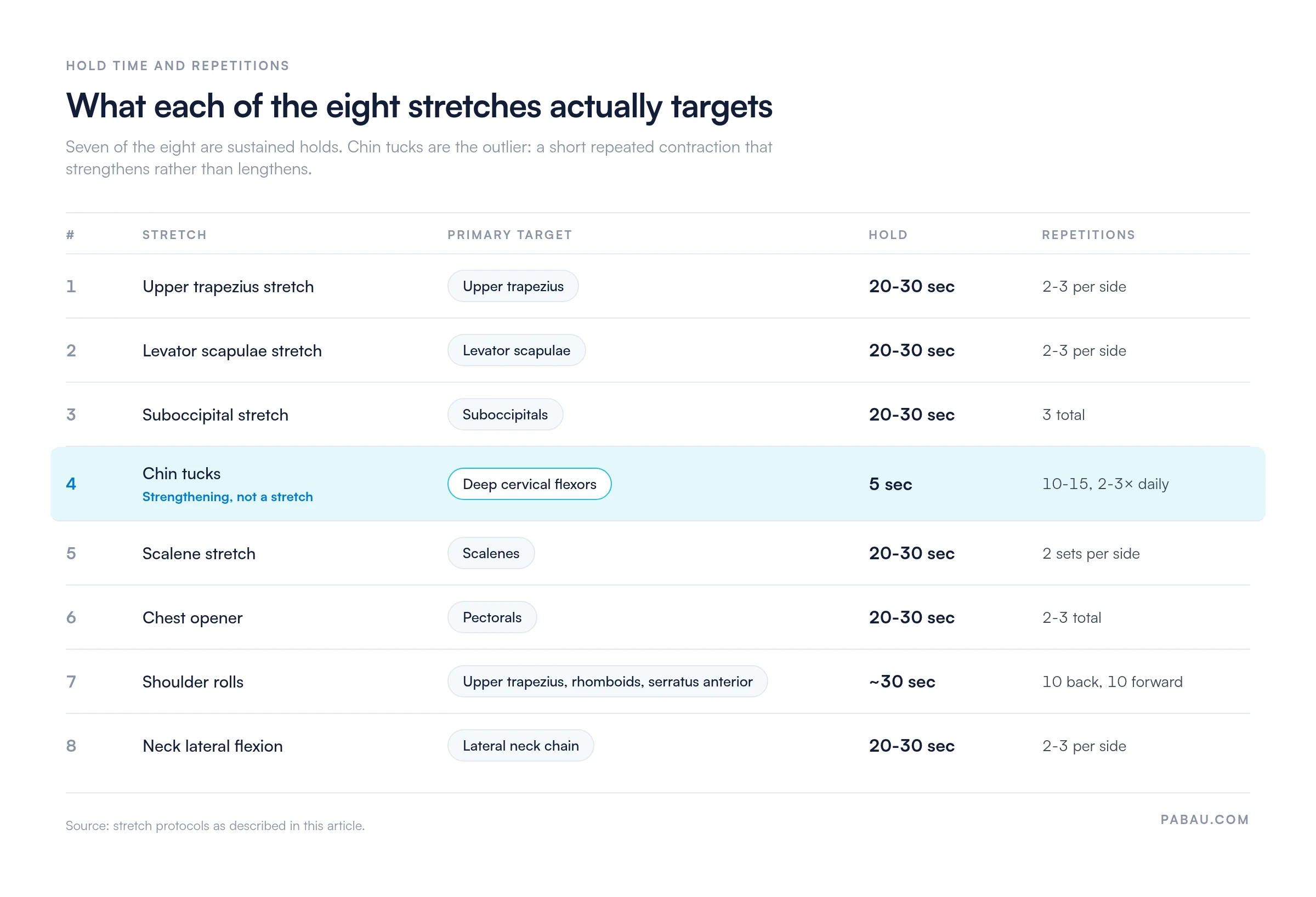
These eight stretches address every major muscle group involved in tension-type headache. Work through them in order for a complete 10-12 minute routine, or pick the two or three most relevant to your pattern.
General guidance: Hold each position 20-30 seconds, repeat 2-3 times per side, breathe steadily, and never push into sharp pain. The grid below shows what each one targets and how long to hold it.
Neck tightness may be your main symptom rather than head pain. A wider set of neck pain exercises adds the strength and mobility work these stretches leave out.
The upper trapezius is the muscle most people instinctively massage when they feel a tension headache building. It runs from the base of the skull to the shoulder and is chronically overloaded by desk work and stress.
The levator scapulae runs from the upper four cervical vertebrae to the shoulder blade. Tightness here creates a characteristic ache between the neck and the top of the shoulder that often refers to the back of the head.
The suboccipital muscles sit at the base of the skull and are heavily implicated in tension-type and cervicogenic headache. Standard neck stretches often leave them untouched, because they need a specific chin-tuck motion rather than a lateral tilt.
Chin tucks directly address forward head posture and strengthen the deep cervical flexors that keep the head balanced over the spine. They are one of the most evidence-supported exercises for neck pain and headache prevention.
The scalene muscles run along the sides of the neck. They are often tight in people who breathe shallowly, which is a common stress response. Tight scalenes can compress the brachial plexus and contribute to both neck pain and headache.
Tight pectorals pull the shoulders forward, which leaves the neck muscles lengthened and overworked. Releasing the chest usually makes the neck stretches above hold their effect for longer.
Shoulder rolls mobilize the upper trapezius, rhomboids, and serratus anterior as a group. That makes them a good warm-up for the targeted stretches above, or a quick-relief technique on their own at your desk.
This is the simplest tension headache stretch and can be done anywhere. It targets the entire lateral neck chain from the upper trapezius to the scalenes in a single movement.
Desk workers are the highest-risk group for tension headaches. They combine prolonged static posture, psychological stress, and screen-driven eye strain for hours at a time. The sequence below runs in your chair, in work clothes, without lying on the floor or drawing attention in an open-plan office.
Run this 5-minute sequence every 2 hours:
Set a recurring calendar reminder to cue these stretches. In a randomized trial of people with chronic tension-type headache, 12 weeks of neck and shoulder strength training reduced headache duration and intensity. The benefit built up over weeks of repeated practice.
Track how often your patients report headaches in your clinical notes. Pabau’s digital intake forms let you capture this at every visit. Patterns show up quickly, and you can measure whether a stretch routine is working.
Frequency depends on whether you are managing an active headache or trying to prevent future ones. The two contexts call for different approaches.
During an active headache: Gentle stretches like shoulder rolls, the upper trapezius stretch, and the suboccipital nod are safe for most people. Avoid aggressive range of motion or any movement that increases head pain.
Two or three of the gentler stretches, held for 20-30 seconds each, can interrupt the muscle spasm cycle. If pain worsens with any movement, stop and rest.
For prevention: Daily practice delivers the most consistent results. Physical therapy guidance typically recommends the full 8-stretch routine once daily, with the desk sequence above every 2 hours during prolonged sitting.
After 4-6 weeks of consistent daily stretching, many people report a meaningful drop in headache frequency. Building the routine into a structured home exercise program from the first session is what keeps patients doing it.
Tension headache stretches are most effective when combined with other self-care strategies that address the underlying triggers.
Stretching addresses the physical component of tension headaches. Avoiding triggers addresses the input side of the equation. The two work together.
For practitioners managing patients with recurring tension headaches, the lifestyle side often matters as much as the clinical treatment. Automated recall messages and post-visit instructions reinforce the habit change between appointments.
Most tension headaches respond well to stretching, self-care, and lifestyle adjustments. Some headaches require professional assessment. See a doctor immediately if you experience any of the following red flag symptoms:
Beyond red flags, book a review if your headaches occur on more than 15 days per month. That pattern meets the definition of chronic tension-type headache. Book one as well if you need OTC medication more than twice a week. Frequent medication use can itself cause medication-overuse headache, which needs a structured withdrawal plan under medical supervision.
A physical therapist specializing in musculoskeletal and headache management can assess whether cervicogenic components are involved, provide manual therapy, and build a targeted exercise program. Many will score your baseline with a headache disability index, then repeat it to show whether the program is working.
A printed sheet handed over at the end of the appointment is easy to lose by Tuesday. The routine then disappears until the next visit, so the clinician has no record of what was done at home.
Pabau sends the routine as pre- and post-care instructions the moment the appointment ends. Patients get it on their phone, with the hold times and rep counts attached to their own record. Follow-up reminders go out on the schedule you set, so the program keeps running without a staff member chasing it.
Digital intake forms then capture headache frequency and triggers at the next visit, so progress sits in the chart instead of in memory. A physical therapy EMR built for allied health lets you compare those scores across a whole caseload, not just one patient.

Pabau helps physical therapy and allied health practices send personalized exercise routines, automate patient follow-ups, and track outcomes across every headache patient on your caseload.

The muscle and postural load behind tension headaches responds to movement, which is why eight minutes a day is worth protecting. The trade-off is patience. Relief during an episode can arrive in minutes, but the drop in frequency takes weeks of repetition.
Start with the two or three stretches that match your own pattern, and add the rest once the habit sticks. If the pain stays one-sided, worsens with specific neck movements, or arrives with any red flag above, stop self-managing and get assessed.
For practices, delivery decides whether a home routine works. Book a demo to see how Pabau sends exercise routines and tracks headache outcomes across your caseload.

Need a repeatable score for headache impact? The headache disability index gives you a baseline at intake and a number to compare against at review.
Need to test the deep cervical flexors before prescribing chin tucks? The cranio-cervical flexion test gives you a scored baseline you can repeat at review.
Want an objective measure of neck endurance? The cervical extensor endurance test covers the hold position, normative times, and how to record the result.
Supporting patients with chronic pain and stress-related conditions? Physical therapy compliance requirements explains the documentation and governance standards that apply to allied health practices.
Tension headache stretches that target the upper trapezius, levator scapulae, suboccipital muscles, scalenes, and pectorals are the most effective. Chin tucks also address the forward head posture that drives much of the muscular tension. Held for 20-30 seconds and repeated 2-3 times, these eight stretches cover the full muscle chain responsible for tension-type headache pain.
Tension headaches are caused by sustained muscle contraction in the neck, shoulders, and upper back. Common triggers include stress, poor posture, prolonged sitting, dehydration, sleep disruption, and eye strain. The International Headache Society classifies them as the most common headache disorder, typically producing bilateral, pressing pain without nausea.
Stretching can reduce or resolve a tension headache for many people, particularly when the headache is driven by acute muscle tightness rather than severe sensitization. Gentle stretches like shoulder rolls, the upper trapezius stretch, and the suboccipital nod are safe during an active episode. Paired with heat and hydration, they often provide relief within 20-30 minutes.
Gentle stretching is generally more effective than complete rest for tension headaches, because rest alone does not release the muscle tension driving the pain. Movement increases circulation and interrupts the spasm cycle. That said, if any stretch increases head pain, stop immediately and rest. Forced movement is counterproductive during an active episode.
See a doctor immediately for any sudden severe headache (thunderclap), headache with fever or stiff neck, headache with neurological symptoms, or headache following head trauma. For recurring tension headaches on more than 15 days per month, a doctor or physical therapist can identify contributing factors and structure a plan.
Yes. The upper trapezius, levator scapulae, scalenes, and suboccipitals are the primary contributors to tension-type headache pain, so neck stretches target the source directly. Trial evidence suggests it takes several weeks of consistent practice before headache frequency shifts.