Scapular assistance test: Procedure, interpretation and free template
The scapular assistance test is a manual examination in which the clinician supp...

2
Last Updated: Oct 19, 2026

The primary trauma survey is the immediate xABCDE assessment that finds and treats life-threatening injuries first.
ATLS 11th edition, launched in July 2025, puts an X step for catastrophic external bleeding ahead of airway.
Resuscitation runs at the same time as the primary survey, not after it. Trainees confuse this often.
Adjuncts such as FAST ultrasound, chest X-ray, and ECG guide the move from survey to definitive care.
Pabau’s digital forms and automated workflows help trauma teams document primary survey findings consistently.
Airway obstruction, respiratory failure, massive hemorrhage, and brain injury are the main causes of death in trauma patients, according to NCBI StatPearls. All four can kill within minutes. The primary trauma survey targets them in a fixed order. That order stops a dramatic but survivable injury from pulling the team away from the one that will kill first.
This guide covers the complete primary trauma survey framework, its xABCDE steps, the diagnostic adjuncts, and how it connects to the secondary and tertiary surveys. It is written for clinicians, medical students, and EMS professionals who need a reliable clinical reference.
The primary trauma survey is the first structured phase of trauma assessment. It identifies and manages immediately life-threatening conditions in a fixed priority sequence, before anything else happens. That sequence is the xABCDE framework taught in Advanced Trauma Life Support (ATLS) training worldwide.
X stands for exsanguinating hemorrhage control, and it now precedes Airway, Breathing, Circulation, Disability, and Exposure. The American College of Surgeons introduced this ordering in the 11th edition of ATLS, launched in July 2025.
The design principle is priority by lethality. Catastrophic external bleeding can empty a patient within minutes, so it is controlled first. A compromised airway kills faster than internal hemorrhage, which kills faster than a neurological deficit. Clinicians do not move to B until A is managed. A trained team runs several steps at once, but the assessment priority stays fixed.
Resuscitation happens at the same time as the primary survey, not after it. A patient with a compromised airway receives airway intervention while the next team member assesses breathing. This treat-as-you-find principle separates the primary trauma survey from a diagnostic checklist.
Each letter in xABCDE represents a clinical priority tier. Here is what each step assesses and what it may trigger.
Catastrophic external bleeding is controlled before the airway is assessed. Apply direct pressure first. Then use a windlass tourniquet high and tight on a bleeding limb, or pack a hemostatic dressing into a junctional wound. A pelvic binder goes on early when the mechanism suggests pelvic ring disruption. Only once visible bleeding is contained does the team move to Airway.
This step is the headline change in the 11th edition of ATLS, published in July 2025. Earlier editions taught plain ABCDE and handled external bleeding at Circulation. Section I of the 11th-edition manual is now titled “Evaluation, Management, and Resuscitation of the Injured Patient (xABCDE)”. The College describes the sequence as a universal language for the primary survey.
Look, listen, and feel for signs of airway obstruction. Stridor, gurgling, hoarseness, or absent breath sounds all point to a threatened airway. Assume cervical spine injury in any blunt trauma mechanism and hold inline stabilization throughout. Interventions escalate stepwise, from simple maneuvers to a surgical airway.
A patent airway does not guarantee adequate ventilation. Expose the chest, inspect for asymmetry, bruising, or paradoxical movement, and listen to both sides. Life-threatening thoracic injuries to catch here include tension pneumothorax, open pneumothorax, massive hemothorax, and flail chest. Tension pneumothorax needs immediate needle decompression before any imaging. Supplemental oxygen goes on every trauma patient at this stage. A primary care practice sees the same presentation in many forms, so consistent recording is what makes review possible.
Assess pulse rate and quality, skin color, capillary refill time, and blood pressure. External bleeding gets direct pressure or a tourniquet immediately. Establish two large-bore intravenous access points. Draw blood for cross-match, complete blood count, coagulation studies, and a metabolic panel. Activate the massive hemorrhage protocol early when the clinical picture warrants it.
Permissive hypotension in penetrating trauma targets a mean arterial pressure near 50 mmHg until surgical hemostasis. Blunt trauma management differs, because normal perfusion is the target there.
Validated decision tools such as the Ottawa Ankle Rules show how explicit criteria cut unnecessary investigations in trauma. The same principle runs through the primary survey. Use validated thresholds rather than clinical gestalt alone.
Neurological assessment at this step is rapid rather than comprehensive. Use the AVPU scale (Alert, Voice, Pain, Unresponsive) as a quick screen, then calculate the Glasgow Coma Scale (GCS). Assess pupil size and reactivity. Check blood glucose to rule out hypoglycemia as a reversible cause of altered consciousness.
A fuller neurological examination waits until the patient is stable. A structured deep tendon reflex exam belongs in the secondary or tertiary survey, where there is time to grade each response properly.
The GCS assigns scores across three domains:
Fully undress the patient to find hidden injuries such as exit wounds, perineal trauma, and posterior thoracic injuries. Log-roll to inspect the back. Counter hypothermia immediately with warm blankets or a warming device. Hypothermia worsens coagulopathy and acidosis in the trauma triad. Keep the patient draped for dignity wherever the examination allows it.
Adjuncts run alongside and immediately after the primary survey. They guide resuscitation and confirm what the hands-on assessment found. The standard set includes:
The adjuncts inform the move to definitive care: the operating room, interventional radiology, or intensive care. They follow from the primary survey rather than replacing any part of it.
The two surveys answer different questions. The primary survey asks what will kill this patient in the next few minutes. The secondary survey asks what else is wrong. Here is how the three phases compare.
The secondary survey begins only when the primary survey is complete and vital signs are stable. If the patient deteriorates at any point, the team goes back to the primary survey. The StatPearls trauma secondary survey chapter sets out the same order.
It opens with a structured SAMPLE history: Symptoms, Allergies, Medications, Past medical history, Last meal, and Events leading to injury. The team takes it from the patient, the family, or the pre-hospital crew. Scoring pain on a numeric pain rating scale here gives a baseline you can track through admission.
The physical examination then runs head to toe: scalp and face, eyes, ears, neck, chest, abdomen, pelvis, and extremities. A log-roll exposes the posterior surface. Each region is inspected and palpated, then percussed and auscultated where relevant. Specialist consultations follow from what the examination turns up.
Even a meticulous primary and secondary survey can miss injuries. Obtunded patients and those with distracting injuries carry the highest risk. The tertiary survey is a repeat systematic examination combined with a review of all imaging and laboratory results. Most units perform it 24 to 48 hours after admission.
StatPearls advises a tertiary survey for any patient with multisystem trauma within the first 24 hours. Injuries commonly picked up at this stage include:
Document the tertiary survey formally, and repeat it if the patient’s clinical status changes.
Advanced Trauma Life Support (ATLS) is the international standard for trauma care training. It is developed by the American College of Surgeons Committee on Trauma. First published in 1980, ATLS codifies the primary trauma survey as the starting point for every trauma resuscitation. The 11th edition arrived in July 2025 and replaced the 10th edition of 2018.
Its reach means a clinician trained in the US, UK, Australia, or South Africa approaches a trauma activation the same way. The xABCDE sequence and the prioritization logic are identical.
Pre-hospital providers work to PHTLS (Pre-Hospital Trauma Life Support) and ITLS (International Trauma Life Support) protocols. Those frameworks are equivalent in the field. The language differs slightly, but the clinical logic holds. Control the most lethal problem first, then work down the hierarchy.
Document primary survey findings in real time rather than afterwards. Retrospective notes on GCS, vital signs, and intervention timing pick up inaccuracies. Those inaccuracies then damage handover quality, clinical audit, and medicolegal records. Structured trauma forms completed during the resuscitation cut that risk sharply.
Handover between pre-hospital and in-hospital teams rests on an accurate, timestamped record of what the primary survey found. Paper trauma sheets make that hard. They invite transcription errors, illegible entries, and version conflicts when several team members write at once.
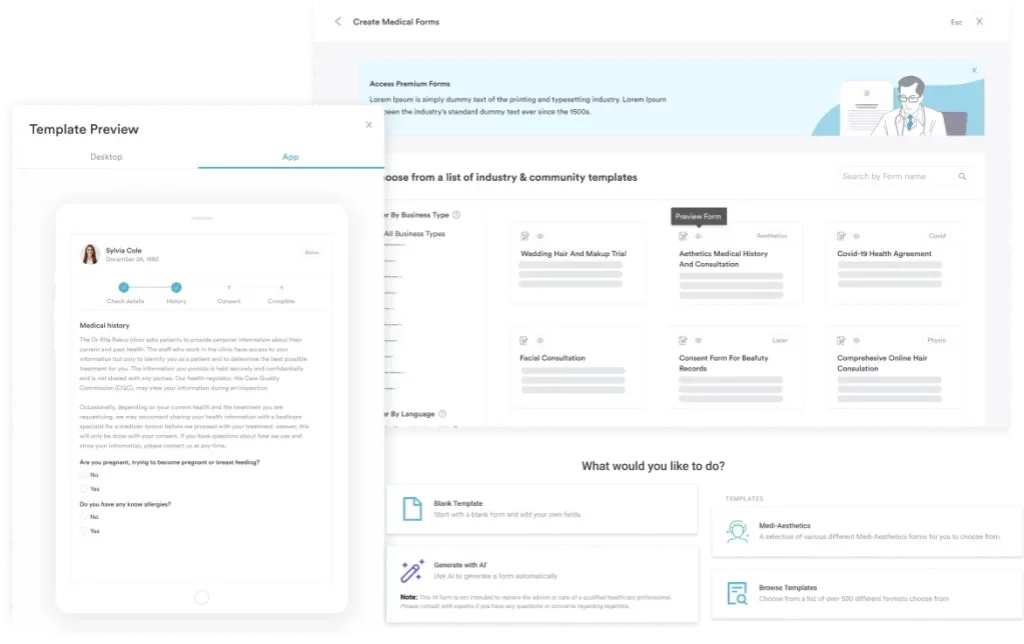
Practice management software like Pabau replaces those sheets with digital clinical forms that require each xABCDE field before the clinician can move on. Clinical record management then timestamps every intervention as it happens, so the note matches the order the team worked in.
Follow-up is where trauma documentation usually slips. Automated clinical workflows trigger tertiary survey reminders, post-discharge contact, and completeness checks without anyone chasing them. The standards behind safer clinical notes in routine care apply just as well under pressure.
Structured intake and clinical documentation matter most to the practices that carry injury work forward. Sports medicine practice software users pair primary survey documentation with automated recall and injury tracking, which cuts missed follow-ups after an acute presentation.
A preparticipation physical evaluation already on file gives those teams a baseline to compare an injured athlete against. Practices running rehabilitation on physical therapy EMR workflows then follow the same patient through recovery.

Pabau helps trauma-adjacent practices build standardized clinical forms, automate follow-up workflows, and keep timestamped records from first presentation through tertiary review.

The order is the whole point. Work X, A, B, C, D, E in sequence and you buy the time that every later decision depends on. Drift from it under pressure and the survey stops protecting the patient.
If your team trained on the 10th edition, the practical change is small but worth drilling. Catastrophic external bleeding is now addressed before anyone touches the airway. Tourniquets, hemostatic dressings, and pelvic binders belong within reach of the trauma bay door.
Whatever the team finds, the record has to survive handover, audit, and any later claim. Book a demo to see how Pabau turns primary survey documentation and trauma follow-up into a workflow your team repeats every time.

Suspecting a cardiac cause after trauma? Echocardiography report explains LVEF bands, valve grading, and reference ranges, plus a free ASE-aligned template.
Managing blood pressure in an elderly trauma patient? Elderly blood pressure chart sets out normal ranges, age-based treatment targets, and fall-risk considerations.
Tracking a patient’s temperature after injury? Fever temperature chart gives a printable form for logging temperature, symptoms, and contact details in one visit.
Building an intake form for new patients? General practice intake form gathers medical history, medications, allergies, and social factors before the first consultation.
Caring for a patient with reflux symptoms? GERD nursing care plan covers NANDA-I diagnoses, interventions with rationale, and measurable goals.
The primary trauma survey is the first structured assessment phase in trauma care. It works through the xABCDE framework, starting with exsanguinating hemorrhage control. Airway, Breathing, Circulation, Disability, and Exposure follow. The survey runs at the same time as resuscitation and must be completed before the secondary survey begins.
xABCDE stands for exsanguinating hemorrhage control, Airway with cervical spine control, Breathing, Circulation, Disability, and Exposure. Each step is a clinical priority tier, ordered by the speed at which each threat kills. The X step was added in the 11th edition of ATLS in July 2025.
The primary survey identifies and treats life-threatening injuries immediately using xABCDE. The secondary survey is a detailed head-to-toe examination with a SAMPLE history, performed only after the patient is stable. The primary survey asks what is killing the patient now. The secondary asks what else is wrong.
Standard adjuncts include FAST ultrasound, chest X-ray, pelvic X-ray, ECG monitoring, pulse oximetry, and urinary catheter placement. Laboratory tests cover arterial blood gas, complete blood count, and cross-match. These run alongside or immediately after the primary survey and inform definitive care decisions.
The tertiary survey is performed 24 to 48 hours after admission. It combines a repeat physical examination with a review of all imaging and laboratory results. The aim is to catch injuries missed during the primary and secondary surveys. Obtunded patients and those with distracting injuries benefit most.
ATLS (Advanced Trauma Life Support) defines the primary survey as simultaneous assessment and resuscitation following the xABCDE sequence. The American College of Surgeons Committee on Trauma publishes the course, and the 11th edition took effect in July 2025. The survey treats life threats before any secondary assessment begins.