How to become a nurse injector in Ontario: The 5 legal steps
Becoming a nurse injector in Ontario takes three steps. You register with the Co...

Last Updated: Sep 22, 2026

PHIPA does not certify software, so no EMR is PHIPA compliant on its own.
The custodian line splits every duty between your practice as health information custodian and your EMR provider as its agent.
PHIPA offences carry fines up to CAD $1,000,000 for an organization, and administrative penalties now reach CAD $500,000.
Ontario’s first administrative penalties landed in August 2025, and the shared system’s own search records were the evidence.
Ask a vendor for the written agreement, the risk assessment results and the hosting location before you sign.
A PHIPA compliant EMR is an arrangement, not a certified product. Ontario’s Personal Health Information Protection Act, 2004 (PHIPA) places its duties on your practice and on your software provider. PHIPA places none on the software itself.
This guide calls that split the custodian line. The custodian line sets out which duty belongs to you as a health information custodian and which belongs to your EMR provider. Each duty also comes with the document that proves it.
In practices we onboard, the question usually arrives as “is this EMR PHIPA approved?”. That question has no answer, because no PHIPA certification exists for anyone to hold. What does exist is a short list of documents you can ask for and read.
Below you get the four statutory roles and the duty-by-duty split. You also get the current CAD penalty ceilings with their dates, and the record set an Ontario nurse injector’s EMR has to hold.
No EMR is PHIPA compliant on its own, because PHIPA assigns its duties to your practice and to your EMR provider. Your practice holds them as the health information custodian. Your provider holds a narrower set as the custodian’s agent or service provider.
EMR is the abbreviation for electronic medical record, the system that holds your patients’ charts. PHIPA governs the information inside it rather than the software around it.
Personal health information (PHI) is identifying information about an individual’s physical or mental health, the health care they received, or their health number. Their substitute decision-maker counts too. A patient’s credit card number is personal information, not PHI, and a different set of rules covers it.
A health information custodian is the person or organization with custody or control of that PHI. In a private practice, the custodian is usually the practice itself or the physician who owns it. An agent is anyone the custodian authorizes to act for it in respect of PHI, for the custodian’s purposes and not their own.
The definition of agent is wide. Your receptionist is an agent, and so, in most arrangements, is the company hosting your charts. The Information and Privacy Commissioner of Ontario (IPC) enforces PHIPA against custodians, and increasingly against their agents too.
So read the rest of this EMR guide as a set of questions to ask, not as a shortlist of approved products. The next section sets out the custodian line duty by duty.
PHIPA and its general regulation between them create four roles that matter when you buy software. Which role your provider occupies decides what you can demand of it.
The HINP role carries the heaviest duties, set out in seven paragraphs of s. 6(3). A HINP must notify every affected custodian at the first reasonable opportunity of unauthorized access.
A HINP must also hand over the written results of a privacy impact assessment and a threat, vulnerability and risk assessment. And it must sign a written agreement describing its services and its safeguards.
There is a practical payoff for the practice. Section 6(4) says that where the provider complies with s. 6(1) and s. 6(3), your practice is not treated as disclosing PHI to the provider. Handing charts to a compliant provider stops being a disclosure that needs consent.
Section 10(4) of the Act is the hook that makes the regulation bite. Anyone supplying goods or services that enable a custodian to handle PHI electronically must comply with the prescribed requirements. Section 6 of the regulation holds those requirements.
OntarioMD certification tests an EMR offering against Ontario’s mandatory EMR specifications and against the vendor’s own EMR Vendor Certification Agreement. Certification is what allows an offering to connect to provincial services such as OLIS, HRM and the Digital Health Drug Repository.
The current Ontario primary care release, PCON-2024-02, does include a Privacy and Security specification and an EMR Hosting specification. Both specifications are useful assurances about the product. Neither one is a finding about your practice.
Two consequences follow. A certified EMR still leaves every custodian duty with you. The program is also scoped to care domains like primary care. An aesthetic or wellness practice usually has no certified option to shop for at all.
Read down the fourth column and the pattern is clear. Every duty on the custodian line resolves into a document. So compliance tools for practices get judged on what they can produce, not on what they claim.
The diagram below plots the same duties by side, using only the rows in the table above.
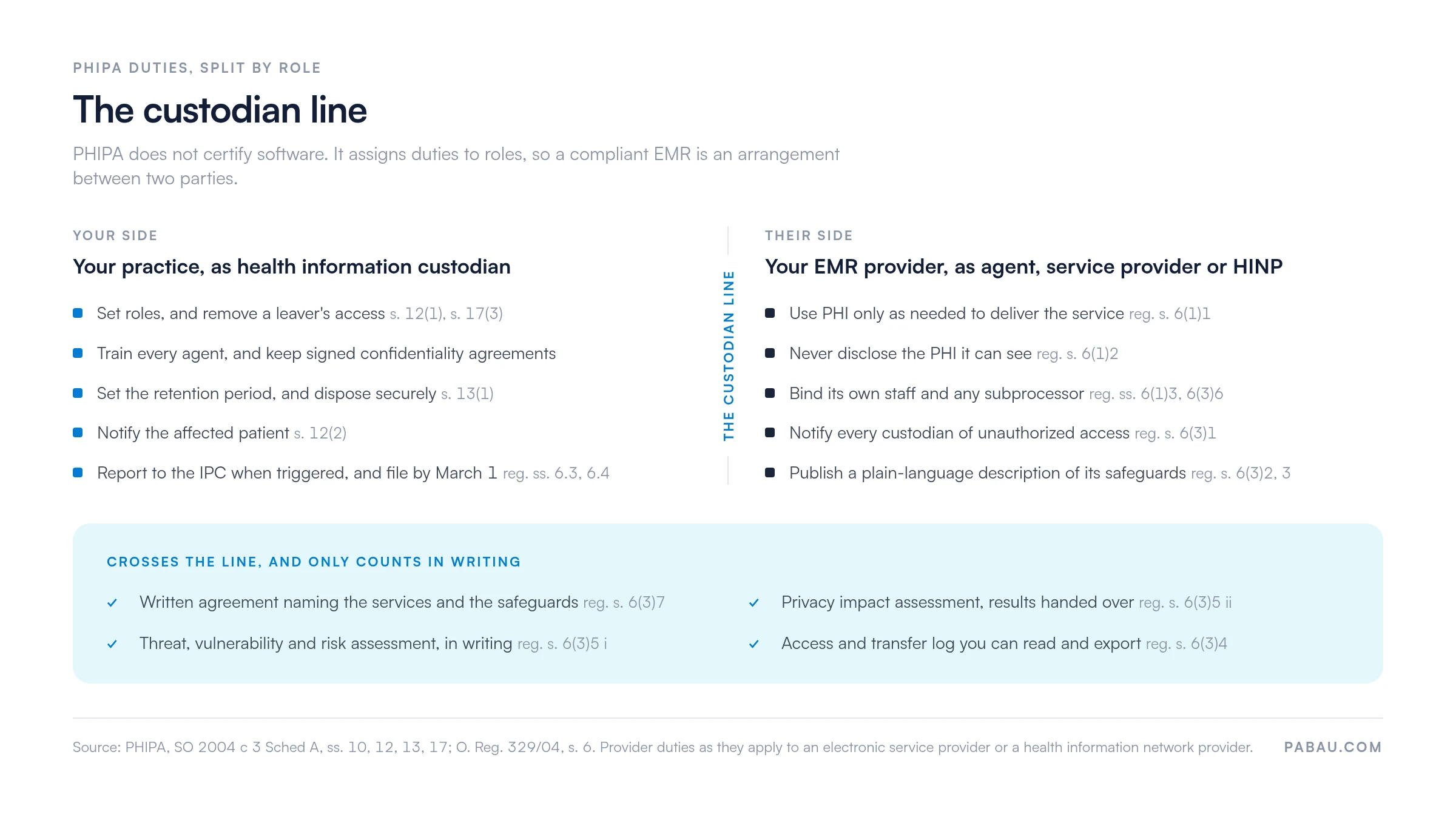
The whole section lands on one sentence. “PHIPA compliant EMR” describes an arrangement, not a badge on a product.
If you provide health care in Ontario, PHIPA governs your patient records. PIPEDA covers personal information handled in commercial activity, and HIPAA is US law that does not reach an Ontario practice.
The reason the two Canadian statutes do not collide is a federal order. On December 14, 2005, the Governor in Council declared PHIPA substantially similar to Part 1 of PIPEDA.
The instrument is the Health Information Custodians in the Province of Ontario Exemption Order. That order exempted Ontario custodians and their agents from PIPEDA for PHI handled within the province.
PIPEDA still reaches an Ontario practice in three places. It applies to PHI you send across a provincial or national border. It applies to commercial activity unrelated to care, such as retail product sales or a loyalty scheme. And it applies to federally regulated organizations you may deal with.
Searches like “CRM HIPAA compliant” and “HIPAA-compliant EMR” send Ontario buyers to US vendor pages every week. A vendor’s HIPAA claim describes a different statute, a different regulator and a different breach clock. The claim tells your practice nothing about its own duties under PHIPA.
Our own guide to HIPAA compliance software is written for US practices, and the contrast is useful. HIPAA runs on a required risk analysis and a business associate agreement. PHIPA runs on reasonableness, a written service agreement, and the IPC’s willingness to read your logs.
Two Ontario statutes sit alongside PHIPA for some organizations. Public hospitals fall under FIPPA, and municipal boards of health under MFIPPA, for their records that are not PHI. A private practice normally has neither to worry about.
PHIPA’s duties on custodians and their agents fall into four categories, and your EMR has to carry its share of each one. The 4 categories of PHIPA duties below follow the Act’s own structure. The Act runs to nine parts, and the parts that touch software are practices to protect PHI, consent, and access and correction.
Consent sits inside the first category and causes most of the confusion. A custodian may rely on implied consent to share PHI with another custodian for the purpose of providing health care. Sharing outside that circle of care generally needs express consent.
PHIPA also lets a patient give a consent directive, widely called a lock-box, restricting what may be shared. An override is permitted in narrow circumstances, and the override is exactly the event your EMR should record. A lock-box the software cannot enforce is a policy, not a safeguard.
The statutory definition of “use” is worth reading closely. PHIPA defines use as viewing, handling or otherwise dealing with PHI, and it excludes disclosing that information. Opening a chart is a use, which is why every chart opened belongs in the log.
The fourth category comes with two hard numbers. Section 54(2) gives you 30 days to respond to an access request, and s. 54(3) allows one extension of up to 30 more days in defined circumstances. Section 55 covers correction requests.
Age matters too. Where a child is under 16, a parent may generally give or withhold consent, with exceptions for treatment and counselling decisions the child made alone. From age 16, the patient may authorize someone else in writing to act for them. Retention sits nearby, and our guide to medical record retention covers the periods your college sets.
PHIPA requires your EMR to record who accessed which patient record, when, and what they did, and to keep that log available for the IPC. EMR charting generates most of that log volume, because every note opened is a use of PHI.
One provision spells the log out field by field, and it is not yet in force. Bill 188 added s. 10.1 to PHIPA, an electronic audit log section. Section 10.1 sits on the statute books awaiting proclamation.
Section 10.1(4) names the fields the log would have to carry for every record viewed, handled or modified.
Section 10.1(2) would also require the custodian to give the Commissioner a copy of the log on request. Treat that list as the specification to buy against now. Until proclamation, the duty still arrives through s. 12(1) and through reg. s. 6(3)4, which requires your provider to keep an access and transfer record and make it available.
Two habits break all of this faster than any technical weakness. Shared login credentials make the log useless, because an entry names an account rather than a person. Unmanaged personal devices put charts on a phone your practice cannot wipe.
Ontario’s first administrative penalty case turned on log quality. The searches were reconstructed from the shared system’s own records, which is covered in full further down. Our guide to EHR security goes deeper on the controls themselves.
The EMR and EHR distinction decides which set of rules applies to a given click. Your EMR is your practice’s own record system, in your custody and control. Ontario’s provincial EHR is a separate shared asset, and Part V.1 of PHIPA governs it.
Part V.1 came into force on October 1, 2020. It defines the electronic health record as the systems developed and maintained by the prescribed organization. O. Reg. 329/04 prescribes the Agency for that role, which is Ontario Health, continued under the Connecting Care Act, 2019.
Ontario Health is the sole prescribed organization, and the IPC does not simply take its word for its controls. Under s. 55.12(1), the Commissioner reviews the prescribed organization’s practices and procedures every three years and may renew the approval.
What changes for your practice is the label on the same action. Section 55.1(2) says that viewing another custodian’s PHI in the provincial EHR for the first time is a collection. Every later view of it is a use. You only disclose when another custodian collects what you contributed.
That relabelling matters because your consent obligations follow the label. Consent directives at the provincial level run under s. 55.6, and overrides under s. 55.7. Part V.2 adds digital health identifier activities, which is the layer ONE ID sits on.
Ontario has no single system, and no ranked answer is honest here. The types of EMR below differ less in features than in who holds the keys. Ask the same nine questions of every EMR application you shortlist, whatever type it belongs to.
One distinction saves a lot of argument. An EMR license tells you what you may use and for how long. The license says nothing about where your data lives, who at the vendor can read it, or what you get back when you leave.
EMR/EHR integration in Ontario means a small number of named connections, each with its own PHIPA consequence. Four come up most often.
OLIS and HRM come with a gate. Connecting to them requires an OntarioMD-certified EMR offering holding an active certificate, so the choice of product decides whether the connection is available at all.
Each connection also changes what your log has to show. A report arriving from HRM is a collection, and the ClinicalViewer records a lookup against the clinician who made it rather than against your practice.
Integration is also where a provider’s role can shift. The moment a service exists primarily to let two or more custodians disclose PHI to one another, reg. s. 6(2) catches it as a HINP, and the seven duties in s. 6(3) attach. Ask any integration partner which side of that line it thinks it is on.
Every tool that touches patient information sits inside your PHIPA duties, so a video platform needs the same written agreement as your EMR. A free tool, or a widely used one, is no exception.
Searches like “Zoom PHIPA compliance” and “Doxy me PHIPA compliant” get typed constantly, and the honest answer is the same for both. No product is compliant by itself. Some are configurable into a compliant arrangement, and some are not, and the agreement is what tells you which.
So run the tool through five checks rather than looking for a verdict.
The answers also tell you the vendor’s role. A video tool serving only your practice is usually an electronic service provider under reg. s. 6(1), owing those three duties. A tool built so your practice and a hospital can exchange PHI can be a HINP instead.
One warning is worth adding about recordings. A consultation recording that nobody has assigned to a retention schedule is the record most likely to outlive its purpose. Secure disposal under s. 13(1) still applies to it.
An Ontario nurse injector works under a medical directive, and the EMR has to hold the directive, the authorizing prescriber and the product’s batch number. Injecting botulinum toxin or a dermal filler is a controlled act, so an RN or RPN needs an order to perform it.
That order arrives one of two ways. A patient-specific order authorizes one named patient. A written medical directive authorizes a procedure for a class of patients who meet stated conditions. Either mechanism has to satisfy two sets of standards. Those come from the College of Nurses of Ontario (CNO) and the College of Physicians and Surgeons of Ontario (CPSO).
PHIPA does not write that record set for you. Your college standards and your own liability do. What PHIPA adds is that the whole set is PHI, so it inherits every duty in the table above.
The third item is the one practices skip, and it is the one under active change. CNO has consulted on new guidance for non-surgical cosmetic procedures, and one direction under discussion would narrow when a directive can be used at all.
Under that version, a physician or nurse practitioner would authorize each treatment rather than a class of them. Public consultation closed in 2026 and the guidance was not settled when this was written, so treat the direction of travel as the planning assumption.
Ahpra took that step in Australia in September 2025, requiring an individual prescription per patient after an in-person or video consultation with the prescriber. Batch prescribing is no longer acceptable practice under the Australian cosmetic injectable rules, and CNO has the equivalent change on the table.
The practical response costs nothing. Record the authorizing mechanism against each appointment instead of once against the directive. A record built that way survives either rule without a migration.
Size does not change the duty, but it changes what counts as reasonable. A solo injector and a six-site group owe identical duties under PHIPA. The IPC’s own safeguarding guidance says organization size is a factor, and that custodians must scale security to their circumstances.
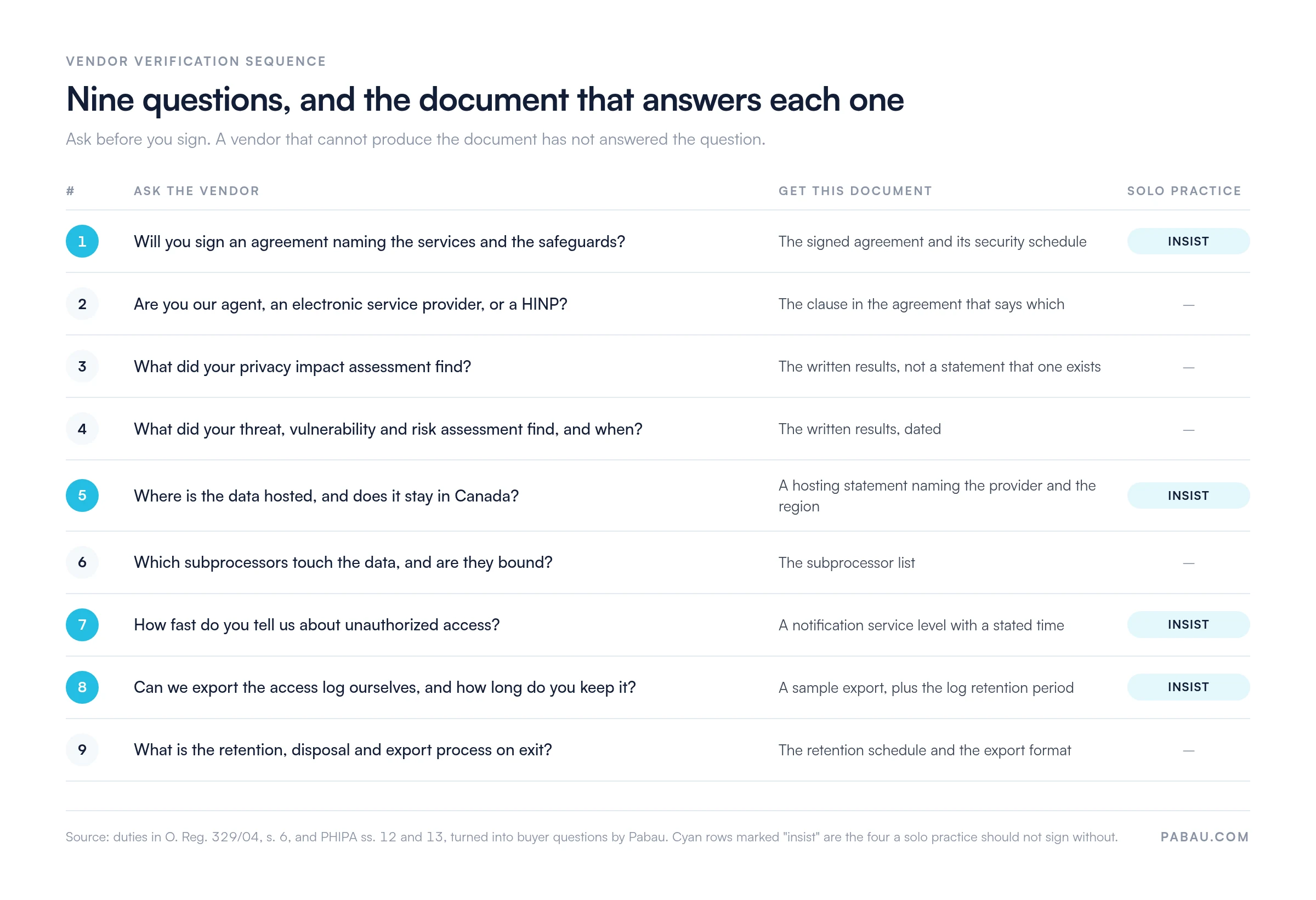
Ask the vendor for the written agreement, the privacy impact assessment, the hosting location and the breach-notification commitment, then read them before you sign. Each question below has a document that answers it, and a bad answer that should slow you down.
Name a privacy contact person on your side too, and get the vendor’s equivalent named in the agreement. An incident at 6pm on a Friday is not the moment to work out who to email.
If you run a solo practice, four of the nine carry most of the weight. Questions 1, 5, 7 and 8 cover the agreement, the hosting location, the notification clock and the exportable log.
A new practice can run these questions before it holds a single chart. Its privacy duties as a custodian start the day it holds one. Our guide to opening an Ontario clinic covers the registrations, fees and ownership rules that sit alongside this choice.
A PHIPA breach means notifying the affected patient and, in prescribed circumstances, the IPC, and it can carry an administrative penalty up to CAD $500,000. The reporting duty arrives before any penalty question does.
Section 12(2) requires you to notify the affected individual at the first reasonable opportunity, and to tell them they may complain to the Commissioner. Section 12(3) adds the report to the IPC, and O. Reg. 329/04, s. 6.3(1) lists the seven circumstances that trigger it.
Three of those triggers catch EMR incidents most often. A use or disclosure by someone who knew they were not authorized. A loss that is part of a pattern. And any loss you judge significant, weighing sensitivity, volume and the number of patients involved.
There is also an annual filing that catches practices out. Under reg. s. 6.4, every custodian must give the Commissioner a report on or before March 1 each year. The report counts the previous year’s thefts, losses, unauthorized uses and unauthorized disclosures. A fifth category covers PHI collected without authority through the provincial electronic health record. A year with none still needs a filing of zero.
The doubling in 2020 came from Bill 188, the Economic and Fiscal Update Act, 2020. The administrative penalty regime arrived through an amendment to O. Reg. 329/04, and s. 35 of that regulation sets both ceilings.
Two details in s. 35 matter more than the headline figures. The Commissioner may add to a penalty an amount equal to the economic benefit the person gained. And s. 61.1(3) of the Act gives a two-year limitation from when the contravention came to the Commissioner’s knowledge.
PHIPA Decision 298, dated August 27, 2025, was the first time the IPC imposed administrative penalties. A physician with privileges at three Windsor-area hospitals used their shared electronic health record to find newborn males.
He ran person searches by sex and date of birth rather than opening charts. The hospitals’ shared services organization reconstructed 146 such searches, through which he could view the PHI of potentially 831 patients.
Between April 20 and May 7, 2024, he used that information to contact 91 individuals by phone or text. The offer was circumcision services at his own pediatric practice, at $350 per procedure.
The Commissioner imposed CAD $5,000 on the physician and CAD $7,500 on the practice. The practice was its own health information custodian, and the physician was acting as its agent. It had imposed no conditions or restrictions on him at the time.
The lesson sits in how he was caught. Nobody spotted this in a chart, because he never opened one. The count of 146 searches, the 831 patients and the window of dates all came out of the system’s own access records.
The practice’s own remediation makes the point again. Before the breach it had no privacy program at all, so neither control existed to be switched on. It then limited EMR access by role and began six-monthly audits of who logged into which chart. Those audits started in September 2024, months after the April and May searches.
So treat the access log as evidence rather than a compliance checkbox. Somebody may read it back to you, which makes log quality the feature to buy on.
One point keeps the risk in proportion. The IPC’s published guidance says administrative penalties are not its default response, and are aimed at more severe contraventions rather than one-off mistakes.
In most Ontario practices we meet, the record set from the injector section is spread across four places. The directive sits in a binder, the photos on a phone, the batch numbers in a notebook, and the consent forms in a filing cabinet. No single log covers any of it.
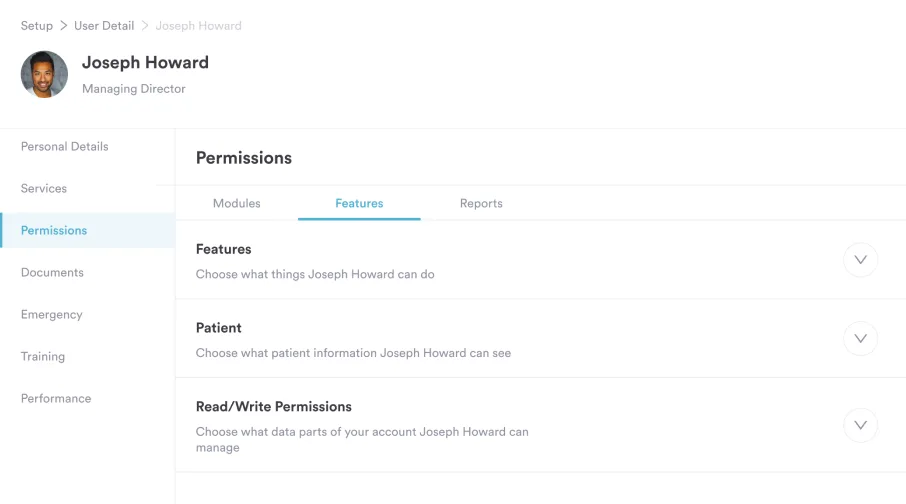
Practice management software like Pabau puts the appointment, the consent form, the treatment note, the before-and-after photographs and the stock record on one patient timeline. Pabau’s staff permissions control who can view, edit or export each part of the client record, down to individual fields.
Every action lands in Pabau’s audit trail, so an access question has an answer you can print instead of reconstruct. Photos carry automatic date and time stamps, and pre- and aftercare messages stay in the record as evidence they were sent.
On the vendor side of the custodian line, Pabau publishes what it will put in writing. A Data Processing Agreement is available. Encryption uses AES-256 at rest and TLS 1.2 or higher in transit, with DigitalOcean as the infrastructure provider. Backups run daily and are kept for six months. Independent penetration testing runs at least annually.
Pabau is not a PHIPA certified EMR, and no vendor is, because no such certification exists. So run the nine questions above at us exactly as you would at anyone else, starting with the written agreement and the hosting location.

Pabau puts the consent form, the treatment note, the batch number and the photos on one patient timeline. Staff permissions and an audit trail sit behind them. Pabau gives an Ontario practice one place to answer an access question.

Stop shopping for a compliance badge, because Ontario does not issue one. Judge a vendor on the custodian line instead. That means the agreement the vendor will sign and the assessments it will hand over. It also means the hosting location it will name, and the log it will let you export.
Two things change when you buy that way. Your due diligence becomes a file you can show the IPC, and your access log becomes readable evidence rather than a feature nobody has opened.
The trade-off worth remembering is that none of it transfers. A vendor can carry its share of the duties and prove that share in writing. The custodian duty stays with your practice permanently. Book a demo to see how Pabau keeps consent, charting and the access log on one Ontario patient record.

Worried what your access log would show today? Medical chart audit sets out how to review your own charts before a regulator does.
Need to know how long records have to stay? How long to keep medical records covers retention periods and the secure disposal step at the end of them.
Something already gone wrong? What to do if you violate HIPAA walks a breach response sequence that maps closely onto PHIPA’s notification steps.
Writing the public statement of your information practices? Notice of privacy practices template gives you a structure to adapt for your own practice.
Still moving off paper charts? Running a paperless practice covers the safeguards that change when the filing cabinet disappears.
PHIPA stands for the Personal Health Information Protection Act, 2004. The statute governs how Ontario health information custodians collect, use and disclose personal health information, and the IPC enforces it.
PHIPA binds Ontario custodians and is enforced by the Information and Privacy Commissioner of Ontario. HIPAA is a US statute enforced by the Office for Civil Rights. A vendor’s HIPAA-compliant claim describes American obligations, so it names duties an Ontario practice does not have.
There is no single provincial system. Primary care largely runs OntarioMD-certified products that connect to OLIS and HRM, while aesthetic, wellness and allied health practices mostly use cloud practice management systems. The types of EMR matter more than the brand name.
No single product wins, because the deciding factors sit in the arrangement around it. Judge a system on the agreement the vendor will sign and the hosting location it will name. Then check the access log you can export, and the retention terms on exit.
PHIPA defines use as viewing, handling or otherwise dealing with personal health information, and it expressly excludes disclosing that information to someone else. Opening a patient chart is therefore a use, which is why it belongs in your audit log.