Pedicure and manicure service menu template
A pedicure manicure treats the nails, cuticles, and skin of both hands and feet ...

1
Last Updated: Oct 13, 2026

Delegating a cosmetic injection under a CPSO medical directive is permitted in Ontario, if the physician assesses the patient, verifies competence, and supervises.
A medical directive is a written order with no named patient, while a direct order covers one named patient at one time.
A compliant directive names the procedure, the qualifying conditions, contraindications, the authorizing physician, the implementer, an effective date, and any approvals.
New patients must be clinically assessed by the delegating physician before delegation, or within two business days, unless a named exception applies.
The three-college delegation map sets Ontario beside British Columbia and Alberta, which regulate cosmetic injectables through three different instruments.
Ontario permits delegating cosmetic injections under a CPSO medical directive. The physician has to assess the patient, verify the injector’s competence, and supervise appropriately. When a physician oversees delegated injections, our roundup of med spa management software includes a pick for medical-director-led med spas.
The College of Physicians and Surgeons of Ontario (CPSO) does not ban delegating Botox or dermal filler injections to a nurse injector. Instead, CPSO sets conditions on how that delegation happens.
Those conditions live across documents that never mention an aesthetic practice. The Regulated Health Professions Act (RHPA) supplies the legal basis, while CPSO’s Delegation of Controlled Acts policy and its Advice to the Profession companion supply the operating rules.
This guide translates those rules for the person running the practice. It also sets Ontario beside British Columbia and Alberta in the three-college delegation map. That said, a group operating in two provinces cannot assume Ontario’s model travels.
A medical directive is a written order that names no patient and authorizes a listed procedure for anyone who meets its stated criteria.
By contrast, a direct order is the other route. It is written or verbal, covers one specific patient at one specific time, and usually follows an existing physician-patient relationship. Any medical directive Ontario physicians write sits inside the same legal framework as that direct order.
Delegation itself has a narrow legal meaning. A physician authorized to perform a controlled act confers that authority on someone not independently authorized to perform it. The RHPA reserves 14 controlled acts for authorized professionals, which is why CPSO delegation exists at all.
The RHPA prohibits sub-delegation. A nurse injector working under a directive, for instance, cannot pass that authority on to an esthetician or a medical office assistant.
The RHPA does carry five narrow exceptions that let an unauthorized person perform a controlled act. The exceptions cover first aid, supervised training, spiritual care, household-member care, and routine assistance with daily living. However, none of the five describes a paid cosmetic appointment.
Registered nurses and physician assistants are the usual delegates for cosmetic injections in Ontario, acting under a physician’s directive rather than on their own authority.
The Canadian Medical Protective Association (CMPA) sets four conditions on any safe delegation. All four sit with the physician rather than with the injector.
Verification is the condition practices underestimate. CPSO’s advice is explicit that foreign credentials cannot stand in for a competence check, and the same diligence applies to any delegate. After all, a license and a training certificate are evidence, not an assessment.
CPSO does allow a physician who played no part in hiring to assume the institution vetted the delegate, absent evidence to the contrary. By contrast, a medical director who signs off on hiring in their own practice has no equivalent assumption to lean on.
Delegation is also framed as a physician extender rather than a physician replacement. A delegate must never independently manage a practice or a patient population.
Nurse delegation in Ontario has no separate rulebook for aesthetics. The same Delegation of Controlled Acts policy governs a nurse injector in a med spa and a nurse in an outpatient clinic.
Practices often go looking for delegated nursing rules written specifically for injectables. Instead, what changes between settings is the risk of the act, and risk is what drives the supervision arrangement.
The physician’s college is only one half of the arrangement. A registered nurse accepting a delegated act also answers to the College of Nurses of Ontario. Its standards for accepting an order sit alongside the physician’s CPSO obligations.
Nursing designation matters as well. Our guide to whether nurses can do Botox covers the scope differences between registered nurses, nurse practitioners and practical nurses.
A physician assistant (PA) cannot prescribe independently in Ontario. Prescribing happens only through a medical directive or a direct order. A PA may also work under more than one supervising physician, which suits a practice that rotates its medical directors.
A PA’s delegated prescription carries three items. The prescription states the directive it was issued under, the authorizing physician’s name and contact details, and the PA’s own name, designation and signature.
A compliant medical directive states the procedure in detail, the qualifying conditions, contraindications, the authorizing physician, the implementer, an effective date, and any approvals.
Those seven elements come from CPSO’s professional obligations guidance on delegation. Knowing how to write a medical directive is largely a matter of covering all seven, because each does a specific job in a cosmetic setting.
The patient’s medical record should also reference every implemented directive by name or number, together with the authorizing physician. That reference is what connects one appointment back to the authority behind it.
Here is that checklist filled in for one procedure. The thresholds below are drafting choices a physician would make. None of them is a CPSO requirement.
Notice that the implementer line names no nurse. Role-based wording is what lets a practice hire an injector in March without redrafting the directive.
A cosmetic practice’s medical director oversees compliance, safe delegation, staff competence, and virtual care held to the same standard as in-person care.
CPSO frames the role as four duties. Each one is an ongoing obligation rather than a one-time sign-off.
A written contract should define the medical director’s role and responsibilities in the practice. CPSO treats that contract as an expectation, not a formality, and it is the document an owner is most likely to be missing.
Practices recruiting for the role can start with our guide to hiring a medical director.
The RHPA sets out 14 controlled acts. Cosmetic injectables sit among the controlled acts Ontario reserves for authorized professionals, which is why a directive is needed at all.
The CMPA names botulinum toxin, dermal fillers and venous sclerotherapy as the cosmetic acts that raise delegation questions most often.
No physician can delegate one controlled act under any circumstance: psychotherapy. The limit rarely bites in an aesthetic practice, but it does show that CPSO treats some boundaries as fixed.
The rules above run in a fixed order, and that order decides whether one appointment can go ahead. The diagram below walks a new patient’s first injectable appointment through all five checks.
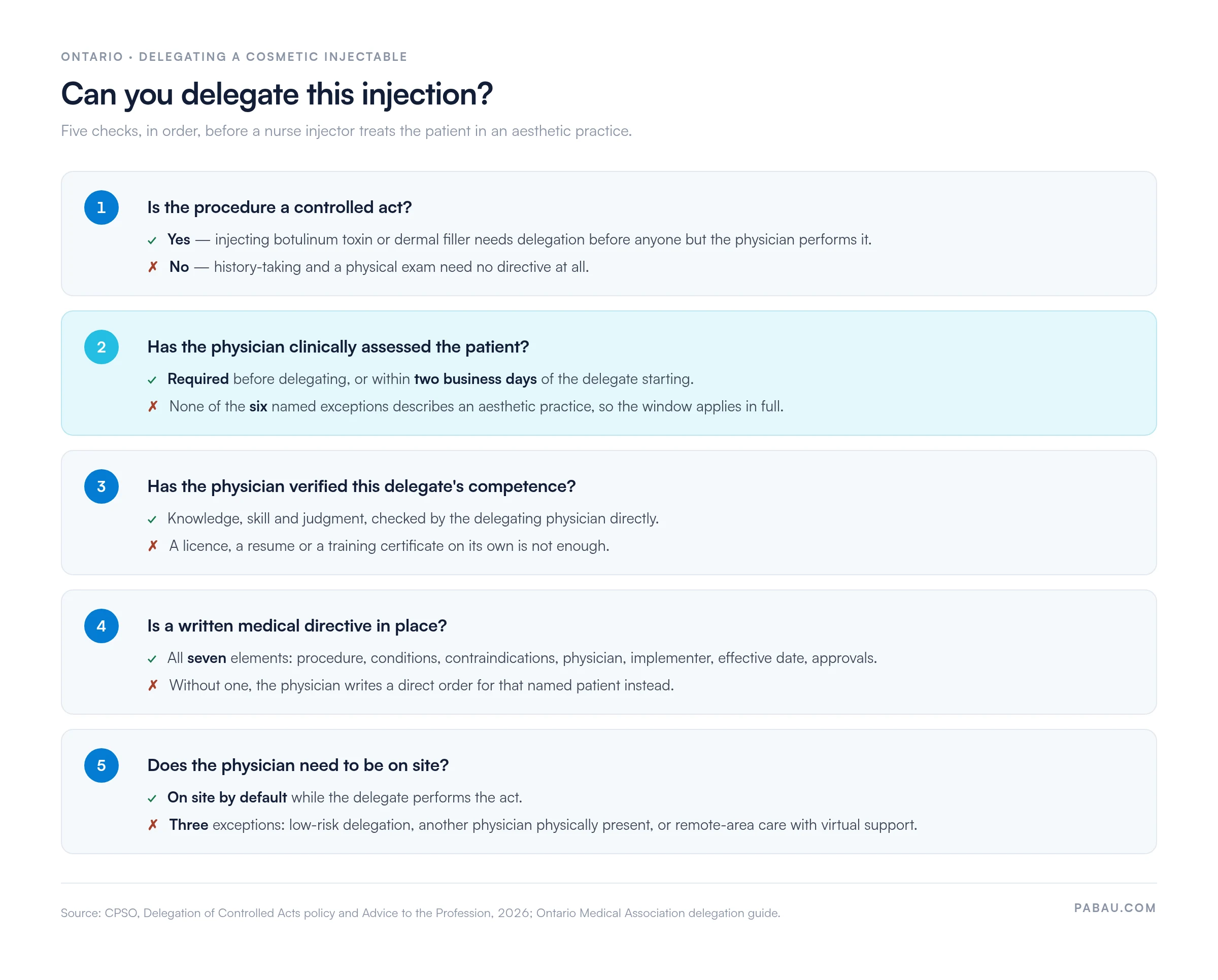
Step two is where an aesthetic practice parts company with the settings CPSO’s own examples describe. Six named exceptions release a physician from the two-business-day assessment window.
Those exceptions cover paramedic transport, remote-area care, public-health immunization, declared emergencies, post-exposure prophylaxis, and hospital care. None of the six describes a med spa, so the assessment window applies in full to a cosmetic appointment.
Step five carries the exception owners ask about most. CPSO expects the physician on site while a delegate performs the act, unless one of three exceptions applies: low-risk delegation, another capable physician physically present, or remote care with virtual support.
In the practices we onboard, the two-business-day window is rarely the hard part. Instead, proving when the assessment happened, months later, is the hard part.
No. Canada has no nationwide medical directive, because each province regulates its own health professions.
Each province authorizes cosmetic injectable delegation through a different instrument, so the working rules for a nurse injector change at the provincial border.
Ontario, British Columbia and Alberta reach a similar destination by three different routes. The table below is the three-college delegation map.
British Columbia’s standard binds physicians. CPSBC describes it as the minimum standard of professional behaviour and ethical conduct expected of its registrants, so it is not optional guidance.
The published standard does not address continuous on-site presence during the injection. Instead, treat “assess, then order” as the confirmed rule, and check the current version of the standard before relying on any further detail.
Alberta is the structural surprise. Neuromodulator and dermal filler injections became regulated personal services under the amended Personal Services Regulation on July 1, 2020. Cosmetic injectable therapy is also a restricted activity under Alberta’s Health Professions Act.
CPSA’s own non-hospital surgical facility accreditation pages do not mention cosmetic injectables. Instead, in Alberta the pathway runs through the Personal Services Regulation, not through facility accreditation — a distinction Ontario owners moving west rarely expect.
Practices commonly report two further requirements for Alberta: a registered nurse injecting there needs a client-specific order, and the overseeing prescriber must be on site and immediately available. However, we could not confirm that against the primary regulatory text, so treat it as reported practice rather than a quoted clause.
Alberta also uses the words “medical director” for that overseeing prescriber. The Alberta role is not CPSO’s medical director role, despite the shared term. Conflating the two is an easy mistake for a group expanding west.
Unlike the three colleges above, Québec sits outside this map entirely. Professionals there may perform only the acts their own governing legislation authorizes.
OHIP pays a physician only for services personally rendered, so a directive authorizing a delegate does not make the delegate’s work billable.
That rule covers assessments, counselling, therapy, consultations and diagnostic interpretations. The Ministry of Health’s Schedule of Benefits carries a Delegated Procedure section in its General Preamble, and the OMA publishes a Payments for Delegated Procedures resource alongside it. For specific billing questions, contact the OMA or OHIP’s Provider Services Branch.
Liability follows the delegation rather than the injection. A physician can face a lawsuit or a College complaint in four situations.
CMPA members are generally eligible for assistance with medico-legal matters arising from care in which they are named. That eligibility also extends to matters where an employee’s actions are at issue, subject to CMPA’s Principles of Assistance to Clinics and Facilities.
Four records have to line up for one delegated injection.
In a paper practice those four sit in four places, and a College complaint tends to arrive long after anyone remembers the appointment.
Practice management software like Pabau keeps the four on one client record. The assessment, the consent form, the treatment note and the before-and-after photos attach to the same patient timeline. Pabau records which staff member created each entry.
Pabau’s stock tracking logs the product batch number against the treatment note, so the injectable used and the record of using it stay in step. Patients complete digital consent forms before the appointment, and the forms land in the record automatically, which removes the scan-and-upload step.
Ontario practices also carry health privacy obligations under the Personal Health Information Protection Act (PHIPA). Keeping the delegation trail inside one system, rather than across a shared drive and a paper file, makes access and retention easier to control.
In practices we onboard, the missing record is almost never the consent form. Instead, what goes missing is usually the assessment date or the directive reference. Our Botox treatment note template shows the fields worth making mandatory.
Pabau is software for med spas and aesthetic practices, so the delegation trail sits inside the client record rather than in a separate compliance folder.

Pabau ties the physician’s assessment, the directive reference, the injector’s identity, the signed consent and the product batch number to a single patient timeline. Aesthetic practices stop rebuilding the story after the appointment.

Ontario permits delegation, and practices can document it. The work is front-loaded: assess the patient, verify the injector, write the directive properly, and settle the supervision arrangement before the first appointment.
The trade-off worth remembering is that a directive transfers the act, never the accountability. The physician who signs it still answers for the delegate’s competence and for the supervision arrangement.
If your practice operates in more than one province, treat the three-college delegation map as a starting point. Check the current text with each regulator, because BC’s practice standard and Alberta’s Personal Services Regulation change on their own schedules.
Book a demo to see how Pabau keeps the assessment date, the directive reference and the batch number on one client record.

Setting up an aesthetic practice’s compliance basics? Med spa compliance covers the records, consent and supervision rules that keep a practice audit-ready.
Want a list you can work through? Medical spa compliance checklist turns those obligations into items you can tick off before an inspection.
Comparing systems for a Canadian practice? Dermatology software in Canada reviews the platforms built for Canadian record-keeping and privacy rules.
A worked example sits in the section above on how to write a medical directive. A cosmetic version names the injectable, the treatment areas, the qualifying conditions, the contraindications, the authorizing physician, the implementer by role, and an effective date.
A directive covering a PA carries the same seven elements as any other, and identifies the implementer by role rather than by name. CPSO delegation rules also require a PA’s delegated prescription to name the directive, the authorizing physician, and the PA.
Not independently. A PA prescribes in Ontario only through a medical directive or a direct order from a supervising physician. A PA also cannot sign a PA student’s order unless a directive is already in place.