How to become a nurse injector in Ontario: The 5 legal steps
Becoming a nurse injector in Ontario takes three steps. You register with the Co...

Last Updated: Sep 22, 2026

An IV therapy clinic in Canada is regulated provincially, so the rule on who may start the IV changes at every border.
For example, Ontario allows a written medical directive covering a class of patients, while British Columbia requires an order written for the individual client.
Notably, Saskatchewan’s nursing college states that IV hydration is a medical treatment, and that clients must not self-select a drip.
Published Canadian prices run from $99 for a saline bag to $400 for an immune or high-dose vitamin C infusion.
In addition, patient records fall under PHIPA in Ontario, the Health Information Act in Alberta, and PIPA in British Columbia.
An IV therapy clinic in Canada is governed by two rules, and neither one is federal. First, the provincial nursing college decides who may start the IV. Then, a physician or nurse practitioner writes the order that makes the infusion lawful.
That sounds straightforward until you compare provinces. Ontario lets a physician write one medical directive that covers every patient meeting its criteria. British Columbia, in contrast, requires an order naming the individual client. Saskatchewan, specifically, requires a diagnosis before the bag is hung.
Patients type IV therapy near me and IV clinics near me, then land on a menu with no price and no named practitioner. Operators, however, need the opposite. This guide sets out Canada’s IV Therapy Compliance Matrix, drawn from the colleges’ own published standards. In addition, the CAD figures come from clinic price menus in Toronto and Calgary.
An IV clinic is a private practice where a regulated professional administers vitamins, minerals or fluids intravenously, under an order from an authorized prescriber.
Ownership and clinical authority are separate questions. A registered nurse, a nurse practitioner, a naturopathic doctor or a physician can all be the person in the room. Only some of them, however, can authorize the infusion themselves. The rest, instead, work from an order.
Three ownership models dominate. First, a nurse-owned clinic retains a physician or nurse practitioner to assess patients and write orders. Second, a naturopathic clinic uses its own prescribing authority, where the province grants it. Third, a physician-owned clinic keeps both roles in-house.
Whichever model you pick, two steps sit in front of every session. First, a pre-treatment health assessment screens for contraindications such as congestive heart failure or kidney disease. Informed consent is then taken and documented. A patient booking online will not ask about either one, so the record has to prove both happened.
Canada has no official count of wellness drip clinics. In fact, Canada’s Drug Agency published the first inventory of privately funded IV infusion clinic locations in June 2022. Since then, a follow-up study in the Canadian Journal of Health Technologies counted 1,097 infusion clinics in January 2025.
Both of those counts covered clinics serving people prescribed IV medicines, not vitamin bars. The wellness segment therefore sits outside every government inventory.
Most Canadian IV therapy clinics sell six or seven recognizable formulations plus a custom option. The names are service names. Indeed, a drip name is not an approved indication, and menu wording should never imply one.
Fatigue and immune support are the two reasons clinics market an IV drip most often. Treat those as positioning rather than clinical claims. Health Canada, for instance, told CBC News in November 2025 that IV health products are regulated as drugs. Specifically, each product must be authorized before legal sale, and administered under a health-care professional’s supervision.
The thin evidence base matters most in your marketing copy. In fact, a secret-shopper study of US IV businesses appeared in JAMA Internal Medicine in October 2025. The authors found 86% recommended therapies aimed at specific headache or cold symptoms. Notably, fewer than a third described the risks or required a consultation with a licensed professional first.
A patient searching IV vitamin therapy near me arrives expecting a menu. Search glutathione drip near me and you arrive expecting one specific bag. In contrast, neither expectation matches what a Canadian college wants your intake to look like.
Only a regulated health professional may give an IV in Canada, and almost always under an order from an authorized prescriber.
In Ontario, administering a substance by injection is a controlled act authorized to nursing. The College of Nurses of Ontario states that an order is required. Specifically, that order can be a direct order, or a written directive from a physician or nurse practitioner. Notably, CNO does not support the term standing order.
The physician’s side of that arrangement is stricter than most clinic owners expect. In fact, the CPSO policy on delegation of controlled acts was updated in May 2026. A delegating physician must clinically assess every new patient before delegating, or within two business days. The physician must also be physically on site to supervise, unless the risk of the delegation is low.
Two more CPSO rules bite directly on a drip business. First, physicians must not delegate where the primary reason is monetary gain or physician convenience. Second, delegates must never be left to manage a practice or a patient population on their own.
In contrast, British Columbia does not work this way at all. Under the Nurses and Midwives Regulation, a BC registered nurse performs the relevant restricted activities only under a client-specific order. BCCNM’s standard requires that order to be client-specific, clear, dated and signed, which rules out a blanket directive covering a class of patients.
BC is also unusually broad about who may write it. A physician, nurse practitioner, dentist, midwife, naturopathic physician, podiatrist, pharmacist or certified registered nurse may give the order. Consequently, many Vancouver clinics are naturopath-led rather than physician-led.
Alberta authorizes the act through legislation instead of a directive. The Health Professions Restricted Activity Regulation authorizes restricted activities by register category. The College of Registered Nurses of Alberta then sets the standards for performing them. Specifically, CRNA is the current name for the body long known as CARNA.
CRNA’s Restricted Activities Standards make one point worth pinning above the desk. Authorization in the regulation, however, does not mean a registrant may perform any restricted activity in any situation or practice area. Competence, clinical area and the college’s criteria all still apply.
Saskatchewan has gone furthest in writing the rules down. The College of Registered Nurses of Saskatchewan confirms that IV hydration therapy in a stand-alone clinic is within RN scope, then sets conditions. Specifically, IV hydration is a medical treatment, so there must be a medical condition, and clients must not self-select treatments.
CRNS also requires a health history and physical examination performed and documented by the prescribing nurse practitioner or physician. There must be an order from that prescriber for the RN to start the IV and administer the additives. In addition, emergency equipment has to be on site.
Read those five provinces side by side and four variables decide the model. Canada’s IV Therapy Compliance Matrix below sets out the college, the authorizing mechanism, the on-site question and the privacy law for each one.
| Province | Colleges that govern the practice | What authorizes the RN to start the IV | Physician on site? | Privacy law for records |
|---|---|---|---|---|
| Ontario | College of Nurses of Ontario (CNO); College of Physicians and Surgeons of Ontario (CPSO) | A direct order, or a written medical directive from a physician or nurse practitioner. CNO rejects the term standing order. | Yes, unless the risk is low. CPSO also requires a physician assessment of each new patient within two business days. | PHIPA |
| British Columbia | BC College of Nurses and Midwives (BCCNM); College of Physicians and Surgeons of BC (CPSBC) | A client-specific order. A physician, NP, naturopathic physician, dentist, midwife, podiatrist or pharmacist may write it. | Not stated for infusions. BCCNM does require the prescriber in the facility for injectables given for medical aesthetic purposes. | PIPA |
| Alberta | College of Registered Nurses of Alberta (CRNA, formerly CARNA); College of Physicians and Surgeons of Alberta (CPSA) | The Health Professions Restricted Activity Regulation, by register category. An order is still needed for the drug itself. | No on-site rule in CRNA’s Restricted Activities Standards. | Health Information Act (HIA) |
| Saskatchewan | College of Registered Nurses of Saskatchewan (CRNS); College of Physicians and Surgeons of Saskatchewan | An order from an NP or physician, plus a history and physical exam documented by that prescriber. | No on-site rule. The prescriber must assess and diagnose first. | The Health Information Protection Act (HIPA); confirm trustee status with the provincial commissioner |
| Quebec | Ordre des infirmières et infirmiers du Québec (OIIQ); Collège des médecins du Québec (CMQ) | An individual prescription, or a collective prescription issued by a physician. Confirm the wording with the CMQ. | Not specified for infusions. Confirm with the CMQ. | Law 25 for private-sector records. Confirm the scope of Law 5 with the Commission d’accès à l’information |
Ontario adds one requirement that lands on the premises rather than the practitioner. Specifically, where a naturopathic doctor performs the infusion, the College of Naturopaths of Ontario inspects the premises through its Intravenous Infusion Therapy program, known as IVIT.
An IVIT inspection reviews the physical environment, emergency preparedness, infection control, sterile compounding, administration, record keeping, occurrences, delegation and quality management. A premises can pass, pass with conditions, or fail. Overall, passing earns a follow-up inspection every five years, and the outcome appears on a public register.
Naturopathic doctors also sit two College exams before they may administer IVIT at all. If you are still weighing which professional to hire, our guide to administering IV vitamin therapy compares the roles in more detail.
IV therapy in Canada costs roughly $99 to $400 per session, with NAD+ infusions and add-on injections priced separately by dose.
Almost nobody publishes those numbers. In fact, four of the six clinic pages currently ranking for this topic point at a menu and show no figure at all. The table below uses two Canadian clinics that do publish a full price list, read in August 2026.
| Treatment | Published price (CAD) | Session length | Source |
|---|---|---|---|
| Saline hydration | $99 to $125 | 45 minutes | Higher Health, Toronto (entry price); Essence Wellness Clinic, Calgary |
| Glutathione or brightening drip | $130 to $240 | 15 to 60 minutes | Essence Wellness Clinic, Calgary; Bar Beauty Medical, Toronto |
| Myers’ cocktail or multivitamin | $160 to $300 | 30 to 45 minutes | Essence Wellness Clinic, Calgary; Bar Beauty Medical, Toronto |
| Immune or high-dose vitamin C | $240 to $400 | 45 to 60 minutes | Essence Wellness Clinic, Calgary; Bar Beauty Medical, Toronto |
| Athlete recovery | $250 to $350 | 45 minutes | Bar Beauty Medical, Toronto |
| NAD+, 50 mg to 250 mg | $280 to $365 | 60 to 120 minutes | Essence Wellness Clinic, Calgary |
| Add-on IM or IV push injection | $22 to $130 | Under 5 minutes | Essence Wellness Clinic, Calgary |
| Initial assessment before any IV | $240 | 60 minutes | Essence Wellness Clinic, Calgary |
The spread matters more than the midpoint, because it tells you where your own list price can sit. The ranges below plot the same figures.
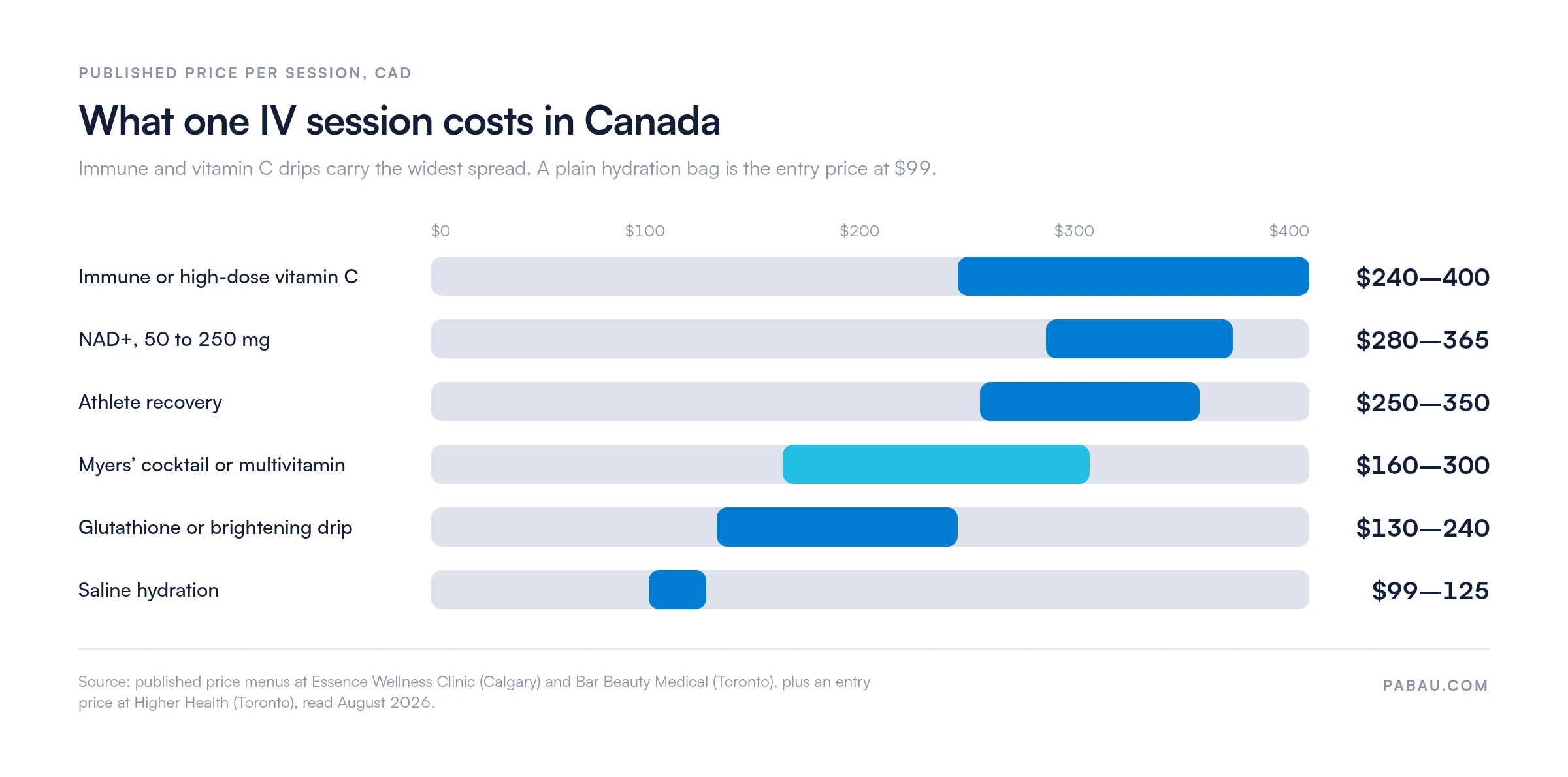
City comparisons are less dramatic than the search volume suggests. Toronto IV therapy sits at the top of the published range, and IV therapy Calgary tends to sit lower. In contrast, IV therapy Vancouver prices are rarely published at all. Vancouver clinics quote after a consultation instead.
One structural detail is worth copying. Essence Wellness Clinic splits every price into a visit fee and a supplies fee, and states that supplies fees are not eligible for insurance coverage. As a result, that split makes the receipt honest, and it protects the clinic when a patient submits a claim.
Provincial health plans do not pay for any of this. OHIP, MSP and AHCIP fund insured medical services, and an elective wellness infusion is not one. However, some extended health plans reimburse the naturopathic or medical visit portion, depending on the plan, but rarely the supplies.
Ask an accountant about sales tax before you set the list price. Cosmetic and wellness services are generally taxable in Canada, and the answer depends on who delivers the service and why.
Ontario clinics follow PHIPA, Alberta custodians follow the Health Information Act, and BC clinics follow PIPA. PIPEDA, the federal law, covers commercial activity where no substantially similar provincial law applies.
PHIPA stands for the Personal Health Information Protection Act, and it applies to health information custodians in Ontario. A regulated practitioner providing health care is a custodian, so a nurse-owned or naturopath-owned clinic is covered directly rather than through its physician.
Alberta names its custodians. The Government of Alberta lists registered nurses among the professionals designated as custodians under the Health Information Act, alongside physicians and chiropractors. In addition, Alberta’s Personal Information Protection Act still covers the commercial side of the business, such as marketing lists and staff records.
British Columbia has no separate private-sector health privacy statute. Instead, a BC IV clinic is a private-sector organization under PIPA, and BCCNM’s privacy and confidentiality standard applies to the nurse on top of that. Confirm current breach-reporting duties with the provincial commissioner before you write your policy.
Whichever law applies, the operational checklist barely changes.
An IV infusion clinic needs a municipal business license, a lease that suits a treatment room, and a corporate structure your college accepts. Check whether your college recognizes independent practice, and register for it where that is a separate step. Saskatchewan, for example, requires a Recognition of Practice process before hours worked in an IV clinic count toward licensure.
Staffing is where the compliance work concentrates. You need nurse injectors with documented IV competence, and a physician or nurse practitioner willing to assess patients and sign orders. In addition, CPSO expects a written contract setting out the medical director’s role, and expects that director to verify staff training and credentials. Our guide to opening an IV clinic covers the build-out sequence.
Budget for three things owners routinely underestimate. Specifically, emergency equipment has to be on site, professional liability protection has to cover independent practice, and compounded solutions have to come from a licensed pharmacy. Supplies also need storing and handling in line with infection prevention and control practice.
A mobile or on-demand delivery model is a different business, and this guide does not cover it. Travel time, drug transport and lone-worker safety change the economics and the risk profile, so read our piece on the mobile IV therapy business instead.
Software carries more of the compliance load than a setup budget suggests. Your EMR has to hold the order, the assessment, the consent and the batch detail against one client timeline. Our review of the best EMR for IV therapy narrows the field, and so does the wider category of software for longevity clinics.
One booking decision follows directly from the Saskatchewan rule. If clients must not self-select treatments, your online booking cannot sell a named drip as a bookable product. Book the assessment, then let the prescriber decide what goes in the bag.
Most new IV clinics run on a stack that cannot survive an audit. Consent forms print, get signed, then live in a filing cabinet. Orders sit in a binder at reception. Photos stay on a phone. Instead, practice management software like Pabau replaces that patchwork with one client record.
In the Canadian practices we onboard, the order and the consent are the two records that go missing first. Pabau’s digital forms capture the screening questionnaire and the consent signature before the appointment, and file both against the client timeline automatically. As a result, the treatment note, the batch detail and any before-and-after photo land in the same place.
Pabau’s online booking handles the self-select problem directly. You publish the consultation rather than the drip menu, attach the intake form to that booking type, and let the prescriber choose the formulation afterwards. As a result, reception stops fielding calls about which bag is available.
Pabau’s access controls and audit trail also support what PHIPA, the Health Information Act and PIPA all ask of you. Every chart view is logged, so you can answer who opened a record and when. That is the answer a commissioner wants, and the one a paper file cannot give.

Pabau holds the prescriber’s order, the screening questionnaire, the signed consent and the treatment note against one client timeline. Canadian IV clinics can show a college or a privacy commissioner exactly who assessed, ordered and administered each infusion.

The province you operate in decides your staffing model, not your treatment menu. An Ontario clinic can run on directives but may need a physician on site. In contrast, a BC clinic needs an order for every individual client, which changes how the front desk books.
Pick your province’s row in the matrix, then design the workflow backwards from it. Get that right and the pricing question gets easier. Indeed, a $160 to $400 session supports a viable clinic when the assessment is billable and the record is clean.
Get it wrong and the exposure lands as a complaint to a college that names your prescriber. Book a demo to see how Pabau keeps every order, consent and treatment note audit-ready for a Canadian IV clinic.

Need the intake paperwork itself? IV therapy patient intake template gives you the screening and consent fields a college expects to find on file.
Worried about what can go wrong mid-infusion? IV therapy complications sets out the reactions to plan for and the emergency equipment to keep in the room.
Building your first formulation protocol? Myers cocktail protocol walks through the components, dosing and documentation for the formula most menus open with.
Ready to fill the chairs? IV therapy marketing covers the channels that work for a drip clinic without making claims a regulator would query.
Comparing systems for the clinical side? IV therapy EMR software explains what an infusion practice needs from its records system.
Yes. Starting an IV is a restricted or controlled act. Specifically, an IV infusion clinic needs a regulated professional to perform it, under an order from a physician or nurse practitioner. Each provincial college sets the conditions, and they differ. For example, Ontario permits a written directive covering a class of patients, while British Columbia requires an order naming the individual client.
Published Canadian prices run from about $99 for a saline hydration bag to $400 for an immune or high-dose vitamin C infusion. A Myers cocktail, for instance, sits between $160 and $300. NAD+ is priced by dose, from $280 at 50 mg to $365 at 250 mg. In addition, many clinics charge a separate initial assessment, often around $240, and provincial health plans pay for none of it.
That depends on what you expect from it. Indeed, evidence for wellness drips is thin, and Health Canada treats IV health products as drugs requiring professional supervision rather than approved treatments for named conditions. For an operator, the honest answer is commercial. Overall, a clinic works when the assessment is billable, the pricing reflects the published market, and the compliance record holds up.