CRM for chiropractors: how to manage patients, bookings and marketing
A CRM for chiropractors is a patient relationship management system built around...

Last Updated: Oct 13, 2026

Ontario CPSO registration, an OHIP billing number and CMPA coverage all have to land before you can bill a patient.
The Ontario Clinic Launch Timeline sequences those lead times against your opening date, starting with the CFPC exam application.
Non-physicians can own a management company around a practice, but every voting share of a physician corporation belongs to a CPSO member.
Published 2026 exam, registration and coverage fees pass $11,000 in a first year of Ontario family practice.
Ontario pays primary care through several models, and the one you join changes your revenue before the first patient books.
How to open a medical clinic in Ontario starts with three registrations: a CPSO certificate of registration, an OHIP billing number, and CMPA coverage. None of the three moves quickly. Two of them run in sequence rather than side by side.
The Ministry of Health cannot issue your OHIP billing number until your CPSO certificate exists. Your CPSO independent license, in turn, can stall until the CFPC exam results arrive. So the date you can bill is set months earlier, by the date you filed an exam application.
This guide sequences every mandatory pre-opening step against a target opening day. We call that the Ontario Clinic Launch Timeline. Each lead time sits with a different body, so the sequence has to be assembled rather than looked up.
In practices we onboard, the front desk is ready weeks before the billing number is. The building, the staff and the software are the manageable part. The regulatory queue is what decides your opening date.
Below you will find the registrations and the fees Ontario’s colleges publish. Then come the ownership rules under the Regulated Health Professions Act, and the differences between the payment models.
You need CPSO certification, an OHIP billing number, and CMPA coverage before you can bill your first patient in Ontario.
Your Ontario CPSO registration is the document the rest of the list waits on. The Ontario Medical Association puts the whole set of licenses and memberships at up to three months to obtain.
The Ministry of Health asks for valid CPSO certification, an Ontario practice address, a signed application form, banking details, and enrollment in electronic claims. Processing takes up to six weeks.
Retroactive billing softens a late start. The ministry allows claims dating back up to six months before your billing number issues, but never before your certificate’s effective date.
A group number is not a billing number. The ministry issues a group number so individual physicians can have their billings associated with a group.
Two mechanics trip up new practices. All OHIP claims must travel by electronic data transfer under Regulation 552, s.38.3 of the Health Insurance Act. Claims submitted by the 18th are typically processed the following month.
Counting back from opening day, the CFPC exam application goes in first, then CPSO certification, then hospital privileges, and OHIP billing registration last.
Each lead time below comes from the body that owns the step. The Ontario Clinic Launch Timeline is the sequence, not a new rule.
| Task | Start before opening day | Typical duration or condition | Source |
|---|---|---|---|
| CFPC certification exam application | 3–5 months before the sitting | Two sittings a year, and 18 months of residency must be complete | College of Family Physicians of Canada |
| CPSO certificate and professional memberships | 2–3 months before you start practicing | Up to 3 months to obtain licenses and memberships | OMA; Ontario College of Family Physicians |
| Hospital privileges application | 1–3 months before your start date | Most hospitals ask for 2–3 professional references | Ontario College of Family Physicians |
| OHIP billing number | After the CPSO certificate is issued | Up to 6 weeks to process | MDBilling.ca; JCL Medical Systems |
One dependency does the damage. CPSO cannot fully complete an independent license until your CFPC exam results arrive. The Ontario College of Family Physicians warns this can leave a new physician unable to bill for the first few months.
The exam runs twice a year, and you need 18 months of completed residency to write it. So the sitting date, rather than the build-out, is what constrains your opening day. The chart below plots the same four lead times on one axis.
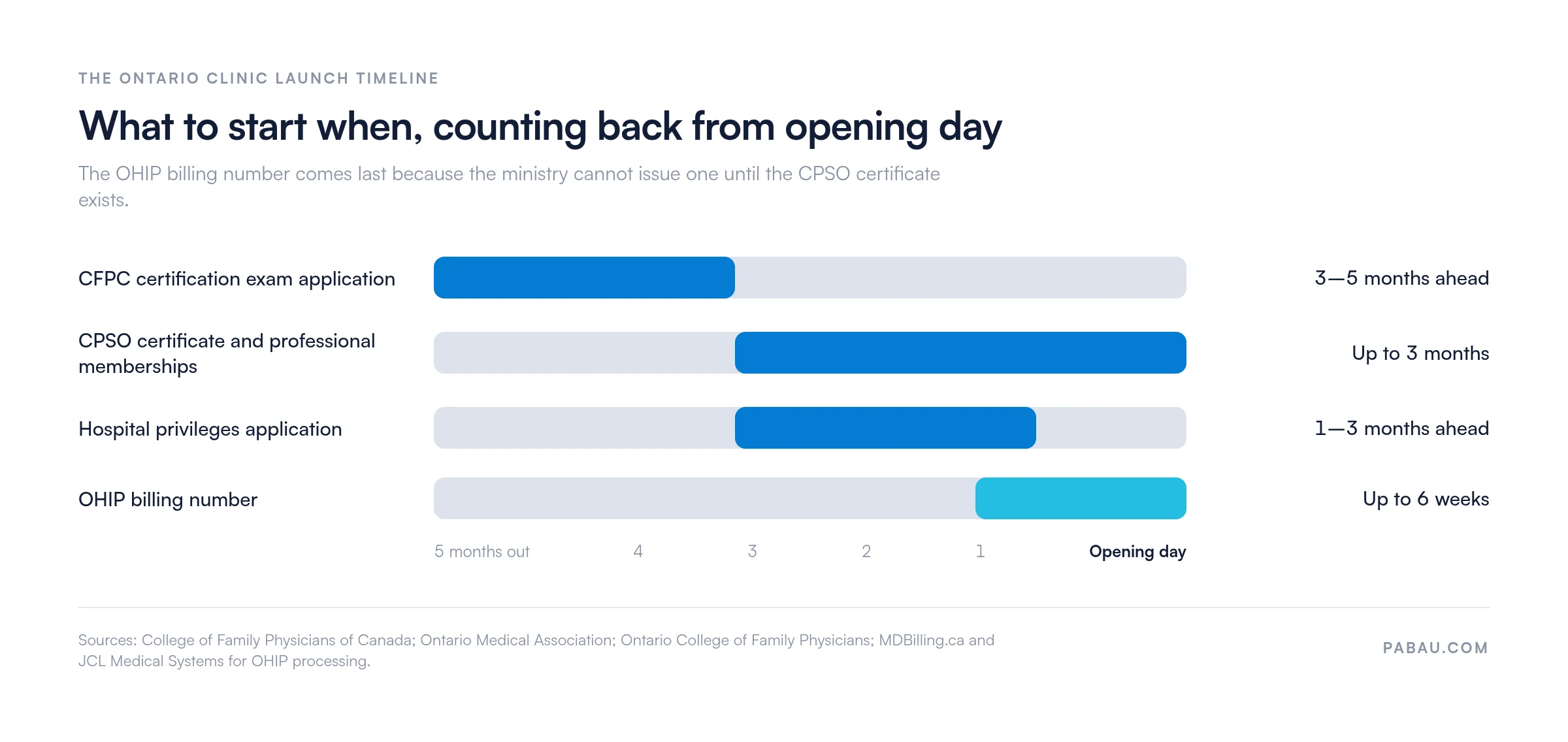
Work the timeline backwards from a date you are willing to defend. If the CFPC sitting slips by six months, your opening slips with it.
Non-physicians can own the business around an Ontario clinic, but diagnosis, prescribing and injections stay with regulated physicians under the Regulated Health Professions Act.
The Regulated Health Professions Act, 1991 does the work here. Section 27(1) bars any person from performing a controlled act while providing health care. The exception is narrow. Either a health profession Act authorizes that person, or an authorized member has delegated the act.
Section 27(2) lists the controlled acts. Communicating a diagnosis, procedures below the dermis, administering a substance by injection, and prescribing or dispensing a drug all sit on that list.
So a non-physician owner cannot deliver the clinical service. Ontario’s corporation rules then stop that owner from holding the practice itself.
Those rules sit in Ontario Regulation 665/05 and section 3.2 of the Business Corporations Act. Read both provisions directly before you settle on a structure.
That leaves one workable shape. The physicians hold the professional corporation and the clinical work. A separate management or services company, which a non-physician can own outright, holds the lease, the equipment, the brand and the non-clinical staff.
The management company then charges the practice for those services. Where that fee is a percentage of billings, the arrangement starts to resemble fee splitting. That is the point at which a healthcare lawyer earns the retainer.
The rules do not soften for a walk-in clinic rather than a family practice. A walk-in model changes your hours, your patient flow and your staffing. The controlled acts and the ownership rules are identical.
Deciding whether to run solo, partner with other physicians, or bring in a non-clinical partner is a structural choice with long consequences. Our comparison of group vs private practice sets out the trade-offs on cost, governance and autonomy.
Treat the above as a summary of the statute rather than legal advice. Take your proposed structure to a healthcare lawyer before you sign a lease or issue a share.
No Ontario body publishes a startup total, but the mandatory exam, registration and coverage fees alone pass $11,000 in a first year of family practice.
Every fee below comes from the body that charges it. Each one is published, so you can check the figure yourself before you budget for it.
| Fee | Amount | Frequency | Published by |
|---|---|---|---|
| Certification Examination in Family Medicine, residency-eligible route | $4,478 | One-time | CFPC, 2026 exam fees |
| Certification Examination in Family Medicine, practice-eligible route | $5,972 | One-time | CFPC, 2026 exam fees |
| CPSO application fee, classes other than postgraduate and short-duration | $1,035 | One-time | CPSO fee schedule, January 2026 |
| CPSO annual membership fee | $1,725 | Annual | CPSO fee schedule, January 2026 |
| CMPA coverage, family medicine without obstetrics, anesthesia, surgery or ED shifts | $3,972 | Annual | CMPA 2026 fees, Ontario region |
| CMPA coverage, family medicine including obstetrics, anesthesia, surgery or ED shifts | $10,188 | Annual | CMPA 2026 fees, Ontario region |
| Medicine professional corporation certificate of authorization | $400, then $175 a year | One-time plus annual | CPSO fee schedule, January 2026 |
Add the residency-eligible exam fee, the CPSO application fee, the first CPSO annual fee and one year of CMPA coverage. That comes to $11,210 before you have signed a lease. Obstetrics, anesthesia or emergency shifts push the CMPA line to $10,188 on its own.
The costs nobody publishes are the ones that vary most. The OMA’s own guide to starting a practice names the categories without putting a figure against any of them.
Treat that list as a quote-gathering exercise rather than a budget you can copy. Anyone quoting a single national build-out figure for a new practice is guessing.
The Ontario College of Family Physicians recommends assembling an advisory team before you start. An accountant, an insurance broker and a legal advisor will cost less than the mistakes they prevent.
If you are weighing a purchase instead of a build, the arithmetic works differently. Our guide to medical practice valuation walks through how an existing practice gets priced.
Location and lease decide costs you cannot renegotiate later. Work through the list below before you sign the lease.
Two of those items carry cost you will not see at signing. A lease with no assignment clause makes the practice hard to sell later. A build-out obligation written as the tenant’s problem moves the whole fit-out onto you.
Buying an existing practice removes the build-out, the equipping and the hiring. It also starts you with a patient base. Against that sit inherited liabilities and, in a single-use building, a thin resale market. Price both routes before you commit to either.
Ontario pays family physicians through several models, and the basis differs sharply between them. Choosing a model is one of the first decisions you make when you open a practice rather than join one.
| Model | How you are paid | What to check before you sign |
|---|---|---|
| Fee-for-service (FFS) | Per insured service, priced by the OHIP Schedule of Benefits | Which of the roughly 6,000 listed services you will bill in a typical week |
| Comprehensive Care Model (CCM) | Fee-for-service, with incentives attached to a defined set of services | Which services trigger an incentive, and what reporting each one asks of you |
| Family Health Group (FHG) | A blend of fee-for-service with incentives and bonuses | The after-hours coverage the group expects from every physician |
| Family Health Organization (FHO) | Capitation, paid per enrolled patient rather than per visit | How patient enrollment and de-rostering work day to day |
| FHO+ | A Family Health Organization variant the OMA lists among Ontario’s models | Ask the OMA or the ministry for the current terms in writing |
Neither the OMA nor the ministry publishes the per-patient capitation rates or the incentive amounts on the pages that describe these models. Ask for the current figures in writing before you commit to one.
The Schedule of Benefits lists roughly 6,000 physician services with the payment conditions attached to each. That document, rather than your model, sets what a given visit is worth under fee-for-service.
Hiring in Ontario is contract-first, and your privacy duties start the day you hold a patient record.
One trap belongs to a purchase rather than a start-up. If the outgoing physician does not formally terminate staff, the buyer takes on their employment obligations.
Getting the shifts, the phones and the room turnover to work together takes a system rather than a spreadsheet. Our guide to medical practice operations covers the workflows a new practice sets up first.
Ownership can pay more than employment, but no current Canadian source publishes a reliable clinic-owner income figure, so treat any single number carefully.
The numbers circulating on this question are worth naming. A widely shared 2020 article claims clinic owners double or triple an employed salary and often earn well over $100,000. Neither claim carries a source.
What you can plan on is the cost side and the revenue basis. The published fees above are fixed. Your payment model and your panel size set the income, and you decide both before opening.
The failures practice consultants report are operational rather than financial. Understaffing, no workflow planning, and opening before the systems are ready all show up repeatedly.
The OMA’s advice on this is blunter. Keep a business emergency fund, and hold enough cash flow to run the practice through its first few years.
A new Ontario practice usually opens with four tools. An EMR for clinical notes, a separate booking page, a spreadsheet for the staff schedule, and a card terminal that talks to none of them.
Practice management software like Pabau replaces that patchwork. Pabau keeps the appointment, the treatment note, the consent form and the invoice on one patient record. No one copies data between systems by hand.
That matters most in your first quarter. When a PHIPA access request or a billing query arrives, Pabau’s client records give you one place to look rather than four. Pabau’s staff permissions also control who can open which file.
Scheduling is the other day-one job. Pabau’s calendar covers the whole team, and online booking lets patients book themselves in. Your front desk stops being the only route into the diary.
Our practice management app brings the calendar, patient records, payments and reporting into one login. Every Pabau subscription includes every feature, so no feature you need on day one sits behind a higher tier.
Pabau has no free trial, by design. Structured onboarding takes its place. A dedicated Client Coordinator supports your data migration, and our Customer Success team then configures the booking rules, forms and payment flows. That setup stage is what decides whether a new system sticks.

Pabau keeps appointments, patient records, consent forms and invoices on a single patient record, so a new Ontario practice runs without copying data between tools. Staff permissions control who can open which file.

The timeline is the forcing function. Almost every item on the list can be compressed with money or effort, except the two that sit with a college. The exam sitting and the CPSO certificate move at their own pace.
So pick an opening date, count back five months, and file the exam application first. Then work forward through CPSO, hospital privileges and the billing number. The lease and the build-out can catch up. The regulatory queue cannot.
The trade-off worth remembering is that retroactive billing covers six months at most, and never earlier than your certificate’s effective date. Start late enough and you will treat patients you cannot invoice.
Get the systems in before opening week rather than after it. Book a demo to see how Pabau runs the records, schedule and payments of a brand-new Ontario practice from one login.

Need the day-to-day running order once you open? How to improve and optimize your private practice management covers the routines that keep a small practice on time.
Ready to grow the panel? How to grow a medical practice in 2026 sets out the referral, recall and retention levers in order.
Building your operating routine from scratch? Medical practice operations: the complete guide for clinic managers maps the workflows a new practice needs first.
Thinking about buying instead of building? How much is a medical practice worth? Valuation guide 2026 shows how an existing practice gets priced.
Yes. The Ministry of Health will not issue an OHIP billing number without valid Ontario CPSO certification, an Ontario practice address and enrollment in electronic claims. Certification and billing registration are two separate applications, filed with two different bodies.
Nurse practitioner-led clinics are a separate Ontario care model, funded by the Ministry of Health, where nurse practitioners are salaried rather than paid per service. A nurse practitioner leads the clinical team and physicians collaborate. Approach the ministry about the model rather than setting one up independently.
Plan on five to six months of regulatory lead time. The Ontario Clinic Launch Timeline starts with the CFPC exam application, three to five months before the sitting. CPSO certification then takes up to three months. The OHIP billing number follows in up to six weeks.
No Canadian body publishes a startup total, so treat any single figure with care. Ontario’s mandatory 2026 fees are published. A residency-eligible CFPC exam, the CPSO application and first annual fee, and one year of CMPA family-medicine coverage come to $11,210.