Fertility clinic marketing: Strategies that attract & convert patients
Fertility clinic marketing is how a fertility practice attracts, educates, and c...

Last Updated: Oct 14, 2026

Patient lifetime value is average visit value multiplied by average visit frequency, then multiplied by average patient lifespan.
The three variables multiply, so a 10% gain in any one of them adds the same 10% to the total.
Work out which variable has the most headroom in your own numbers before you pick a retention tactic.
A 90-day rebook rate on new patients is the earliest reliable signal that lifetime value is moving.
Practice management software like Pabau keeps visit value, frequency, and lapse dates on one record, so the number stays current.
Patient lifetime value is the total revenue one patient brings your practice from their first booking to their last. Very few ever calculate it.
The math is simple. Multiply average visit value by visit frequency, then by how many years the patient stays. What matters more is knowing which of those three has room to move in your practice.
We start with the calculation, then benchmarks by practice type, then the levers worth pulling first.
Patient lifetime value (PLV) is the total revenue you expect from one patient across the whole relationship. It is a projection, not a record of what they have already spent.
Three variables produce it. Average visit value is what a typical appointment brings in. Average visit frequency is how often that patient books in a year. Average patient lifespan is how many years they stay active before lapsing. Multiply the three and you have PLV.
Retail and subscription businesses call the same idea customer lifetime value. Healthcare adds two wrinkles. Patient data carries compliance duties that a loyalty database does not. And clinical outcomes, not just service, decide whether someone books again.
PLV turns three recurring arguments into arithmetic. Once you have the number, marketing spend, forecasting, and operational investment stop being matters of opinion.
Retention is the cheaper side of that arithmetic. Research from Harvard Business Review and Bain & Company puts the cost of winning a new customer at five times the cost of keeping one.
In a practice, the difference is wider still. A new patient costs you ad spend, consultation time, intake admin, and a record built from scratch. A returning one costs a reminder message.
The number also settles which retention work comes first. Set it beside your patient retention strategies and the priority list usually reorders itself.
The formula is short, and each part comes straight out of your booking and billing history.
PLV = average visit value × average visit frequency × average patient lifespan
Divide total revenue for a period by the appointments completed in that period. A practice billing £40,000 across 200 appointments has an average visit value of £200.
Count retail sales, product add-ons, and package redemptions where they are tied to an appointment. Leave out membership fees that are not attached to a visit. They inflate the figure and hide what appointments earn.
Pull 12 months of booking history and count appointments per unique active patient. Divide the total by your active patient count. If 150 patients booked 420 appointments last year, frequency is 2.8.
Run the same sum by treatment type as well. One busy injectables cohort can lift an otherwise flat average and mask a problem elsewhere.
Decide what “lapsed” means for your practice first. No visit in 12 or 18 months is the usual line. Then count the patients who crossed it in the last 24 months.
Average lifespan is the inverse of your annual churn rate. Lose 25% a year and lifespan is roughly four years. Lose 10% and it is roughly ten.
Specialty matters here. Aesthetic practices work in shorter treatment cycles, so tenure looks shorter. Primary care and physical therapy hold patients across longer chronic-care arcs.
Take a single-site med spa with 180 active patients and a year of clean booking data.
Multiply that by 180 active patients and the book of business carries £594,000 in projected revenue. That is the number worth defending, and it is far larger than any single month’s takings.
Now the part the formula hides. The three variables multiply, so a 10% gain in any one of them lifts PLV by the same 10%. What separates them is headroom. How far can each one realistically move in your practice?
No single benchmark covers every practice type. The ranges below are directional, built from typical visit values and frequency patterns.
They shift with geography, treatment mix, and pricing model, so use them to sense-check your own figure rather than as a target.
Two patterns stand out. Practices with high frequency and modest visit values, like physical therapy, still reach a strong PLV when patients stay engaged across several care episodes.
And the widest ranges belong to the specialties where lifespan swings most, which is usually where the largest gains are sitting. Here is how that plays out on the med spa example above.
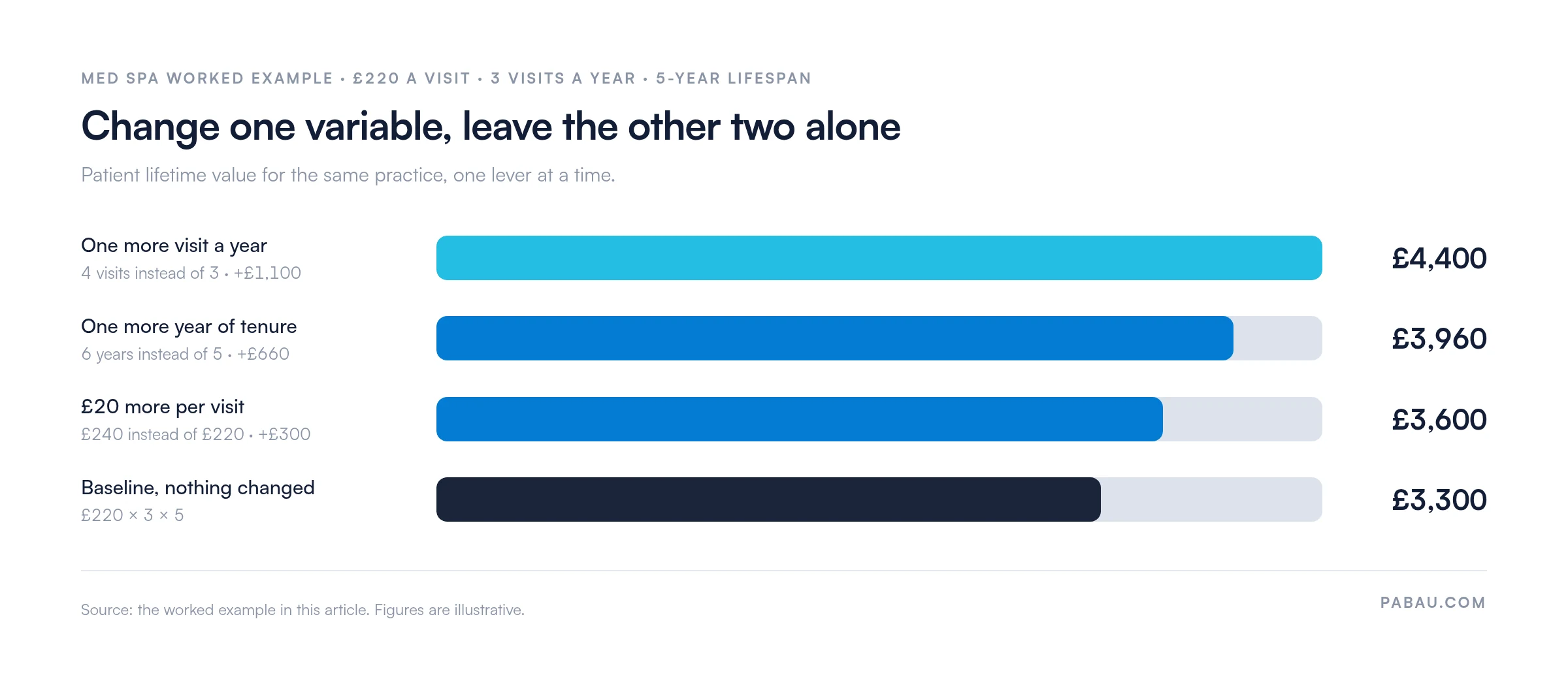
Frequency wins on that chart because three is the smallest number in the equation. Adding one visit is a 33% jump. Adding one year to a five-year lifespan is only 20%. That is arithmetic rather than strategy.
Measured in percentages, the three levers are worth exactly the same, so the question becomes which 10% is cheapest for you to buy. In most practices, holding a patient one more year takes less selling than talking them into an extra appointment.
Each of the seven below targets one of the three variables. Running all of them at once is how a retention push dies in week three. Pick the variable with the most headroom and start there.
Five conditions need to be in place before you launch:
A no-show is a direct tax on visit frequency. A patient who books four times a year and misses one is a three-visit patient. A quarter of their PLV goes with the missed slot. Reported no-show rates in healthcare commonly sit between 10% and 30%, depending on specialty and patient mix.
Automated SMS and email reminders at 48 hours and two hours before the appointment cut that reliably. Deposits do more. A patient with money on the appointment turns up, or reschedules instead of going quiet.
Recall extends lifespan more directly than any other lever here. A patient who last came in 14 months ago and has had no contact since has already left, whatever your database says. A sequence that fires at six, nine, and twelve months after the last appointment keeps the relationship alive.
Tie the timing to the treatment cycle where you can. Botulinum toxin refreshes at three to four months, skin courses at six. Then make the reply easy. Send the recall message with a link to online booking for practices. The patient rebooks in the 30 seconds they have, instead of promising to call back.
Post-appointment contact is the cheapest retention work available, and most practices go quiet between the booking confirmation and the next reminder.
A message 48 to 72 hours after treatment does three jobs. It checks recovery, answers the question the patient did not ask in the room, and creates a natural moment to rebook.
Surveys do the same work in reverse. Measuring patient satisfaction surfaces the complaint that would otherwise turn into silence. A patient who feels heard after a problem usually comes back. One who never got the chance to raise it rarely does.
Payment friction shows up as a shorter lifespan, not as a lost sale. A patient who wants a £600 laser course and cannot pay for it upfront rarely argues. They postpone, then drift.
Installment plans, stored cards for repeat charges, and pay-later options move the decision back to whether they want the treatment. Practices that add them tend to see fewer quotes go quiet, and more course bookings instead of single sessions.
A membership settles visit frequency in advance, which is what makes it the most reliable lever here. A patient on a £99 monthly plan that includes two treatments books 24 times a year. An unstructured patient books three or four. Across five years, that is 120 appointments against roughly 18.
The admin is what usually kills the idea. Pabau’s membership management handles tiers, recurring billing, and usage per member. It all sits in the same system as the appointment, so nobody reconciles a spreadsheet at month end.
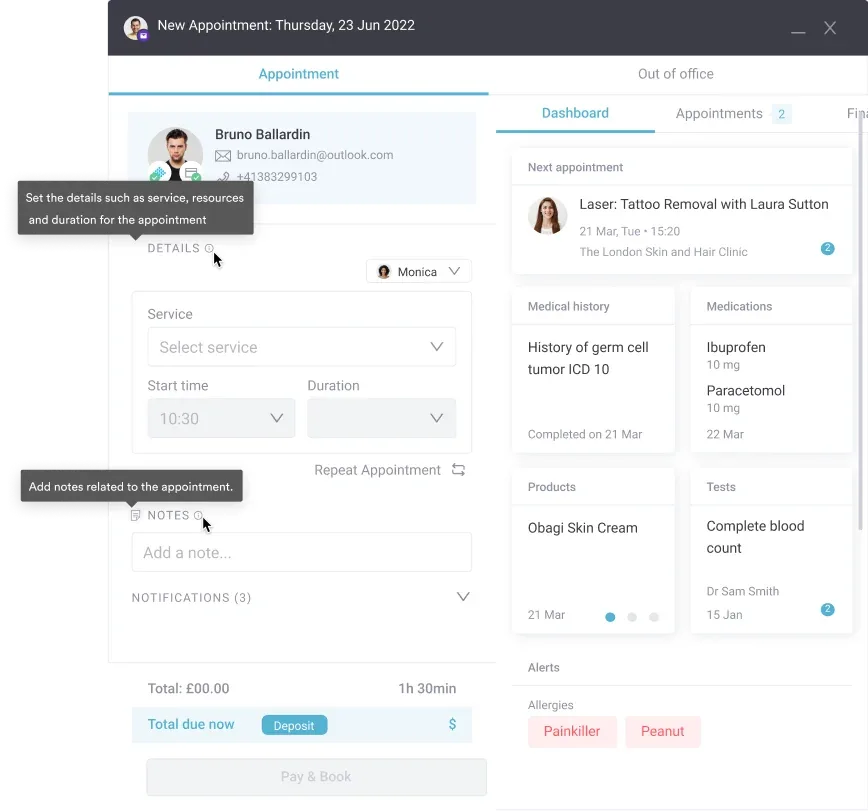
Churn shows up in the data weeks before the last appointment. The signals repeat across specialties: longer intervals between bookings, falling treatment frequency, recall messages going unopened. A report listing patients overdue for their next visit, sorted by last appointment date, is enough to act on.
Every Pabau subscription includes reporting on revenue per patient, visit frequency, and appointment history. Insights Plus, a paid add-on, layers further reporting depth on top of that. Once outreach outgrows a manual list, practices tend to look at patient reactivation software to run the win-back sequence properly.
Journey mapping as a PLV tool means tracing one patient’s path from first booking to lapse, then finding the point where that path usually breaks. Three break points come up again and again.
Ask the question directly against your booking data. Which patients should statistically have rebooked by now and have not? Cohort reporting answers it at the month level. You can see whether the drop-off lands at one month, three, or six, then aim the recall sequence there.
Run a 12-month cohort report. Take every new patient who first booked last year and track how many rebooked within 90 days. That 90-day rebook rate is the strongest early predictor of patient lifetime value you can get. Below 40%, fix your post-visit follow-up before you spend another pound on acquisition.
Four mistakes account for most of the PLV figures that turn out to be useless:
Most practices that try to track PLV start in a spreadsheet. They export appointments, work out averages by hand, and update the file quarterly if someone remembers. That holds until the patient list passes a few hundred. After that the number goes stale, and a stale number stops getting used.
The fix is to stop assembling it by hand. When booking, payments, recall, and reporting sit in the same system, the three PLV variables get captured as a by-product of running the day.
Practice management software like Pabau records every appointment, payment, recall trigger, and membership charge against the same patient record. Revenue per patient, visit frequency, and retention cohorts then read straight off it.
That consistency matters most for the two levers that depend on it. Recall sequences send whether or not the front desk has a quiet hour this week. Membership billing does not wait for anyone to chase it. You get a PLV figure you can check on a Monday and act on the same morning.
Building retention segments out of patient records carries obligations too. UK practices need to stay inside GDPR and ICO guidance, and US practices inside HIPAA.
Pabau is built with both in mind, though your own data processing agreements are still worth reading before you start segmenting.

Pabau keeps appointments, payments, recall, and memberships on one patient record. Revenue per patient and retention cohorts stay current without a manual export.

Patient lifetime value rewards patience more than effort. The levers that move it are unglamorous. Recall discipline, follow-up that happens on schedule, and memberships that hold frequency all compound quietly. The practices growing PLV are rarely the ones running the most campaigns.
Start with one number, not a program. Work out your PLV by treatment type, find which of the three variables has the most headroom, and fix that one variable for a quarter. Then check the 90-day rebook rate and see whether it moved. If it did, you have a lever you can pull again.
If the tracking is what stops you, that part is solvable. Book a demo to see how Pabau keeps visit value, frequency, and lapse dates current on every patient record.

Ready to put recall on autopilot? Patient recall software compares the tools that run the sequences described above.
Looking for one system to hold retention together? Patient retention software sets out what to look for, and what to ignore.
Want the relationship side, not just the numbers? Patient relationship management covers the habits behind a longer patient lifespan.
Need somewhere to keep all this patient data? Healthcare CRM software explains what a practice CRM tracks and who needs one.
Quarterly for visit value and frequency, annually for lifespan. Visit value moves with your price list, and frequency responds to recall within a quarter or two. Lifespan comes out of your churn rate, so it needs a full year of lapse data before the new figure means much.
Yes, with a proxy. Use the 90-day rebook rate on the patients you already have. Borrow a lifespan figure from the benchmark range for your specialty. Treat the result as a planning estimate. Recalculate at 12 months, once you have your own lapse data.
Three to one is the usual rule of thumb. If a patient is worth £3,000 and costs £1,000 to win, the campaign covers treatment time, admin, and risk. Below two to one, you are buying revenue that never turns into profit.
They cut average visit value straight away, so they only pay if frequency or lifespan rise by more. A first-visit discount that converts someone into a five-year regular is cheap. A standing 20% off that trains your list to wait for the offer is not.
Both, but act on the treatment-level figure. A practice-wide average hides the gulf between an injectables patient on a three-month cycle and a one-off facial patient. Segmenting also shows which patients are worth paying to acquire.