HIPAA compliant texting: What you can send patients & how to communicate securely
HIPAA compliant texting is possible when a text holds no protected health inform...

Last Updated: Oct 16, 2026
Patient identity verification is the process of confirming a patient is who they claim to be before care, record access, or any administrative task. In practice, staff confirm at least two independent identifiers, such as full name and date of birth, at registration, check-in, treatment, and every digital login. Each check is then recorded against the patient file.
The Joint Commission’s National Patient Safety Goals make correct patient identification a standing priority, because misidentification contributes to medication errors, wrong-site procedures, and wrong-patient records.
This guide covers the legal rules in the US and UK and the methods that suit each touchpoint. It also shows how practice software makes the check routine, so your front desk spends less time on manual lookups.

Patient identity verification confirms who a patient is before care, record access, or admin tasks, using at least two independent identifiers.
WHO Patient Safety Solution 2 calls for at least two identifiers, such as full name plus date of birth, and never a room number.
HIPAA requires covered entities to verify identity and authority before disclosing protected health information (PHI), and to authenticate anyone accessing electronic PHI.
Check-in is the riskiest moment, so ask patients to state their details instead of confirming details read out to them.
Practice software such as Pabau captures identity details through digital intake and links them to one patient record, which cuts manual errors at check-in.
Patient identity verification is the systematic confirmation that the person presenting for care, opening their records, or completing intake paperwork is the correct patient. Hearing a name at the front desk doesn’t count. Staff cross-reference at least two independent identifiers against the patient’s record before any clinical interaction begins.
Misidentification puts medication into the wrong person, a procedure onto the wrong patient, and sensitive health data in front of someone unauthorized. That’s why verification works best as the first clinical act of every visit.
Verification is required at four touchpoints:
Each of those moments calls for a slightly different check, as the map below shows.
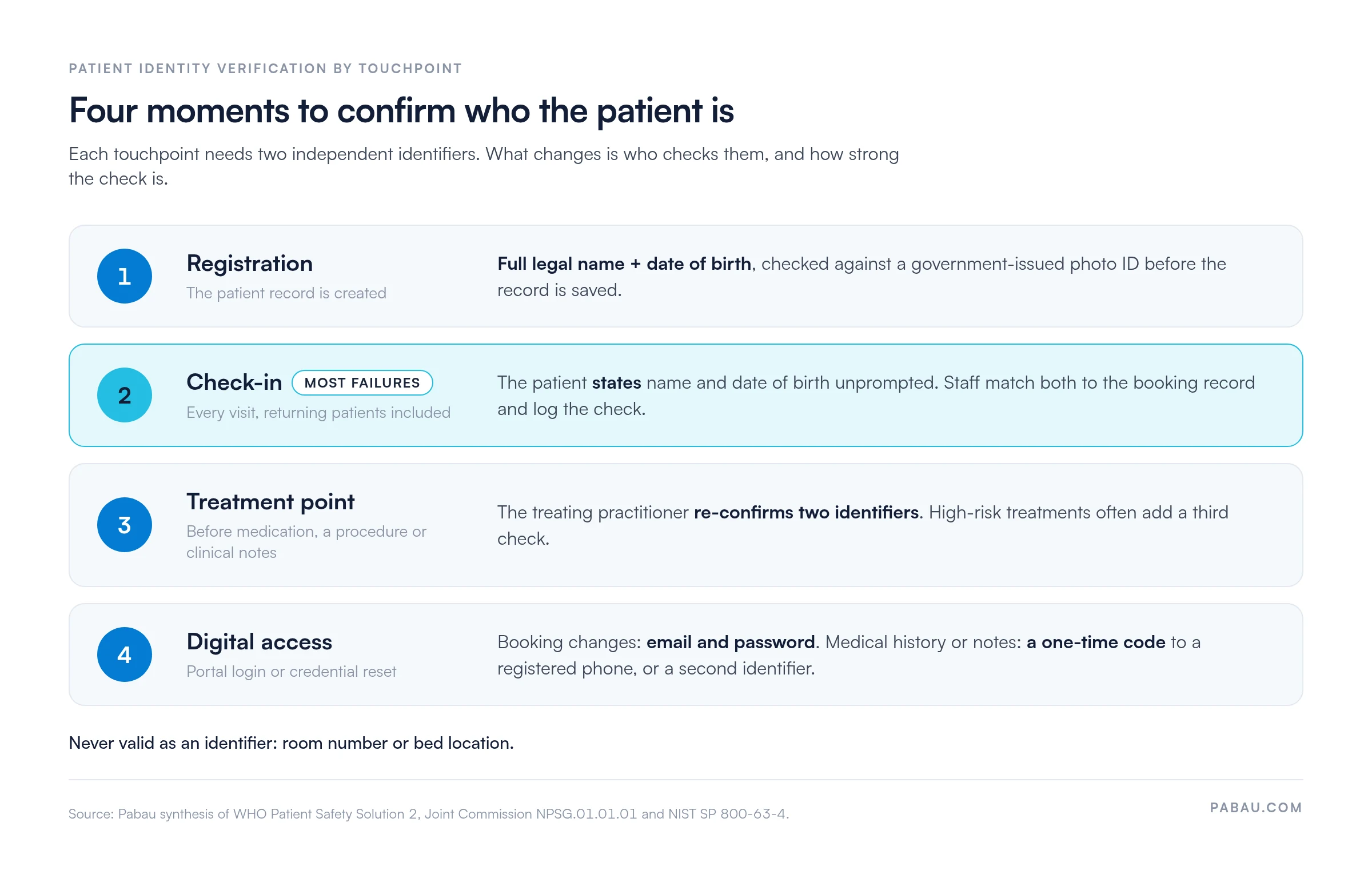
A missed check at any one of them lets a wrong match through to the next. Misidentification incidents often trace back to an inconsistent process that relied on staff memory instead of a documented workflow.
Wrong-patient errors cause direct clinical harm. WHO’s Patient Safety Solutions name patient misidentification as a widespread, preventable source of harm in health systems worldwide. The WHO links it to medication and transfusion errors, testing errors, and procedures performed on the wrong person.
Three categories of harm follow from failed verification:
For aesthetic and private practices, the risk runs higher. Many patients book online, arrive without a referral, and see a different practitioner at each visit. Without a verification step built into intake, no structural safeguard catches the error.
The WHO two-identifier rule requires at least two independent patient identifiers before any clinical procedure, medication administration, or record access. It’s set out in WHO Patient Safety Solution 2. The Joint Commission requires it in the United States under National Patient Safety Goal NPSG.01.01.01. National patient-safety bodies such as NHS England and Safer Care Victoria give similar guidance.
The two identifiers must be independent, and a name alone doesn’t qualify. Acceptable combinations include:
Two identifiers set the minimum standard. Practices handling controlled substances, surgery, or high-risk treatments often add a third check at the point of care. That matters most when the person treating the patient isn’t the one who completed intake.
HIPAA doesn’t prescribe a single verification method. It does require covered entities to verify identity before disclosing protected health information (PHI). The rules that shape front-desk workflows and HIPAA compliance software sit in two places.
Privacy Rule (45 CFR § 164.514(h)): requires verification of identity and authority before PHI is disclosed to anyone requesting it. That includes patients asking for their own records through a portal or a records request.
Security Rule (45 CFR § 164.312): requires access controls, unique user identification, and authentication for electronic PHI (ePHI). The rule requires procedures to verify that a person seeking access to ePHI is the one claimed. Multi-factor authentication is a widely recommended way to meet it. A HIPAA risk assessment shows whether your current logins meet that bar.
For US practices, start by checking your medical office HIPAA compliance obligations. They apply to any covered entity handling PHI, not only hospitals. Med spas, aesthetic practices, and private practices fall within scope if they transmit health information electronically, for example to bill insurance.
In the UK, identity verification obligations come from the NHS Data Security and Protection Toolkit, the CQC’s fundamental standards, and the UK GDPR. CQC Regulation 17 (good governance) expects accurate, secure records and effective systems. Regulation 12 (safe care and treatment) is the one that bears on correct patient identification in treatment.
Across both countries, the law requires you to verify identity without dictating the technology. Defining and documenting the method is the practice’s job, and compliance management software keeps that documentation ready for inspection.
Write your identity verification protocol down, even if it’s simple. Inspectors and auditors such as the CQC and the HHS Office for Civil Rights look for evidence that a process exists and is followed consistently. A one-page standard operating procedure (SOP) naming the two identifiers, when they’re checked, and who’s responsible is a solid starting point.
Verification methods range from verbal confirmation to biometric scanning. The right one depends on the clinical context, how sensitive the interaction is, and the technology your practice has.
Most outpatient and aesthetic practices pair a photo ID with a second identifier confirmed verbally. The patient shows a government-issued ID, such as a passport or driver’s license. The receptionist checks the name against the booking and asks for a date of birth. This typically takes a minute or less and meets the WHO two-identifier standard for most appointments.
Knowledge-based authentication (KBA) can stand in for document checks in digital workflows. The patient confirms their registered email address or a previous appointment date. KBA is weaker than a document check because answers can be guessed or stolen. Keep it for lower-sensitivity tasks such as booking changes or portal login.
Biometric ID uses a patient’s unique physical traits, typically a fingerprint, iris scan, or facial geometry, as an identity credential. Because the trait is tied to the person, it’s hard to impersonate and needs no document.
Biometric verification is most common in inpatient and emergency settings. There, patients may arrive without documents or be unable to identify themselves, for example after an unconscious admission. Outpatient and aesthetic practices rarely use it because of cost, privacy concerns, and data governance duties.
Under the UK GDPR, biometric data used to uniquely identify a person is special category data. Processing it requires explicit consent (or another Article 9 condition) and a documented lawful basis.
If your practice is considering biometric verification, put three safeguards in place first:
Digital verification applies at three moments in the patient journey:
The NIST SP 800-63-4 Digital Identity Guidelines, the current revision, set assurance levels that rise with the risk of the transaction.
In a practice, booking an appointment needs basic authentication, such as an email and password. Opening a full medical history or downloading clinical notes needs a stronger check, such as a one-time code sent to a registered phone. If you use an online booking portal, build these thresholds into the workflow instead of leaving them to staff discretion.
Check-in is where verification most often slips. Staff are often managing a waiting room, answering calls, and taking payments at the same time. Without a structured checklist or software prompt, the check becomes inconsistent.
Five habits make check-in verification reliable:
A search for patient identity verification surfaces two kinds of result. One is clinical guidance for healthcare providers. The other is enterprise identity platforms built for financial services, insurance, and large-scale digital onboarding. Knowing the difference stops practices from buying the wrong tool.
Enterprise platforms such as Entrust (formerly Onfido) and LexisNexis Risk Solutions verify identities at scale for financial onboarding. They’re built to confirm, once and fully online, that a stranger opening an account is who they say they are.
Clinical verification confirms that the person in your waiting room matches the record you hold. It repeats at every visit and answers to HIPAA or the CQC instead of anti-money-laundering (AML) rules.
For most practices, a standalone identity platform is more than the job needs. A practice management system with identity capture and intake built in handles verification inside the existing workflow, with no separate tool to run.
Software gives the verification process a fixed shape. A paper process depends on staff discipline, while a software-enforced one builds the check into every booking, form, and record.
Pabau supports patient identity verification across the patient lifecycle through four connected features:
If your practice still uses paper medical forms, moving intake online is the single biggest improvement to verification reliability. Paper forms aren’t linked to records, can’t enforce completeness, and leave no timestamped audit trail. A form with a blank date of birth can pass straight through a paper system unnoticed.
Verification also overlaps with wider data protection. Our guide to EHR security covers the access controls and audit logging that protect the records you’ve just verified.

Pabau captures patient identifiers through digital intake and online booking, then links them to one patient record. Every check-in starts from details the patient has already confirmed.

Patient identity verification fails quietly until the day it causes harm, whether that’s a medication error, a records breach, or a failed CQC inspection. The standard itself is settled. Check two independent identifiers at every touchpoint, and write each check down.
Start with check-in, because that’s where a busy front desk is most likely to skip a step. Ask patients to state their details, send intake forms before the visit, and log every check. A one-page protocol backed by a software prompt holds up on a busy morning far better than memory does.
Pabau’s digital intake forms, linked patient records, and role-based access make that protocol a built-in step instead of a manual one. Book a demo to see how Pabau keeps identity checks consistent at every check-in.

Preparing for a CQC inspection? CQC requirements 2026: what every provider must prove sets out the evidence inspectors expect from your systems and records.
Not sure where your HIPAA risks sit? HIPAA risk assessment: a complete guide walks through identifying and documenting threats to patient data.
Training a new front-desk team? HIPAA training for employees covers what staff need to know before they handle PHI.
Deciding how long to keep patient records? How long to keep medical records lists the retention rules state by state.
Wondering what a verification lapse could cost? HIPAA violation penalties explains the fine tiers and how practices avoid them.
Patient identity verification is the process of confirming that the person presenting for care or accessing records is the correct patient. It uses at least two independent identifiers, such as full name and date of birth. It applies at registration, check-in, treatment, and digital access, and it’s built into The Joint Commission’s NPSG.01.01.01 and HIPAA’s disclosure rules.
In the United States, HIPAA requires covered entities to verify identity before disclosing protected health information. The Joint Commission also requires two identifiers when providing care, treatment, or services. In the UK, CQC regulations on safe care and good governance expect effective systems for identifying patients. NHS data security requirements expect the same for protecting their records. The law sets the obligation to verify and leaves the technology to you.
The most reliable method is asking the patient to state their full name and date of birth, then checking both against the booking record. A government-issued photo ID check adds a third layer. Digital intake forms completed before arrival cut data entry and create a documented audit trail.
Biometric ID enrolls a unique physical trait, such as a fingerprint or facial geometry, at registration and matches it at each later visit. It makes impersonation very hard. It needs explicit patient consent and a fallback for patients who decline. It also needs a lawful basis under the UK GDPR or applicable state law, such as BIPA in Illinois. It’s most common in inpatient and emergency settings.
Most practices handle identity verification through their practice management software rather than a standalone tool. Digital intake forms, linked patient records, and role-based access controls build verification into each workflow step. Enterprise identity platforms, used in banking and insurance, solve a different problem and rarely suit clinical check-in.