HIPAA compliant texting: What you can send patients & how to communicate securely
HIPAA compliant texting is possible when a text holds no protected health inform...

Last Updated: Oct 16, 2026
Healthcare risk management is the process of finding, assessing, and controlling risks to patients, staff, compliance, and the finances of a healthcare organization.
It runs as a repeating five-step cycle: identify, assess, mitigate, monitor, and report. According to the Agency for Healthcare Research and Quality (AHRQ), preventable medical errors contribute to tens of thousands of US patient deaths each year.
Hospitals run that cycle with a dedicated risk team. A private practice runs the same five steps at a smaller scale. The practice manager or clinical lead usually owns it, with software capturing the evidence as care happens.

Healthcare risk management is a proactive, repeating cycle that covers clinical, operational, financial, IT, and regulatory risk.
Patient safety and regulatory compliance (HIPAA, Joint Commission, CMS) are the two highest-stakes risk categories for most practices.
The CPHRM credential, administered by the American Hospital Association (AHA) Certification Center, is the primary professional certification for healthcare risk managers.
Practice management software with audit trails, locked notes, digital consent, and incident records reduces compliance risk at the point of care.
Healthcare risk management covers every step a provider takes to anticipate harm, limit the damage, and learn from it so patterns do not repeat.
The American Society for Health Care Risk Management (ASHRM) is the main professional body for the discipline. It frames the job as protecting patients, visitors, staff, assets, accreditation, and community standing at the same time.
The business case is straightforward. Malpractice claims cost US hospitals billions each year. A single serious adverse event can trigger regulatory scrutiny, reimbursement clawbacks, and reputational damage that lasts for years. A structured program moves the practice from damage control after the fact to prevention before it.
Most healthcare organizations track risk across five domains, and each one needs its own identification and mitigation strategy.
Clinical risk is the most consequential domain. Adverse events, near-misses, medication errors, and diagnostic delays all fall here. Lower-acuity settings such as aesthetic and elective practices still need formal incident capture and root-cause review. Near-miss reporting is especially valuable because it surfaces hazards before they cause harm.
Risk assessment tools help teams decide which clinical risks need immediate attention and which can be monitored. The two most common are failure mode and effects analysis (FMEA) and the classic likelihood-severity risk matrix. The Joint Commission requires accredited organizations to run proactive risk assessments using frameworks of this type.
Healthcare IT risk management protects electronic protected health information, known as ePHI. Ransomware attacks on US health systems rose sharply through 2023 and 2024, and some forced hospital-wide paper fallbacks for days.
The HIPAA Security Rule requires covered entities and business associates to document a security risk analysis. That analysis, often called a HIPAA risk assessment, sets the safeguards a practice must put in place.
For practice owners, choosing HIPAA compliance software starts with mapping where ePHI lives. That means scheduling systems, clinical notes, payment processors, and every third-party integration.
Strong EHR security adds role-based access controls, encryption at rest, automatic session timeouts, and an audit trail of who opened which record and when.
Most frameworks describe risk management as a repeating cycle rather than a one-time project. The five-step model below reflects standard practice across ASHRM guidance and ISO 31000, and each report feeds the next round of identification.
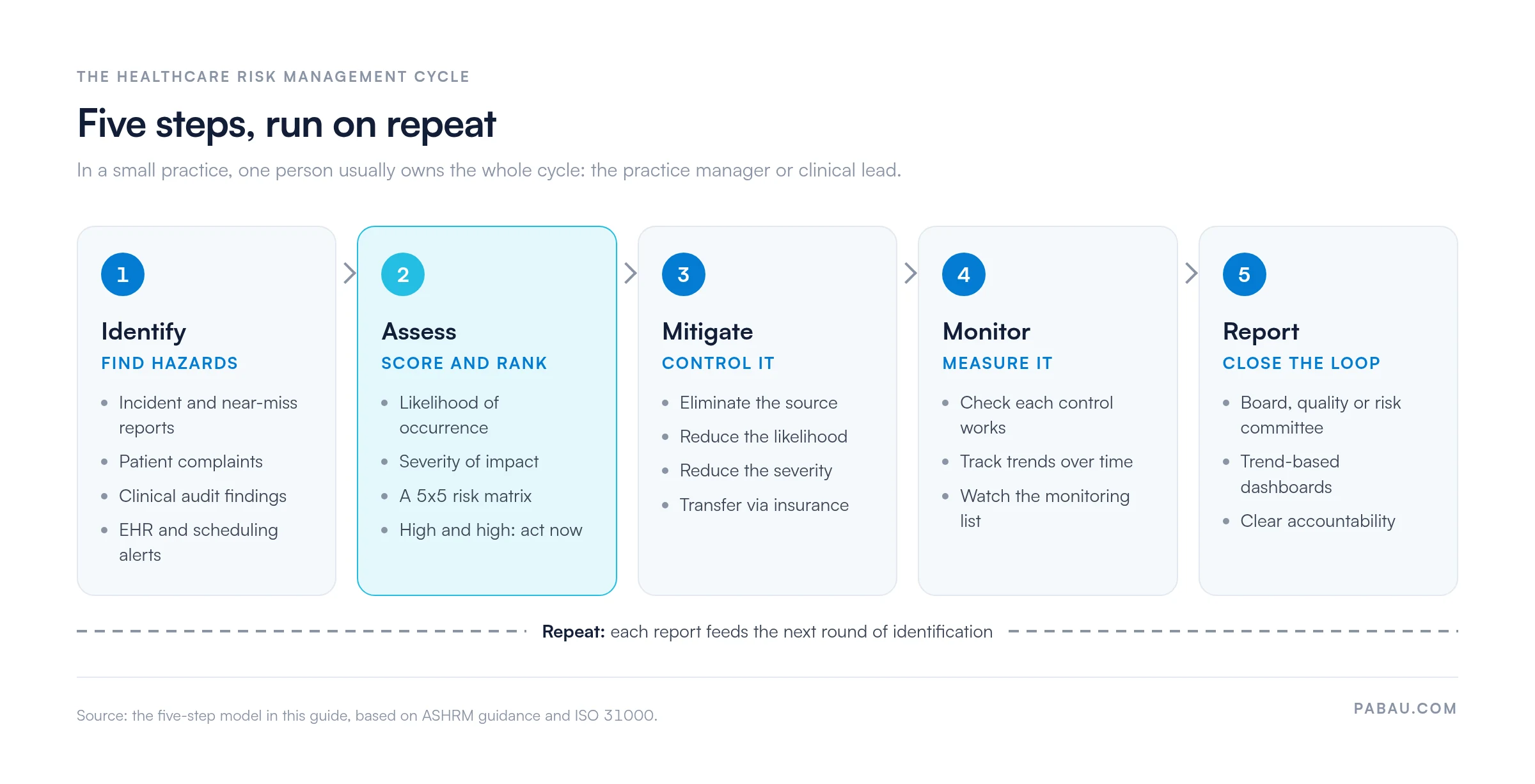
Risk identification surfaces hazards before they become incidents. The most productive source is a consistent incident report form that staff fill in right after an event or near-miss. Many specialties also require periodic structured reviews, which double as identification exercises.
Each identified risk is scored on two dimensions: how likely it is to happen and how severe the impact would be. The resulting score sets its priority. High-likelihood, high-severity risks need immediate mitigation. Low-likelihood, low-severity risks go on a monitoring list. A simple 5×5 risk matrix handles most practice-level scenarios without any actuarial expertise.
Mitigation strategies fall into four standard categories. You can eliminate the risk source, reduce the likelihood, reduce the severity, or transfer the risk through insurance or contracts. Policy updates, staff training, process redesign, and technology controls all contribute. For liability-heavy risks, malpractice and professional indemnity insurance covers the financial exposure the practice cannot remove internally.
A control only counts if someone measures whether it works. A monthly medical chart audit is one of the simplest checks, because it shows whether documentation controls are holding. Regular reports to a governance body close the loop. Depending on size, that is the board, a quality committee, or a risk committee. Programs that produce clear, trend-based dashboards consistently outperform those relying on ad hoc escalation.
A healthcare risk manager designs, runs, and improves an organization’s risk management program. In large hospital systems the role sits at director or VP level with a dedicated team. In a small practice it is usually a shared responsibility, held by a practice manager or clinical lead alongside other duties.
The responsibilities span the full cycle. Effective risk managers work closely with clinical, IT, and finance teams rather than operating as a standalone compliance function.
Purpose-built healthcare risk management software brings incident capture, investigation workflows, policy management, and reporting into one platform. When you evaluate tools, prioritize the following capabilities.
Private practices and specialty practices rarely need an enterprise risk suite. A practice management platform with built-in compliance tools usually covers most of their operational risk without the extra overhead.
HCC risk adjustment is a CMS program that adjusts capitation payments to Medicare Advantage and other value-based plans. Payments are calibrated to the documented health status of each patient population. The more complete and accurate the diagnosis coding, the more closely the payment reflects the expected cost of care.
From a financial risk perspective, coding errors cut both ways. Undercoding means failing to document every active condition with the right ICD-10 specificity. It leaves legitimate reimbursement unclaimed and can become a compliance risk if audited. Overcoding means claiming conditions the clinical documentation does not support. It creates fraud and abuse exposure under the False Claims Act.
For practices on value-based contracts, accurate HCC coding belongs inside the risk program. It sits where clinical documentation quality, regulatory compliance, and financial sustainability meet.
The primary credential in the field is the Certified Professional in Healthcare Risk Management (CPHRM), administered by the American Hospital Association (AHA) Certification Center.
Eligibility and exam structure change periodically, so check the AHA Certification Center directly rather than third-party summaries. Candidates generally need a mix of healthcare experience and education. The exam covers risk identification, assessment, treatment, financing, and administration.
ASHRM supports candidates with exam-prep materials, but it does not administer the CPHRM exam itself. It also runs a separate healthcare risk management certificate program for professionals earlier in their careers who are not yet CPHRM-eligible.
Two adjacent credentials are worth knowing. The Certified Professional in Healthcare Quality (CPHQ) suits roles that span quality improvement and risk. The Certified Risk Management Professional (CRMP) suits broader organizational risk roles.
Most healthcare risk management guides are written for hospital systems. Private practices, specialty practices, and med spas face the same risk categories with leaner teams and tighter budgets. That makes controls built into daily software especially valuable, because nobody has time to run a separate risk system.
Pabau, the all-in-one practice software we build, keeps the evidence a risk review needs inside the patient record. Its compliance management software keeps an audit trail of every clinical record access, amendment, and deletion.
If a regulator or insurer asks who opened a patient record and when, the log answers in seconds instead of a manual reconstruction. Locked clinical notes block retrospective edits, which protect the practice’s defense if a malpractice claim arrives.
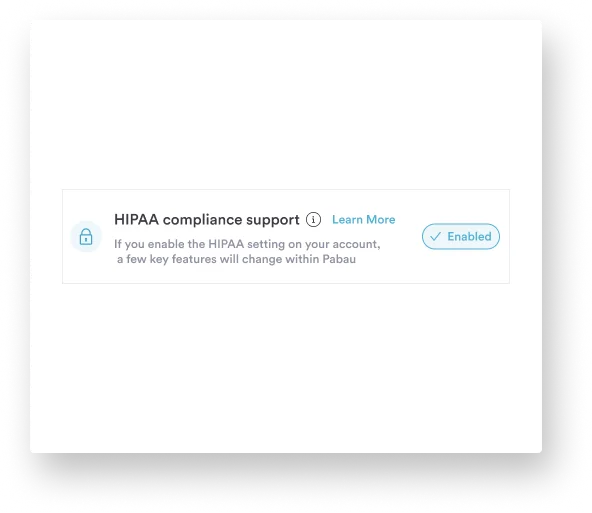
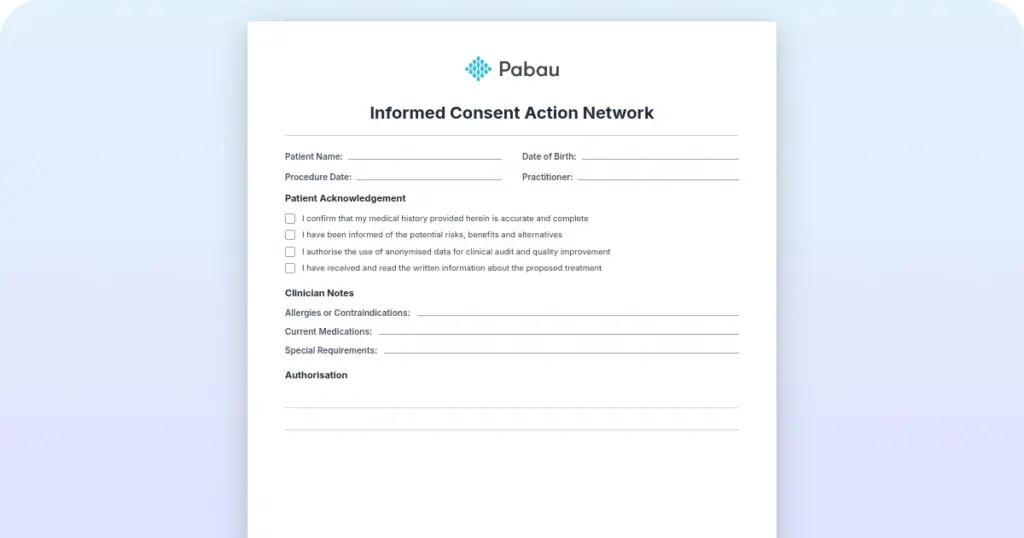
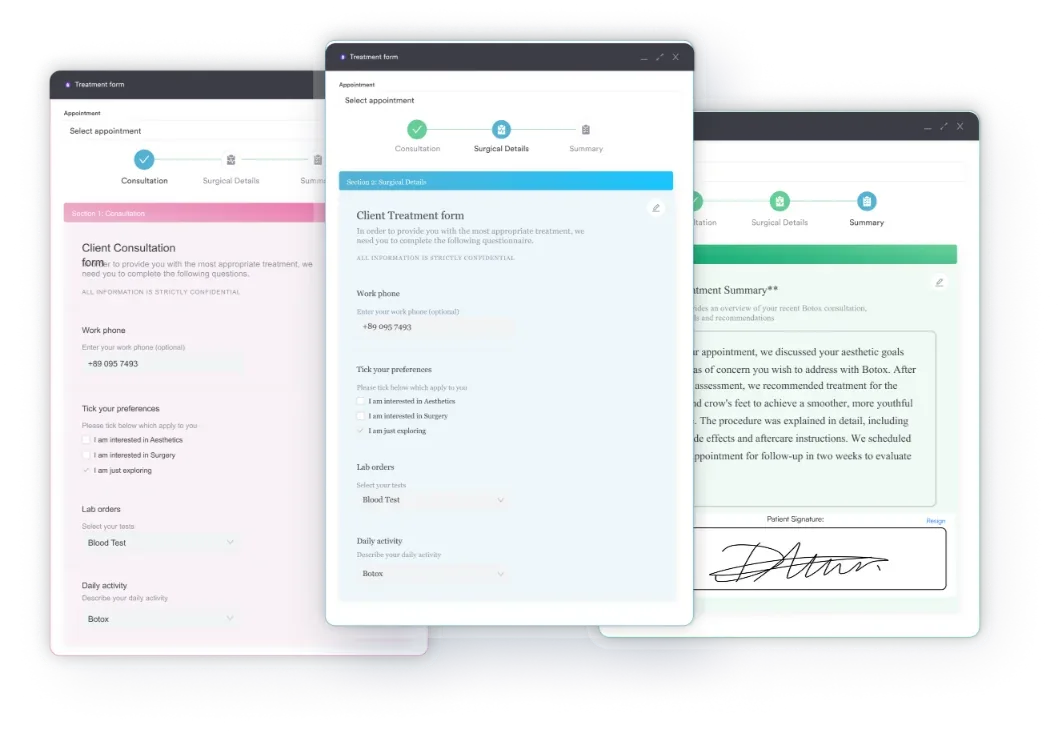
On the consent side, Pabau’s digital consent forms are timestamped, signed by the patient, and stored against the clinical record. Paper consent forms can go missing before a procedure, or come back signed but undated.
In aesthetic and elective practice, either one leaves the practice exposed if a treatment is challenged. Pabau also sends pre-treatment questionnaires automatically and flags incomplete forms before the appointment goes ahead.
Pabau’s reporting dashboards surface operational patterns such as cancellation rates, incomplete documentation flags, and overdue follow-ups. Risk managers and practice owners can use them to spot systemic issues before they escalate. For HIPAA, Pabau includes role-based access controls and encrypted data handling aligned with Security Rule requirements.
Audit your clinical documentation at the end of each month. Run a report on notes flagged as incomplete and on consent forms not received before treatment. Those two reports surface most of the compliance and liability exposure that matters during an inspection or a malpractice investigation.

Pabau gives practices audit trails, locked clinical notes, digital consent forms, and automated workflows. Your risk controls run inside daily operations instead of being bolted on afterward.

A private practice does not need a hospital-scale risk department to manage risk well. It needs one named owner, a 5×5 matrix, and records that are captured at the moment care happens rather than reconstructed later.
Start with the two places liability usually surfaces first: consent captured before treatment, and clinical notes that cannot be edited after the fact. Get those right and every later step of the cycle has evidence to work from. The trade-off is a little discipline at the point of care in exchange for far less exposure when an inspector or insurer calls.
Book a demo to see how Pabau builds audit trails, locked notes, and digital consent into your practice’s daily routine.

Need a standard way to log adverse events? Incident report form covers what a healthcare incident report should capture.
Planning for the worst-case scenario? Crisis management plan template gives your practice a ready structure for emergencies.
What does a HIPAA breach actually cost? HIPAA violation penalties breaks down the fine tiers and how to avoid them.
Is your team trained on privacy risk? HIPAA training for employees explains the requirements and what good training includes.
Risk management in healthcare is the organized process of identifying, evaluating, and controlling events or conditions that could harm patients, staff, or the organization. It covers clinical, operational, financial, IT, and regulatory risk, and it aims to prevent harm rather than respond to it afterward.
Risk management protects patients from preventable harm and limits malpractice liability. It also helps facilities keep accreditation with bodies like the Joint Commission and CMS, preserve reimbursement, and protect their reputation. Without a formal program, a single serious adverse event can trigger cascading clinical, financial, and regulatory consequences.
A healthcare risk manager designs and oversees the organization’s risk management program. That includes running incident reporting, conducting risk assessments, coordinating malpractice claims with counsel and insurers, maintaining regulatory readiness, and reporting risk trends to leadership. In smaller practices the role is often combined with quality improvement or compliance duties.
Risk assessment is one step inside the broader risk management cycle. Risk management is the end-to-end program: identify risks, assess their likelihood and severity, implement controls, monitor outcomes, and report results. A health risk assessment produces a scored inventory of current threats. Risk management decides what to do with that inventory and tracks whether interventions are working.
The primary credential is the Certified Professional in Healthcare Risk Management (CPHRM), administered by the American Hospital Association (AHA) Certification Center. Related credentials include the Certified Professional in Healthcare Quality (CPHQ) and the Certified Risk Management Professional (CRMP). ASHRM provides CPHRM exam-prep materials and a separate certificate program for professionals not yet eligible for the exam. Eligibility requirements change periodically, so confirm current criteria with the AHA Certification Center.
Healthcare IT risk management focuses on the security of electronic protected health information (ePHI) and the systems that store or transmit it. General healthcare risk management covers clinical, operational, and financial risk. IT risk management is governed mainly by the HIPAA Security Rule and addresses ransomware, unauthorized access, and data breaches. In practice the two should be integrated, because a ransomware attack is also a patient safety and business continuity event.