Monika Lazarevska

Exercise worksheet to download: What it is and what to record on the worksheet
An exercise worksheet is a structured document that records a patient’s ex...

4
Last Updated: Oct 27, 2026
Free PDF 3 pages, print-ready Clinician-reviewed
A nutrition plan for gaining muscle sets three numbers before it lists a single meal. For most adults who lift, that means eating 250 to 500 kcal above maintenance and 1.6 to 2.2 g of protein per kg of bodyweight. That protein range comes from a 2018 meta-analysis by Morton and colleagues. The International Society of Sports Nutrition sets a slightly lower 1.4 to 2.0 g/kg. Carbohydrate covers most of the remaining calories, and fat stays at 20 to 35%.
What follows covers the protein math, the macro split, a 2,860 kcal sample day and the intake answers that shape each plan.
A three-page intake form covering weight history and goals, weekly activity, cooking and eating-out habits, alcohol and smoking. It also records allergies, intolerances, foods avoided and the eating challenges a patient wants to work on.
Start from scratch, or upload this PDF or any form you already use, and Pabau's AI Form rebuilds it with tick boxes, text fields and a signature. Attach it to the treatment once, and every patient gets it on time.
AI Form rebuilds the consent, history and aftercare forms you already use. You review each one, then publish.
Patients complete forms on their phone before they arrive, so the front desk stops retyping paper.
Every signed form is versioned and attached to the treatment record, ready when you need it.
Set how long a consent stays valid. Returning patients skip forms they have already signed.
Supports HIPAA and GDPR compliance AES-256 encryption 4.8 on G2 4.7 on Capterra Trusted by 4,000+ practices worldwide

Eat 250-500 kcal above maintenance, and stay near 250-300 kcal once you have three or more years of training behind you.
Aim for 1.6-2.2 g of protein per kg of bodyweight a day, split across four or five meals of 20-40 g.
Carbohydrate needs run from 3-5 g/kg on lighter training days to 5-7 g/kg with higher volume, while fat stays at 20-35% of calories.
Weigh in each morning, compare weekly averages, and move calories by 150-200 kcal when the monthly gain drifts out of your band.
Creatine monohydrate at 3-5 g a day has the strongest evidence of any supplement for strength and muscle gain.
A nutrition plan for gaining muscle is a structured way of eating that pairs a modest calorie surplus with set macronutrient targets. It supports muscle growth alongside resistance training, without the fat gain that comes from eating far above maintenance.
The three numbers are calories above maintenance, enough protein to drive muscle protein synthesis, and enough carbohydrate to fuel training and recovery. Fat fills the rest of the calorie budget and supports hormone function. Miss any one of them and progress stalls, however hard the training.
Most plans people find online trip on the same points. They undercount protein, ignore total calories, or hand over a generic menu that stops fitting after the first few weeks. For sports medicine and weight management teams, the same framework also underpins nutrition protocols for injury recovery and return-to-sport planning.
A plan built from bodyweight alone misses the details that decide whether a patient can follow it. The free nutrition intake form collects most of them in one sitting, but not all. Check these answers, and fill the two blanks below, before you set a single target.
Appetite is what trips people up most. A day of about 2,860 kcal is a lot of food for a light eater. Plan a shake or an extra snack from the start.
Total daily energy expenditure (TDEE) is the number of calories you burn in a day, and it is your baseline. Add 250-500 kcal on top and you create the surplus your body needs to build new tissue.
Beginners and people returning after a break can use the top of that range. Trainees with three or more years behind them do better at 250-300 kcal, where fat gain stays easier to control.
TDEE varies with body weight, training volume and daily activity outside the gym. A 75 kg person doing four strength sessions a week burns noticeably more than a sedentary person of the same weight. Then adjust using weekly weight averages, and aim for 0.25-0.5 kg of gain a month if you are an intermediate lifter.
To estimate TDEE, start with the Mifflin-St Jeor equation for resting energy expenditure. Weight is in kg, height in cm and age in years.
Take a 30-year-old man who weighs 75 kg, stands 175 cm tall and trains four times a week. His resting figure is about 1,700 kcal, and at a factor of 1.55 his TDEE is about 2,630 kcal. A 250 kcal surplus puts him close to the sample day later in this article. Treat the result as a starting estimate, since the equation can miss by 10% or more for some people.
Practitioners in weight management and body composition settings will know this loop of setting a target, weighing and recalibrating. It is the same cycle that weight loss clinic software tracks, pointed at gain instead of loss. For a full week of meals built on a modest surplus, see the clean bulk nutrition plan.
The surplus and the expected gain both shrink as training experience grows.
Once the calorie target is set, the macro split decides where those calories come from. These are the ranges used in sports nutrition practice.
Most people building muscle need 1.6-2.2 g of protein per kg of bodyweight per day. That range comes from a 2018 meta-analysis by Morton and colleagues in the British Journal of Sports Medicine.
The International Society of Sports Nutrition (ISSN) position stand recommends a slightly lower 1.4-2.0 g/kg for most exercising people. For a 75 kg person, 1.6-2.2 g/kg works out at roughly 120-165 g a day.
Per-kg targets run too high for patients with obesity, because fat mass inflates bodyweight. For them, base the target on goal weight or lean body mass instead.
Aim for the top of the range during a calorie deficit or when training frequency is high. The lower end works well in a surplus with consistent training.
Total daily intake matters more than protein quality, but quality still counts. Leucine drives muscle protein synthesis most strongly, which is why chicken, eggs, dairy, fish and whey work so well.
Plant-based eaters can match these results by combining sources, such as lentils with rice, and aiming high in the range. A vegetarian bodybuilding meal plan shows how that looks across a week.
Here is what common staples deliver per portion.
Carbohydrates replenish glycogen, the main fuel for high-intensity lifting. The ACSM/AND/DC joint position statement on nutrition and athletic performance sets 3-5 g/kg for lighter training days, rising to 5-7 g/kg with higher volume. Low-carb approaches tend to underperform for strength and hypertrophy because glycogen runs short during hard sessions.
Build around complex sources such as oats, brown rice, sweet potatoes and whole grain bread. They supply steady energy and useful micronutrients alongside the carbohydrate. Put the largest servings around training where you can, though total daily intake matters most.
Fat should make up 20-35% of total calories. Dropping below 20% risks suppressing testosterone and other anabolic hormones. Above 35%, fat crowds carbohydrate and protein out of the calorie budget. Good sources include avocado, olive oil, nuts, chia seeds and oily fish, which also supply fat-soluble vitamins and omega-3s.
Meal timing matters less than total daily intake, but it still counts. Spreading protein evenly across four or five meals keeps muscle protein synthesis elevated more consistently than one or two big meals.
Areta and colleagues compared three ways of eating 80 g of whey after training. Taking 20 g every 3 hours produced a greater muscle protein synthesis response than 40 g twice or 10 g eight times. In practice, 20-40 g per meal is the usual range.
Food quality decides micronutrient intake, recovery and how long someone sticks with the plan. These four groups are the most useful to build meals around. A high protein grocery list turns the first row into a shopping list.
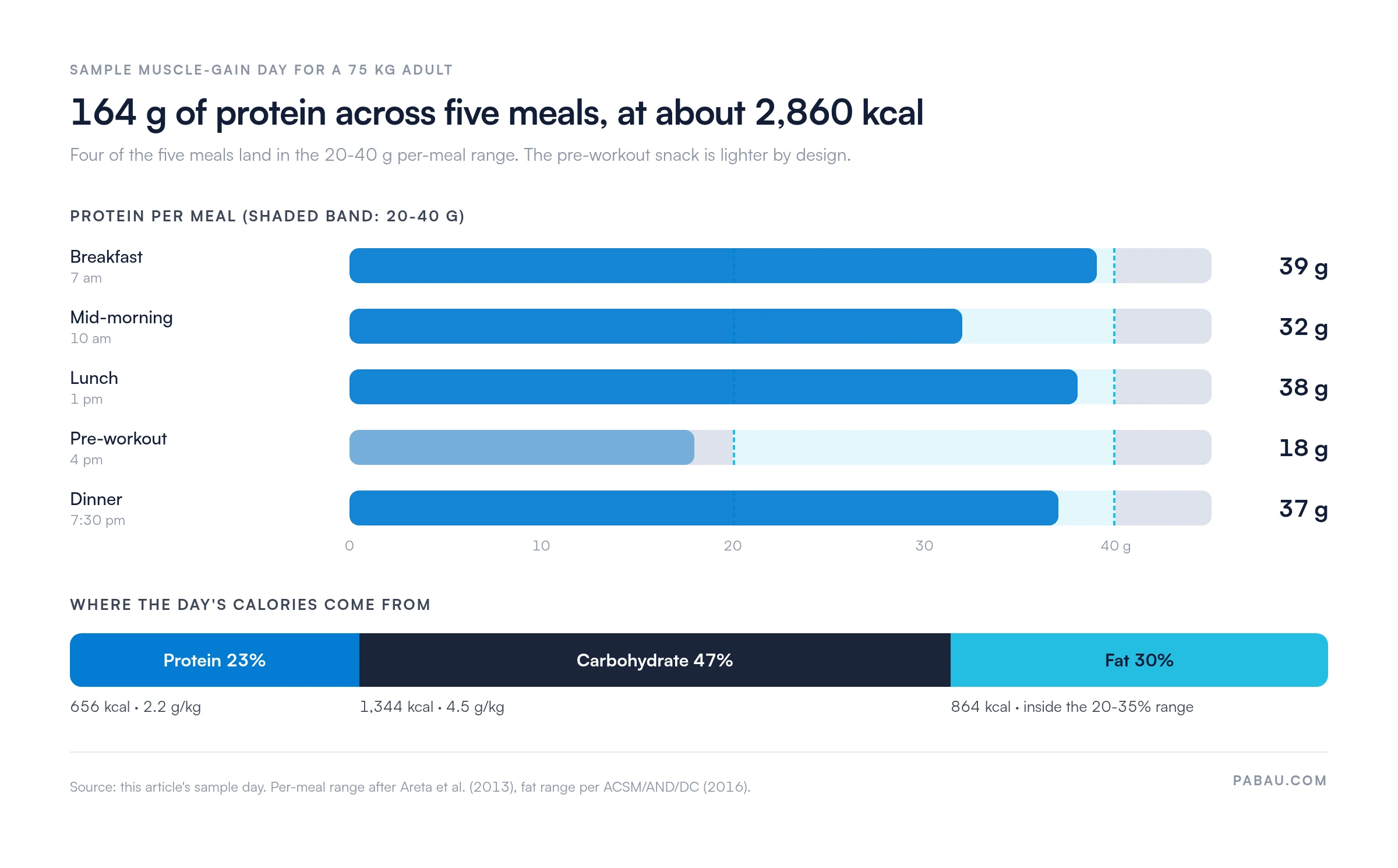
This sample day is calibrated for a 75 kg individual targeting about 2,860 kcal and 164 g of protein. The macro split works out at roughly 23% protein, 47% carbohydrates and 30% fat. Scale the portions up or down to match your own calorie target.
Protein comes to about 2.2 g/kg for a 75 kg individual, the top of the 1.6-2.2 g/kg range. Carbohydrate lands at about 4.5 g/kg, which suits a moderate training week. Meals sit roughly 3 hours apart, and the two biggest carbohydrate servings come at breakfast and at dinner after training.
To move the day up or down by 200-300 kcal, change the rice at dinner or the sweet potato at lunch.
Plotted meal by meal, the protein spread looks like this.
Weigh yourself every morning before eating, and average the readings for each week. Compare those weekly averages across the month rather than day to day. If the monthly gain falls below your band in the surplus table, add 150-200 kcal a day. If it runs above the band, take the same amount off. Skip daily weighing for anyone with a history of disordered eating, and agree a check-in schedule with their clinician instead.
Supplements support a nutrition plan rather than replace one. A small handful have solid evidence behind them and are worth adding once the dietary foundation is consistent.
Creatine monohydrate is the most evidence-backed supplement for strength and hypertrophy, according to the ISSN position stand on creatine. The standard protocol is 3-5 g a day, taken consistently. A loading phase is optional, because a daily 3 g dose fills muscle stores within about four weeks. Creatine raises phosphocreatine in muscle, so you can do more work per session and recover faster between sets.
Whey protein is a convenient, high-leucine protein source rather than a magic muscle builder. Its value is in making daily protein targets easier to hit, especially after training or when whole food isn’t practical. Whey isolate delivers 22-25 g of protein per 30 g scoop with little fat or carbohydrate. Plant-based alternatives such as pea and rice blends work similarly when dosed properly.
Peptides such as BPC-157 and TB-500 come up in muscle recovery conversations, but the evidence is mainly preclinical. Most are not approved for human use and carry regulatory and safety unknowns. Anyone considering them should speak to a sports medicine physician or a qualified prescriber first. Practices that run performance-focused consultations often have a protocol for handling these requests safely.
A starting plan only gets you so far. Long-term results depend on what you do when progress slows, and it will. As you gain mass, your TDEE creeps up, so the same diet delivers a smaller surplus over time.
Review the numbers every four weeks. If the weekly average hasn’t moved for two to three weeks despite consistent training and eating, add 150-200 kcal, mostly from carbohydrates. If fat gain seems to be outpacing muscle, trim the surplus to the low end of your range. A useful warning sign is waist size rising faster than bodyweight.
Teams at metabolic health clinics run structured reassessment cycles like this, often pairing diet changes with DEXA or bioimpedance scans. Even without clinical testing, body composition tracking shows trends before they turn into problems.
When someone trains hard and still doesn’t grow, the diet is usually the cause. Logging a week of meals in a food log exposes most of these patterns.
In many practices, a nutrition plan still lives on paper. The intake form is printed, the weight goes into the notes, and follow-up depends on someone remembering to call. That makes the four-weekly review hard, because the weekly averages are scattered or missing.
Pabau, the practice management platform we build, turns the nutrition intake form into a digital form that patients complete before their first visit. Their answers land straight in the patient record. Measurements tracking then records weight, BMI, body composition and waist size at each visit and plots the trend for you.
You can also schedule recurring form requests weekly or monthly, so check-ins arrive without anyone chasing them. At each review the trend is already on screen, so adjusting the surplus takes minutes.

Pabau sends the nutrition intake form before the first visit, then tracks weight, BMI and body composition at every review. You see the trend and adjust the plan without chasing paperwork.

Start with the numbers and let the menu follow. Set the surplus and the protein target, then run a day like the sample for four weeks before you change anything. Small, deliberate adjustments beat constant reshuffling.
The trade-off worth remembering is speed against fat. A bigger surplus feels productive but mostly adds fat, so a slower monthly gain is usually the better deal.
For practices running these plans with patients, most of the work happens between visits, in intake, weigh-ins and reviews. Book a demo to see how Pabau keeps that review loop running without the paperwork.

Want to add muscle while trimming fat? Build muscle, lose fat diet plan sets out a seven-day recomposition template with the macros already worked out.
Working with an underweight patient? 7-day meal plan for weight gain gives a calorie-dense week built around regular meals and snacks.
Need a fuller intake for a weight program? New patient weight loss intake form captures medical history and goals before the first consultation.
Measuring body composition at the first visit? Body mass index assessment explains how BMI is calculated and where it misleads in muscular patients.
Looking for more high-protein menus? High-protein meal plan lays out a week of meals that make the daily protein target easier to hit.
Yes, in some groups. Beginners, people returning after a break and people with higher body fat can add muscle while losing fat. This is called body recomposition. It needs protein near the top of the 1.6-2.2 g/kg range and only a small deficit. Lean, experienced lifters usually gain faster in a surplus.
It can help, especially when dinner is early. The ISSN position stand notes that 30-40 g of casein before sleep can raise muscle protein synthesis overnight. Cottage cheese or Greek yogurt does the same job as a shake. Count it toward the daily total rather than adding it on top.
A dirty bulk adds weight faster, but most of the extra is fat. Muscle can only grow so quickly, so calories beyond a 500 kcal surplus are mostly stored. A clean bulk takes longer and leaves less fat to lose afterward.
No, the principles are the same. Protein targets are set per kg of bodyweight, so a lighter person simply needs fewer grams. Calorie needs are usually lower because of smaller body size, so the surplus often sits nearer 250-300 kcal.
No. Tracking for two to four weeks shows where your protein and calories land. After that, many people hold their targets with a repeatable meal structure and a weekly weigh-in. Go back to tracking whenever the weekly average stalls.