HIPAA compliant texting: What you can send patients & how to communicate securely
HIPAA compliant texting is possible when a text holds no protected health inform...

Last Updated: Oct 16, 2026
A clean bulk nutrition plan builds muscle on a surplus of 200 to 500 calories a day, eaten almost entirely as whole foods. The size of that surplus is the whole game. Keep it small and roughly three quarters of the weight gained arrives as muscle.
Push the surplus past 750 calories and closer to half of that weight arrives as fat. That turns a 12-week gaining phase into a much longer clean-up. Protein anchors the rest at 0.7 to 1 gram per pound of bodyweight.
What follows is the arithmetic, a week of meals, a grocery list and a template you can hand over.
A printable worksheet covering calorie and macro targets, a five-meal daily structure at 2,900 calories, and a seven-day protein and carb rotation. It also carries a grocery list by category, meal prep steps, and a four-week progress log with blank rows.
Download template
A clean bulk runs 200 to 500 calories above maintenance, which keeps roughly 75 to 80% of the weight gained as muscle.
Protein comes from bodyweight at 0.7 to 1 gram per pound, then carbs take 40% of daily calories and fat about 35%.
The same five-meal day repeats all week, with only the protein source and the carb base rotating between days.
Weekly weigh-ins, tape measurements and a strength log show whether the new weight is muscle or fat.
Gaining under 0.5 lb a week for two weeks running means adding 100 to 200 calories, not rewriting the plan.
Three decisions carry the whole plan, and the rest is execution.
First, set the surplus. A surplus of 200 to 500 calories above total daily energy expenditure is large enough to drive muscle protein synthesis. It is also small enough to leave insulin sensitivity and blood lipids roughly where they were.
Second, hold protein steady. The Academy of Nutrition and Dietetics supports 0.7 to 1 gram per pound of bodyweight for resistance-trained adults. Spread it across three or four meals rather than loading it into one.
Third, take the calories from whole foods. Lean protein, slow carbohydrates and unsaturated fat carry the micronutrients that support recovery, which ultra-processed calories do not.
Run correctly, most patients gain 0.5 to 2 lbs a week. Roughly 75 to 80% of that is lean tissue, provided training and sleep hold up alongside the food.
Both approaches add weight. The difference shows up in what that weight is made of, and in how long the cut afterward takes.
Those two composition rows are the argument for the discipline, so they are worth seeing side by side.
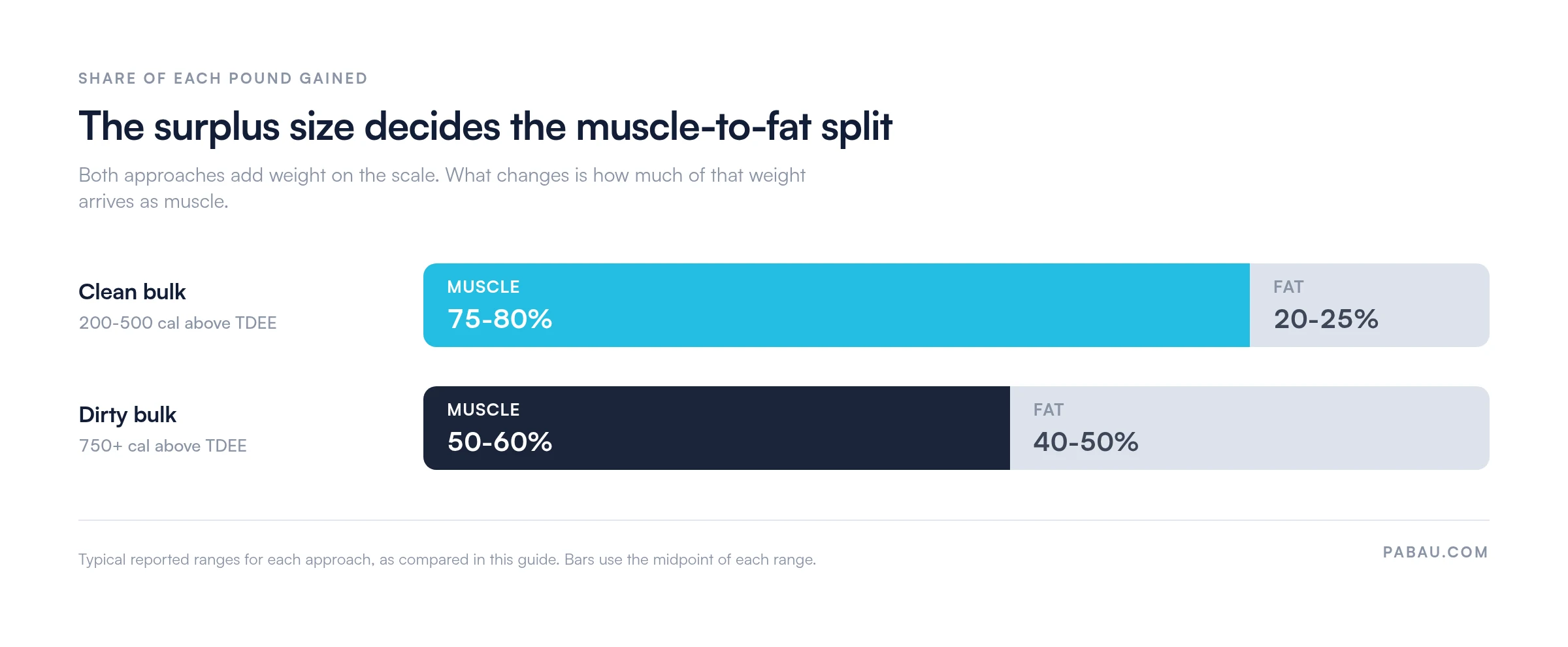
Keeping the surplus small also shortens what comes next. A patient who finishes a gaining phase near 12% body fat needs a few weeks on a lean diet plan. One who finishes near 20% needs months of it.
Three calculations produce every number in the plan. Work through them once per patient, then revisit after the first three weeks of data.
TDEE is basal metabolic rate multiplied by an activity factor. Calculate BMR with the Mifflin-St Jeor equation first. Then apply the factor that matches training frequency. Lightly active, meaning one to three sessions a week, takes 1.375. Moderately active, three to five sessions, takes 1.55.
Take a 180-lb man with a 1,800 calorie BMR who lifts three days a week. His TDEE lands at 1,800 × 1.375, or about 2,475 calories a day.
Add 200 to 500 calories on top. Most patients start at 300 to 400 and hold that for two to three weeks before judging it. The 180-lb example above lands somewhere between 2,675 and 2,975 calories, and the table below uses 2,900.
Protein is set by bodyweight, not by percentage. Target 0.7 to 1 gram per pound, which is 126 to 180 grams for a 180-lb patient. Carbohydrate then takes 40% of the daily calories, and fat takes the remaining 35% or so.
The table runs protein at 1 gram per pound, the top of the range. Figures round to the nearest gram, so each row totals within five calories of its stated target. If a patient would rather work from fixed percentages than from bodyweight, the macro diet plan template runs the same arithmetic the other way around.
Food choice decides two things at once. It decides whether the calories are easy to hit, and whether the micronutrients arrive with them.
Reaching 180 grams of protein a day without living on chicken breast takes some planning. A high-protein meal plan arranges these same foods into portions. That helps when a patient stalls around 120 grams and cannot see where the rest should come from.

None of the foods below are banned. They spend the surplus without paying much back, so they crowd out the foods that do:
Alcohol is worth a separate note. It brings calories that do nothing for recovery, and a heavy night close to a training session works against the surplus rather than with it.
The week does not need seven different days. It needs one day that hits the targets, plus a rotation that keeps the food interesting enough to repeat.
The day below is built to the 180-lb row above, at 2,900 calories and 180 grams of protein.
Across the week, only two slots move. The lunch and dinner proteins rotate, and the carb base rotates with them:
Rotating those two slots keeps micronutrients varied without recalculating a thing. Breakfast, both snacks and every portion size stay where they are all week.
Plans collapse at the supermarket more often than at the table. The quantities below cover one person for seven days at roughly 2,900 calories.
Protein, 3 to 4 lbs for the week
Carbohydrate
Fats and extras
Print the list by category rather than by meal, because that is how a store is laid out. A ready-made healthy grocery list saves writing one out from scratch every week.
Consistency beats precision over a 12-week phase, and batch cooking is what buys the consistency. Six steps cover most of a week:
Two hours on a Sunday covers most of it. What that session really removes is the moment where a hungry patient has to decide what to eat.
Daily totals do most of the work here. Session timing adds a little on top, and it costs nothing to get right.
The after-training meal is also a large share of the daily total, so it rarely needs adding on top of what is already planned for that slot.
Research in the Journal of the International Society of Sports Nutrition supports this pattern for resistance training. It matters most when the previous meal was several hours earlier.
Supplements are optional. Four have enough evidence behind them to be worth the shelf space, and they support the food rather than stand in for it:
Scale weight on its own will mislead you, because water, glycogen and food volume all move it. Three measurements read together are much harder to fool.
Weekly weigh-ins. First thing in the morning, after the bathroom and before breakfast. Aim for 0.5 to 2 lbs a week. If weight holds flat for two weeks, add 100 to 200 calories and reassess seven days later.
Body composition. Progress photos from the front, side and back every four weeks, under the same lighting. Tape measurements at the chest, waist and thighs every two weeks add numbers to what the photos suggest.
Strength progression. Log the top set of two or three main lifts. Rising numbers say the surplus is doing its job. Stalled numbers usually show up before the scale stalls, which buys you a week to adjust.
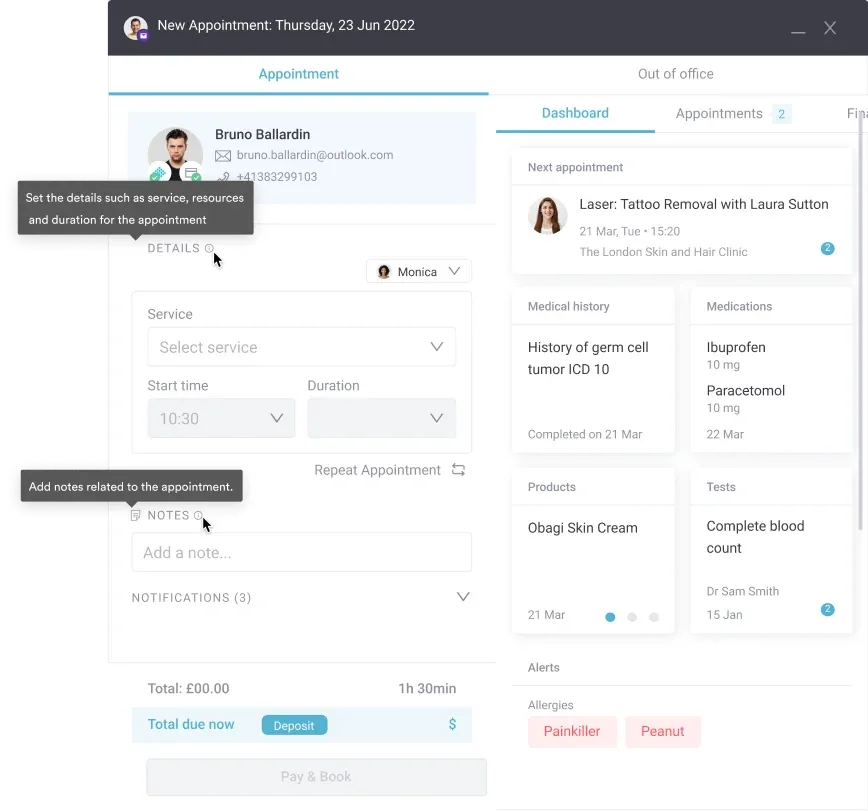
Running this review cycle across thirty patients at once is where a spreadsheet breaks. Software built for weight management practices stores the plan, the photos and the weigh-ins against one record. Nobody has to rebuild the history before each appointment.
Most nutrition practices run this on three systems. The plan sits in a spreadsheet, the photos sit in an email thread, and the weigh-ins get typed into a note after the appointment. None of the three talk to each other, so the four-week review starts with ten minutes of assembly.
Practice management software like Pabau keeps all three in one place. Digital intake forms capture bodyweight, training history, allergies and food preferences before the first appointment. Those answers land straight on the patient record, so the plan gets built from data you already hold.
From there, before-and-after photos attach to that same record instead of a camera roll, and treatment notes carry the weekly numbers. Automated reminders prompt the patient for a weigh-in or a photo, so nobody on the front desk is chasing them by text.
The outcome is a review that takes two minutes to prepare. You open one record and read the targets, the intake, the photos and the trend together. Then you adjust the surplus with the evidence in front of you.

Pabau’s digital intake forms, patient records and automated reminders capture baseline data, store the plan, and prompt weekly check-ins. Your four-week reviews start with the numbers already in front of you.

The surplus is the one number worth getting right. Set it at 200 to 500 calories, hold protein near a gram per pound, and the composition of the weight gained mostly looks after itself.
The harder part runs for the next twelve weeks. Portions drift, weekends happen, and the weigh-ins tend to stop arriving somewhere around week five. That is the failure mode worth planning for, rather than the macro arithmetic.
Download the worksheet, set the targets with your patient in the room, and book the four-week review before they leave. Book a demo to see how Pabau keeps the plan, the photos and the weigh-ins on one patient record.

Want a fixed percentage split instead? The 30/30/40 diet plan sets macros as shares of total calories rather than by bodyweight.
Building the day around protein first? The high-protein diet plan covers portion sizes and sources for patients who struggle to reach the target.
Need the food-quality rules on their own? The clean eating meal plan sets out whole-food swaps that hold up in a surplus or a deficit.
Want a record of what was eaten? My food diary gives patients a printable log to fill in and bring to the review.
Most gaining phases run 12 to 16 weeks, followed by four to eight weeks of dieting. Shorter phases rarely add enough tissue to justify the setup. Longer ones let fat accumulate faster than muscle, which stretches out the cut that follows.
Yes, though it takes planning. Dairy, eggs, soy and a plant protein powder do most of the work, with lentils and beans filling in the rest. Expect a higher carbohydrate total, since most plant proteins arrive with carbs attached.
Not for most people. A consistent daily target is easier to follow and produces the same weekly total. Calorie cycling suits advanced lifters who already track accurately, and it adds a layer of complexity everyone else can skip.
It rises. Adults over 50 respond less to a given dose of protein. The top of the range, one gram per pound, is the sensible starting point. Spreading it across four meals helps more than raising the daily total.
With supervision, yes. Growth already demands a surplus, so the calorie target usually sits above what the tables here suggest. Refer to a pediatric dietitian before setting macros for anyone still growing.