HIPAA compliant texting: What you can send patients & how to communicate securely
HIPAA compliant texting is possible when a text holds no protected health inform...

Last Updated: Oct 16, 2026

Aim for 1.6 to 2.0g of protein per kilogram of bodyweight daily, from tofu, tempeh, legumes, quinoa and dairy.
Spread that total across five or six meals, because plant proteins arrive in smaller portions than meat does.
Pair incomplete proteins such as lentils and rice so the day still covers all nine essential amino acids.
Watch B12, iron, zinc and omega-3 intake, and treat creatine and vitamin D as the supplements worth buying.
Practice management software like Pabau turns the plan into a digital form and keeps adherence in the client record.
A printable weekly planner with a slot for breakfast, lunch, a snack and dinner on every day of the week. It also carries a health conditions field and a sign-off line for the practitioner, with space for a license ID.
Download templateA vegetarian bodybuilding meal plan lives or dies on one number. That number is grams of protein per day. Hit 1.6 to 2.0g per kilogram of bodyweight, and plant-based lifters add muscle at the same rate as anyone eating chicken. Fall 20g short every day and training stalls while the scale sits still.
Plant proteins also come in smaller portions than meat, so the target takes five or six deliberate meals rather than three.
What follows is the macro split by phase and the protein sources worth building a week around. Then comes a full day of eating, the supplements that earn their place, and the prep routine that holds it together.
Vegetarian athletes reach the same strength and size as omnivores once protein intake meets the target, according to the Academy of Nutrition and Dietetics.
The limit is planning discipline rather than biology. Plant proteins need combining, and the day needs structure. Put both in place and progress follows the same rules as any other lifting program.
Most published work on vegetarian athletes still looks at endurance sport.
Research in The Journal of Nutrition took a different angle. It compared resistance-trained vegans and omnivores on matched high-protein diets, and both groups gained the same amount of muscle. The constraint sits in hitting the protein figure day after day, not in where the protein came from.
The number to write down first is 1.6 to 2.0g of protein per kilogram of bodyweight a day. That range comes from the International Society of Sports Nutrition (ISSN), and it applies to strength and power athletes. For a 70kg (154 lb) lifter, it works out at 112 to 140g a day.
The ISSN’s position stand on protein reserves the higher figure of 2.3 to 3.1g per kilogram for one case, a calorie deficit.
Notice that the cutting row carries more protein than the bulking row, which is the deficit rule in action. Scale every figure to your own bodyweight and to how training is going.
If you would rather work in grams than in meals, the macro diet plan template runs the same math against any calorie target.
With the target set, the next question is where those grams come from. Complete proteins carry all nine essential amino acids on their own.
Incomplete ones need a partner. Tofu, tempeh, quinoa, edamame and Greek yogurt anchor the day, and lentils, chickpeas and peanut butter pull their weight once a grain joins them.
Anchor two meals a day on a complete protein, then let the pairs fill the rest. Lentils with rice, chickpeas with bread, peanut butter with oats. That flexibility is what keeps a week sustainable, and the same shopping list covers a bulk or a cut.
Where a client eats meat on some days, a high-protein meal plan hits the same targets without the pairing rules.
Sources and targets only start working once they sit in a schedule.
Six meals, each landing somewhere between 8 and 40g of protein. That rhythm spreads intake across the day, which supports muscle protein synthesis better than two large hits. The day below is built for an 80kg (176 lb) lifter in a bulking phase, at roughly 2,700 calories.
That comes to 158g of protein and 2,730 calories, which lands just under 2.0g per kilogram. Look at how unevenly the grams are spread, because it explains where a day usually goes wrong.
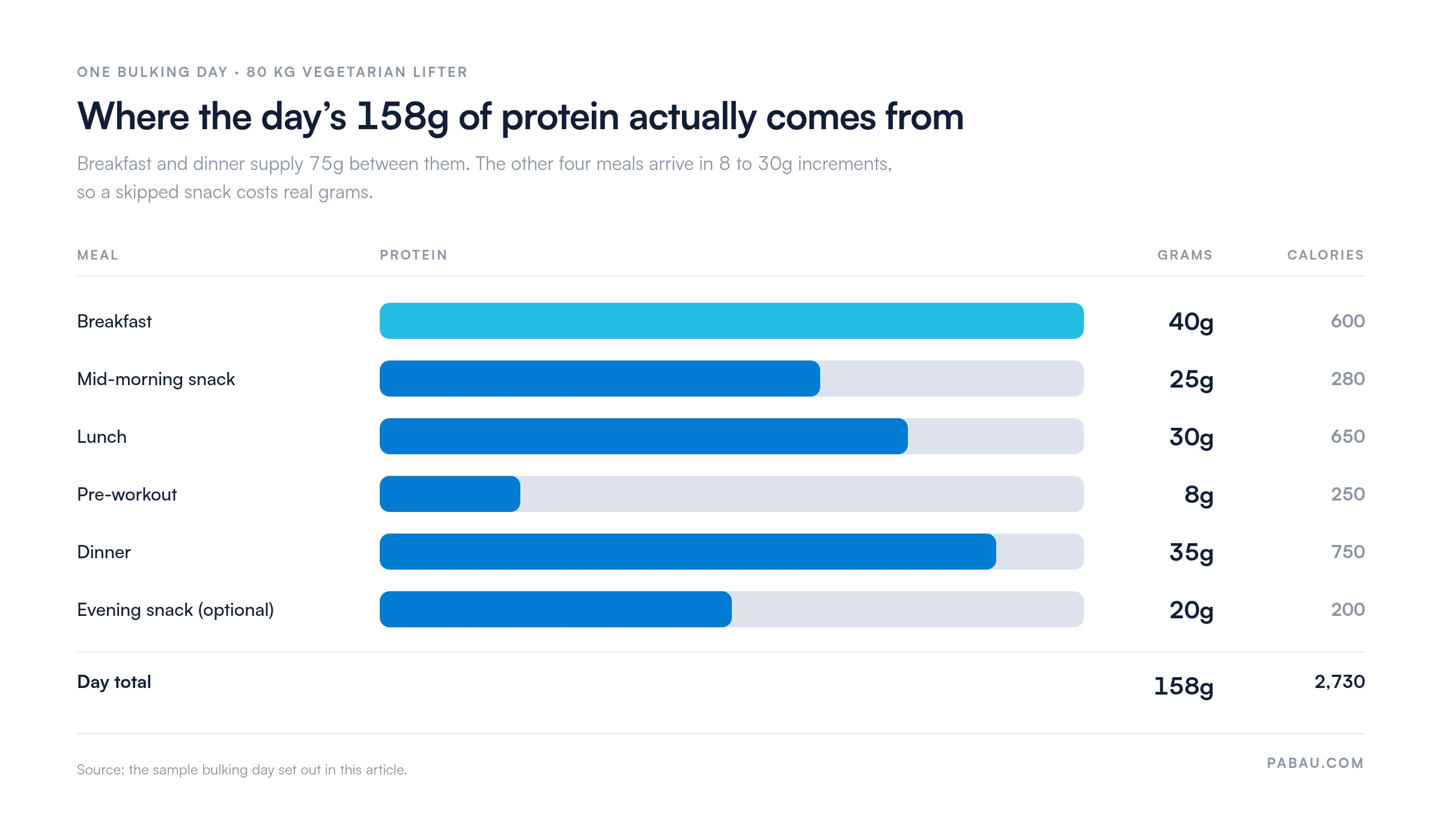
Two meals do most of the work, so those are the two to protect when a day gets busy. Rotate five versions of this template through the week and micronutrient intake varies on its own.
The printable planner at the top of this page gives you a blank week to write those variations into.
The protein figure barely moves between phases, so carbs and fat do the adjusting. A bulk sits 300 to 500 calories above maintenance and supports 0.5 to 1kg of gain a week.
Take those calories from nuts, seeds, plant oils, legumes and grains. Spread the surplus over six smaller meals rather than two big ones, which keeps the fiber load manageable and the bloating down.
A cut runs the same plan on less fuel. Drop 300 to 500 calories below maintenance, hold protein at 150 to 160g for a 70kg athlete, and keep the training heavy. Leafy greens and cruciferous vegetables fill the plate for very little energy. Track intake closely here, because vegetarian food is less calorie-dense and undereating creeps in quietly.
Clients arriving from an omnivore diet rarely cope with that fiber jump straight away. A plant-based diet plan gives them a month to adapt before the macros get strict.
Protein gets all the attention, and then a B12 result catches someone out. Plant-based diets run low on a short list of nutrients, and hard training raises demand for all of them. These four deserve a place in the annual review.
Book bloodwork once a year with a registered dietitian and let the results decide the doses. Guessing at supplements is how clients end up taking four they do not need and missing the one they do.
Food covers most of that list on a well-planned week. Five compounds are still worth buying, because the evidence behind them is solid for plant-based lifters. The rest is optional at best.
Stop there. A well-planned week covers the rest from food, and a supplement only earns a place where bloodwork or a genuine shortfall points at it.
None of this survives contact with a busy Tuesday unless the food is already cooked. Consistency is the bottleneck, not knowledge. Ninety minutes on a Sunday removes most of the mid-week decisions that derail a plan.
One session covers the week, which takes Wednesday night off the negotiating table. Log each day as it happens, because a food diary template catches caloric drift long before the scale shows it.
Plans fail in fairly predictable ways. Stalled progress on a plant-based diet usually traces back to one of five errors.
The first one accounts for most of them. Ask a client to weigh their protein sources for a single week and the guessing usually stops for good.
All of that assumes somebody is watching the plan between appointments. Handing over a meal plan is the easy part. Knowing three weeks later whether the client actually ate it is the part that decides the result.
Practice management software like Pabau replaces the email-and-spreadsheet routine that most coaching practices run on. You build the plan as a digital form and send it from the client’s record. What comes back attaches to that record instead of sitting in an inbox, and progress photos and measurements land in the same file.
Automated messages handle the check-ins for you. Send a reminder to prep on Sunday and a nudge before a review appointment. Clients who need to move one get a link to the online booking portal. Your team stops chasing and starts reading what came back instead.
Practices running structured body composition programs outgrow spreadsheets quickly. Purpose-built weight loss software holds the plans, the photos and the review notes in one client record, and every subscription includes every feature.
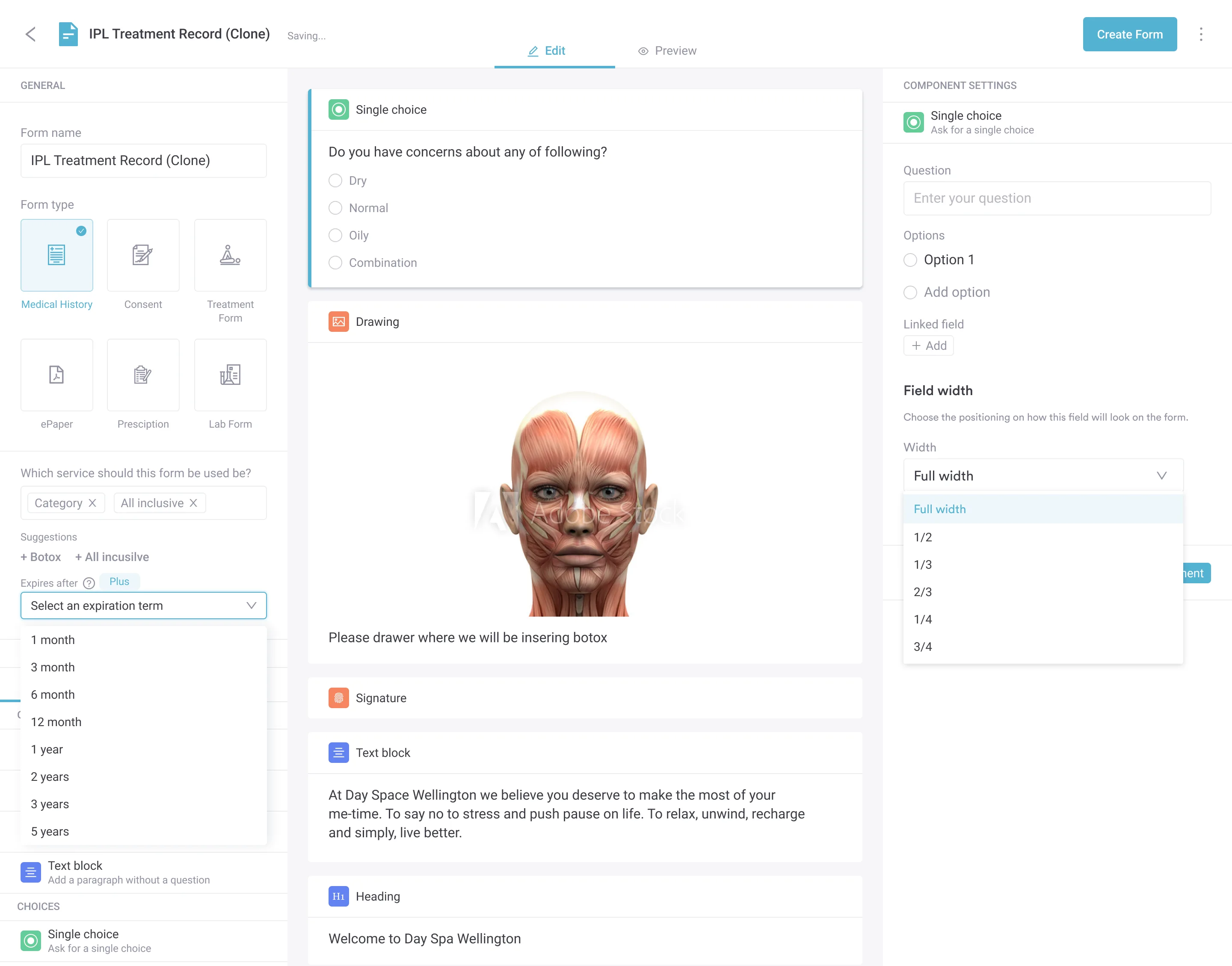

Pabau’s digital forms, client records and automated messages let coaches send a meal plan, collect the answers, and track adherence without a separate spreadsheet. Every subscription includes every feature.

Getting the numbers right takes an afternoon. Running them for twelve weeks is where the muscle actually comes from, and that is the part worth building a system around.
The trade-off to remember is volume. Plant food fills you up faster than chicken and rice, so a bulk takes more deliberate eating than clients expect. A cut, on the other hand, tends to feel easier than they feared.
Print the planner, write week one into it, and review at four weeks rather than four days. Book a demo to see how Pabau keeps meal plans, progress photos and review notes in one client record.

Working with a client who eats no dairy or eggs? Vegan meal plan for weight loss covers the same protein math without the lacto-vegetarian options.
Building plans for a full caseload? Nutritionist meal plan template gives you a repeatable layout to hand out week after week.
Need a baseline before you set macros? Nutrition assessment form captures diet history, allergies and goals in a single intake.
Want clients logging what they really eat? Food diary template turns guesswork into a record you can review together.
Client easing into plant-based eating? Flexitarian diet plan keeps some meat on the menu while the fiber load ramps up.
No. Pooled clinical trial data shows that neither soy foods nor isoflavones change testosterone levels in men at normal intakes. Tofu, tempeh and edamame stay on the list.
Slightly. Plant proteins digest less completely and carry less leucine per gram. Aim at the top of the 1.6 to 2.0g range rather than the bottom.
Yes, though the eating volume goes up. Replacing one 25g scoop means roughly 150g of tofu, or a cup of lentils with rice. Powder is convenience rather than a requirement.
Strength usually moves within four to six weeks. Visible size takes eight to twelve weeks of consistent training and eating. Measure and photograph monthly, not weekly.
Less than the daily total does. Spreading the target across five or six meals beats obsessing over the hour of the post-workout shake. A 25 to 35g serving within a couple of hours is plenty.