Nursing narrative note template
A nursing narrative note template is a structured PDF that guides you through re...

3
Last Updated: Oct 21, 2026
The sulcus test is an orthopedic special test that checks for inferior glenohumeral instability. The examiner pulls the arm downward and measures the gap that opens below the acromion. A gap wider than on the other shoulder, graded I to III by size, points to inferior laxity.
This article covers how to perform the test, grade the sulcus sign and record the result on a structured form. Physical therapists, chiropractors and sports medicine clinicians use the test as part of a wider shoulder examination. Its value depends on consistent technique and clear documentation, which is where a standard form helps.
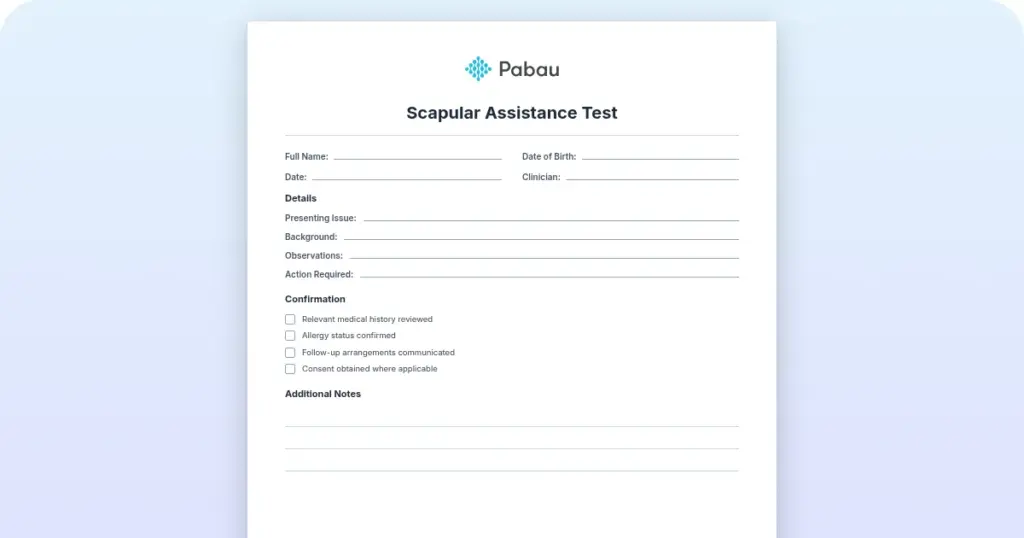
A printable form with patient information fields, chief complaint and history boxes, and five pre-test patient questions. It also sets out the test step by step, with traction at the elbow, and a short note on what the result means.
Download template
The sulcus test is a clinical assessment for inferior glenohumeral instability, not a standalone diagnosis.
The free template records patient information, history and pre-test questions, then sets out the procedure with traction applied at the elbow.
Always compare with the contralateral shoulder, since generalized laxity can produce a positive finding.
Practice software such as Pabau lets you store sulcus findings in custom digital forms within the patient record.
A sulcus test assessment form is a structured record of the test. It covers the patient’s details, their history, a set of pre-test questions and the procedure itself. It gives the clinician one place to capture findings that are otherwise scattered across handwritten notes.
The sulcus test itself assesses inferior glenohumeral stability. Clinical documentation of the result matters because it supports the treatment plan and shows change over time. In the UK, for example, the Health and Care Professions Council (HCPC) expects physiotherapists to keep clear, accurate records of the assessments they perform.
The template follows the order of a typical assessment, from patient details to the test itself. Follow these five steps.
The sulcus test is used to assess inferior glenohumeral instability. A positive sulcus sign is a gap between the acromion and the humeral head when inferior traction is applied.
The coracohumeral ligament and rotator interval are the main restraints to inferior translation of the humeral head. When these structures are lax, the humeral head moves inferiorly under traction, and the resulting sulcus gap is what clinicians grade.
Physical therapy practices use the form when assessing patients with shoulder pain, recurrent dislocation or suspected multidirectional instability. Clinicians working in sports medicine use it to screen athletes before and after return-to-play decisions.
Chiropractors and musculoskeletal practitioners also use the test during upper quadrant examinations, where a consistent record makes it easier to compare findings across visits.
A standard form keeps the history, pre-test questions and procedure in the same order for every patient, so steps are less likely to be skipped. Note the comparison with the uninjured shoulder alongside it, because a missing comparison is a common reason a sulcus finding is hard to interpret later.
Consistent records also make it easier to show change over time, which supports both treatment decisions and discussions with referrers.
Always test and record the uninjured shoulder first. Noting both results side by side in your records lets you judge whether the sulcus on the affected side is larger.
The patient sits with the arm relaxed at the side and the examiner applies a steady inferior traction force at the wrist or elbow. The examiner watches the gap below the acromion and measures it against the humeral head.
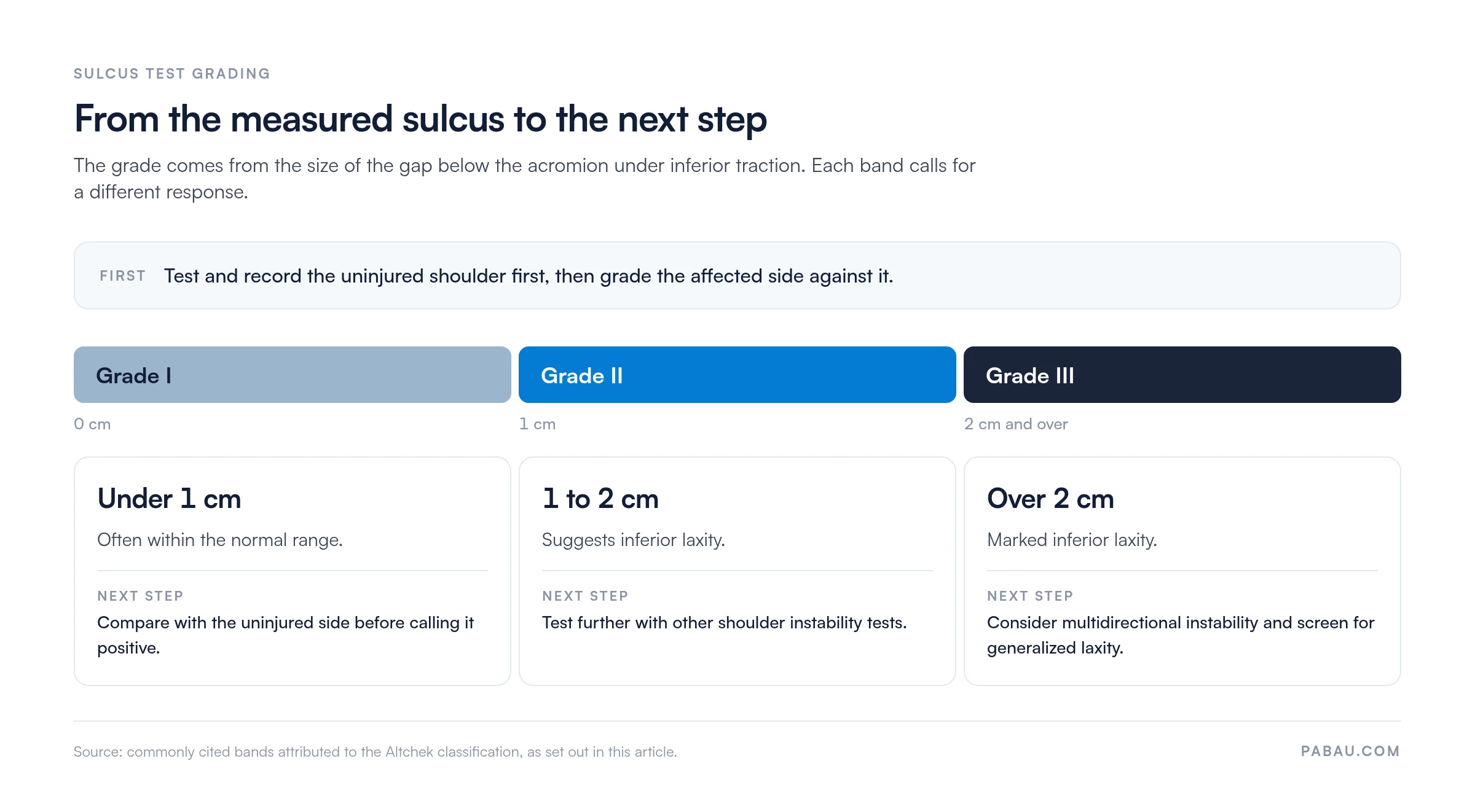
Grading is based on the distance of the sulcus. The table below sets out the commonly cited bands, which are attributed to the Altchek classification in most sources. The template has no grading field, so record the grade in your clinical notes.
A positive sulcus sign is a finding that needs context. Generalized ligamentous laxity can produce a sulcus in a shoulder that is lax but stable, so the uninjured side is essential for comparison. A Beighton score shows whether the laxity extends to other joints.
The sulcus test has limited accuracy on its own. Clinicians usually combine it with other tests in the shoulder examination before reaching a conclusion. The Gagey test is a common partner, because it stresses the inferior glenohumeral ligament from a different position. The chart below shows how each grade translates into a next step.
The sulcus test sits alongside the apprehension test and the load and shift test. Each adds a different piece of evidence about the stability of the glenohumeral joint.
Recording all of these results on one form keeps the examination consistent. Our guide to shoulder special tests shows how each one fits into a full assessment.
On paper, the sulcus grade and the side-to-side comparison often end up in free-text notes, where they are hard to find at the next visit.
Pabau, the physical therapy EMR we build, turns this template into a custom assessment form through its digital forms. You can add your own fields, such as the sulcus grade and a side-by-side shoulder comparison. The completed form is stored against the patient for the next visit.
The patient record keeps sulcus findings alongside treatment notes and follow-up appointments. Outcomes are easier to track across a practice with several clinicians, because each one sees whether laxity has changed since the last visit.

Pabau’s digital forms turn the sulcus test template into a custom assessment form with your own grading fields. Each completed form is saved to the patient record, so findings are ready to compare at the next visit.

The sulcus test is quick to perform, but a single positive sign proves little on its own. Its value comes from consistent technique, a comparison with the other shoulder and the other instability tests that sit beside it.
Use the template to keep the history, pre-test questions and procedure the same for every patient. Then record the grade and the side-to-side comparison in your notes, so the next clinician can see whether laxity has changed.
Treat a Grade II or III finding as a reason to test further, not as a diagnosis. Book a demo to see how Pabau keeps shoulder assessment findings in one patient record.

Want a second test for anterior and posterior laxity? Free load and shift test template covers how to grade humeral head translation against the glenoid.
Building a full shoulder examination? Shoulder special tests: technique, sensitivity, and interpretation shows how each test fits into a wider assessment.
Need a range-of-motion baseline as well? Shoulder range of motion chart template gives you a printable chart for active and passive movement.
Checking for anterior instability too? Shoulder relocation test: technique, interpretation and accuracy explains how the test confirms an apprehension finding.
The sulcus test is used to assess inferior glenohumeral instability. It applies inferior traction to the arm and measures any gap that opens below the acromion.
Grade I is under 1 cm, Grade II is 1 to 2 cm and Grade III is over 2 cm. Interpret each grade against the uninjured shoulder.
A positive sign suggests inferior laxity. Generalized laxity can also cause it, so clinicians confirm with bilateral comparison and other special tests.
No, the sulcus test is not a standalone diagnosis. It works best as part of a wider shoulder examination alongside other special tests.