GLP-1 diet plan
A GLP-1 diet plan is a structured eating framework for patients taking semagluti...

2
Last Updated: Oct 13, 2026

The Kernig sign test checks for meningeal irritation by extending the knee while the hip stays flexed at 90 degrees.
A positive result points toward meningitis or subarachnoid hemorrhage, but only a lumbar puncture confirms either one.
Sensitivity sits at around 5%, so a negative Kernig sign never rules meningitis out.
Specificity is roughly 95%, yet a positive likelihood ratio of 0.97 means a positive result barely shifts the odds.
Recording the angle where resistance starts is far more useful to the next clinician than a bare positive or negative.
Fewer than half of adults with bacterial meningitis arrive with the full triad of fever, neck stiffness, and altered consciousness. In the landmark New England Journal of Medicine cohort, only 44% presented that way. The classic picture misses more patients than it catches.
That puts more weight on the bedside exam. The Kernig sign test is one of the first maneuvers most clinicians reach for, and it needs no equipment at all. What it can tell you, though, is narrower than its reputation suggests.
The Kernig sign test checks for meningeal irritation. You flex the patient’s hip to 90 degrees, then try to straighten the knee. Pain or involuntary resistance that blocks full extension counts as a positive sign.
Inflamed meninges leave the lumbar nerve roots hypersensitive to stretch. Straightening the knee pulls on those roots, and the body answers with pain or a protective hamstring contraction.
Vladimir Kernig, a Russian neurologist, described the pattern in 1882, and it has stayed in the neurological exam ever since.
Several conditions produce a positive sign, and the first two on this list are emergencies:
Three membranes wrap the spinal cord: the dura mater, the arachnoid mater, and the pia mater. Infection or blood inflames those layers, and the nerve roots crossing the subarachnoid space turn sensitive to any pull.
Flexing the hip to 90 degrees slackens the sciatic nerve and the lumbar roots. Extending the knee from there stretches them again. A healthy patient feels nothing. An irritated root fires instead, and the hamstrings tighten well before the knee reaches full extension.
That mechanism also explains the test’s biggest weakness. Anything else that tethers or shortens the same structures produces the same resistance. That is why tight hamstrings and disc disease keep turning up as false positives.
Technique decides whether the result means anything at all. Small differences in positioning, or in how hard you push, change the answer. They also break the comparison between one examination and the next.
A positive result is pain or resistance that stops passive knee extension short of roughly 135 degrees.
Most bad results trace back to the examiner rather than the patient. Five errors account for nearly all of them.
Interpretation matters more than the maneuver. Getting the binary right counts for less than knowing what the finding can and cannot support.
Kernig’s sign confirms very little on its own. The reference dataset is a 2002 Clinical Infectious Diseases study by Thomas and colleagues. They assessed 297 adults with suspected meningitis before each patient went for lumbar puncture.
High specificity is the number people quote, and on its own it flatters the test. The likelihood ratio tells the fuller story. At 0.97, a positive Kernig’s sign shifts the odds of meningitis by almost nothing. Treat it as a prompt to keep investigating, not as confirmation.
One finding in the same study is worth holding onto. Among the handful of patients with severe meningeal inflammation, nuchal rigidity picked up every case. The signs are weak across the broad population, then sharpen at the extreme end. That pattern fits what most clinicians notice in practice.
A clinical review in the BMJ’s Archives of Disease in Childhood lands in the same place from the other direction. The absence of Kernig’s sign must never be used to rule meningitis out.
Both signs detect meningeal irritation, but they get there by different routes. Eliciting the pair raises the sensitivity of the examination a little without costing much specificity, which is why they are almost always taught together.
Thomas and colleagues found no meaningful difference between the two signs. Neither is sufficient alone, and guidelines consistently ask for both as part of a single meningeal battery.
Kernig’s sign never travels alone. Two further maneuvers belong in the same sequence, and each answers a slightly different question.
None of the three confirms or excludes meningitis alone. Together they build the picture that decides whether you go to lumbar puncture, which remains the only test that settles the question.
A positive Kernig sign test does not mean meningitis by default. Several conditions produce the identical physical finding through unrelated mechanisms, and knowing them prevents both false alarm and false comfort.
Musculoskeletal causes are common enough to be worth a moment of history. A quick look at prior notes often shows the patient’s hamstrings have blocked that knee for years. Those records may sit in your system or in a physical therapy EMR.
Ask five questions before the result goes into the notes or drives a decision.
Children deserve a separate note. Kernig’s sign is unreliable below roughly two years of age, so a pediatric physical examination leans on the bulging fontanelle, feeding refusal, and irritability instead. In a baby, a negative Kernig test tells you close to nothing.
Older and immunocompromised patients present the mirror problem. They can carry culture-positive bacterial meningitis and still mount no meningeal signs whatsoever.
Confusion, a new headache, or an unexplained fever should carry the same urgency in these groups as a textbook triad would in anyone else.
Escalation moves fast, and the window for effective antibiotics is narrow. In primary care the question is whether to send the patient in, not whether to tap them.
Whatever GP practice software you work in, the referral needs your reasoning attached. Once meningitis is confirmed, a meningitis nursing care plan takes over the monitoring schedule.
Documentation carries the rest of the weight. Serial neuro checks only mean something when every entry records the same fields. Safer clinical notes start with agreeing those fields before the shift, not after it.
Fatigue works against all of this. Burnout in healthcare is a known contributor to missed diagnoses. A borderline finding is exactly what drops out of a note written three hours late. Capturing it at the bedside helps, which is why medical dictation tools have moved from novelty to routine.
A meningeal exam generates more detail than a free-text box handles well. Five things matter later: the angle of restriction, the result on each leg, the other signs, the timing, and the decision that followed. In most systems they end up buried in a paragraph of prose.
Practice management software like Pabau gives that detail somewhere to live. Our digital forms let you build a neurological exam template with a field for each sign, so nothing depends on anyone remembering to type it.

Handover is where the record earns its keep. Pabau’s patient records timestamp every entry and every action taken. The receiving team sees what you found, when you found it, and what you did next.
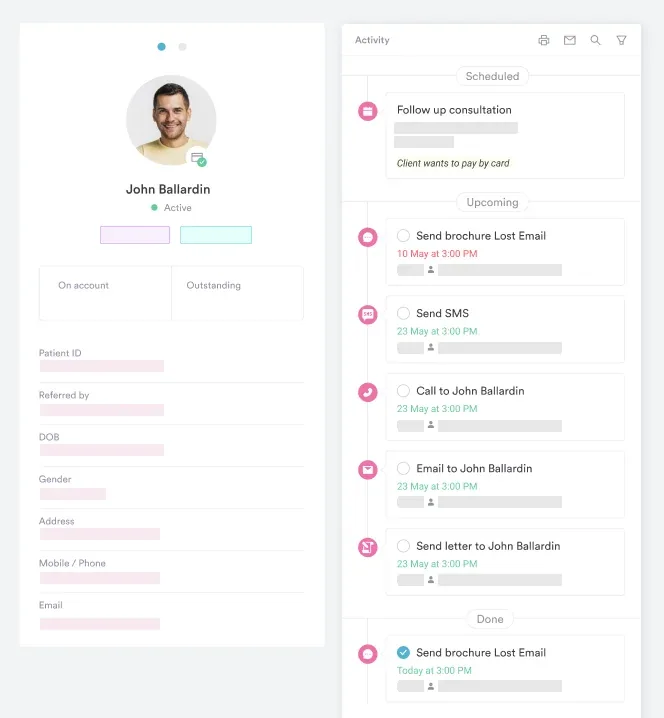
Writing it up under time pressure is the last hurdle. Pabau Scribe, our AI scribe, turns what you say at the bedside into the note itself. The same record then drafts the letter to whoever is taking the patient on.
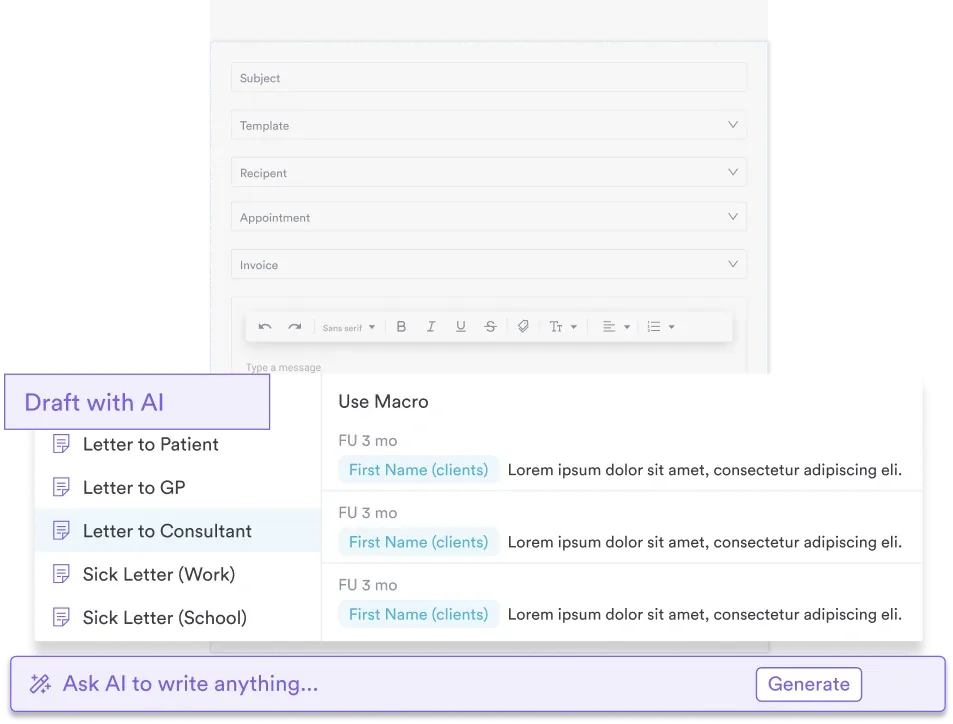

Pabau’s digital forms give each bedside sign its own field, and patient records timestamp what you found and what you did next. Escalation letters draft straight from the note.

Kernig’s sign is worth eliciting and worth writing down properly. It costs 15 seconds, needs nothing but your hands, and adds one more data point to a picture you are assembling under pressure.
What it will not do is settle the question. A likelihood ratio close to 1.0 means a positive result barely moves your probability, and a negative one moves it just as little. So the sign belongs in your notes, while clinical suspicion stays in charge of the plan.
Get the documentation habit right and the rest follows: the angle, both legs, the other signs, the timing, the decision. Book a demo to see how Pabau structures neurological exam records, so nothing from the bedside gets lost in handover.

Writing a care plan for syncope? Syncope nursing care plan template covers patient assessment, NANDA-I diagnoses, interventions with rationales, and evaluation criteria.
Documenting a tiptoe test for appendicitis? Tiptoe test template documents the tiptoe test with result fields, clinical observations, and differential diagnosis notes.
Filling out a TLC medical form? TLC medical certification form captures the applicant details and the physician’s fit determination on one page.
Documenting a UTI case? UTI system disorder template covers risk factors, diagnostic criteria, medications, and urosepsis escalation protocols.
Running a holistic wellness review? Wellness review assessment template examines lifestyle factors, mental health, social connections, and personal goals in one review.
No, and the joints move differently. In the Lasegue or straight leg raise test, the knee stays straight while the hip flexes. In Kernig’s test, the hip is held at 90 degrees and the knee is the joint you move. Lasegue’s tests for nerve root compression, Kernig’s for meningeal irritation.
Not reliably. Below roughly two years of age the sign is often absent even in proven meningitis. Look instead for a bulging fontanelle, feeding refusal, high-pitched crying, and unusual irritability. Treat a negative result in an infant as no information at all.
R29.1 covers meningismus, the sign picture without confirmed meningitis. Use it when meningeal signs are documented but no cause has been established. Once cerebrospinal fluid results identify the organism, switch to the specific meningitis code instead.
No. Passive knee extension from a flexed hip is painless when the meninges are normal. Mild stretch in the hamstrings is common and is not a positive result. Pain in the lower back or posterior thigh, or a knee that will not straighten, is what you are looking for.
Yes. The maneuver is passive, so involuntary hamstring resistance can still appear in a drowsy or unresponsive patient. You lose the pain report, which is half the finding, so weight the result accordingly and document that the patient could not respond.