Exilis patient treatment record: Free PDF for RF sessions
An Exilis patient treatment record is the session log for BTL’s radiofrequ...

3
Last Updated: Oct 23, 2026

England’s licensing scheme for non-surgical cosmetic procedures is written into the Health and Care Act 2022, but no regulations have been made under it.
No commencement date has been set, so no part of the scheme applies to your practice yet.
Government has confirmed a three-tier red, amber and green risk model, with a separate practitioner licence and premises licence.
Premises licensing already exists in London, where boroughs charge from £582 to £1,555 for a special treatment licence.
Standard botulinum toxin, filler and laser treatments generally sit outside CQC registration in England today.
The aesthetics licensing scheme England has been waiting for exists only as a power in the Health and Care Act 2022. The regulations that would switch it on have still not been made.
The Department of Health and Social Care consulted on the licensing of non-surgical cosmetic procedures in 2023 and received over 11,800 responses. It published its response on August 7, 2025, confirming a three-tier risk model.
So the honest answer for practice owners is that the scheme is coming, and it is not here yet. Meanwhile botulinum toxin and dermal fillers are already governed by medicines law, an under-18 ban, and in London by local licensing.
This guide sets out what the proposals contain, which rules bind you today, and where the other three UK nations have gone further. Voluntary bodies such as the JCCP sit alongside all of it, without statutory powers.
The aesthetics licensing scheme is a power in the Health and Care Act 2022 to license non-surgical cosmetic procedures in England. It would create a practitioner licence and a premises licence, sorted by a red, amber and green risk classification. No regulations have been made, so it is not yet in force.
Local authorities would administer the green and amber tiers. The highest-risk red tier is intended to sit with the Care Quality Commission instead, outside local authority licensing. So the body you answer to would depend on the procedure, not on your job title.
The tiers also turn on who may treat. Green procedures would be open to any licensed practitioner meeting agreed standards. Amber procedures would restrict a non-healthcare practitioner to working under a named regulated healthcare professional with an accredited qualification. Search interest in non medic aesthetics tracks that amber rule closely.
Voluntary registers would not become the licensing route. The JCCP register and the Save Face register are independent accreditation schemes. The Department of Health and Social Care has given neither a statutory role.
You will also see the US form aesthetic license in search results, and English law spells the document as a licence.
A short Health and Care Act 2022 summary helps here. Section 180 sits in Part 6 of the Act, under the “Cosmetic procedures” cross-heading. It lets the Secretary of State make regulations prohibiting specified cosmetic procedures in the course of a business without a personal licence.
The stated purpose is reducing the risk of harm to the health or safety of members of the public. Schedule 19 provides the enforcement machinery, including offences and financial penalties. The penalty amounts are left to regulations that do not exist yet.
Pressure for the power built over a decade. The Keogh review in 2013 recommended tighter control of non-surgical cosmetic procedures. The Botulinum Toxin and Cosmetic Fillers (Children) Act 2021 then closed the under-18 route.
Section 180 is an enabling power. It authorizes a scheme rather than building one. Until the Secretary of State makes regulations naming the procedures, the licence types and the conditions, there is no licence to apply for.
That is also why operating without a licence is not an offence today. The offence would be created by regulations under Schedule 19, and none have been made.
The consultation response confirmed the shape of the scheme rather than its detail. The procedure list itself will be set in regulations.
A practitioner licence, described in the proposals as a personal licence, would cover the individual carrying out the procedure. Expect proof of qualification against agreed standards, plus evidence of insurance where a council sets that condition. Training standards were not finalized in the response.
A premises licence would cover the location. London practices will recognize the pattern, because premises licensing already operates there under separate legislation. Mobile and home-visit practitioners are the harder case, and the proposals leave that detail to regulations.
The table below maps procedures to the tiers as they stand in the proposals. Only red-tier examples have been named so far, so treat the rest as open.
| Procedure | Tier in the proposals | What that would mean |
|---|---|---|
| Dermal fillers to the breasts, buttocks or genitals | Red (proposed) | Restricted to regulated healthcare professionals, and intended to become a CQC-regulated activity |
| Thread lifts | Red (proposed) | Same restriction, sitting outside local authority licensing |
| Fat-transfer body augmentation, including the non-surgical BBL | Red (proposed) | Same restriction, sitting outside local authority licensing |
| CO2 laser resurfacing | Red (proposed) | Same restriction, sitting outside local authority licensing |
| Deep chemical peels | Red (proposed) | Same restriction, sitting outside local authority licensing |
| Intravenous drips for cosmetic purposes | Red (proposed) | Same restriction, and a CQC-regulated activity already |
| Botulinum toxin and standard dermal fillers | Not yet published | The green and amber definitions are confirmed, and the procedure list is not |
| Micro-needling, skin boosters and superficial peels | Not yet published | Likely to sit in the local authority tiers, with no published assignment |
| Laser and IPL hair removal | Not yet published | Already caught by special treatment licensing across the London boroughs |
| Hair restoration surgery | Outside the scheme | A CQC-regulated activity today, because it is surgery |
Micro-needling, skin boosters and superficial peels have not been placed in a tier publicly, so any table that assigns them is guessing.
The aesthetic regulations UK practices follow today are spread across several regimes. Medicines law controls the product, professional regulators control the prescriber, and local authorities control the premises.
Cosmetic industry regulations have been promised for over a decade, so it is easy to assume the sector is unregulated. Plenty already binds you, and it is enforced today.
Botulinum toxin is a prescription-only medicine under the Human Medicines Regulations 2012. Regulation 214 governs administration by, or under the direction of, an appropriate practitioner. So botox regulation in England runs through medicines law rather than through a licence.
A non-prescriber can administer the product only against a prescription and a direction from a prescriber. That prescriber is usually a doctor, dentist, nurse or pharmacist independent prescriber. The MHRA regulates the medicine itself and the devices used alongside it.
Remote prescribing sits in regulator guidance rather than in statute. The GMC has barred it for injectable cosmetic medicines since 2012 and the GDC followed in 2013. The GPhC updated its guidance in April 2025, and the NMC did the same from June 1, 2025. Breaching that guidance risks fitness-to-practise action rather than prosecution.
The Botulinum Toxin and Cosmetic Fillers (Children) Act 2021 received Royal Assent on April 29, 2021, and its remaining provisions commenced on October 1, 2021. Administering botulinum toxin or fillers to a person under 18 for cosmetic reasons is an offence.
Arranging that treatment is caught as well. A narrow exemption applies where a doctor, dentist, nurse or other qualifying regulated healthcare professional carries it out or directs it. Age checks at booking are therefore a compliance control, not admin.
Standard injectable and laser treatments generally sit outside the CQC’s regulated activities in England. So a practice offering anti-wrinkle injections, dermal fillers and laser hair removal usually needs no CQC registration today.
Registration is triggered by the procedure. Surgical procedures, thread lifts, liposuction and laser lipolysis, subcision, cosmetic intravenous drip therapy and hair restoration surgery are regulated activities. Scope has also been extended to genital and intimate-area filler augmentation.
Medically indicated use of botulinum toxin or lasers is registrable too. Where registration applies, the CQC charges on a formula tied to activity and scale rather than a flat fee. Pulling the red tier into CQC regulation remains a proposal.
Cosmetic laser and IPL work is not a CQC matter in England. In London it needs a licence from the borough, because the 1991 Act covers light and electrical treatments. Outside London the position varies council by council.
Health and safety law still applies to the equipment and the room. The HSE enforces general workplace duties, and council environmental health officers inspect premises. Trading Standards can act on misleading treatment claims under consumer protection law.
Training sits outside statute for now, and voluntary frameworks such as the qualification work published by Health Education England carry no legal force. NHS services pick up some of the corrective treatment when a cosmetic procedure goes wrong.
England already licenses aesthetic premises in one part of the country. A special treatments licence is required across the London boroughs under Part II of the London Local Authorities Act 1991. Section 6 is blunt about it.
“No premises shall be used in the borough as an establishment for special treatment except under and in accordance with a special treatment licence.”
Special treatment covers massage, manicure, acupuncture, tattooing, cosmetic piercing, chiropody, and light, electrical or vapour treatments. Laser and IPL fall inside that last category, so many London aesthetic practices hold a licence already.
The penalty is smaller than the sector believes. Section 14 sets a fine not exceeding level 4 on the standard scale, currently £2,500. Some council pages state a higher figure, and the statute is what counts.
Enforcement does happen. In June 2026 Hounslow prosecuted an unlicensed operator at Uxbridge Magistrates’ Court. The outcome was a £1,000 fine with a £400 surcharge and £600 in costs.
A council licence for aesthetics outside London is often not available at all. Part VIII of the Local Government (Miscellaneous Provisions) Act 1982 lets a district or borough council adopt a registration scheme by resolution. It is opt-in rather than national.
That scheme covers acupuncture, tattooing, semi-permanent skin-coloring, cosmetic piercing and electrolysis. Injectables and laser are not on the list. So an injectable practice in most of England needs no premises licence today.
Check your own council before assuming either way, because fees differ widely. The London figures sit far above the 1982 Act registrations.
| Council | Licence or registration | New | Renewal or amendment | Effective |
|---|---|---|---|---|
| Newham (London) | Special treatment licence, laser | £1,555 | £1,555 | April 1, 2026 to March 31, 2027 |
| Newham (London) | Special treatment licence, massage | £1,072.50 | £1,072.50 | April 1, 2026 to March 31, 2027 |
| Wandsworth (London) | Special treatment licence, high-risk (laser/IPL) tier | £1,041 | £674 | From April 1, 2026 |
| Croydon (London) | Special treatment licence | £582 (Part A £423, Part B £159) | £540 | Current published fees |
| Medway | 1982 Act registration | £247.45 | £117.10 amendment | Current published fees |
| Wakefield | 1982 Act registration, premises and personal | £204 | £47 relocation | From April 1, 2026 |
Newham charges by treatment type, which is why laser sits at the top of the range. The spread between Croydon and Newham is over £900 for the same class of licence. Wandsworth’s figures cover the high-risk laser and IPL tier, effective from April 1, 2026.
Search results promising new regulations for aesthetics 2026 are running ahead of the paperwork. No regulations have been made under section 180. Headlines about new botox regulations uk usually describe the consultation trail rather than a rule in force.
The consultation on the licensing of non-surgical cosmetic procedures ran from September 2 to October 28, 2023. Over 11,800 responses came in. The government published its response on August 7, 2025 and confirmed the red, amber and green model.
Coverage of new regulations for aesthetics 2025 refers to that response, not to a live scheme. A written answer in November 2025 set out an intention to consult again in spring 2026. That consultation would cover red-tier procedures and CQC regulation.
Alice Webb, 33, died in September 2024 after a liquid BBL, the first such death in the UK. At the time, no law stopped a practitioner without medical training from performing it. High-risk procedures of that kind are the stated priority for early action.
The new aesthetic regulations will not arrive as a single switch. Regulations must be laid, licensing teams must be built inside local authorities, and a transition period is likely.
Aesthetics regulations differ sharply across the four nations. England holds a power and no scheme. Scotland has an Act with a start date in 2027. Wales licenses four procedures that exclude injectables. Northern Ireland has no injectables scheme at all.
Scotland aesthetics regulations moved further than England’s in 2026. The Non-surgical Procedures and Functions of Medical Reviewers (Scotland) Act 2026 passed on March 17, 2026 and received Royal Assent on May 12, 2026.
The Act restricts higher-risk non-surgical procedures and bans certain procedures for under-18s. Its offences do not commence until September 2027. A companion order designates the licensable activity from September 6, 2027.
So Scotland is passed and not yet enforced. Healthcare Improvement Scotland already registers independent practices there, a separate obligation from the licensing regime to come.
Part 4 of the Public Health (Wales) Act 2017 has been in force since November 29, 2024. It licenses four special procedures, namely acupuncture, body piercing, electrolysis and tattooing.
Botulinum toxin, fillers and laser sit outside that list. A Welsh injectable practice therefore holds no special procedure licence.
Northern Ireland regulates independent practices through the RQIA under the Independent Health Care Regulations (Northern Ireland) 2005. Those regulations carry a modified definition of cosmetic surgery, covering hair and blemish removal by electric current.
No dedicated framework covers non-surgical cosmetic injectables in Northern Ireland. That is a genuine difference from the other three nations, rather than a slower version of the same plan.
Preparation is mostly record-keeping and evidence. A licensing officer will ask who performed a procedure, what qualification that person holds, and what the patient consented to. Practices that can answer from a system will pass quickly.
Voluntary registers are the closest available dry run. The JCCP register is accredited by the Professional Standards Authority, and the CPSA sets the standards behind it. The Save Face register runs its own assessed accreditation.
Insurance is where the sector repeats an imprecise claim. Employer’s liability insurance is compulsory under the Employers’ Liability (Compulsory Insurance) Act 1969, with a £5m minimum, and only if you employ staff.
Public liability and indemnity cover are not general legal requirements for aesthetic practitioners in England, and are usually licence conditions instead. A minimum level of public liability cover is a common condition of a special treatment or council licence. Check the level your own council’s licence conditions set.
Redress and representation matter too. A cosmetic redress scheme such as ISCAS handles complaints for member providers. The British Beauty Council, BAAPS, BAPRAS and the Nuffield Council on Bioethics have all pressed for tighter rules.
Licensing turns paperwork into evidence. Practice management software like Pabau keeps that evidence inside the client record, so you are not rebuilding it from paper when an officer asks.
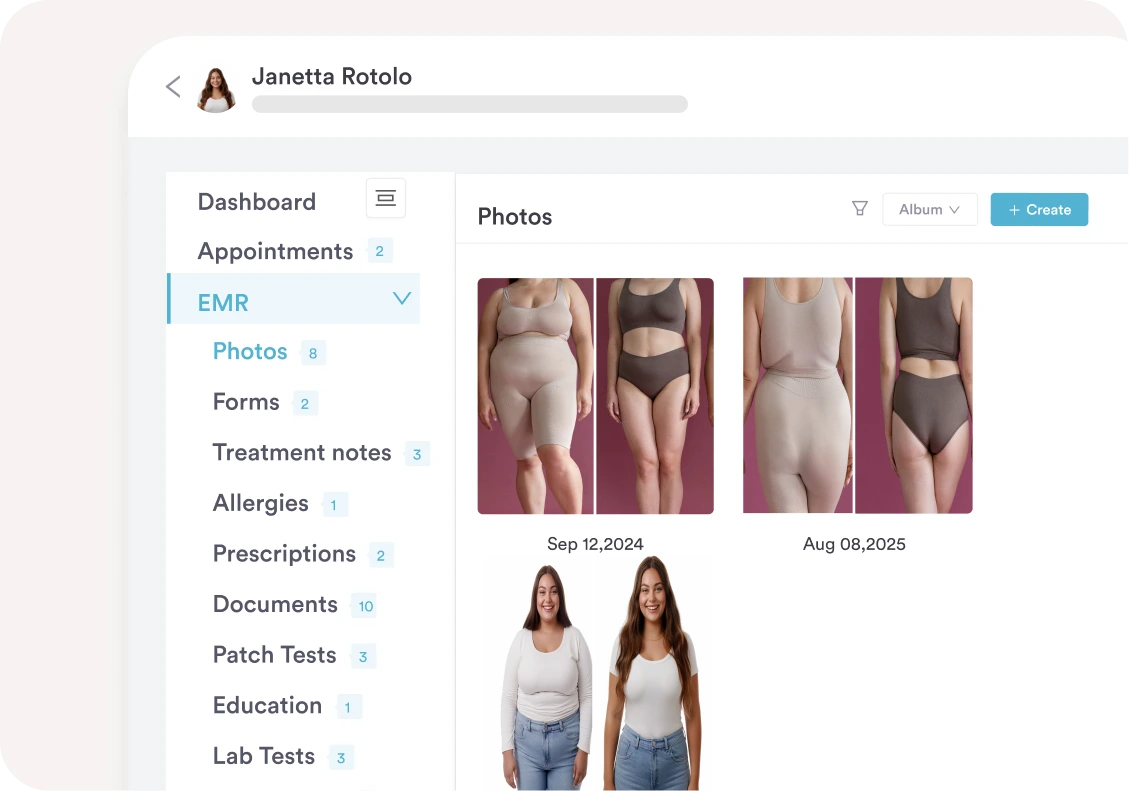
Consent forms and medical questionnaires are completed digitally before the appointment, and land in the client file automatically. Date of birth is captured at that point, which supports the under-18 rules. Treatment notes and before-and-after photographs sit in the same record.
Care Pathways in Pabau GO, our iOS app, prompt patients through forms, consents and photographs ahead of the visit. Prescriptions can flow through integrations with CloudRx, SignatureRx or Pharmacierge, so the authorizing prescriber is recorded alongside the treatment.
Online booking, reporting and client records are included in every subscription, so the compliance side does not need a separate purchase.

Pabau keeps consent, treatment notes, photographs and prescriber detail on one client record. So your practice can evidence who treated whom, and on whose authority.

The safest position is to run your practice as though the licence already existed. The requirements will be built from qualification records, consent, age checks and premises standards, all of which you can hold today.
Watch for the statutory instrument rather than the headline. Once regulations are laid, the tier boundaries become concrete and your local authority becomes the body to talk to.
If your records live across paper, spreadsheets and a booking tool, that is the part to fix first. Book a demo and see how one client record handles consent, notes and prescriber detail.

Thinking about CQC registration? How to get CQC registered walks through the application, the evidence and the timescales involved.
Not sure what the CQC actually does? The role of the Care Quality Commission explains its remit and where it stops.
Inspection booked? This CQC inspection checklist sets out the records and policies an inspector expects to see.
Hiring injectors? Can nurses do botox covers prescribing, direction and the qualifications behind each role.
No proposal bans non-medics outright. The confirmed model would let a non-healthcare practitioner carry out green procedures under a licence, and amber procedures only under a named regulated healthcare professional. Red-tier procedures would be restricted to regulated healthcare professionals.
Yes, in pieces. Medicines law controls prescription-only injectables, an under-18 ban applies, London boroughs license premises, and professional regulators control prescribers. What is absent is a single licensing scheme for practitioners in England.
Not under the England licensing scheme, because it is not in force. You may still need a special treatment licence for premises in London, or a council registration outside London for procedures such as electrolysis.
No start date has been announced. The government confirmed the model in its consultation response of August 7, 2025, and signalled a further consultation on red-tier procedures for spring 2026. Regulations must be laid before any date applies.
In London, yes, if you provide special treatments such as massage or light and electrical treatments, which includes laser and IPL. Outside London, most councils operate no equivalent licence for injectables or laser.
Usually not. Standard botulinum toxin, filler and laser treatments sit outside CQC regulated activities in England. Registration is triggered by procedures such as surgery, thread lifts, laser lipolysis, cosmetic intravenous drips and hair restoration surgery.