NeoGraft consent and patient screening form template
Download your free NeoGraft consent and screening form template A two-page pre-p...

25
Last Updated: Sep 4, 2026
A free printable botox face chart maps injection sites and records unit dosages for every treatment. It creates a visual record of what was delivered, which protects the practice medico-legally and supports quality assurance. Download the two-page template below to standardize your aesthetic practice’s botox documentation.
This guide covers the anatomy of a face chart and how to fill in the blank template. It also gives unit dosage reference ranges for all seven facial zones, plus guidance on digital record management.
A two-page A4 chart with a facial diagram and injection-site markers for all seven zones. Page one records the units delivered per zone. Page two covers pre-treatment assessment, contraindications, aftercare, and practitioner sign-off.
Download template
A botox face chart documents injection sites, units per area, and treatment outcomes. It supports medico-legal protection, patient safety, and regulatory compliance (CQC, HIPAA, GDPR).
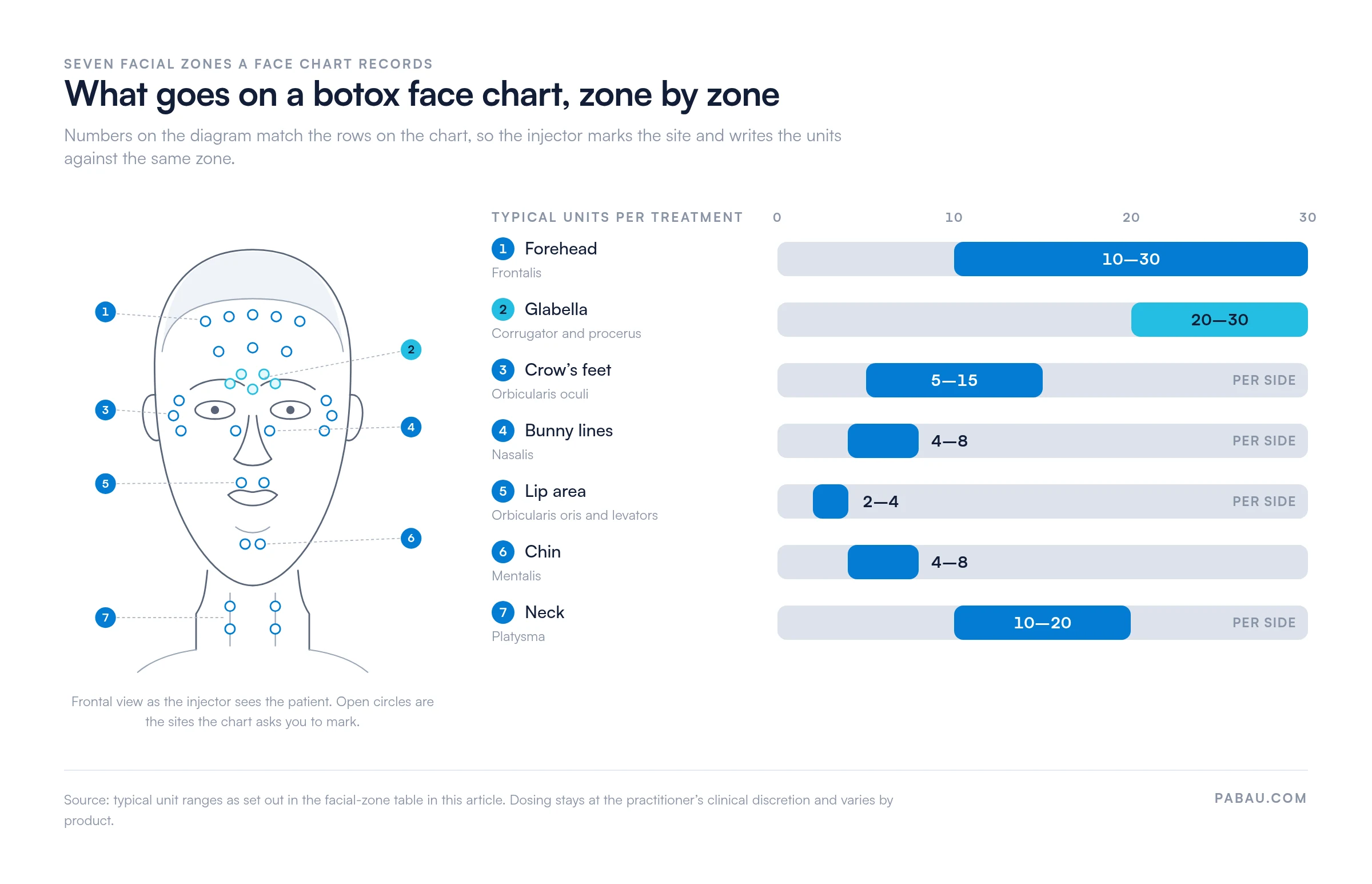
Standard zones are the forehead (10-30 units), glabella (20-30 units), crow’s feet (5-15 units per side), bunny lines, lip area, chin, and neck.
Print or import the blank template, mark the injection sites, and record the units delivered. Note contraindications and attach it to the patient record straight after treatment.
Pabau’s digital face chart removes paper charts and the audit risk that comes with them. Practitioners mark injection sites, store before-and-after photos, and open treatment history from any device.
A botox face chart is a visual anatomical template that marks the location and dosage of botulinum toxin injections. It covers one treatment session for one patient, and it does four jobs at once.
In the UK, the Care Quality Commission (CQC) expects aesthetic practices to keep detailed treatment records. Those records cover patient anatomy, injection sites, and dose information. In the US, HIPAA requires patient records to be stored securely, and incomplete documentation creates liability risk if an adverse outcome occurs.
Botox face mapping is a professional standard that regulators and clinical governance bodies enforce. A completed face chart becomes part of the patient’s permanent record. Attach it to their clinical file in paper form, or store it digitally in the patient management system.
A standard botox face chart covers seven primary facial zones where botulinum toxin is commonly injected. Each zone has a typical unit range drawn from clinical experience and manufacturer prescribing guidance. Dosing is still individualized for patient anatomy, muscle mass, and treatment goals.
Important note: Unit ranges vary by individual patient anatomy, muscle mass, gender, and botox brand. Botox, Dysport, Xeomin, and Azzalure all require different unit conversions. Dosing sits with the qualified practitioner, and it should align with manufacturer prescribing information and the practitioner’s training.
The map below pairs each zone with its number on the downloadable chart, so the marked site and the recorded units line up.
A blank face chart is designed to be completed during or immediately after the botox appointment. Follow these five steps to standardize your documentation and keep every record complete.
Best practice is to complete the chart during the treatment, marking each site as you inject. Details stay accurate, and the record does not depend on memory.
A botox face chart is essential for any aesthetic practice offering botulinum toxin injections. That includes medical spas, dermatology practices, and plastic surgery offices. It also covers private beauty practices working under a medical director or qualified prescriber, in the UK and elsewhere.
In the UK, medical spa software with digital face chart functionality supports CQC compliance. Practice management software like Pabau creates searchable, timestamped treatment records. In the US, HIPAA-compliant record-keeping reduces both the documentation burden and the audit risk.
Whether you run a single site or a multi-location franchise, a standardized template keeps every practitioner documenting the same way.
Compliance and medico-legal protection: A completed chart shows that the patient’s anatomy was assessed and the injection sites were chosen with care. It also shows that units were recorded and informed consent was obtained. That protects the practice if a patient reports an adverse outcome.
Treatment continuity: Future appointments reference the prior chart, which keeps dosing and site selection consistent. Patients notice the consistency, and the risk of over-correction or under-treatment at follow-up drops.
Staff training and quality assurance: A chart-based workflow teaches new injectors the standard anatomical zones and typical unit ranges. Senior practitioners can review completed charts to audit consistency and see where an injector needs more supervision.
Regulatory readiness: CQC inspections, HIPAA audits, and GDPR compliance checks all expect evidence of detailed treatment records. A complete chart satisfies that expectation and reduces documentation-related findings.
Patient safety and aftercare accuracy: A visual record of injection sites supports precise aftercare advice, such as avoiding the forehead when applying makeup. It also shows which post-treatment activities to rule out for the zones treated.
Document the patient’s resting face and facial animation (brow position, smile asymmetry) before injection. This pre-treatment baseline on the chart allows post-treatment comparison and helps manage patient expectations for the 7-14 day settlement period.
A single template works across all genders, but dosing and treatment planning still turn on anatomy. Women and men differ in brow position, forehead muscle thickness, and the results they ask for. Recording those details on the chart keeps each decision defensible.
Female patients typically present with a higher brow position and a lighter frontalis muscle. The forehead is often narrower, and the goal is usually to preserve or slightly raise the brow tail. Forehead doses for female patients typically range 10-20 units.
Male patients usually have a thicker frontalis, a lower brow position, and a preference for a less arched brow. Forehead doses for male patients often range 20-30 units, which softens the lines without creating a feminine arch.
Glabellar dosing also reflects these differences. Women often request more dramatic softening of the 11-lines. Men often prefer a subtle reduction that preserves some dynamic movement. Record the patient’s stated goal on the chart, such as softening expression lines while keeping frown movement.
That helps the injector hit the intended outcome and supports continuity at follow-up. Use one blank template for every patient, and note the anatomy and goals that shaped the dose on the completed chart.
In the UK, the Care Quality Commission expects aesthetic practices to keep detailed patient records covering treatment type, materials used, and technique applied. A completed face chart satisfies that expectation, as does the med spa consultation form taken at the first visit.
During an inspection, the practice has to show which charts are complete, where they are filed, and who can retrieve them. A digital record system answers all three questions without a search through the filing cabinet.
In the US, HIPAA requires that patient records be accurate, timely, and stored securely. A chart completed on the day of treatment and stored in a HIPAA-compliant system meets that standard. Never backdate a chart or complete it days later, because that undermines the record’s authenticity.
Under GDPR in the EU and UK, a face chart carrying photos or identifiable health data counts as special category data. It must be stored with enhanced security controls. A system with role-based access, encryption, and deletion policies protects that data better than paper files in a locked cabinet.
Always verify current requirements with your own regulator: CQC in England, HIS in Scotland, the FDA in the US, or the MHRA in the UK. Expectations evolve, so this is worth rechecking each year.
Printable PDF charts serve paper-based workflows well. Digital record management removes the scanning, filing, and retrieving, which matters most in multi-location practices and at high patient volumes.
Pabau’s injection-plotting tool replaces paper charts with a digital canvas built into the patient record. Practitioners mark injection sites on screen, record units per zone, and capture before-and-after photos. The completed record attaches to the patient’s account in seconds.
Every chart is timestamped, backed up, and searchable. That cuts documentation risk and puts the full treatment history in front of the injector at the next appointment.
Digital records also work with Pabau’s AI medical scribe, which populates standard treatment details from voice input. It fills in the patient name, date, zone names, and unit totals, so the injector can stay with the patient. Completed charts sync across devices, so the prior data is there whether the patient returns to another location or another practitioner.
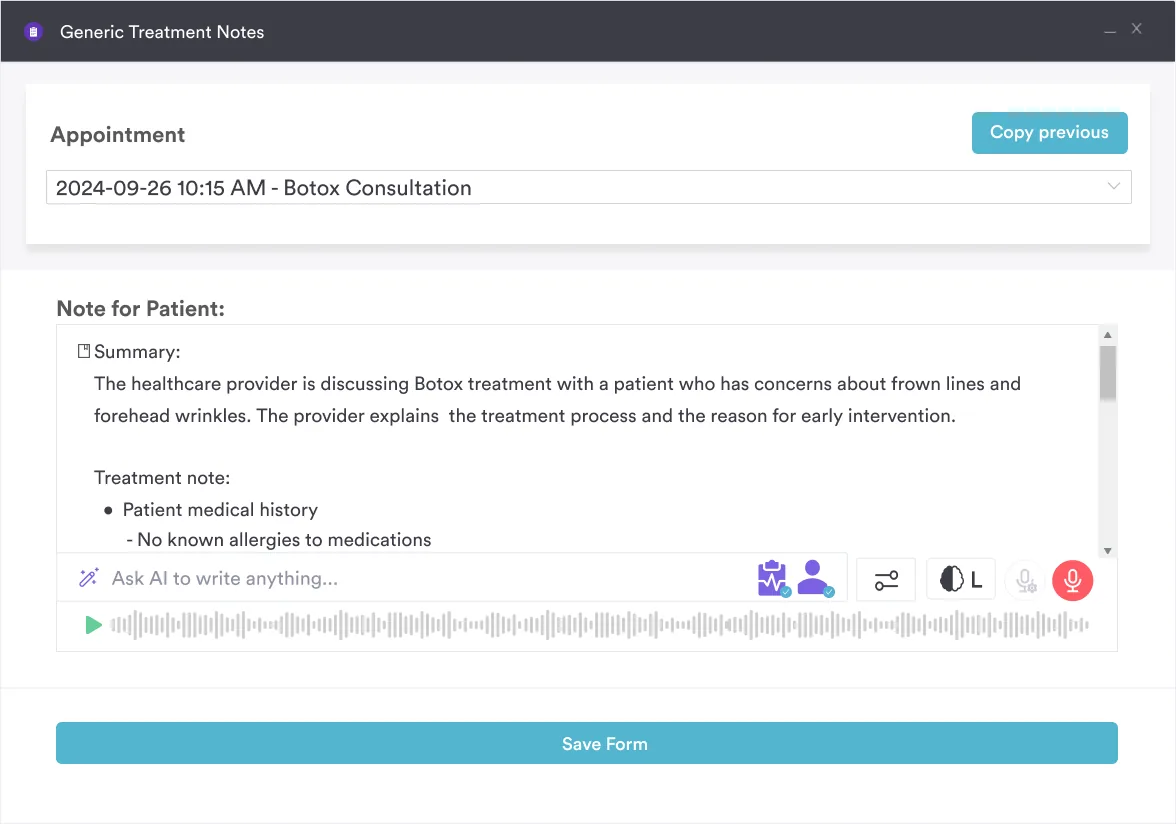
For practices still working on paper, a blank printable chart is a cost-effective starting point. For a practice that is scaling, digital record management is where the compliance and efficiency advantage sits.

Pabau’s digital face chart and patient record system removes paper charts, ties injection-plotting to clinical notes, and supports CQC and HIPAA compliance. Book a demo to see injection-plotting in action.

The chart earns its place the moment a patient questions a result or an inspector asks what was injected where. A practice that fills one in at every appointment can answer both in seconds. A practice reconstructing the session from memory a week later cannot.
Print the template above, or fill it in digitally, and treat it as part of the treatment rather than paperwork that follows it. The trade-off worth remembering is time. Two minutes at the chairside costs far less than rebuilding a record under scrutiny.
Ready to move past paper templates? Book a demo to see how Pabau keeps injection sites, units, and photos in one patient record.

Need a written note to pair with the chart? Botox treatment note template gives you the narrative record that sits alongside the marked-up face chart.
Treating filler as well as toxin? Filler face mapping covers the separate anatomical map and depth notes that filler documentation needs.
Want a stronger consultation before you inject? How to do a botox consultation walks through the assessment that feeds the chart’s pre-treatment section.
Storing before-and-after photos with the chart? Before-and-after photo consent requirements explains the wording you need before images go into the record.
In the UK, the Care Quality Commission expects detailed treatment records. In the US, HIPAA requires timely, accurate patient records. A face chart is not a standalone legal requirement, but it is standard-of-care documentation that protects the practice from liability. Your practice should keep a written documentation policy aligned with your regulator.
No. Each patient must have their own completed chart attached to their individual clinical record. Reusing a chart creates a legal and compliance risk. Use the template as a reusable form. Print multiple copies, or load it into a digital form tool, and complete a new one for every appointment.
File the completed chart in the patient’s physical or digital record immediately after treatment. If you use paper, store the file securely and log every access. If you use digital records, confirm the system is encrypted and HIPAA or GDPR compliant. Retain charts per your practice’s record retention policy, typically a minimum of 8 years in the UK.
Yes. Botox and filler have different injection depths, anatomical targets, and unit or mL measurements. Use separate, labeled charts for each product. Some practices use a dual-sided chart, with botox on one side and filler on the other. Label each side clearly to avoid confusion.
A consent form is signed before treatment and documents the patient’s understanding of risks and benefits. A face chart is completed during or after treatment and documents what was done, including sites, units, and outcomes. Both are medico-legally necessary. Consent establishes informed agreement, and the chart provides evidence of safe execution.
Yes. Digital storage is preferred for security, searchability, and backup. Use a practice management system with digital form capability and encryption. Make sure the system logs who accessed the record and when. Never store patient charts on unencrypted devices, or on cloud services without HIPAA or GDPR compliance.
Dysport and Xeomin have different units per mL than Botox and are not unit-for-unit equivalent. Dysport is typically dosed at approximately 2.5-3 units per 1 unit of Botox. Xeomin is approximately 1:1. Always check the specific product’s prescribing information and your own training. Note the brand name on the chart to avoid future confusion.