Maja Popovska

Standard authorization form
What is a standard authorization form? A standard authorization form records a p...

1
Last Updated: Nov 13, 2026
Free PDF 7 pages, print-ready Clinician-reviewed
This semaglutide consent form is a free template for US practices, built from the FDA prescribing information for semaglutide revised in June 2026. The form covers the label contraindications, the boxed warning, every current warning and precaution, a compounded-product section, dose-step check-ins, and patient and prescriber signatures.
Every risk line carries its label section number and revision date, so you can see when the form has fallen behind the label. We call that label-dated consent. Review it with your medical director and legal counsel before use.
A 16-section consent form for injectable semaglutide, with the label contraindications, the boxed warning and warnings 5.2 to 5.11. It adds a compounded-product section, dose-step check-ins, financial terms, and patient and prescriber signatures.
Start from scratch, or upload this PDF or any form you already use, and Pabau's AI Form rebuilds it with tick boxes, text fields and a signature. Attach it to the treatment once, and every patient gets it on time.
AI Form rebuilds the consent, history and aftercare forms you already use. You review each one, then publish.
Patients complete forms on their phone before they arrive, so the front desk stops retyping paper.
Every signed form is versioned and attached to the treatment record, ready when you need it.
Set how long a consent stays valid. Returning patients skip forms they have already signed.
Supports HIPAA and GDPR compliance AES-256 encryption 4.8 on G2 4.7 on Capterra Trusted by 4,000+ practices worldwide

Keep the label’s two contraindications separate from the exclusion criteria your medical director adds.
The Wegovy label revised in June 2026 has eleven warnings and precautions, including heart rate, aspiration under sedation and never sharing a pen.
The suicidal behavior and ideation warning left the Wegovy label in February 2026, so a form that still lists it is out of date.
Compounded semaglutide needs its own section: Not FDA approved, no salt forms, the dose in mg and mL, and a 28-day vial discard date.
Book a dose-step check-in before each label dose increase, at weeks 4, 8, 12 and 16, and again at maintenance.
This semaglutide consent form has 16 sections, from patient details and label contraindications to a compounded-product disclosure, dose-step check-ins, financial terms and signatures. Each risk statement comes from the Wegovy prescribing information on DailyMed, revised 06/2026, with its section number printed beside it.
When we reviewed five published semaglutide consent forms in November 2026, none had a prescriber signature line. Four listed contraindications the label doesn’t, and one still carried the removed suicidal ideation warning. The table shows where each section of this form gets its wording.
| Form section | What the patient confirms or fills in | Source (label section or FDA page, dated) |
|---|---|---|
| Label version checked | The practice records the label revision it checked and the date | DailyMed “Revised” date |
| 1. Patient details | Name, date of birth, contact details and an emergency contact | Practice intake |
| 2. Medical history and medications | Yes or no on type 2 diabetes, retinopathy, pancreatitis, planned sedation, insulin, sulfonylureas and other GLP-1 medicines | Wegovy label sections 1, 5.4, 5.8 and 5.10 (06/2026) |
| 3. Product | The prescriber ticks one: a branded product and its presentation, or compounded semaglutide | Wegovy label section 2.1 (06/2026) |
| 4. Label contraindications | No personal or family history of MTC, no MEN 2, and no prior serious allergy to semaglutide | Wegovy label section 4 (06/2026) |
| 5. Practice exclusion criteria | Criteria your medical director sets, kept apart from the label | Your practice policy |
| 6. Boxed warning | The rodent thyroid tumor finding and the neck symptoms to report | Boxed Warning and section 5.1 (06/2026) |
| 7. Warnings and precautions | One plain line each for sections 5.2 to 5.11 | Wegovy label section 5 (06/2026) |
| 8. Common side effects | The reactions seen in 5% or more of patients | Wegovy label section 6.1 (06/2026) |
| 9. Pregnancy and breastfeeding | Report a pregnancy, stop 2 months before a planned one, and the registry number | Wegovy label sections 8.1 to 8.3 (06/2026) |
| 10. Dosing and missed doses | Weekly injection, site rotation and the 2-day missed-dose rule | Wegovy sections 2.2 and 2.4 (06/2026); Ozempic section 2.1 (05/2026) |
| 11. Compounded semaglutide | Not FDA approved, base form only, pharmacy, concentration, dose in mg and mL, discard date | FDA pages dated 10/01/2026, 04/01/2026, 07/26/2024 and 06/15/2026 |
| 12. Dose-step check-ins | Five planned check-in dates, one per label step | Wegovy label Table 1, section 2.2 (06/2026) |
| 13. When to stop and call | The stop-and-call signs and the adverse event reporting numbers | Wegovy label section 17 and Highlights (06/2026) |
| 14. Financial terms | Fee, payment timing and refund terms, filled in by the practice | Your practice policy |
| 15. Questions, alternatives and right to stop | Questions answered, alternatives discussed, no promised result, and the right to stop | Your practice policy |
| 16. Signatures | Patient, guardian, prescriber and interpreter lines, plus initials on every section | Your practice policy |
Have your medical director and legal counsel review the form before the first patient signs it. If you also need a separate history form, start from our weight loss intake form.
The form takes the boxed warning, the two contraindications and all eleven warnings and precautions from the semaglutide injection label revised in June 2026. Each one keeps its section number.
The source is the Wegovy prescribing information, which DailyMed shows as revised 06/2026. Compounded semaglutide is not FDA approved, so it has no FDA-reviewed label of its own. The form therefore uses the approved product’s label as the risk reference for every patient.
The eleven warnings and precautions, in label order:
None of the five published practice forms we reviewed carries 5.9, 5.10 or 5.11. Two of them ask the patient to act outside your practice: Warning another provider before sedation, and never sharing a pen.
The label lists exactly two contraindications. One is a personal or family history of medullary thyroid carcinoma or MEN 2. The other is a prior serious hypersensitivity reaction to semaglutide or an excipient.
Pancreatitis history, type 1 diabetes and pregnancy are not on that list. The form keeps them for Section 5, where your medical director decides whether they exclude a patient.
Pregnancy has its own section. The label says semaglutide may cause fetal harm and advises stopping at least 2 months before a planned pregnancy, because of its long half-life.
Section 6.1 lists the reactions seen in 5% or more of patients, from nausea and diarrhea to hair loss. The adverse event lines on the form, Novo Nordisk at 1-833-934-6891 and FDA at 1-800-FDA-1088, are copied from the label.
The missed-dose rule differs by product. Wegovy’s label says to take a missed dose if the next one is more than 2 days away, and to skip it if less. The Ozempic prescribing information, revised 05/2026, allows a missed dose within 5 days instead.
Keep one consent form per drug, because each label carries its own risks, numbering and missed-dose rules. Mounjaro and Zepbound patients need a separate tirzepatide consent form for the same reason.
Two warnings changed on the Wegovy label in 2026: The suicidal behavior and ideation warning went in February, and a never-share-the-pen warning arrived in June. A form written before either date is out of step with the current label.
Label-dated consent is the fix. Every risk line on the form names its section and the label revision it was checked against. The “Label version checked” field records which revision the practice last compared the form with.
| Label date | What changed | What to change on your form |
|---|---|---|
| 02/2026 | Suicidal behavior and ideation (then section 5.10) removed | Delete it from the warnings list. Section 5.10 now covers pulmonary aspiration. |
| 06/2026 | Never share a Wegovy FlexTouch pen between patients (5.11) added | Add the never-share line to the warnings section. |
| Current label, 06/2026 | A 7.2 mg maximum maintenance dose for adult weight reduction, plus Wegovy tablets | Add a check-in before any increase to 7.2 mg. Keep tablets on a separate form. |
The label dates its 7.2 mg and tablet content only through dosage changes marked 08/2025, 12/2025 and 03/2026. So the form treats them as features of the current label rather than tying them to one month.
The decision rule is simple. Whenever the “Revised” date on the DailyMed label changes, compare sections 4 to 10 of the form against it. Then update the “Label version checked” field, even if nothing else moved.
A compounded semaglutide consent section must say the product is not FDA approved or reviewed, name the pharmacy and concentration, and avoid brand names. It also records why this patient needs a compounded product.
FDA’s own wording sets the floor. Its page on concerns with unapproved GLP-1 drugs (content current as of 10/01/2026) says compounded drugs are not FDA approved. FDA does not review them for safety, effectiveness or quality before they are marketed. FDA adds that they should only be used when a patient’s needs cannot be met by an FDA-approved drug.
The shortage-era rules are over. According to FDA’s policy page for compounders (content current as of 04/01/2026), the dates run like this:
Under 503A, a compounded copy of an approved drug needs a prescriber to determine and document a significant difference for an identified individual patient. FDA has said it won’t act against a compounder filling four or fewer prescriptions of such a copy in a calendar month.
Adding vitamin B12 doesn’t help by itself: FDA may still treat semaglutide plus B12 as essentially a copy.
Those rules shape the compounded section of the form, which asks the prescriber for these fields:
The mg and mL fields answer a documented problem. FDA’s dosing-error alert (content current as of 07/26/2024) describes patients drawing up five to 20 times the intended dose. Confusion between milliliters, milligrams and “units” may have contributed.
FDA’s page for telehealth companies promoting compounded drugs (content current as of 06/15/2026) is the source for the naming rule. FDA’s concerns page adds the 28-day vial guidance and a warning against using a vial that arrives warm. It also reports 990 adverse event reports for compounded semaglutide as of May 31, 2026.
The form contains no compounded or microdosing schedule. Dose steps on every version follow the prescriber’s order and the FDA label.
The form sets up a dose-step check-in before each label dose increase, at the end of weeks 4, 8, 12 and 16, then at maintenance. The dates go in Section 12, so the patient signs up to them along with the risks.
The steps come from Table 1 of the Wegovy label. Patients take 0.25 mg in weeks 1 to 4 and 0.5 mg in weeks 5 to 8. They move to 1 mg in weeks 9 to 12 and 1.7 mg in weeks 13 to 16. Maintenance starts at week 17, at 1.7 mg or 2.4 mg for adult weight reduction.
Patients who tolerate 2.4 mg for at least 4 weeks may go up to a 7.2 mg maximum. The label also says to consider delaying escalation by 4 weeks if a dose isn’t tolerated. Each dose-step check-in is where that decision gets made and written down.
| Label dose step (weeks, mg) | Check-in questions | Stop-and-call signs to repeat |
|---|---|---|
| Weeks 1 to 4, 0.25 mg. Check in at the end of week 4. | How much nausea, vomiting, diarrhea or constipation? Are you drinking enough fluids? Same injection day, sites rotated? | Severe stomach pain that won’t go away, sometimes reaching the back (5.2) |
| Weeks 5 to 8, 0.5 mg. Check in at the end of week 8. | Any stomach symptoms that are severe or not going away? Any low blood sugar symptoms, if on insulin or a sulfonylurea? | Swelling of the face, lips, tongue or throat, or trouble breathing (5.7) |
| Weeks 9 to 12, 1 mg. Check in at the end of week 12. | Any upper stomach pain, fever or yellow skin? Any racing heartbeat at rest? | Clay-colored stools or yellow eyes (5.3) |
| Weeks 13 to 16, 1.7 mg. Check in at the end of week 16. | Any surgery or sedation booked? Any vision change, for patients with type 2 diabetes? Any pregnancy plans? | Vomiting or diarrhea that doesn’t stop (5.5) |
| Week 17 onward, 1.7 mg or 2.4 mg. Up to 7.2 mg only after 4+ weeks at 2.4 mg. | Any neck lump, hoarseness, or trouble swallowing or breathing? Any missed doses since the last check-in? | A lump in the neck or new hoarseness (5.1) |
Every sign on the form’s stop-and-call list applies at every step. The table puts one beside each step so the conversation covers all of them by week 17. Each question is phrased from the label’s patient counseling section and Medication Guide, not from a practice protocol.
For Ozempic, the label’s steps differ. Patients start at 0.25 mg for 4 weeks, then take 0.5 mg. Each later increase, to 1 mg and then 2 mg, comes after at least 4 weeks. Book a check-in before each of those increases instead. To give Wegovy patients eating guidance between check-ins, hand out our Wegovy diet plan.
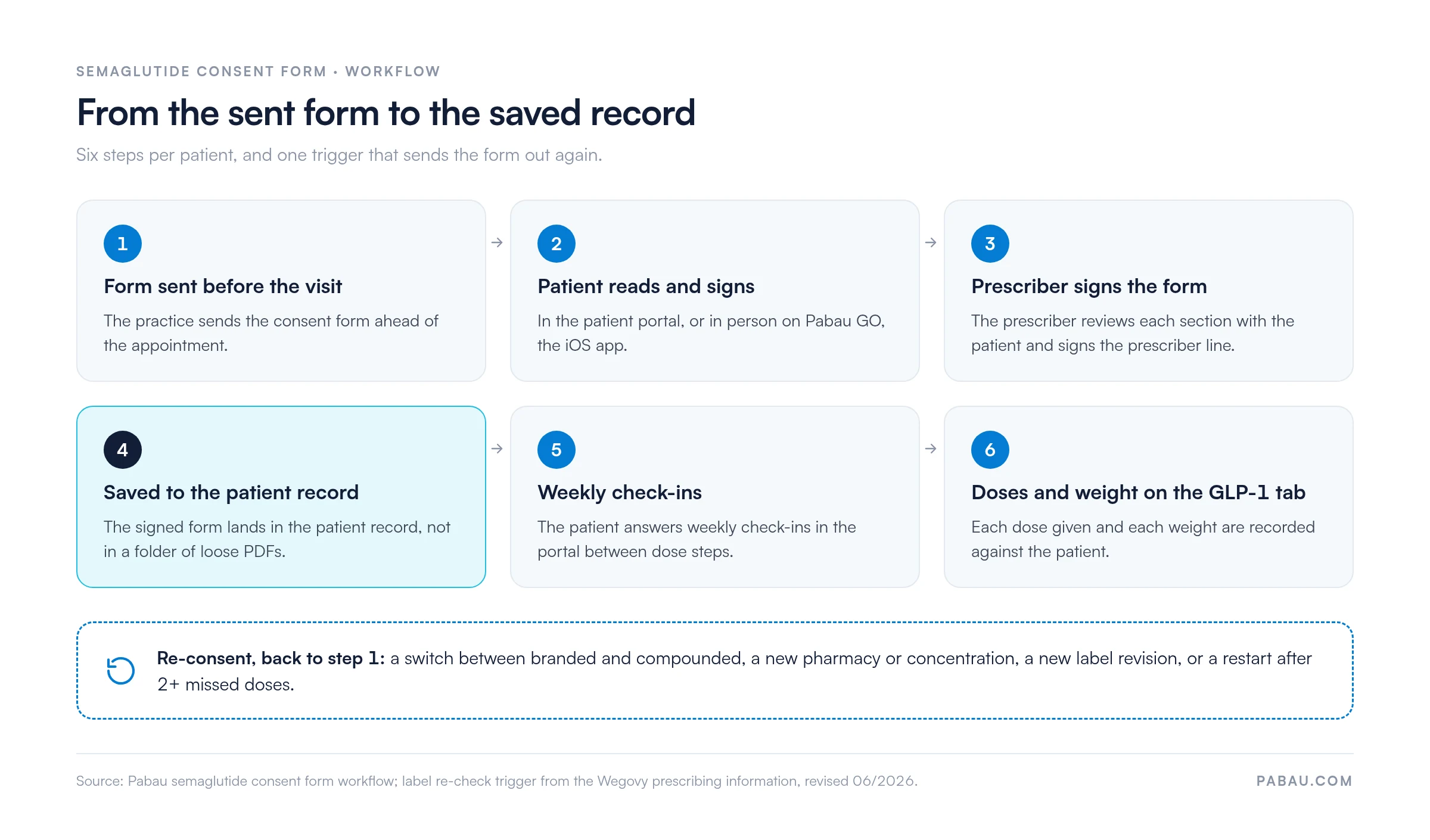
To take semaglutide informed consent, send this form before the visit, walk through each section with the prescriber, collect initials, then get both signatures.
Where your state requires a medical director, that physician sets the Section 5 criteria. The prescriber’s signature confirms the conversation happened, which a patient-only signature cannot show.
A signed form doesn’t last for the whole course of treatment. Have the patient sign a new form when any of these happen:
In Pabau, the weight loss clinic software we build, the consent form goes out before the visit as a digital form. The patient fills it in through the patient portal. Pabau GO, our iOS app for practitioners, takes care-pathway forms and consents in person instead.
The completed form lands in the patient record rather than sitting as a PDF in a shared drive. So the prescriber opening the chart at the week 8 check-in sees the signed consent next to the notes.
Practices can switch on the GLP-1 tab, which shows dose over time, the current dose, the licensed dose-step ladder and weight. The same tab carries weekly patient check-ins from the portal, so check-in answers sit beside the dose record.
The GLP-1 tab records the doses given, and the prescriber still decides each step. The flow from sending the form to the saved record looks like this.
When the practice stocks the medicine, each batch carries a batch number and expiry date in Pabau. The lot is then recorded against the patient and the appointment. For the rest of the clinical setup, see our comparison of the best EMR for weight loss clinics.
A paper or PDF consent form records a signature, but it can’t file itself in the chart or collect side-effect answers between dose steps. Each limit maps to a way the practice records the same thing in Pabau.
| Paper or PDF limit | How the practice handles it in Pabau |
|---|---|
| The patient reads 16 sections at the front desk, minutes before the injection. | The consent form goes out before the visit, and the patient completes it in the patient portal. |
| A scanned PDF sits in a folder, away from the chart. | The completed form lands in the patient record. |
| In-person signing needs a tablet and a separate forms tool. | Pabau GO, the iOS app, takes consents in person. |
| Paper can’t collect weekly side-effect answers. | Weekly patient check-ins arrive through the portal on the GLP-1 tab, which practices switch on per account. |
| A handwritten dose log drifts away from the consent. | The GLP-1 tab shows dose over time, the current dose, the licensed dose-step ladder and weight. |
| Vial lot numbers and expiry dates get copied by hand. | Stock carries a batch number and expiry date, and the lot is recorded against the patient and appointment. |
Every Pabau plan includes the core features, and add-ons enhance the experience. If you want to see the consent form, the check-ins and the dose record working on one patient record, book a demo with our team.

Send the semaglutide consent form before the visit and get it back signed in the patient record. With the GLP-1 tab switched on, weekly check-ins and doses sit on the same chart.

A semaglutide consent form is only as current as the label date on it. The label changed twice in 2026, and a form that still lists a removed warning tells a reviewer nobody checked it.
Branded and compounded semaglutide need separate disclosures, because FDA treats them differently and the dosing risks differ. The trade-off is a little upkeep: One label check whenever DailyMed shows a new revision, and a fresh signature when the product changes.
That upkeep is easier when the form, the check-ins and the dose record live on one chart. Book a demo to see how Pabau keeps semaglutide consent signed, dated and attached to every dose step.

Screening patients before the first dose? Ozempic questionnaire gives you a pre-treatment questionnaire to pair with the consent form.
Need an intake form for new weight loss patients? New patient weight loss intake form covers the history you collect before prescribing.
Checking a patient’s other medicines? GLP-1 medication list lists the GLP-1 drugs a patient may already be taking.
Teaching pen technique? Ozempic pen template helps patients track pen doses at home.
Setting up a weight loss service? How to start a weight loss clinic walks through licensing, staffing and setup.
A consent form for any GLP-1 medicine should include that drug’s label contraindications, boxed warning, warnings and precautions, common side effects and missed-dose rule. Add a compounded-status section where relevant, plus patient and prescriber signatures. Use a separate weight loss injection consent form for each drug, because each label differs.
Yes, mainly in the label each one cites. Ozempic is labeled for adults with type 2 diabetes, allows a missed dose within 5 days and has no separate heart rate warning. Wegovy’s window is 2 days. For semaglutide informed consent, tick the product on the form and check that product’s label.
No, use a separate form for each drug. Semaglutide and tirzepatide have different labels, warnings and dose steps, and a combined form blurs them. For tirzepatide, use our tirzepatide consent form template.
Yes. The Download template button at the top of this page gives you the printable PDF. Review it with your medical director and legal counsel, and note the label revision you checked it against.