Ethical consent form: free template and what to add
An ethical consent form is a written record that a patient or participant agreed...

2
Last Updated: Oct 26, 2026

Only 19 percent of medical group practices used a chatbot or virtual assistant in April 2025, across 375 MGMA responses.
Reminders are already widespread, yet MGMA polling shows no-show rates barely moved, because a one-way notice never offers to move the slot.
Weill Cornell Medicine reported digital bookings rising 47 percent after rolling out an AI chatbot for patient scheduling.
Gallup found trust in AI health information split almost evenly between trusting, neutral, and distrusting adults, so keep the AI’s role narrow.
Outbound AI calls carry consent duties under the FCC’s 2024 ruling, plus disclosure rules in California and Texas.
This post was guest-written by Dr. Giriraj Tosh Purohit, expert on healthcare products and security.
I want to start with a number that surprised me more than any single hospital case study could.
In April 2025, the Medical Group Management Association (MGMA) asked medical group practices a simple question. Do you use a medical chatbot or virtual assistant to talk with patients?
Only 19 percent said yes. 81 percent said no. That poll drew 375 responses — a sample size large enough to make the result worth paying attention to.
Sit with that adoption figure for a second. Patients have told practices for years what they want. They would rather text than call, and book online than wait on hold. Four out of five practices still are not set up to give them either.
That mismatch is where the conversation about conversational AI in healthcare starts. Patient expectations moved years ago. Most front desks stayed where they were. The first place that shows up is a number most practices already track, yet rarely question.
Ask your team how many patients did not show up last week. Now ask them whether that number is getting better or worse, and most people go quiet.
Here is what MGMA’s own polling says:
Put the two polls side by side and the movement is small in both directions.
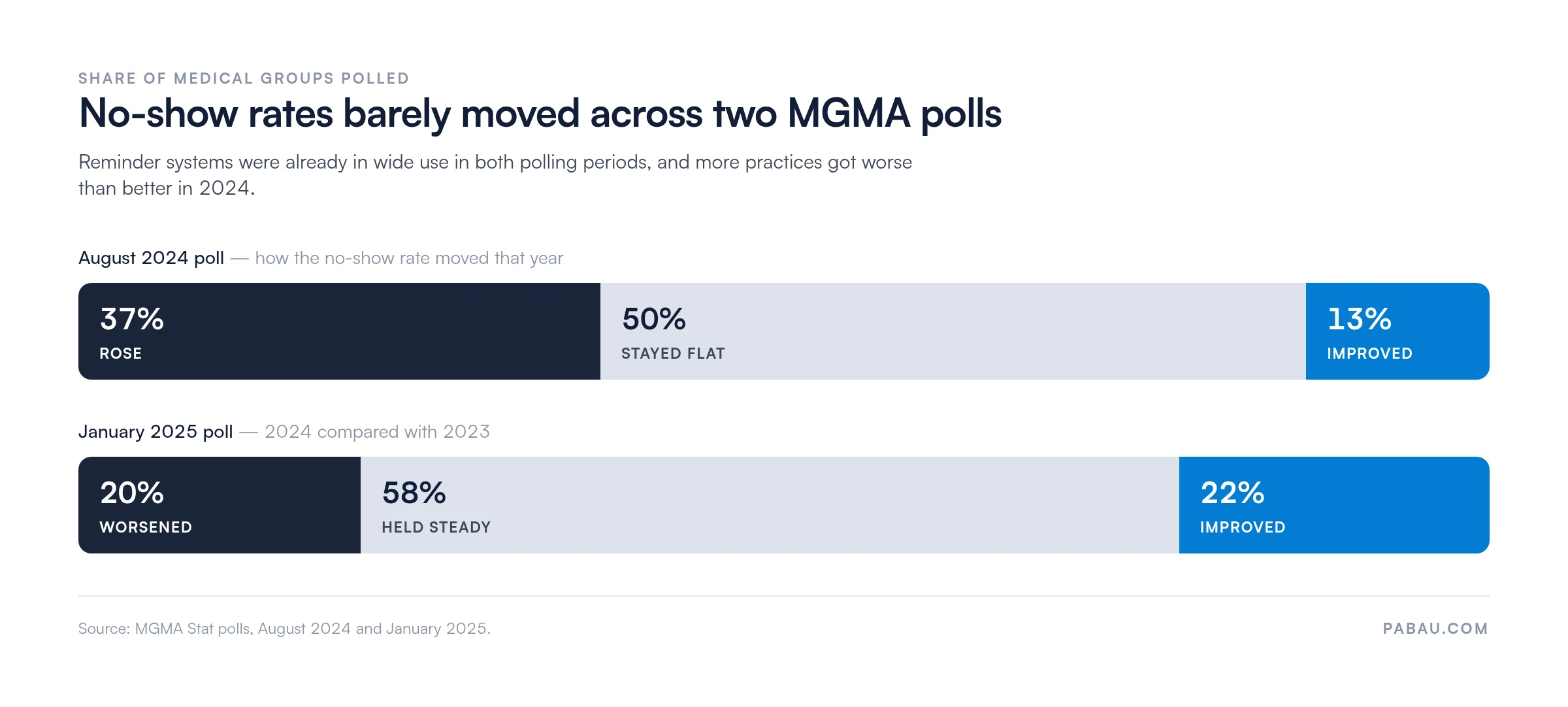
Reminders were already common in most of these practices, yet no-show rates barely moved. A reminder tells someone their appointment exists. It does not ask whether they can still make it. It does not offer to move the slot if they can’t.
The distance between a one-way notice and a two-way conversation is why practices now look at conversational AI differently from plain reminder software. One well-documented rollout shows what closing that distance looks like.
Academic medical center Weill Cornell Medicine rolled out an AI chatbot for patient scheduling, and digital bookings through that channel rose 47 percent. That is one named with a reported outcome, published by an independent association.
Alongside that, a Relatient survey, covering more than 350 provider group executives, found that 84 percent of providers still say patients schedule primarily through the front desk, and 73 percent of patients still call in to cancel or reschedule, even where digital tools exist. That’s the real starting point for most practices.
The tools are not the missing piece nearly as often as adoption is, and that’s where the phone line starts to back up.
Wait time gets talked about as a lobby problem, but in reality it starts on the phone, long before anyone sits in a waiting room chair. When most patients are still funneled through the phone line to book a simple visit, hold times and patient wait times stack up.
But in reality, patient wait times don’t shrink when staff work harder. They shrink in the practices that remove the manual steps causing the wait in the first place. Of the workflows worth automating, appointment reminders and digital intake pay back fastest. Removing those steps only works, though, if patients trust the system doing the removing.
A Gallup survey covered more than 5,500 US adults between October and December 2025. Among those who had used AI for health information in the past 30 days, trust split almost evenly three ways. About a third trusted it, a third were neutral, and a third distrusted it. Only 4 percent said they strongly trusted its accuracy.
However, this is not a reason to avoid conversational tools. It’s a reason to be honest about what they do.
For a patient-facing system such as OmniMD AI Front Desk, that boundary matters. Routine administrative conversations run through the AI workflow. Patients who need staff assistance get routed to the right person or escalation path.
That kind of caution also explains where practices are, and are not, putting their AI budgets right now.
A September 2025 poll found 68 percent of medical groups added or expanded AI tools that year. Most of that effort went to clinical documentation, meaning scribing and note-taking, rather than patient-facing scheduling or communication.
In other words, the money mostly went to AI scribes and note-takers, while patient communication and scheduling fell behind charting support.
That tells you something useful if you are deciding where to focus. Conversational AI in healthcare for scheduling and call handling is still an underused lane compared to clinical AI tools. The practices moving into it now are not chasing a crowded trend.
They are moving into ground most competitors have not covered yet. Covering it well means understanding a compliance layer that catches a lot of practices off guard.
Once a system starts placing calls to patients, not just answering them, different rules apply. An FCC ruling in 2024 confirmed that AI-generated voices in outbound calls count as artificial voices under the Telephone Consumer Protection Act.
The consent rules that govern any automated outbound call now apply to AI ones too. A few state rules are worth checking with legal counsel who knows your state:
None of this rules AI out. Inbound call handling and outbound calling carry separate legal weight, so write the disclosure and consent steps into your healthcare AI compliance checks before launch. A vendor’s blanket promise of compliance does not deserve to be taken at face value.
Once that piece is settled, the rest of the decision comes down to a short list of direct questions.
Based on everything above, here is what I would bring into a vendor conversation:
Most of the friction in this article traces back to one place. Routine requests arrive by phone, a staff member handles each one by hand, and calls that land after closing sit unanswered until morning.
Pabau now takes that work off the phone line. Pabau’s AI Receptionist, one of the AI agents in our Agent Workforce, holds a spoken conversation with the caller. It books, reschedules or cancels the appointment during the call, and the calendar updates as it goes.
It also works when nobody is at the desk. Out-of-hours calls get answered, missed callers receive a text back, and no-shows are invited to rebook. Aftercare instructions go out from the same client record. Because the agent reads data already inside Pabau’s HIPAA-compliant environment, there is no integration to build.
Trust is the part practices ask about first, so the agent starts in training. Each action is drafted for your approval before it reaches a patient, and you hand over autonomy one skill at a time. Of the 41 skills the agents ship with, 19 never work unattended.
None of them can edit a patient record automatically, and every action lands in a log you can read. The result is a phone line that answers at 9pm as well as 9am. Empty slots get offered back out instead of written off.

Pabau’s AI Receptionist answers calls day and night, books and reschedules during the call, and invites no-shows to rebook. Every action is drafted for your approval until you decide the skill can run on its own.

The data keeps pointing the same way. Patients already want faster, more direct ways to reach a practice. Only a small share of practices have built that.
Weill Cornell’s reported numbers and MGMA’s polling agree. Practices that closed the distance are not seeing magic. They are seeing what happens when you remove friction that was already costing them patients.
The practices that get this right are not the ones buying the loudest AI pitch. They ask for source-backed numbers, check the compliance side before signing, and make sure a patient can always reach a person.
That last part decides the outcome. One tool recovers lost patients. The other pushes them toward the practice down the street, and nobody at the front desk notices. Book a demo to see how Pabau keeps booking, reminders, and patient records in one place, so fewer patients slip away.

New to the format? Chatbots in healthcare covers where the technology helps patients and where it stalls.
Want the intake side? AI patient intake shows how forms and histories arrive before the visit starts.
Weighing the downsides? Pros and cons of AI in healthcare sets the benefits against the risks.
Comparing platforms? AI healthcare software walks through what each type of tool handles.
Focused on retention? AI patient engagement explains how automated messages keep patients coming back.
It is software that talks with patients in plain language, by text or by voice. In a practice that usually means answering calls, booking and moving appointments, sending reminders, and handling routine questions. Clinical judgment sits outside that scope.
No tool is compliant on its own, so treat a vendor’s blanket promise with caution. Ask for a business associate agreement, and check where call recordings and transcripts are stored. Outbound calling adds a second layer, because the FCC’s 2024 ruling brings AI voices under the consent rules.
Most vendors quote per location or per call volume rather than publishing a rate card, so ask for the figures in writing. Then measure them against numbers you already hold. Missed calls, no-show rate, and the hours your front desk spends on the phone are the ones that decide the case.
Yes, or your staff will retype whatever the AI collected. Ask whether the platform writes back into your scheduling system and patient record, rather than only reading from them. A tool that cannot write back moves the work instead of removing it.
Some will and some will not, which is why scope matters more than the technology. Gallup found trust in AI health information split almost evenly between trusting, neutral, and distrusting adults. Keep the AI on scheduling and routine questions, and give every patient a fast route to a person.

Dr. Giriraj Tosh Purohit is an experienced Product Manager and Security officer with a strong background in healthcare technology and management consulting. With expertise spanning clinical workflows, EHR, RCM, Digital Health, and AI-driven products, he has been instrumental in shaping innovative healthcare solutions. Connect with him on LinkedIn.