Compare

Pabau vs SimplePractice: AI Healthcare Software Compared

Key Takeaways

Key Takeaways

Pabau is all-in-one ai healthcare software built for aesthetics, wellness, and multi-specialty private clinics – not just therapy practices.

SimplePractice’s AI Note Taker reportedly helps clinicians complete notes faster, with 83% of users agreeing it reduced documentation time, per SimplePractice’s own data.

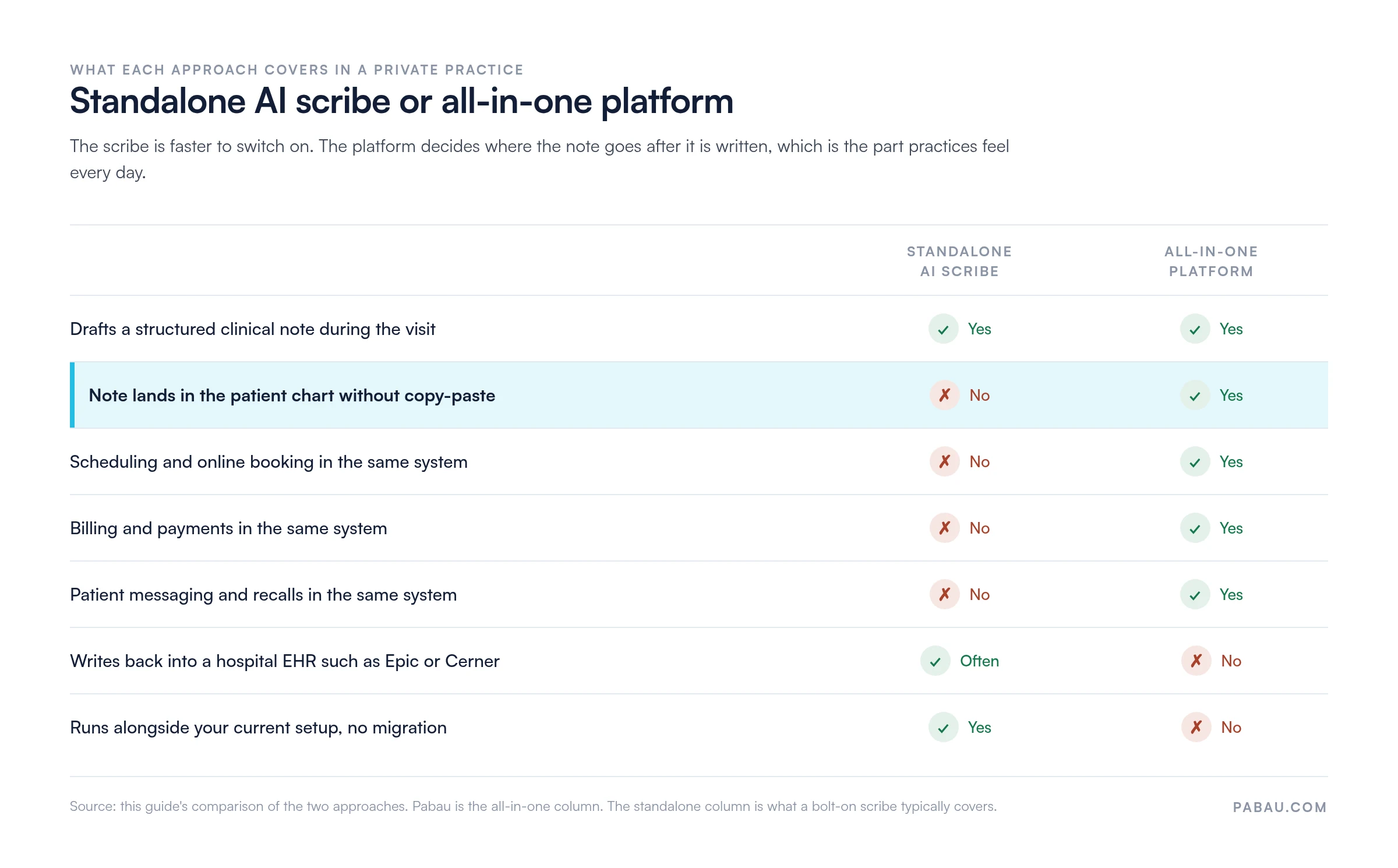
Pabau covers scheduling, billing, consent forms, and AI documentation in one platform; SimplePractice focuses on US-based therapy workflows with insurance billing.

Choose Pabau for multi-location clinic operations; choose SimplePractice for solo or group US therapy practices needing insurance billing.

Most private clinics don’t have an AI problem – they have an integration problem. They’re stitching together a note-taking app, a scheduling tool, a billing system, and a patient portal, then wondering why their team spends more time on admin than on care. The right ai healthcare software doesn’t just automate one step – it connects every clinical and operational workflow in a single platform.

A 2024 MGMA survey found that practices using disconnected software spend an average of 17 hours per week on administrative tasks that a unified platform eliminates. That gap translates to roughly $45,000 in annual staff time for a mid-size clinic. Pabau and SimplePractice both claim to close it, but they approach the problem from opposite ends: one is built for multi-specialty private clinics running aesthetics, dermatology, and wellness under one roof; the other is purpose-built for US-based therapy and behavioral health practices billing through insurance.

Pabau vs SimplePractice: AI Healthcare Software at a Glance

Both platforms incorporate AI features, but they serve fundamentally different clinic types. Here’s how they compare across the key decision criteria.

Name Best For Standout Feature Starting Price Rating
Pabau Multi-specialty private clinics, aesthetics, wellness All-in-one clinic OS with AI documentation, scheduling, billing, and CRM Contact for pricing 4.5/5 (Capterra)
SimplePractice Solo and group US therapy practices AI Note Taker with US insurance billing and HIPAA-compliant telehealth Contact for pricing 4.6/5 (Capterra)

What is AI Healthcare Software? Understanding Both Platforms

The term ai healthcare software covers a wide spectrum. At one end, you have standalone clinical documentation tools that transcribe patient conversations. At the other, you have comprehensive platforms that use AI to automate scheduling, generate clinical notes, flag documentation gaps, and coordinate post-visit follow-up. The distinction matters because buying a transcription tool when you need a practice management platform creates more integration work, not less.

SimplePractice Online Appointments

Pabau is built as a unified clinic operating system. Its Echo AI feature handles clinical documentation while the broader platform manages automated workflows, online booking, billing, and patient records. Clinicians don’t switch between apps to complete a note and then trigger a follow-up sequence – it all happens in one environment.

SimplePractice approaches ai healthcare software from a narrower angle. Its AI Note Taker is designed specifically for therapy sessions, helping counsellors and psychologists capture session content and generate structured notes faster. The platform excels within that defined scope – particularly for US-based practitioners who need insurance billing alongside documentation.

Pabau vs SimplePractice: AI Clinical Documentation

Clinical documentation is where clinician time goes – and where AI offers the clearest ROI. The question isn’t whether a platform uses AI for notes; it’s how deeply that AI connects to the rest of the clinical record.

Pabau: AI Documentation Within a Full Clinical Record

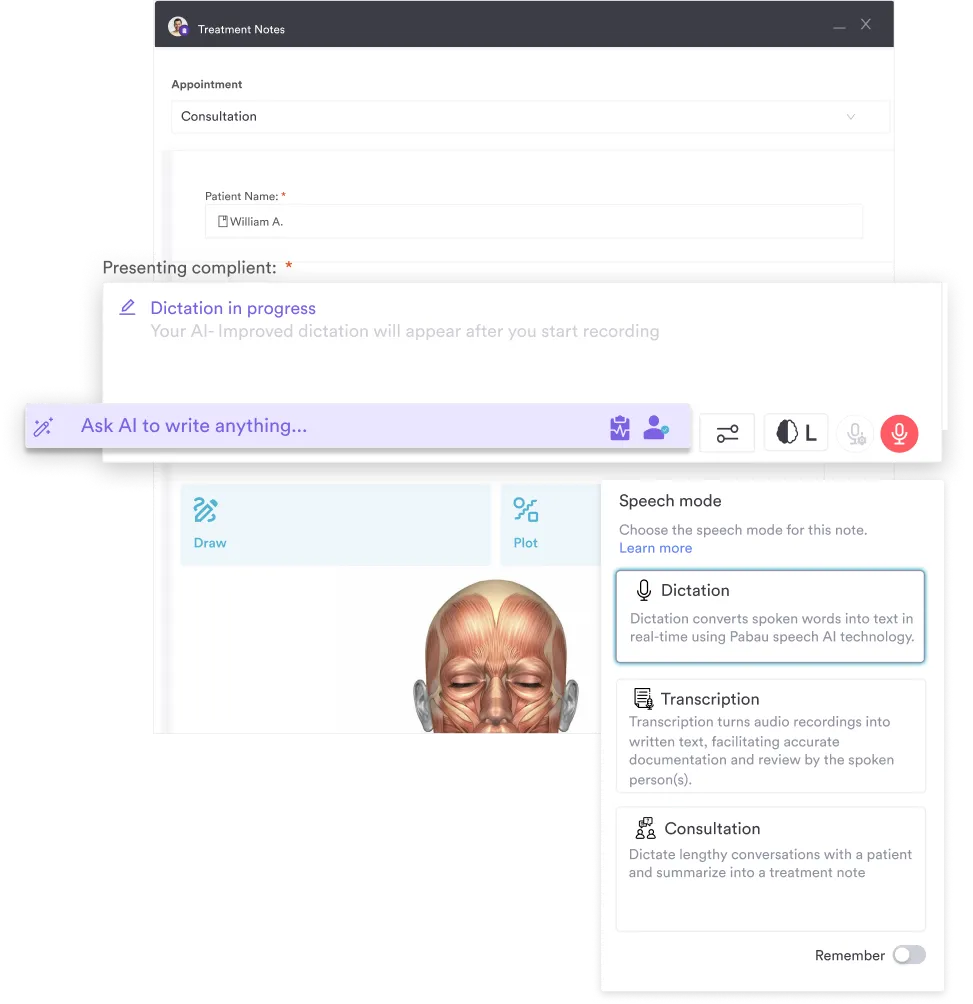
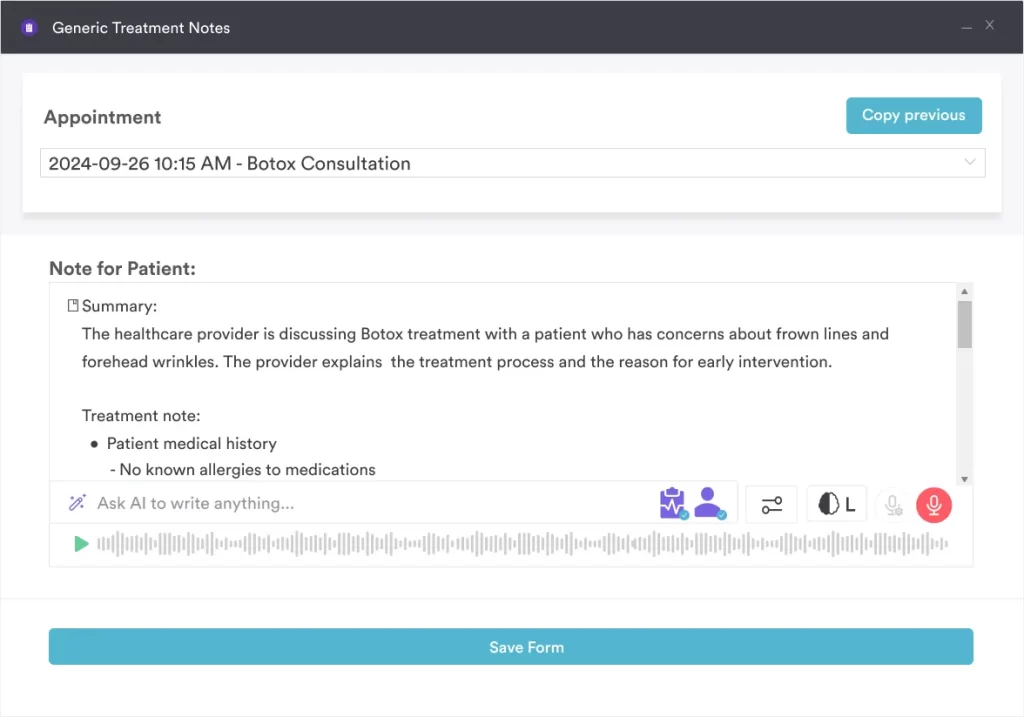
Pabau’s Echo AI generates consultation notes within the patient’s full clinical record. Here is what the workflow looks like in practice: a dermatologist finishes a mole-check consultation, taps the Echo AI button in the patient record, reviews the auto-generated SOAP note (which already references the patient’s photo timeline and prior visit history), edits one line to add a clinical impression, and signs it. The signed note automatically triggers a 48-hour follow-up SMS to the patient and flags the record for a 3-month review. No copy-pasting between apps, no manual reminder setup. The note sits alongside treatment history, before-and-after photos, consent forms, and prescriptions. Clinicians working across aesthetics, wellness, or private GP settings can dictate or capture notes during or after a consultation without leaving the patient’s record context.

The practical benefit: when a clinician reviews a returning patient’s file, every data point is in one place. The AI-generated note doesn’t exist in a separate documentation app that has to be manually reconciled with the scheduling or billing system. According to Pabau’s feature documentation, Echo AI supports note generation for a range of consultation types common in private clinics – including aesthetic treatments, wellness assessments, and GP-style consultations.

For practices using dictation workflows, Pabau also supports voice-to-text capture, giving clinicians flexibility in how they initiate documentation during busy clinic days.

Creating treatment notes with Echo AI
Pabau’s Echo AI note generation

SimplePractice: AI Note Taker for Therapy Workflows

SimplePractice’s AI Note Taker was designed specifically for therapy session documentation. According to data published on SimplePractice’s own blog, 83% of clinicians using the feature agreed it helped them complete notes faster, and users reported saving up to 5 hours per week on documentation. These are self-reported figures attributed directly to SimplePractice’s 2025 impact data, not independently verified benchmarks – but the directional signal is meaningful for therapy-focused practices.

The tool captures session content and generates structured notes formatted for mental health documentation. For a solo therapist or small group practice running back-to-back sessions, reducing note-writing time by even 30 minutes per day meaningfully changes the shape of the working day.

Where SimplePractice’s AI documentation is limited: it operates within a platform designed for therapy workflows. Clinics outside that scope – aesthetics, physiotherapy, fertility, dermatology – will find the AI documentation tools don’t map to their consultation types or clinical record structures. The comparison with private practice tools becomes relevant here, since different specialties have materially different documentation requirements.

Pabau vs SimplePractice: Scheduling and Workflow Automation

Scheduling is the operational backbone of any clinic. AI-assisted scheduling doesn’t just fill appointment slots – it reduces no-shows, optimises practitioner capacity, and triggers downstream workflows automatically after a booking is confirmed.

Pabau: Multi-Location Scheduling With Automated Workflows

Pabau’s calendar and online booking system is built for clinics running multiple practitioners across one or more locations. The platform handles automated workflows triggered by appointment events: confirmation messages, pre-appointment intake forms, post-visit care instructions, and review requests – all without manual intervention from the front desk.

For clinics that run high appointment volumes – a busy aesthetics clinic seeing 40-60 patients per day, or a multi-location wellness group with 10 practitioners – this automation infrastructure removes a significant administrative load. The platform also supports waitlist management, so cancellation slots are filled automatically rather than leaving gaps in the schedule.

Pabau’s automated workflows

SimplePractice: Scheduling for Therapy Session Volumes

SimplePractice includes solid scheduling functionality optimised for therapy practice rhythms: recurring appointments, automated reminders, and calendar sync. For a solo therapist seeing 20-25 clients per week, the scheduling tools are well-suited and require minimal configuration.

The platform doesn’t extend as naturally to high-volume multi-practitioner environments or to clinic types where appointment complexity is higher – for example, coordinating treatment room allocation, equipment availability, or multi-step aesthetic procedures. Practices with those requirements will find Pabau’s multi-location management features more operationally relevant.

See How Pabau Handles AI Documentation and Scheduling in One Platform

Pabau connects clinical notes, automated workflows, and multi-location scheduling so your team spends less time on admin and more time with patients.

Pabau clinic management platform

Pabau vs SimplePractice: Billing Infrastructure

Billing requirements differ sharply between the two platforms’ target audiences. This is one of the clearest differentiators in the comparison – and where clinic operators need to be precise about their own billing model before choosing.

Pabau: Private-Pay Billing for Elective and Aesthetic Clinics

Pabau’s billing infrastructure is built around private-pay clinic models. A typical workflow: a patient books a Botox appointment online, pays a 50% deposit at booking, arrives and receives treatment, then pays the remaining balance at checkout via the integrated terminal. The system automatically generates the invoice, applies the deposit, sends a digital receipt, and updates the practitioner’s revenue dashboard – no manual data entry between booking and payment. Package billing (e.g., a course of 6 laser sessions) tracks remaining sessions and auto-invoices each visit. This runs through integrated payment tools. For a medical spa running package deals on laser treatments, or a private GP clinic invoicing directly to patients, the billing workflow is straightforward and integrated with the appointment and clinical record.

The platform also supports claims management for clinics that bill private insurers, and handles deposits and cancellation policies natively. For UK and international private clinics operating outside the US insurance billing ecosystem, this model is the practical standard.

Pabau-payment types
Pabau’s payment types

SimplePractice: US Insurance Billing With ERA and EOB Processing

SimplePractice has deep US insurance billing infrastructure: electronic claim submission, ERA (Electronic Remittance Advice) and EOB (Explanation of Benefits) processing, superbill generation, and insurance eligibility verification. For a US-based therapist accepting insurance, this is a significant operational advantage. The platform’s billing tools are built around the workflows that US mental health practices use daily.

Outside the US insurance context, SimplePractice’s billing functionality is less relevant. UK private practice clinics, international wellness operators, or aesthetics businesses billing direct-to-patient will find Pabau’s model a better fit. The private practice EHR comparison covers this distinction in more detail for practices navigating the decision.

Pabau vs SimplePractice: Compliance and Data Security

Both platforms take compliance seriously, but they’re built for different regulatory environments. Getting this wrong isn’t just an administrative inconvenience – it can create real patient data governance risks for the practice.

Pabau: GDPR and UK/International Private Clinic Compliance

Pabau is GDPR-compliant and designed for UK and international private clinics operating under European data protection standards. The platform includes built-in digital consent forms, patient data governance tools, and compliance management features aligned with CQC requirements for UK-regulated practices.

For private clinics in the UK, EU, UAE, and other international markets, GDPR compliance and ICO-aligned data handling aren’t optional – they’re the operational baseline. Pabau’s compliance architecture reflects these requirements. The UK Information Commissioner’s Office (ICO) provides detailed guidance on GDPR for health organisations that informs how platforms like Pabau approach patient data handling.

SimplePractice: HIPAA Compliance for US Therapy Practices

SimplePractice is HIPAA-compliant, with Business Associate Agreements (BAAs) available and secure messaging built into the platform. For US mental health practitioners, HIPAA compliance is the regulatory floor – and SimplePractice’s compliance infrastructure is well-established within that framework.

The platform’s compliance focus is US-centric. Practices operating in UK or international markets where GDPR, CQC registration, or other non-US frameworks apply will find Pabau’s compliance posture more directly aligned with their legal obligations. For a deeper look at how HIPAA applies to private clinic operations, the Pabau HIPAA compliance page outlines the relevant standards.

Pro Tip

Review your primary market’s regulatory framework before shortlisting ai healthcare software. A HIPAA-compliant platform serves US practices well, but UK and EU clinics operate under GDPR and CQC requirements that need different compliance architecture. Confirm which framework applies to your patient population before evaluating features.

Pros and Cons: Pabau AI Healthcare Software

What Pabau Does Well

According to Capterra reviewers, Pabau earns consistent praise for its all-in-one approach to clinic management. Common themes in positive reviews include the breadth of features available in a single platform and the strength of scheduling automation.

  • Unified clinical and operational platform: AI documentation, scheduling, billing, CRM, consent forms, and before-and-after photo management in one system.
  • Multi-specialty coverage: Supports aesthetics, wellness, private GP, dermatology, physiotherapy, fertility, and more – Pabau is not limited to one clinical vertical.
  • Automated workflow engine: Appointment confirmation, pre-care instructions, post-visit follow-up, and review requests all run automatically without front-desk involvement.
  • Multi-location management: Designed for clinics operating across multiple sites with centralised reporting and practitioner management.
  • UK and international compliance: GDPR-compliant with CQC-aligned features for UK-regulated private clinics.

Where Pabau Could Improve

  • Learning curve for new users: Reviewers note that the breadth of features requires time to configure and learn, particularly for smaller practices transitioning from simpler tools.
  • Reporting depth: Some users flag that reporting customisation could be more granular for complex multi-location analytics needs.

Pros and Cons: SimplePractice AI Healthcare Software

What SimplePractice Does Well

According to Capterra reviewers, SimplePractice scores well for ease of use among solo therapists and the quality of its US insurance billing functionality.

SimplePractice Billing and Payments
  • AI Note Taker for therapy workflows: Purpose-built for mental health documentation, with reported time savings for therapy practices.
  • US insurance billing: ERA/EOB processing, superbill generation, and insurance eligibility verification – strong infrastructure for US-based therapists accepting insurance.
  • HIPAA-compliant telehealth: Built-in video sessions with BAAs for secure telehealth delivery.
  • Ease of use for solo practitioners: Reviewers consistently note the platform is straightforward to set up and navigate for individual therapists.

Where SimplePractice Falls Short

  • Limited beyond therapy workflows: The platform’s features, including its AI documentation, are optimised for mental health practitioners and don’t map well to aesthetics, wellness, or multi-specialty clinics.
  • Pricing increases at higher tiers: Reviewers note that costs rise as practices scale to group configurations or add telehealth features.
  • Customer support wait times: Some reviewers flag slower response times as a concern at peak periods.

Feature Comparison: Pabau vs SimplePractice AI Healthcare Software

The table below maps key capabilities across both platforms. Feature claims are based on verified research data and each platform’s published product documentation.

Feature SimplePractice Pabau
AI Clinical Documentation ✅ AI Note Taker (therapy-focused) ✅ Echo AI (multi-specialty)
Online Booking
Automated Appointment Workflows ⚠️ Reminders only ✅ Full pre/post-visit automation
US Insurance Billing ✅ ERA/EOB, superbills ⚠️ Private-pay focus; claims management available
Digital Consent Forms ⚠️ Basic intake forms ✅ Full digital forms with consent workflows
HIPAA Compliance ⚠️ US-market aligned; GDPR primary
GDPR Compliance ⚠️ Not primary focus
Multi-Location Management ⚠️ Group practice support only ✅ Built for multi-site clinic operations
Before-and-After Photo Management
Telehealth ✅ HIPAA-compliant video
Inventory Management

Pabau vs SimplePractice: Pricing

Neither platform publishes a full public pricing page with specific per-seat figures at the time of writing. Pricing for both is available on request and varies by practice size, feature tier, and configuration needs.

SimplePractice Team Management

Pabau Pricing

Pabau offers tiered subscription pricing that scales with clinic size, number of practitioners, and feature requirements. The model suits clinic operators managing staff across one or more locations, where per-practitioner costs are less relevant than total platform capability. For specific pricing relevant to your clinic setup, contact Pabau directly via the pricing page.

SimplePractice Pricing

SimplePractice uses a per-clinician subscription model with tiered plans. Reviewers on Capterra note that costs increase at higher tiers and when adding group practice configurations or telehealth features. The per-clinician structure is well-suited to individual practitioners or small groups, but becomes less cost-efficient as practice headcount grows beyond a handful of clinicians.

Platform Pricing Model Best Suited To Notes
Pabau Tiered subscription by clinic size and feature set Multi-practitioner and multi-location clinics Contact for pricing; scales with operational complexity
SimplePractice Per-clinician subscription tiers Solo therapists and small group practices Contact for pricing; costs increase at group tiers

Reviews: What Users Say About Pabau vs SimplePractice

Review platform sentiment reflects the distinct audiences each platform serves.

Pabau Reviews

According to Capterra reviewers, Pabau holds a 4.5 out of 5 rating. Positive themes cluster around the all-in-one nature of the platform – reviewers from aesthetics, wellness, and private clinic backgrounds note the value of having scheduling, billing, and clinical records in one system. The most common criticism is the initial learning curve, which reviewers acknowledge improves once the platform is configured for the specific clinic workflow. The breadth of features means there is more to set up initially compared to simpler single-purpose tools.

SimplePractice Reviews

According to Capterra reviewers, SimplePractice holds a 4.6 out of 5 rating. Solo therapists and counsellors consistently rate the platform highly for ease of use and the quality of its insurance billing functionality. Reviewers flag the AI Note Taker as a genuine time-saver for session documentation. The platform’s limitations become visible in reviews from practitioners who outgrow the solo or small-group model, particularly around cost increases at higher tiers and the absence of features needed by clinical specialties outside mental health.

Pro Tip

Check recent reviews on Capterra and G2 filtered to your clinic type before making a final decision on ai healthcare software. A 4.5 rating from aesthetics clinic owners tells you more than a 4.7 rating from solo therapists if you’re running a multi-location wellness group. Filter by industry and practice size to find the most relevant signal.

Which AI Healthcare Software Should You Choose?

The decision comes down to clinic type, regulatory market, and operational scale. Neither platform is universally better – they’re built for different practices with different needs.

Choose Pabau if you:

  • Run an aesthetics, wellness, private GP, dermatology, physiotherapy, or multi-specialty clinic
  • Operate in the UK, EU, UAE, or other international markets where GDPR compliance is a requirement
  • Need a unified platform covering scheduling, AI documentation, billing, consent forms, and patient records
  • Manage multiple practitioners or locations from a single operational system
  • Bill patients directly (private-pay model) rather than submitting US insurance claims

Choose SimplePractice if you:

  • Are a solo therapist or small group mental health practice based in the US
  • Need HIPAA-compliant telehealth and secure messaging built into the platform
  • Require deep US insurance billing with ERA/EOB processing and superbill generation
  • Want AI note-taking specifically designed for therapy session documentation

For practices sitting between these profiles – a US-based wellness clinic, for example, or a UK therapy practice considering expansion into aesthetics – the right choice depends on which operational requirements dominate. The best AI practice management tools guide covers a wider set of options for practices with more complex requirements.

Expert Picks

Expert Picks

Evaluating Pabau’s AI documentation capabilities in detail? Echo AI explains how Pabau’s ambient documentation tools work within the full clinical record.

Running a medical spa and want to see how AI fits the workflow? Medical Spa AI covers the practical applications of AI in aesthetics and wellness clinic environments.

Considering how AI scribes affect patient care quality? AI Scribes Impact on Patient Care examines the evidence on documentation quality and clinician-patient interaction.

Looking at the broader case for AI in practice management? AI in Practice Management outlines how AI features are reshaping clinic operations across specialties.

What Happens When You Outgrow SimplePractice?

This is the question most comparison articles skip, but it is the one clinic owners ask most often after 12-18 months on a platform. SimplePractice works well for solo therapists and small group practices running a straightforward insurance-billing model. The friction starts when a practice adds a second service line (nutrition counseling, wellness coaching, aesthetics), opens a second location, or needs to manage inventory for injectables or skincare retail.

SimplePractice does not support multi-location scheduling from a single view, has no inventory management, and cannot handle mixed billing models (insurance for therapy sessions, private-pay for wellness services) within the same patient record. Practices that hit these limits typically face a migration – exporting patient data, re-entering clinical histories, retraining staff, and rebuilding their entire booking and billing workflow on a new platform.

Pabau’s onboarding team reports that former SimplePractice clinics are among the most common migration sources for multi-specialty practices. The typical transition takes 2-4 weeks, with Pabau’s data migration support handling patient record imports, appointment history, and document transfers. The practices that switch most often cite three triggers: adding a cosmetic or wellness service line that SimplePractice cannot bill for, opening a second location, or needing before-and-after photo management that does not exist in SimplePractice’s clinical record.

If your practice is currently on SimplePractice and approaching any of these growth thresholds, the cost of switching later is higher than starting on the right platform now. Book a Pabau demo to see how the migration process works for practices moving from therapy-only platforms to a unified clinic operating system.

Conclusion

The gap between Pabau and SimplePractice isn’t really about which platform has better AI. It’s about which platform’s AI exists inside the right operational context for your clinic. SimplePractice built AI documentation for therapy practices – and it does that well within its defined scope. Pabau built AI healthcare software as one layer inside a full clinic operating system, connecting documentation to scheduling, billing, compliance, and patient records in a way that solo-practitioner tools aren’t designed to do.

For private clinics outside the US therapy market – aesthetics, wellness, multi-specialty, private GP – Pabau’s unified approach removes the integration burden that comes with stitching together separate tools. To see how Pabau handles AI documentation alongside scheduling and billing in your specific clinic context, book a demo and walk through the platform with your clinic setup in mind.

Frequently Asked Questions

What is AI healthcare software used for in private clinics?

In private clinic settings, ai healthcare software typically handles three functions: generating clinical notes automatically from consultations, automating administrative workflows like appointment reminders and follow-up communications, and connecting patient documentation to billing and scheduling systems. The specific capabilities vary significantly between platforms designed for therapy practices versus those built for multi-specialty clinical environments.

Is SimplePractice suitable for non-therapy clinic types?

SimplePractice is purpose-built for mental health practitioners – therapists, counsellors, and psychologists. Its AI documentation, billing, and compliance infrastructure is optimised for that workflow. Aesthetics clinics, physiotherapy practices, dermatology centres, and wellness operators will find that the platform’s feature set doesn’t map to their clinical or operational requirements.

How does GDPR compliance differ from HIPAA compliance in clinic software?

HIPAA governs patient health data in the United States, focusing on protected health information (PHI) and requiring Business Associate Agreements with software vendors. GDPR applies in the UK and EU, with broader rights for individuals over their data, stricter consent requirements, and different breach notification rules. UK clinics operating under both frameworks – for example, treating US patients – need to confirm which standards their chosen platform meets before signing a contract.

Can Pabau support both single-location and multi-location clinics?

Yes. Pabau’s multi-location management features are built for clinics operating across more than one site, with centralised practitioner management, reporting, and scheduling. Solo-practitioner clinics can also use the platform, though the pricing and configuration are typically optimised for practices with multiple practitioners or locations where the unified platform value is most pronounced.

How do AI-generated clinical notes affect documentation accuracy?

AI-generated notes can help clinicians capture consultation content more consistently and reduce the time between the consultation and note completion. However, clinicians should always review AI-generated notes before finalising them in the patient record. The American Medical Association (AMA) has published guidance on physician use of AI in clinical documentation, noting that the clinician remains responsible for the accuracy of the final record regardless of how it was generated.

×