HIPAA compliant texting: What you can send patients & how to communicate securely
HIPAA compliant texting is possible when a text holds no protected health inform...

Last Updated: Oct 16, 2026

AI patient engagement uses machine learning and NLP to automate, personalize, and time every patient interaction across the care journey.
No-show prediction, automated recall, and personalized follow-ups are among the highest-ROI use cases for private and aesthetic practices.
HIPAA and GDPR compliance must be verified for any AI tool handling patient data, and human oversight remains essential for clinical decisions.
Pabau’s automated workflows, Pabau Scribe, and SMS/email campaigns bring AI patient engagement within reach for independent practices without enterprise budgets.
Most practices lose 5-15% of potential revenue to missed appointments, lapsed patients, and follow-ups that never happen. The bottleneck is rarely clinical quality. It’s what happens after the appointment ends, when no one follows up. Improving patient engagement has traditionally meant more staff hours: more calls, more manual emails, more administrative overhead. AI patient engagement changes that equation by automating the touchpoints patients need, at exactly the moment they need them, without adding headcount.
This guide covers what AI patient engagement actually means in practice, how private and aesthetic practices are using it today, and what measurable outcomes to expect from adoption.
AI patient engagement is the use of artificial intelligence technologies, including machine learning, natural language processing (NLP), and predictive analytics, to actively involve patients throughout their own healthcare journey. It moves beyond a static reminder system toward dynamic, personalized communication that responds to individual patient behavior, history, and risk profile.
Traditional engagement tools relied on manual workflows: a receptionist calling to confirm appointments, a nurse sending a generic aftercare handout, a practice manager chasing overdue recalls. These approaches don’t scale past a certain patient volume, and they depend entirely on staff availability.
According to a scoping review published in PMC, patients’ willingness to engage with AI tools in healthcare settings is growing, with early interactions strongly influencing long-term acceptance. The research on AI and patient experience consistently shows the same pattern: when AI handles routine communication, patients receive faster, more consistent responses, and clinical staff spend less time on administrative tasks.
For independent practices, the practical shift looks like this: instead of a receptionist manually calling 40 patients ahead of a busy week, an AI system sends personalized confirmation messages 48 hours before each appointment, flags non-responders for a follow-up call, and sends condition-specific pre-care instructions automatically. The receptionist’s attention goes to the patients who actually need human contact.
Some vendors simply brand this as patient engagement AI, but the label doesn’t change the mechanics. Four components make it run:
These aren’t separate tools. In a well-integrated system, they work together: the predictive model flags a high-risk patient, the workflow triggers a personalized SMS reminder, and the NLP chatbot handles any questions the patient sends back, without a staff member touching the interaction at all. Pabau’s automated recall workflows and patient communication tools are built around this integrated model, letting smaller practices access functionality that was previously exclusive to large health systems. Each of those touchpoints produces replies, and one shared inbox is where a person picks them up.
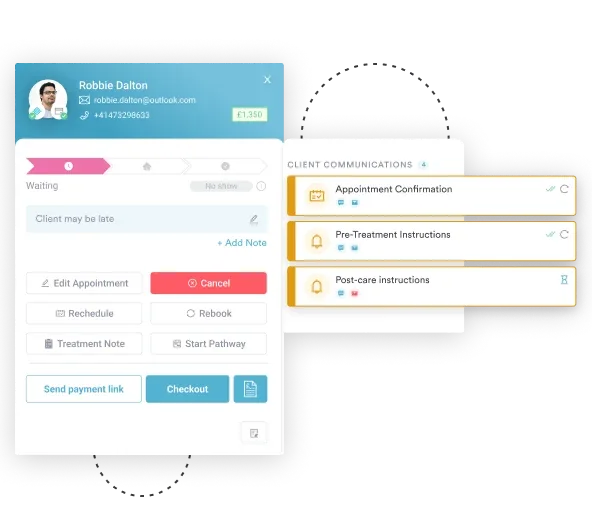
The patient portal is another key component: patients can view upcoming appointments, review their treatment history, complete intake forms, and request bookings without calling the front desk. That self-service layer reduces inbound volume for staff while increasing patient satisfaction.
Two use cases deliver the clearest, most measurable ROI for private practices: predicting and preventing no-shows, and automating multi-step communication sequences.
Machine learning models can analyze historical appointment data, patient demographics, booking behavior, and past cancellation patterns to generate a risk score for each upcoming appointment. A patient who has rescheduled twice in the past three months and booked through a third-party referral carries a different risk profile than a long-standing patient who books directly and always confirms. Reducing patient no-shows with these models means interventions can be targeted, not blanket: high-risk appointments get an extra SMS touchpoint, a deposit prompt, or a callback from a staff member. Low-risk appointments get a standard automated confirmation and nothing else.
The result is fewer wasted appointment slots without overwhelming patients who never needed prompting in the first place.
AI patient engagement extends well beyond the pre-appointment reminder. A well-designed communication sequence covers the full patient lifecycle:
Pabau’s automated SMS and email campaigns handle each of these stages without manual intervention. Practices set the logic once and the system executes at scale, consistently, regardless of how busy the front desk is on any given day. The role of AI in practice management is precisely this: removing the dependency on human memory and availability for tasks that can be rule-based and data-driven.
Scaling this well means automating outreach across the full patient lifecycle, not just the pre-appointment reminder.
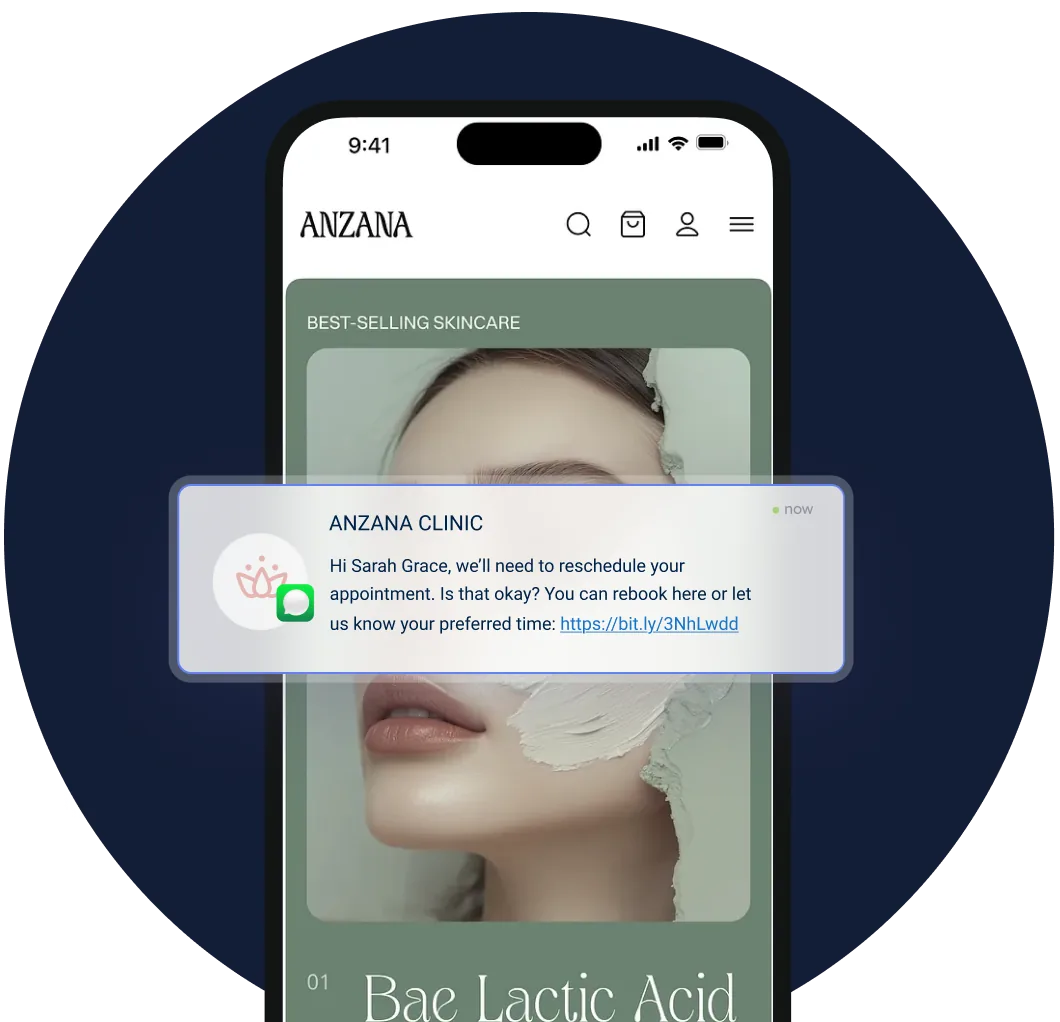
A peer-reviewed study found that AI teleconsultation platforms support increased patient engagement for effective treatment compliance, particularly for patients managing ongoing conditions. For aesthetic and wellness practices running treatment plans across multiple sessions, that compliance signal matters significantly for outcomes and retention.

Pabau automates recalls, appointment reminders, pre- and post-care communications, and lapsed patient reactivation. Watch how it works for practices like yours.

Personalization is where AI in patient engagement moves from useful to genuinely differentiated. Sending every patient the same SMS reminder is better than nothing. Sending a patient a message that references their last treatment, their upcoming appointment type, and the specific aftercare they’ll need is a different category of experience entirely.
Research published by the Northeastern University Institute for Experiential AI demonstrates this directly: combining AI with patient engagement platforms gives patients access to personalized, evidence-based health information that significantly outperforms generic internet searches. That difference in information quality builds trust and drives patients to stay connected with their provider rather than seeking answers elsewhere.
For a dermatology or aesthetic practice, personalization works at several levels simultaneously:
Pabau’s AI-powered clinical documentation through Pabau Scribe, an ambient AI scribe that listens during the appointment, supports this by structuring clinical notes in a way that makes patient data actionable for automated workflows. When a clinician’s notes are captured accurately and structured consistently, the engagement system can pull the right data to personalize the right message. The automated pre- and aftercare emails feature extends this into the full appointment lifecycle.
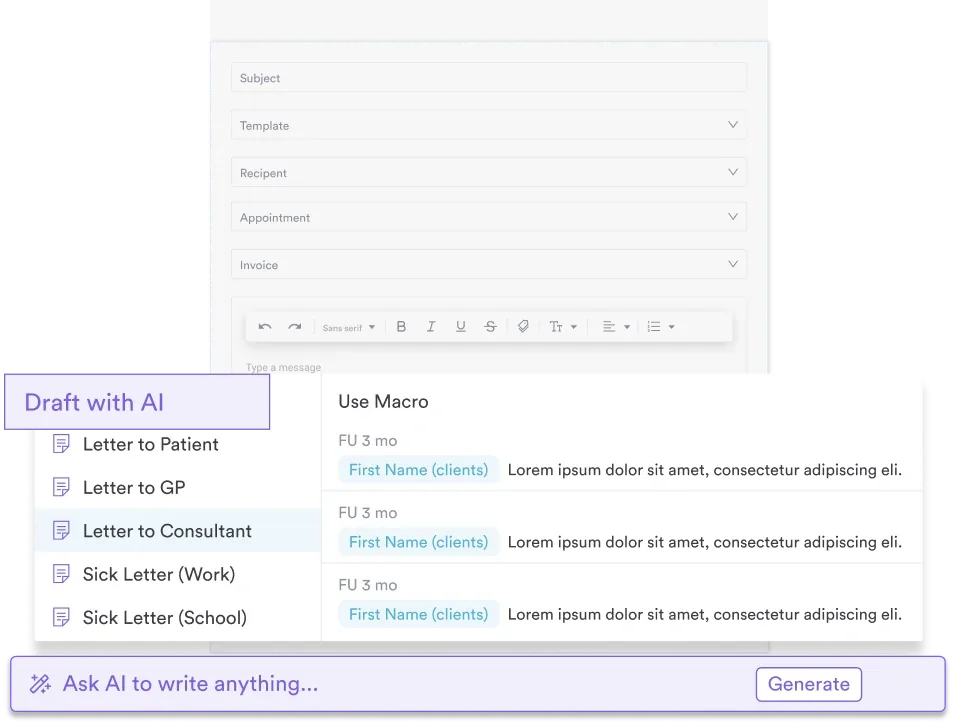
AI chatbots in healthcare handle routine patient queries: appointment availability, service information, FAQs about preparation and aftercare, and basic triage routing. According to Healthcare IT News reporting on chatbot adoption, engagement rates exceed 90% for patients enrolled in conversational AI systems, largely because of how accessible and immediate the interaction feels compared to waiting on hold or sending an email that takes 24 hours to get a response.
That said, chatbots carry a clear boundary: they must never replace clinical judgment. Any symptom query, treatment decision, or medical concern must route to a qualified clinician. HIPAA-compliant platforms ensure that patient data shared in chatbot interactions is encrypted and protected, and that audit trails exist for every exchange. The benefits of patient portals complement chatbot functionality here: together, they create a connected self-service layer that handles high-volume routine interactions while keeping clinical staff available for the conversations that actually require them.
Automated follow-up sequences double as an early-warning system for service recovery. A patient who replies to a 48-72 hour check-in with a lukewarm or negative response is far easier to win back three days after treatment than three weeks later in a public review.
Routing that reply to a staff member for a same-day call, instead of letting it sit in an inbox, is often the difference between a recoverable patient and a lost one.
Audit your last 30 days of inbound patient messages. Categorize each one: appointment availability query, aftercare question, rescheduling request, or clinical question requiring practitioner input. For most private practices, 60-75% of inbound volume falls into the first three categories, which are exactly what AI chatbots and automated workflows handle. That number tells you how much staff time is currently spent on tasks that could run automatically.
Large health systems had a head start on AI for patient engagement, but private and aesthetic practices now have access to the same core capabilities through integrated practice management platforms. The implementation reality is more practical than the enterprise case studies suggest.
Robust patient care management infrastructure makes each of these touchpoints possible at scale. For medical spa software specifically, where treatment courses often span 4-6 sessions and patients expect a consumer-grade communication experience, these automated touchpoints directly affect both retention and revenue per patient. Good patient compliance with multi-session treatment plans also depends heavily on consistent follow-up, which manual processes simply cannot deliver reliably at volume.
Most practices build these five touchpoints out gradually, following a structured patient engagement program rather than switching everything on at once.
Any AI engagement tool handling patient data in the US must be HIPAA-compliant. This means end-to-end encryption of all patient communications, business associate agreements (BAAs) with all third-party vendors, audit logs for every automated message, and patient consent for automated communication at the point of intake. In the UK and EU, GDPR applies equivalent requirements around lawful basis for processing, explicit consent, and data retention policies. GDPR compliance requirements for UK practices are covered in depth in Pabau’s GDPR checklist for UK clinics.
The FDA has begun issuing guidance on AI and software as a medical device (SaMD), which becomes relevant when AI tools make or influence clinical decisions rather than purely administrative ones. For engagement tools handling scheduling, reminders, and communication, that threshold is generally not crossed, but it’s worth reviewing with any vendor whose AI makes clinical triage recommendations.
Seeing a patient once and keeping them engaged across their full care journey is where most private practices lose revenue and retention. AI patient engagement solves this by automating the touchpoints that build trust, improve compliance, and bring patients back, without adding administrative overhead.
Pabau’s automated workflows, Pabau Scribe clinical documentation, and SMS/email campaign tools bring these capabilities to independent practices without enterprise-scale budgets or IT teams. To see how it works for a practice like yours, book a demo and we’ll walk through the engagement features that are most relevant to your patient mix and treatment types.

Running a med spa and want AI marketing help? Medspa AI marketing guide shows how AI automates social posts, follow-ups, and content drafts to save hours.
Want intake done before the patient walks in? AI patient intake collects and verifies patient details ahead of the visit, so check-in is a confirmation.
Ready to automate your practice’s marketing and recall workflows? Automated Patient Engagement guide shows how automated touchpoints between visits cut no-shows and protect revenue.
AI patient engagement is the use of artificial intelligence technologies, including machine learning, NLP, and predictive analytics, to automate and personalize every interaction between a healthcare provider and their patients. It covers appointment reminders, post-treatment follow-ups, no-show prediction, lapsed patient reactivation, and chatbot-based query handling, all without requiring manual staff intervention for each touchpoint.
AI improves patient engagement by automating routine communication that would otherwise require staff time, personalizing messages based on individual patient history and treatment type, and predicting which patients are at risk of missing appointments or lapsing before it happens. The result is more consistent outreach across a larger patient volume, with less administrative overhead.
Yes. Machine learning models can analyze historical appointment data, booking behavior, and past cancellation patterns to generate a no-show risk score for each upcoming appointment. High-risk appointments can then receive targeted interventions, such as an additional reminder or a deposit prompt, while low-risk appointments proceed with standard confirmation only.
Compliance depends on the specific platform, not AI patient engagement as a concept. Any tool handling patient data in the US must meet HIPAA requirements: end-to-end encryption, business associate agreements with all vendors, audit logs, and patient consent for automated messaging. Always verify HIPAA compliance status directly with any vendor before deployment.
Common examples include automated appointment reminder systems that use predictive timing, AI chatbots that handle patient queries around the clock, personalized recall workflows triggered by treatment interval logic, and post-treatment follow-up sequences that deliver condition-specific aftercare instructions. Pabau combines several of these capabilities within a single practice management platform designed for private and aesthetic practices.
Yes. AI intake tools send digital forms, consent documents, and medical history questionnaires to patients before their appointment, and sync the completed responses directly into their record. This is one of the most practical entry points into automated patient engagement, since it removes paperwork from the day of the visit without requiring the front desk to learn a new system.