

Watson test (scaphoid shift test): Technique, interpretation, and accuracy

Missed scapholunate instability is one of the more consequential diagnostic misses in wrist assessment. A patient presents with vague radial-sided pain, gets a normal scaphoid series, and goes home with a sprain diagnosis. The ligament tear then goes undetected until the joint reaches cartilage damage or fixed deformity. The Watson test, also known as the […]
Apley’s test: Procedure, interpretation, and reference card
Download your free Apley’s test reference card A ready-to-use assessment form covering patient positioning, the compression and distraction sequence, positive sign criteria, and differential diagnosis fields. Print it for the exam room or attach it to the patient record. Download template Apley’s test is the prone compression-and-distraction maneuver clinicians use to screen a painful knee […]
CPT code 22844: Posterior segmental instrumentation, 13 or more segments
CPT code 22844 covers posterior segmental instrumentation spanning 13 or more vertebral segments. It is an add-on code, so it never goes on a claim without a primary spinal arthrodesis procedure beside it. A construct running from the upper thoracic spine to the pelvis can span 15 or 16 vertebrae. That count is what separates […]
Quadriceps strain test: Administration, grading & interpretation
Download your free quadriceps strain test template The form walks through the five-phase examination, then hands you a Grade I to III classification chart to score what you found. It also carries the phased rehabilitation plan and the return-to-sport criteria you sign off against. Download template An accurate quadriceps strain test tells you three things: […]
CPT code 20936: Bundled spine autograft billing guide
CPT code 20936 is an add-on code for local autograft in spine surgery, and it will never pay you a cent. The bone comes from the incision the surgeon already opened, whether that is rib, spinous process, or laminar fragments. Medicare assigns status indicator B, so the code carries 0.00 RVUs and its value sits […]
CPT code 25031: Incision and drainage, forearm and/or wrist; bursa

CPT code 25031 is maintained by the AMA and carries the official descriptor: Incision and drainage, forearm and/or wrist; bursa. It sits within the Musculoskeletal System section of the CPT codebook, specifically under Incision Procedures on the Forearm and Wrist (codes 25000-25040). The procedure involves a surgical incision into an inflamed or infected bursal sac […]
CPT Code 22554: Anterior cervical fusion billing guide
CPT Code 22554 is the primary procedure code for anterior interbody arthrodesis at the cervical spine below C2. The approach is anterior or anterolateral. The official American Medical Association (AMA) descriptor reads: Arthrodesis, anterior interbody technique, including minimal discectomy to prepare interspace (other than for decompression); cervical below C2. That parenthetical is the billing crux […]
Progress note template
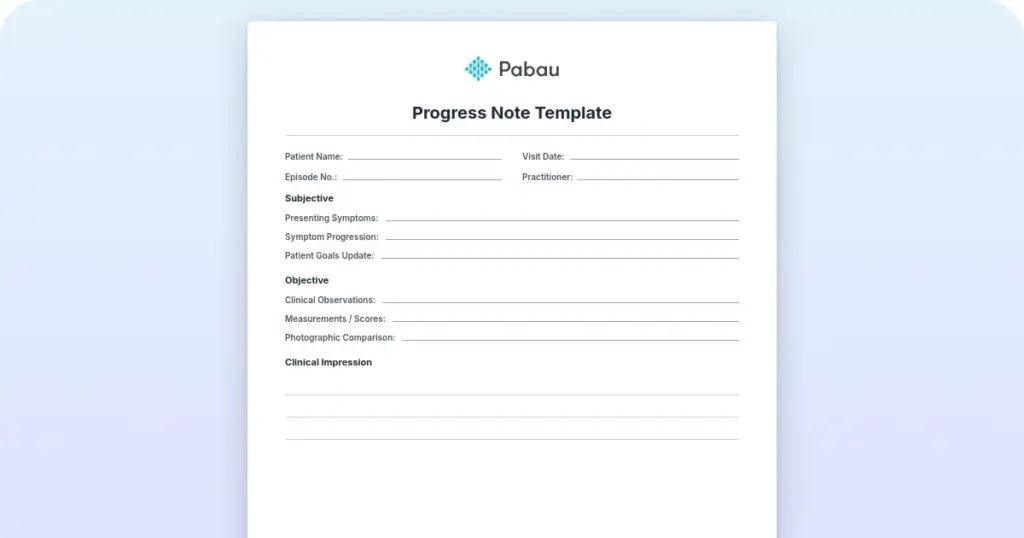
Download your free progress note template A ready-to-use form with fields for patient details, presenting concerns, clinical observations, interventions, assessment, and the treatment plan. It suits mental health, physical therapy, nursing, and general medical practice. Download template Structured documentation is what keeps care continuous when the next appointment lands with a different clinician. A progress […]
ICD-10 Code S76.909A: Thigh muscle injury, initial encounter

ICD-10 Code S76.909A: Definition and quick reference ICD-10 Code S76.909A is a valid, billable ICD-10-CM diagnosis code in the FY2026 release. Its full official description is: Unspecified injury of unspecified muscles, fascia and tendons at thigh level, unspecified thigh, initial encounter. Note the anatomical scope. The S76 category as a whole is titled “Injury of […]
Proprioception test: methods, procedures, and clinical interpretation
Most ankle sprains look fully healed within six weeks. Re-injury rates in athletes are still widely reported at 70% or more. The ligament has recovered, but proprioceptive function often has not. A proprioception test is what separates structural healing from sensorimotor readiness. This guide covers the validated assessment methods, the step-by-step procedures, and an interpretation […]