Hyperbole and a Half pain scale: Every level + free template
The Hyperbole and a Half pain scale is Allie Brosh’s humorous pain chart, ...

1
Last Updated: Oct 5, 2026

A labral tear test is a physical examination maneuver that screens for a torn labrum before you order imaging.
No single special test is accurate enough on its own. Combining two or more tests with clinical reasoning raises accuracy to 80-90%.
A positive test reproduces the patient’s pain or clicking, which points toward MRI or MR arthrogram. A negative test does not rule a tear out.
The FADIR test is the exception worth knowing: it is sensitive rather than specific, so a negative result is the informative one.
Practice management software like Pabau captures each test result in a structured digital form, so your documentation stays audit-ready.
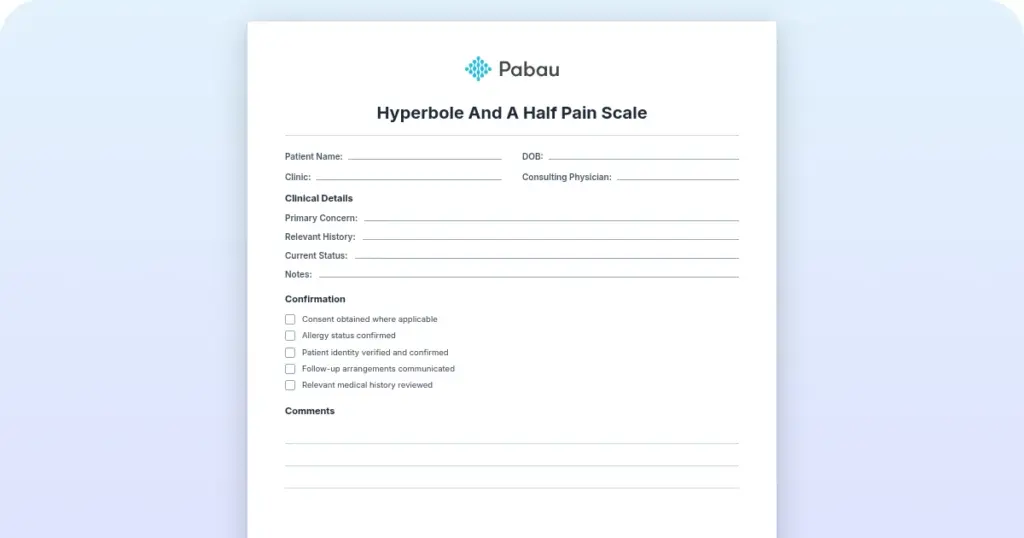
A clinical assessment form for documenting hip and shoulder labral tear findings. It has fields for the O’Brien, crank, FABER, FADIR, and Fitzgerald tests, plus result interpretation.
Download templateLabral tears in the shoulder and hip are common in athletes, manual workers, and patients whose sport involves repetitive overhead or rotational movement. Clinicians use a battery of special tests to screen for these injuries before ordering imaging. This guide covers the step-by-step procedure for each of the useful tests and what a positive result means. It also covers their diagnostic accuracy and how to record findings in a structured assessment.
A labral tear test is a physical examination maneuver that provokes symptoms in the shoulder or hip joint. Those symptoms are usually pain, clicking, or clunking. The labrum is a ring of cartilage that deepens the joint socket and stabilizes the ball-and-socket joint. When it tears, from trauma or from overuse, specific movement patterns trigger the symptom, which is what makes these tests useful screening tools.

These tests are not diagnostic on their own. Imaging, either MRI or MR arthrogram, is required for definitive diagnosis. What the tests do is help you prioritize further investigation and explain your reasoning to the patient and the specialist.
Clinicians use several tests together because any single positive result carries only moderate weight. A physical therapy EMR that structures your clinical assessment keeps every result in one place. It also flags the findings that warrant an imaging referral.
The O’Brien test, also called the active compression test, is the most commonly cited shoulder test for labral tears and acromioclavicular (AC) joint pathology. It has moderate sensitivity (72%) and specificity (60%) for SLAP lesions, which are superior labral anterior-posterior tears.
Clinical interpretation: Pain with internal rotation that improves with external rotation suggests a labral tear or SLAP lesion. Combine it with at least one other test before you refer for imaging.
The crank test has sensitivity around 73% for SLAP lesions. The compression is what earns it a place in an overhead athlete’s assessment. It shears the labrum rather than simply moving the joint through range.
Speed’s test and the Biceps Load II test both target the biceps anchor at the superior labrum. They are usually run alongside the O’Brien and crank tests, since two agreeing results are worth far more than one.
Research shows that combining the O’Brien, crank, Speed’s, and Biceps Load II tests improves sensitivity to 80-90% when at least two of them are positive. Relying on a single test risks a false negative.
Hip labral tears are common in dancers, soccer players, and patients with hip dysplasia or femoroacetabular impingement. The three main tests differ in patient positioning and direction of movement, which lets you load different regions of the labrum.
The FADIR test has high sensitivity and low specificity for hip labral pathology. That combination makes the negative result the informative one. If a properly performed FADIR test does not reproduce the patient’s pain, impingement and labral involvement both become much less likely. A positive result, taken alone, confirms very little.
Across both joints, the position you put the patient in decides what a positive finding can tell you. The panel below sets the seven tests side by side.
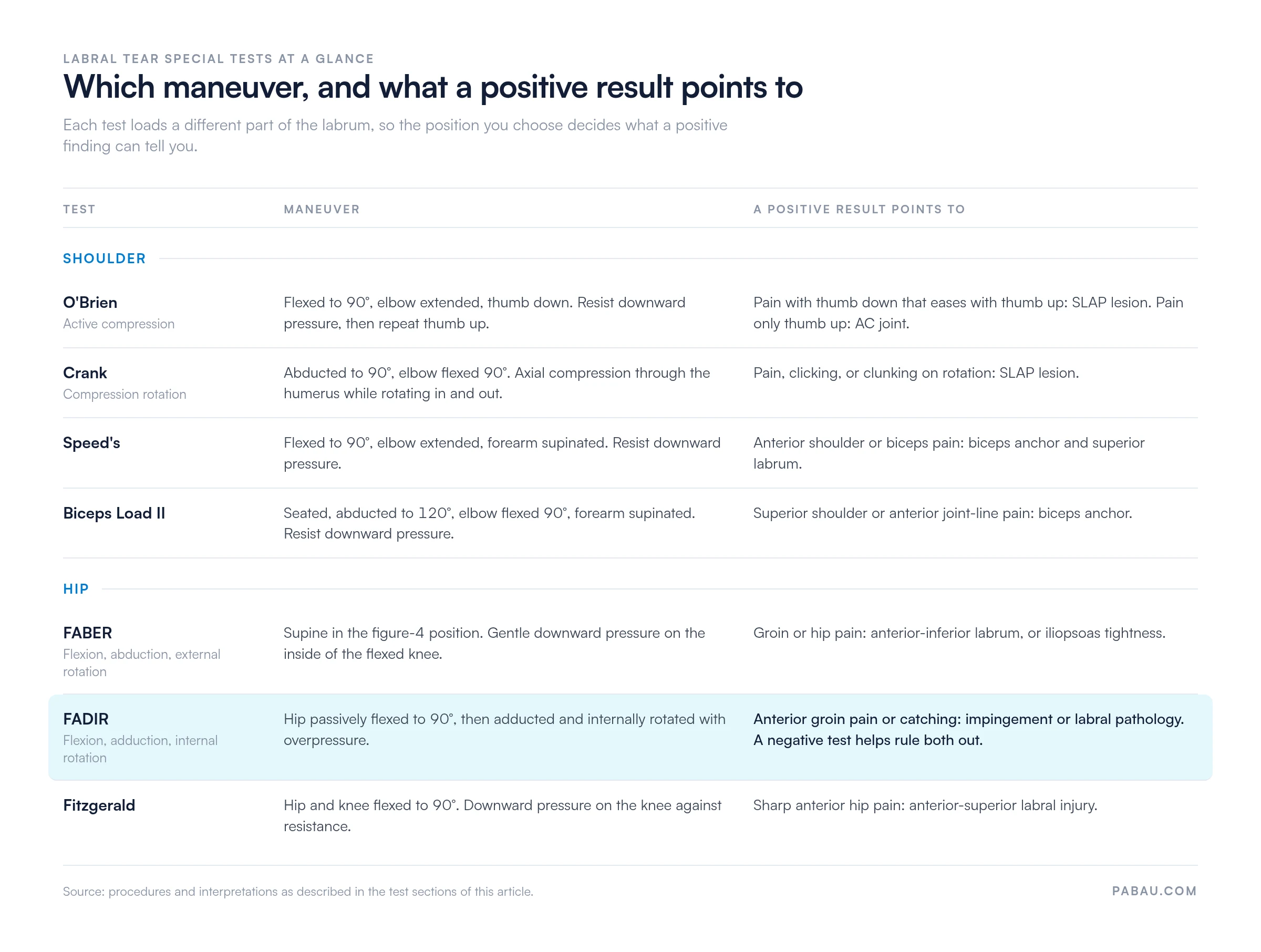
No single physical examination test is accurate enough on its own to diagnose a labral tear. Published figures also vary widely between studies, so read the numbers below as a guide to each test’s character rather than a fixed value. You still have to combine the tests with the patient’s history, the mechanism of injury, and imaging.
Two positive tests beat any single test, and by a wide margin. A patient with a positive O’Brien test and a positive crank test has a high probability of a labral tear and warrants an imaging referral. One positive test on its own calls for follow-up and a second assessment first.
Read the two hip tests as a pair. FADIR is the screening test, since a negative result makes impingement and labral pathology unlikely. FABER is the more specific of the two, so a positive FABER test carries more weight in the referral letter.
Positive physical examination findings alone do not confirm a labral tear. MRI or MR arthrogram gives you the definitive diagnosis. Refer for imaging when:
MRI is the standard imaging modality. An MR arthrogram, which injects contrast into the joint, raises sensitivity for small labral tears. Documenting your clinical findings in a structured clinical record lets you pass those reasoning steps straight to the radiologist and the specialist. Nobody has to reconstruct them from memory.
The downloadable form walks you through documenting findings, interpreting the pattern, and flagging patients who warrant an imaging referral. Here is how to fill it out during a consultation:
Storing completed forms in a system that links assessment findings to automated follow-up workflows means a patient with imaging-indicated findings gets chased rather than forgotten. You can set reminders for post-imaging communication, or for checking where a specialist referral has got to.
Special tests are screening maneuvers rather than diagnostic tools. They do three jobs in an assessment:
Labral tears also travel with company. In the shoulder that often means a rotator cuff tear, impingement, or AC joint arthritis, and in the hip it means dysplasia or impingement. Working through the tests in a fixed order is what stops a second finding going unnoticed. Managing patient care systematically from intake to post-imaging follow-up is what keeps outcomes consistent.
A paper exam sheet works fine until the findings have to travel. The detail thins out when somebody retypes a summary into the record hours later, and the negative tests are usually the first to drop off. Those are the results that rule alternatives out, so losing them costs the referral its reasoning.
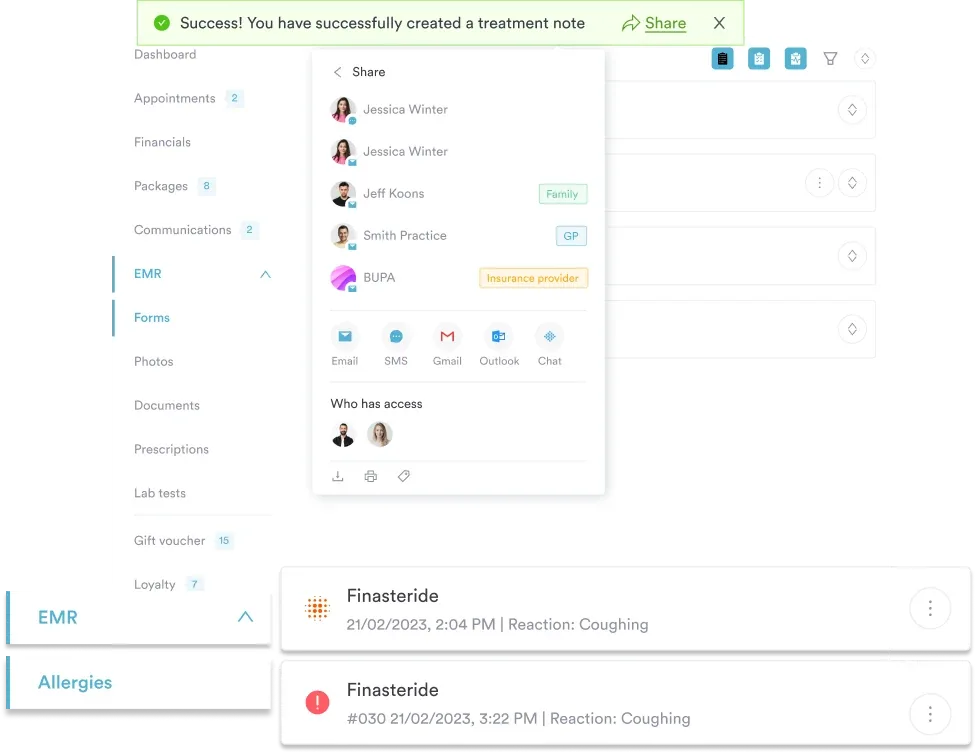
Practice management software like Pabau replaces that sheet with a digital form you design once. Each test gets its own field, positive or negative, with room to name the movement that provoked the symptom. The completed form sits in the patient record, so an imaging referral can quote the exam instead of paraphrasing it.
The follow-up then runs on its own. Pabau can trigger a reminder when an MRI result is due back, or when a patient on conservative management reaches the four-week review. Nobody has to hold a mental list of who is waiting on what.

Pabau’s digital forms and clinical records help you document special test findings, track outcomes, and automate referral follow-up in one practice management platform.

Special tests earn their place by changing what you do next, not by naming the diagnosis. Two positive tests in a patient whose mechanism of injury fits is enough to move to imaging. One positive test usually buys another appointment and a second look, and that is the right call.
The harder discipline is writing the findings down in a form another clinician can read. A referral built on a documented pattern of positive and negative tests gets taken seriously. One built on a remembered click does not. Book a demo to see how Pabau keeps assessment findings and referral follow-up in one place.

Need guidance on structuring clinical assessments? Safer clinical notes best practices teach you how to document findings systematically so your special test results are audit-ready and defensible.
Want to automate post-assessment follow-up? Automated clinical workflows help you schedule imaging referrals, patient education, and specialist consultations without manual tracking.
Looking for sports medicine context? Sports medicine practice management covers the full workflow from injury assessment through return-to-sport protocols.
There is no single best test. O’Brien test, crank test, Speed’s test, and Biceps Load II test each have moderate sensitivity and specificity. Combining at least two tests improves diagnostic accuracy to 80-90%.
A positive O’Brien test (pain with internal rotation that improves with external rotation) suggests a superior labral tear or SLAP lesion, or acromioclavicular joint pathology. However, this finding alone does not confirm diagnosis; imaging is required.
Self-assessment is not a substitute for clinical examination. While you might reproduce symptoms at home, clinical context (mechanism of injury, other signs, duration) is required for accurate interpretation. Consult a healthcare professional if you suspect a labral tear.
Accuracy varies widely between studies. Sensitivity runs from about 50% for Speed’s test to almost 99% for FADIR, and specificity from single digits for FADIR to around 80% for FABER. Two or more positive tests together reach 80-90% accuracy. MRI or MR arthrogram remains the reference standard for definitive diagnosis.
The FABER test (Flexion, ABduction, External Rotation) assesses hip joint pathology. A positive test suggests anterior-inferior hip labral pathology, femoroacetabular impingement, or iliopsoas tightness, depending on the location and quality of pain.