Bear hug test: Procedure, interpretation and free template
The bear hug test is a quick shoulder special test that screens for subscapulari...

2
Last Updated: Oct 23, 2026

The SFMA screens seven whole-body movement patterns in patients who already have musculoskeletal pain, then breaks any failure down to its cause.
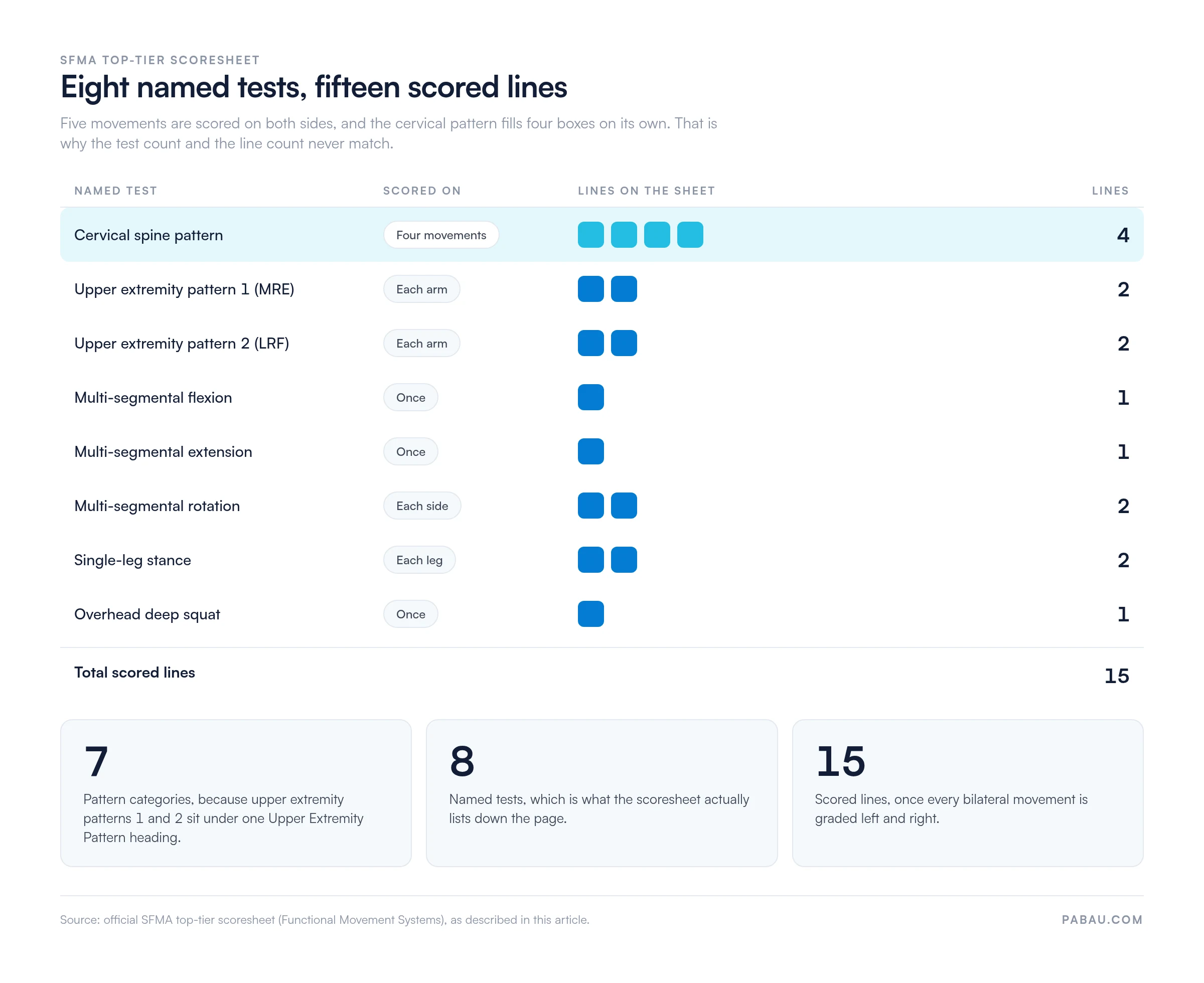
The scoresheet writes those patterns as eight named tests and fifteen scored lines, once the five bilateral movements are scored on both sides.
Every line is graded FN, FP, DN or DP, and any score other than FN sends the clinician into that pattern’s breakout sequence.
A breakout ends in one of three findings: a joint mobility dysfunction, a tissue extensibility dysfunction, or a stability and motor control dysfunction.
Peer-reviewed agreement sits in the moderate-to-good range, so a shared scoring reference and a structured form keep results comparable between clinicians.
All fifteen scored lines across the seven top-tier patterns, plus a breakout checklist for each pattern with the criteria to look for. There is a scoring key, patient details, a notes field, and a clinician sign-off block.
Download templateThe selective functional movement assessment (SFMA) is a movement exam for patients who already hurt, and it deliberately starts away from the sore spot. You score seven whole-body patterns first, then work back to what caused each failure. A painful shoulder can begin at a stiff thoracic spine, and a local exam never shows that.
One rule carries the rest. A top-tier score names the pattern, and only the breakout names the tissue you treat. Stop at the score and you leave with a label instead of a plan.
This guide walks the eight tests, the four-letter key, one full breakout, and the record a second clinician can work from.
The SFMA is a movement-based clinical exam for patients who present with musculoskeletal pain. Gray Cook and Functional Movement Systems built it as the clinical counterpart to the Functional Movement Screen.
It answers two questions in order. Which movement pattern is dysfunctional, and what is causing that dysfunction?
The top tier is seven whole-body movement patterns, written on the official scoresheet as eight named tests and graded on fifteen lines.
All three numbers describe the same protocol. None of the tests isolates a single joint, and each is scored for pain and for function before any breakout begins.
Sources disagree on the count because one protocol can be described three ways. Seven is the number of pattern categories, since upper extremity patterns 1 and 2 sit under one named Upper Extremity Pattern category.
Eight is the number of named tests. Fifteen is the number of boxes on the sheet, once the five bilateral movements are scored on each side.
Grouping is not the same as sharing. Each upper extremity pattern runs its own breakout chart, so a failed pattern 1 and a failed pattern 2 send you down different sequences.
The cervical pattern goes the other way. It fills four boxes on its own, covering flexion, extension, and rotation with lateral bend to each side.
One mix-up is worth naming. The top tier is often listed as a set of regions, such as cervical mobility, shoulder mobility, thoracic mobility, hip mobility, and ankle mobility.
That is the joint-by-joint model, a separate concept from the same authors. It is not the SFMA scoresheet, and regional findings come out of the breakout rather than the screen.
Every top-tier movement gets one of four scores, set by two questions. Is it painful, and is it functional?
The answer sets the treatment order, with the painful and limited patterns going first. It also decides whether a breakout is needed.
The order of work follows the scores. Dysfunctional painful patterns are treated first, then dysfunctional non-painful, then functional painful. Functional non-painful patterns are left alone.
Any score other than FN sends you into that pattern’s breakout sequence. That includes FP, where the range is available but the movement provokes symptoms.
Two scoring errors are easy to make on a busy afternoon.
The first is grading against a general impression instead of the written criterion. The second is leaving a bilateral line half-filled, with a score on the right and a blank on the left. Both cost you the breakout that should follow.
A breakout is a fixed sequence of sub-tests that turns a failed pattern into a named cause. Each flowchart ends in one of three findings.
Take a multi-segmental flexion score of DN, where the toe touch fails but nothing hurts. The official flowchart runs the sub-tests in this order.
The endpoint is what makes the record useful at the next visit. Writing down multi-segmental flexion DN records a symptom. Writing down multi-segmental flexion DN, passive SLR 85 degrees, core SMCD records a treatment target.
Naming the target that precisely also changes what you rehabilitate. You build a return-to-running protocol around the failed pattern rather than around the joint that hurts.
The SFMA assesses patients who already hurt. The FMS screens people who do not. They also produce different outputs, and that second difference is the one that matters in practice.
The FMS ends in a single composite number, so it can be tracked and compared across a whole squad. The SFMA ends in a prioritized list of patterns and causes, which is what a treatment plan needs.
Many practices run both, choosing by whether the person in front of them has symptoms.
Agreement on SFMA scores is moderate to good among trained raters, and it improves with standardized administration. Two peer-reviewed studies carry most of that evidence, and they measure different things.
Dolbeer and colleagues (2017) tested inter-rater agreement between three SFMA-certified physical therapists scoring 49 patients with musculoskeletal pain. On the four-category score, Cohen’s kappa ranged from -0.07 to 0.85.
Ten of the fifteen scored movements reached moderate agreement or better. On the criterion checklist, the ICC was 0.61 across all three raters, and 0.72 between the two scoring live.
A 2023 study of 28 young athletes compared an experienced rater with a student. The student’s intra-rater agreement was moderate, at a mean kappa of 0.49. Inter-rater agreement against the experienced rater was higher, at 0.60 before a training block and 0.62 after it.
Both papers report kappa for the categorical score rather than an ICC, and the two statistics are easy to confuse when citing them.
The practical reading is that a shared protocol matters more than any one clinician’s experience. The weakest agreement clusters in the harder patterns, such as upper extremity pattern 2. A scoring reference kept at each workstation removes most of that drift.
Validity is narrower than the language around movement systems suggests. The SFMA is not a diagnostic test, and it does not name a pathology. It identifies patterns of movement dysfunction that direct where rehabilitation starts.
The assessment runs in one sitting, and the order is fixed. History first, then all eight tests, then breakouts only for the patterns that failed. A few minutes of setup keeps that order intact once the patient is in the room.
Four checks prevent most of the interruptions. Sort them before the appointment starts.
Skipping the breakout is the most common shortcut, and it costs you the point of the assessment. A top-tier score tells you which pattern to work on. Only the breakout tells you what to do to it.
An SFMA record has to let another clinician repeat the same test the same way and get a comparable answer. A four-letter score on its own does not manage that.
Recording the FN lines matters as much as recording the failures. Without them, a later reader cannot tell whether a pattern passed or was simply skipped. That ambiguity is what makes a second-visit comparison worthless.
Keep a scoring reference at every treatment room workstation, laminated or on screen, listing the pass criterion for each of the eight tests. Agreement between clinicians is the weak point in the published reliability data. A shared reference removes most of the drift before it reaches the record.
The template above already carries these fields. It has the fifteen scored lines, a breakout checklist for each of the seven patterns, the scoring key, a notes area, and a sign-off block. Print it for in-room use, or use it as the field list when you build the digital version.
The top tier has no walking task, so gait never gets scored here. Where walking itself is the complaint, a functional gait assessment scores it directly and gives you a second baseline to re-test.
For a multi-clinician practice, a shared protocol is what makes the data comparable. Everyone screens the same patterns, applies the same criteria, and files the findings in the same fields.
That turns a folder of scans into a record you can audit. Athlete-facing practices usually get there with sports medicine software rather than a paper system.

The SFMA is intended for licensed healthcare professionals with formal movement assessment training. That includes physical therapists, chiropractors, athletic trainers, occupational therapists, and sports medicine physicians.
Functional Movement Systems runs an SFMA Level 1 certification course covering administration, scoring, and clinical decision-making. Certification is not legally required in most jurisdictions.
Some staff may run the screen under supervision, depending on qualification and jurisdiction. Exercise physiologists and physical therapy assistants are the usual examples.
The supervising practitioner interprets the findings and directs treatment. Check your own scope-of-practice rules before delegating any part of it.
Most practices run the SFMA on paper, then scan the sheet into the patient file. The score exists, but it is locked inside an image. Comparing visit one with visit six means opening two attachments and reading them side by side.
Practice management software like Pabau captures the assessment as structured fields instead. Digital forms hold the fifteen scored lines, the criteria that failed, and the breakout endpoint as data you can query. Every assessment then lands on the same patient file.
That is what medical records management buys you, so the movement history reads as one timeline rather than a stack of attachments.

The software choice matters as much as the form design. A purpose-built physical therapy EMR already expects repeat measures on the same patient. Fifteen scored lines and a re-test date then slot in without a workaround.
Automated reminders and workflow rules also prompt a re-test of the failed patterns at the follow-up appointment. They can also flag a pattern that has not moved across three visits. That turns the SFMA from a one-visit snapshot into an outcome measure you can report on.


Pabau captures SFMA scores and breakout findings as structured fields, keeps them in one patient record, and prompts the re-test at follow-up. Your team compares visit one against visit six without opening a single scan.

The SFMA earns its place by refusing to test the painful region first. Seven patterns, four score categories, and a breakout for every failure is a lot of structure to carry. What you get back is a treatment target with a name, instead of a region with a complaint.
The cost is discipline. Scores only stay comparable when every clinician runs the tests the same way and records the same fields, including the ones that passed. That is a documentation problem more than a clinical one, and it is the part that slips first when the schedule gets busy.
Decide where the fifteen lines and the breakout endpoints will live before the second visit arrives. Book a demo to see how Pabau holds SFMA scores as fields you can re-test, compare, and report on.

Need the history before any movement testing? The physical therapy intake form captures the complaint, onset, and prior injuries the SFMA expects you to record first.
Want the degrees behind a breakout finding? This guide to range of motion assessment walks the measurement technique that decides a straight-leg raise result.
Following up a failed single-leg stance? The star excursion balance test adds a scored reach task for dynamic single-leg control.
Regional interdependence is the idea that a limitation in one body region can drive symptoms in another. It is why the SFMA scores whole-body patterns before it examines the painful area. A stiff hip can present as low back pain, and a stiff thoracic spine can present at the shoulder. The breakout is what confirms which region is doing the driving.
No. The SFMA has no composite number and no pass mark. Each of the fifteen lines carries its own four-letter score, and the output is a ranked list of patterns to treat. Progress is tracked line by line, so a patient can improve on one pattern while another holds still.
Then the top tier has not found the problem, and a regional exam of the symptomatic area comes next. A clean top tier rules out a pattern-level cause, not a local one. Record the FN lines anyway. They are the baseline you compare against if the symptoms change.
Yes, and that is why five movements get two lines each. The scoresheet grades left and right separately, so a patient can fail the right single-leg stance and pass the left. Grade each side against the criterion on its own. A side-to-side difference is often the most useful finding on the sheet.