Moberg pick-up test: How to administer, score, and interpret
The Moberg pick-up test is a timed hand assessment that measures tactile gnosis,...

Last Updated: Sep 23, 2026

A functional assessment template records how well a patient performs daily living tasks across physical, cognitive, psychological, and social domains.
The free form below is patient-reported. It rates 20 everyday upper limb activities on a five-point difficulty scale, then totals them.
Barthel, FIM, Katz, and Lawton scores stay in clinical use, but CMS post-acute reporting runs on Section GG items instead.
CMS removed the FIM and its Function Modifiers from the IRF-PAI in October 2019, so the FIM is no longer required for Medicare.
Digital forms score the assessment automatically and file it in the patient record, so the baseline is ready at the next visit.
Twenty everyday activity items covering work, self-care, driving, and household tasks, each rated on a five-point difficulty scale. There is a total score field and space for clinical notes.
Download templateA functional assessment template is a standardized form that records what a patient can and cannot do without help. It turns a clinical impression into a score you can compare at the next visit.
The form above is patient-reported and focused on the upper limb. Your patient rates 20 everyday activities, from doing up buttons to carrying a suitcase, and you total the responses.
The rest of this page covers how to run the assessment, score it, and turn the result into care plan goals. It also answers a question that trips up post-acute teams. Medicare no longer requires the FIM.
A functional assessment template evaluates how well a patient performs self-care, mobility, and daily living tasks. Informal observation gives you an impression, while a standardized form gives you numbers you can compare.
Clinicians in rehabilitation, occupational therapy, geriatrics, and post-acute care reach for it at three points. They document baseline function at admission, track progress across sessions, and set measurable discharge criteria. Most practices keep the form in a dedicated assessment section of their physical therapy EMR.
The template also removes guesswork from three hard decisions. Can this patient safely return home? Which support services do they need? And which functional goals are realistic, given their medical status?
Standardized assessment is a documentation requirement in some settings. Medicaid programs for home and community-based services require functional assessment records to determine level-of-care eligibility. In post-acute Medicare settings the requirement is Section GG, not a branded instrument.
A comprehensive functional assessment evaluates four interconnected domains:
Within physical function, the form separates ADLs from IADLs. ADLs are basic self-care tasks: bathing, dressing, eating, and toileting. IADLs are complex community tasks such as managing finances, cooking, using transportation, and managing medication. A patient can be independent in ADLs and still need help with IADLs, which changes discharge planning.
A standardized functional assessment follows a five-step clinical workflow:
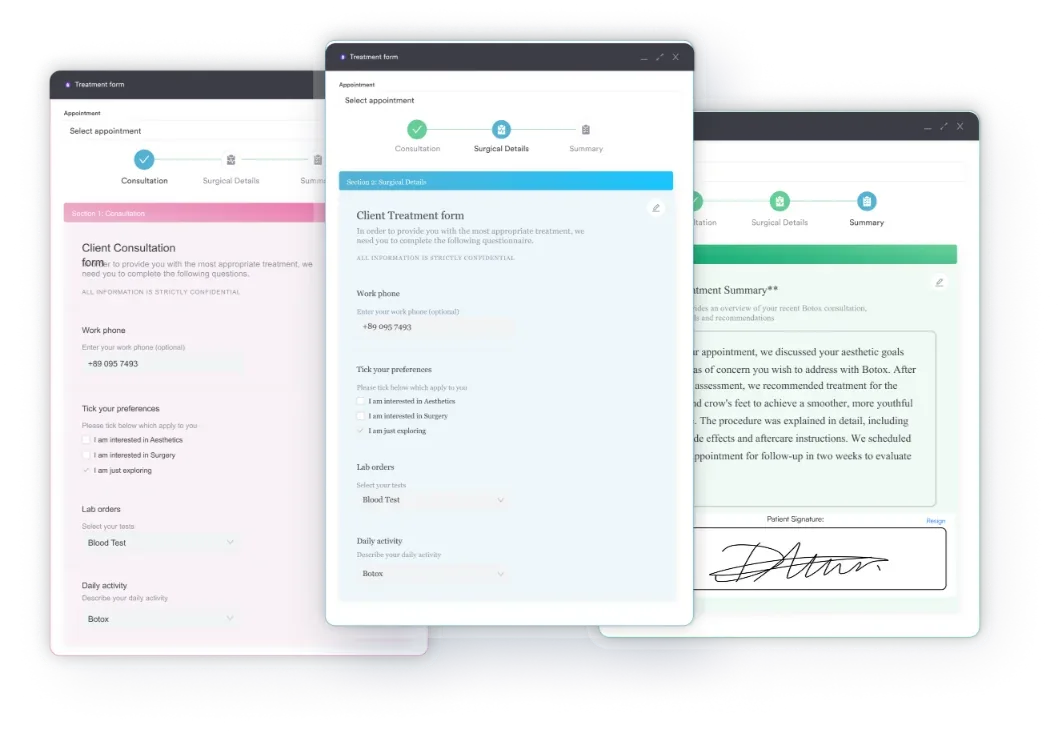
Many practices run this workflow on patient intake software rather than paper. In practice management software like Pabau, clinicians record scores directly in the chart. The totals calculate themselves, and the result lands in the care plan section.
A functional assessment earns its place across several disciplines. Physical therapy practices use it to measure mobility and strength recovery. Practices running occupational therapy software track self-care independence and community participation for clients rebuilding life roles.
Geriatric practices use the same form to screen falls risk and decide on home-safety modifications. Skilled nursing, inpatient rehabilitation, and home health agencies collect functional data for Medicare reporting and discharge planning. Mental health providers use it to see how symptoms affect daily role functioning.
Whether you run a solo practice or a large health system, one standardized form gives you documentation that holds up under audit.
Objective outcome measurement. A Barthel score of 60 says far more than the patient is improving. Numbers justify treatment duration to payers, hold up in quality audits, and give patients feedback they can see.
Interdisciplinary communication. When physical therapy, occupational therapy, nursing, social work, and medicine all score the same form, the team shares one language. A 5 on the FIM mobility item means the same thing to each of them.
Reduced clinician variability. Published scoring criteria remove the it-depends-who-assessed-them problem. Two therapists scoring the same patient on the same instrument should land within a point or two of each other.
Defensible documentation. CMS, Medicaid, The Joint Commission, and state licensing boards all expect evidence-based functional documentation. A validated instrument shows an auditor that your scoring followed a published method.
Keep every completed assessment in the same place in the patient record, such as a dedicated assessment section. Trend analysis then takes seconds at the next visit. A new team member can read the baseline and the progress without hunting through documents.
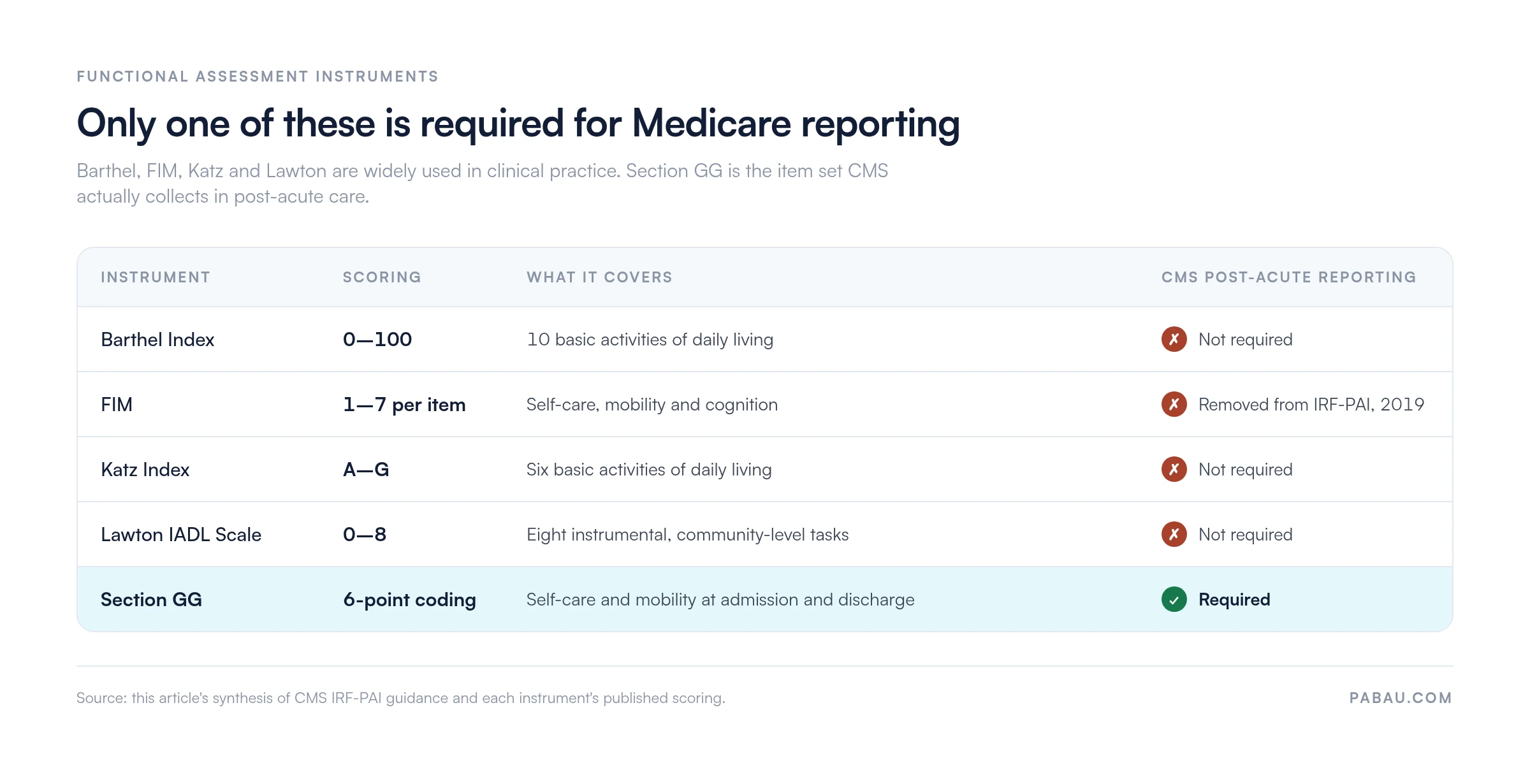
Five instruments cover most of clinical practice, and only one of them carries a Medicare reporting requirement.
The Barthel Index scores 10 basic activities of daily living on a 0 to 100 scale. The FIM, or Functional Independence Measure, scores each item from 1 to 7 across self-care, mobility, and cognition.
The Katz Index grades ADL ability from A, independent, to G, dependent. The Lawton IADL Scale scores eight instrumental, community-level tasks from 0 to 8, and suits occupational therapy caseloads.
Section GG is the outlier. These are the standardized self-care and mobility items CMS collects in post-acute care, coded on a six-point scale at admission and discharge. In October 2019 CMS removed the FIM and its Function Modifiers from the IRF-PAI, replacing them with Section GG items for reporting and case-mix. The FIM is still widely used clinically, but it is not a CMS requirement.
The Functional Assessment Standardized Items set, or FASI, is easy to confuse with Section GG. It is a voluntary CMS tool built for home and community-based services populations, not a post-acute discharge-planning mandate.
The table below lines up the five instruments on scoring range, coverage, and CMS reporting status.
Choosing an instrument depends on your patient population, your setting, and the domains you need to measure. Medical records management that stores results in a searchable format lets you compare scores across time and disciplines.
Each instrument uses its own rubric. The Barthel Index runs 0 to 100, where 100 is complete independence and 0 to 20 is total dependence. The FIM runs 1 to 7 per item, where 7 is complete independence and 1 is total dependence.
The number alone does not tell you enough. A Barthel score of 60 usually means the patient is dependent for mobility but modified independent elsewhere. Your next question is which specific tasks are failing, and which intervention will move them.
Do not read scores in isolation. A patient can score well on a paper assessment and still perform poorly at home. Fatigue, fear, or an unmentioned front step usually explains the difference. Some patients also rise to the occasion during formal testing, which flatters the score.
Ground the score in what you observed and in what the patient says about their own confidence.
Create a scoring reference sheet, laminated or digital, and post it at team workstations. This reduces scoring variability when several clinicians administer the same instrument. When the team applies the same scoring logic, your outcome data becomes comparable across months and clinicians.
The strongest use of a functional assessment is converting a baseline into SMART goals. SMART stands for specific, measurable, achievable, relevant, and time-bound.
Say a patient scores 3 out of 7 on the FIM mobility subscale, which is moderate assistance to transfer. The care plan can then set a target. Reach 5 out of 7 on FIM mobility within four weeks, through daily transfer training and a progressive reduction of the assistive device.
This link between assessment and goal is the core of evidence-based rehabilitation. Automated workflows can pull assessment scores into a goal template, so no patient leaves without measurable objectives. Progress notes then compare the current score to the baseline, which closes the loop.
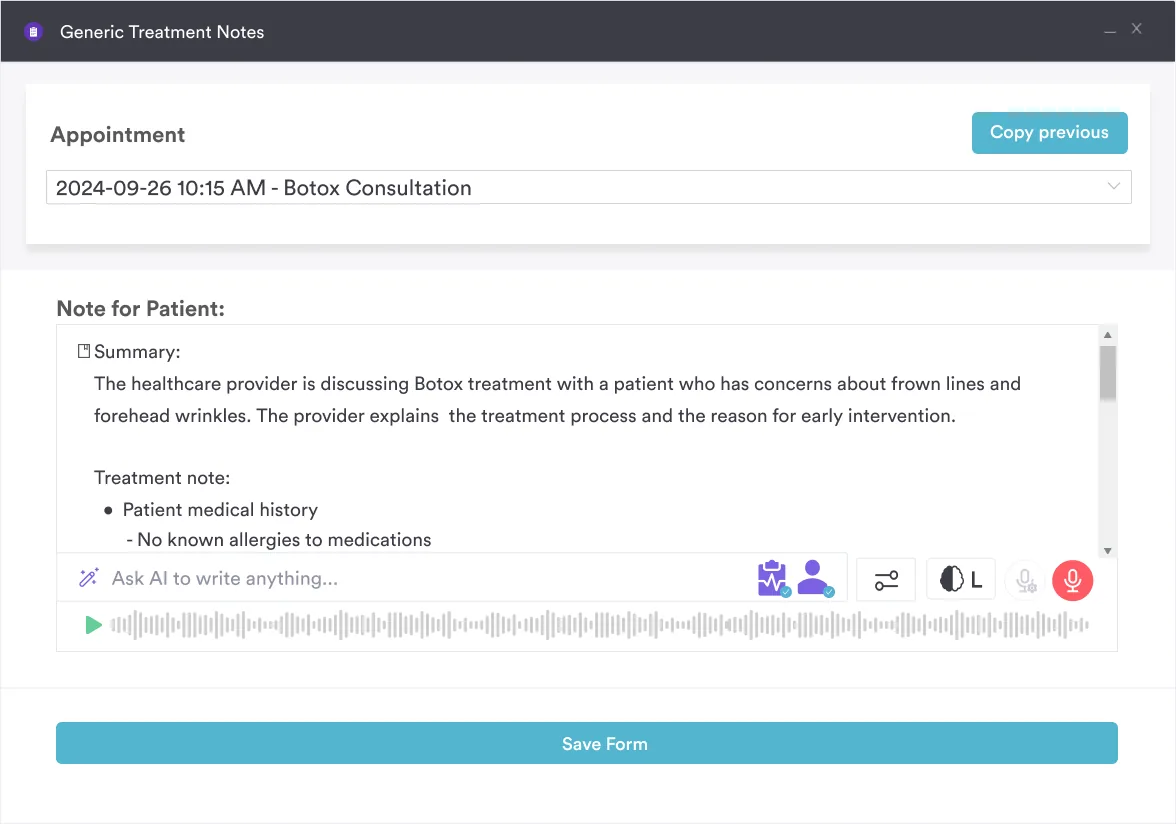
Most practices still run this on paper. A clinician scores the form at the bedside, then someone types the total into the chart later. The previous score sits in a different file, so trend analysis becomes a filing exercise.
Pabau does it differently. You build the functional assessment once as a digital form, assign it to the patient, and the totals calculate as answers come in. The completed form files itself against the client record, next to the treatment note from the same visit.
Because the score sits in the record rather than a folder, the reassessment four weeks later opens next to the baseline. Care plan goals can reference the score directly, and the audit trail comes with the record. Your team stops re-typing numbers and starts reading trends.

Move functional assessment templates into your patient records, automate the scoring, and link each result straight to a care plan goal.

A functional assessment template turns clinical intuition into documentation you can defend. The instrument you pick matters less than scoring it the same way every time, and filing it where the next clinician will find it.
Keep one distinction straight. The instrument with the best clinical reputation is not always the one your payer collects. FIM and Barthel scores still guide treatment, but post-acute Medicare reporting runs on Section GG.
Download the upper limb form above and use it at your next initial evaluation. Book a demo to see how Pabau scores functional assessments automatically and keeps every result in the patient record.

Assessing upper limb recovery after stroke? Action Research Arm Test (ARAT) covers the scoring rules and the free PDF for a performance-based upper limb measure.
Need a broader self-care screen? ADL assessment tool walks through documenting basic independence across a whole caseload.
Assessing walking rather than reaching? Functional Gait Assessment Template scores balance and gait tasks with the same structure.
Building goals around what the patient wants? Canadian Occupational Performance Measure is the interview-based measure for ranking the tasks a client cares about.
Screening for neural involvement in the arm? Upper Limb Tension Tests (ULTT) covers the test positions and what a positive response means.
A functional assessment is a structured evaluation of how well a patient performs self-care, mobility, and daily living tasks. It scores physical, cognitive, psychological, and social domains, so treatment planning and discharge decisions rest on numbers rather than impressions. Barthel, FIM, and Katz are the most common instruments.
ADLs, or activities of daily living, are basic self-care tasks such as bathing, dressing, eating, toileting, and transferring. IADLs, or instrumental activities of daily living, are community tasks such as managing finances, cooking, transportation, and medication. A patient can be independent in ADLs and still need help with IADLs.
Scoring depends on the instrument. The Barthel Index uses 0 to 100, where 100 is complete independence. The FIM uses 1 to 7 per item, where 7 is complete independence. The Katz Index grades ability from A to G. Follow the published criteria for your instrument, and document observed performance rather than patient report.
The FIM, or Functional Independence Measure, scores each item from 1 to 7, where 7 is complete independence and 1 is total dependence. It is widely used in inpatient rehabilitation, but it is no longer a CMS requirement. CMS removed the FIM and its Function Modifiers from the IRF-PAI in October 2019. Section GG items are collected for Medicare reporting instead.
Yes. The upper limb functional assessment above is free to download. It has 20 everyday activity items, each rated on a five-point difficulty scale, plus a total score field. Barthel, Katz, and Lawton are in the public domain, while the FIM requires a license from its developer.