Newborn head circumference chart
A newborn head circumference chart plots a baby’s head measurement against...

1
Last Updated: Oct 14, 2026

Mill’s test is a passive provocation test for tennis elbow. The examiner pronates the forearm, flexes the wrist, and extends the elbow to reproduce pain at the lateral epicondyle.
A positive result points to extensor carpi radialis brevis (ECRB) tendinopathy. It never confirms lateral epicondylitis on its own, so use it inside a clinical battery.
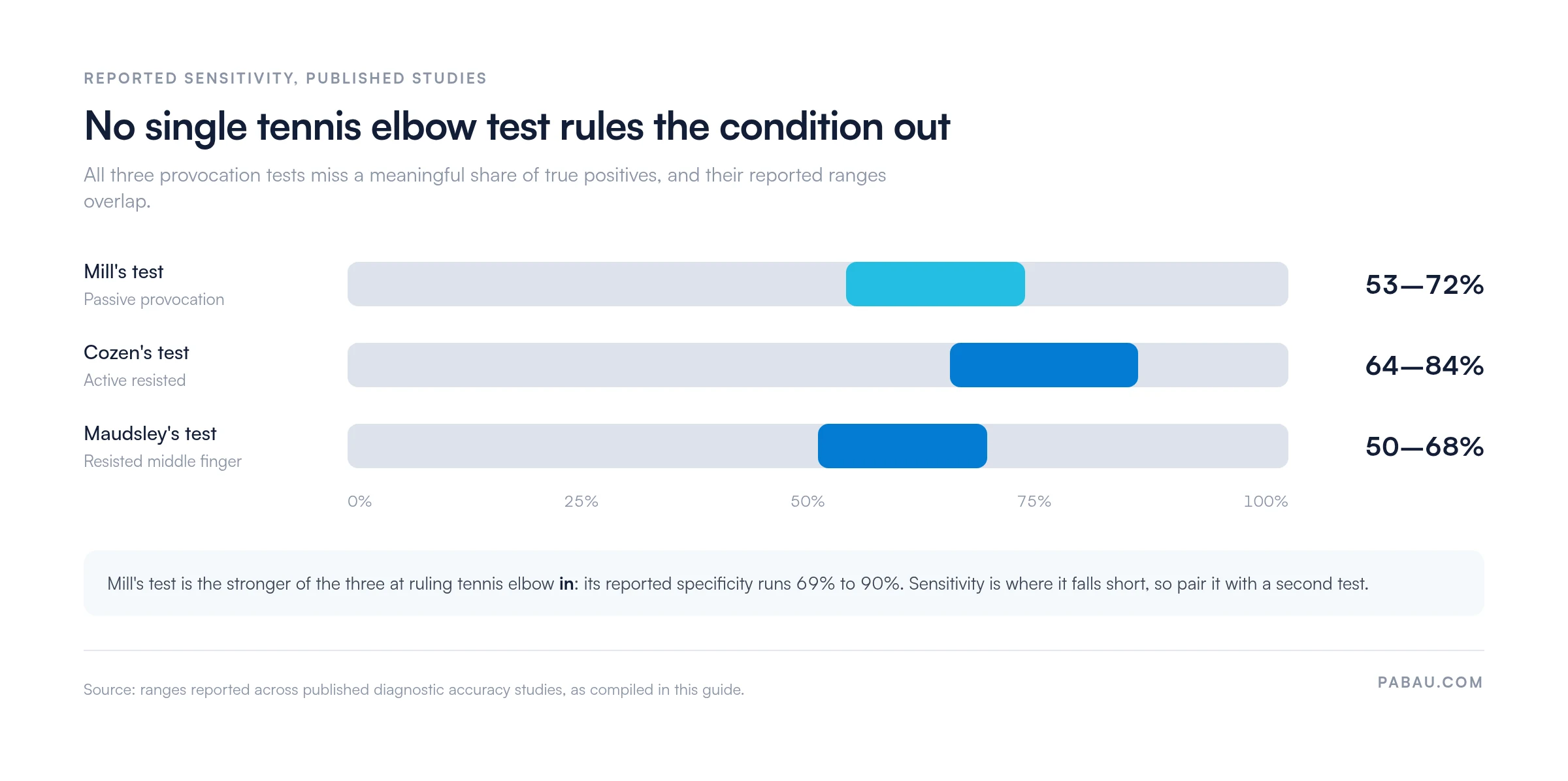
Reported sensitivity runs 53% to 72% and specificity 69% to 90%. A negative result does not rule the condition out.
Practice management software like Pabau lets physical therapy practices record test findings, track functional progress, and trigger structured reassessment.
Mill’s test is a passive provocation test for tennis elbow. You pronate the patient’s forearm, flex the wrist, then extend the elbow. Familiar pain at the lateral epicondyle counts as a positive. The whole sequence takes under 30 seconds and needs no equipment.
Lateral epicondylitis affects roughly 1% to 3% of working adults, so it turns up in most musculoskeletal caseloads. This guide covers the technique, how to read the result, and what the accuracy figures mean in practice. It also compares the test with Cozen’s and Maudsley’s.
Mill’s test is an orthopedic provocation test used to assess lateral epicondylitis, also called tennis elbow or lateral elbow tendinopathy. It belongs to the family of elbow special tests that stress the common extensor origin at the lateral epicondyle of the humerus. Loading that tissue passively reproduces the patient’s symptoms when it is the source.
G. Percival Mills (G.P. Mills), FRCS, described the test in the BMJ in 1928. It remains one of the most widely used clinical tools for identifying extensor carpi radialis brevis (ECRB) tendinopathy. Its value lies in its speed. An experienced clinician can complete it in under 30 seconds, which makes it practical inside a busy musculoskeletal appointment.
The Physiopedia clinical reference on Mill’s Test notes that the test provokes pain specifically at the lateral epicondylar region. It does so through a combination of passive movements that maximally tension the ECRB.
Knowing which structures each movement tensions tells you what an unexpected result means. The lateral epicondyle of the humerus is the bony attachment site for the common extensor origin, where several forearm extensor tendons converge.
The ECRB originates here and inserts at the base of the third metacarpal. It is the most mechanically vulnerable tendon in this region. Its origin sits directly beneath the radial head and takes high tensile loads during gripping and wrist extension.
Pronating the forearm internally rotates the radius, placing the ECRB under stretch. Adding full wrist flexion increases that tension. Extending the elbow to full range removes any slack left in the tendon complex.
The three movements build a cumulative load on the ECRB. That is why all three must be performed in sequence for the result to mean anything.
Technique is the single biggest variable affecting the test’s reliability. Run each step below in order. Skipping or rushing a stage reduces the load on the ECRB and invites a false negative.
Seat the patient with the shoulder in neutral rotation and the arm relaxed at the side. The elbow starts slightly flexed, at roughly 20 to 30 degrees. Avoid full extension at the start, because that pre-tensions the elbow and gives a misleading baseline. The forearm should sit neutral or slightly supinated before you begin.
Stand on the lateral side of the patient’s arm. Place one hand over the dorsum of the wrist and hand to control forearm rotation and wrist position. Place the other over the posterior elbow to guide extension and monitor for lateral epicondyle tenderness. Neither hand grips tightly, because the movements are passive rather than forceful.
Perform the three movements in sequence, then apply gentle overpressure at end range:
Guidance from the Chartered Society of Physiotherapy on musculoskeletal assessment puts a condition on tests like this one. A passive special test should follow a thorough subjective history and a baseline range-of-motion assessment, so the finding has context.
Interpretation is where the test earns its keep, and where it misleads if you read it without context.
A positive Mill’s test is pain reproduced at or near the lateral epicondyle during the passive sequence. The pain should feel familiar to the patient and match their presenting complaint rather than being a new sensation. Pain over the ECRB insertion suggests tendinopathy at the common extensor origin.
A positive result raises the probability of lateral epicondylitis without confirming it. Combine the finding with a full history, symptom duration, grip strength assessment, and at least one more provocation test. Cozen’s or Maudsley’s will do. Only then form a working diagnosis.
Recording the result the same way every time is what makes a reassessment comparable four weeks later. Structured clinical notes let a team log the test, the pain score, and the interpretation in the same fields on every visit.

A negative Mill’s test does not rule out lateral epicondylitis. Reported sensitivity of 53% to 72% means the test misses a meaningful share of true positives.
Say a patient reports lateral elbow pain aggravated by gripping and resisted wrist extension. A negative Mill’s test should not end the diagnostic pathway there. Try Cozen’s test or Maudsley’s test instead. Each places different mechanical demands on the common extensor origin, so one may provoke symptoms the other does not.
Published accuracy values for Mill’s test vary across studies. The differences come from reference standards, patient populations, and examiner training. Read the ranges below as population-level estimates rather than absolutes for the patient in front of you.
Values are ranges across multiple published studies. Consult primary sources for study-specific figures.
Mill’s test does not sit alone in that band. Set its reported sensitivity against the two tests clinicians most often run alongside it, and the overlap is hard to miss.
These are the technique errors most likely to produce a false negative or an invalid result.
Standardizing technique across a team reduces inter-rater variability. A digital assessment form can carry a Mill’s test checklist field. Every clinician then documents the same technique variables, and the record reads consistently across the team.

Before performing Mill’s test, confirm the patient’s elbow has full passive range of motion and no signs of acute trauma or instability. A pre-test palpation of the lateral epicondyle helps you localize where to watch for the pain response during the movement sequence.
Mill’s test reads best alongside its companion tests. The table compares the three most common alternatives on technique type, sensitivity, and clinical use case.
Cozen’s test uses active resisted wrist extension. The patient makes a fist and pushes into extension against your resistance, with the elbow extended.
That loads the ECRB through active contraction rather than passive stretch, which is why its sensitivity tends to run higher. Our Cozen’s test template sets out the hand placement and the scoring.
Maudsley’s test resists extension of the middle finger alone, which loads the extensor digitorum communis at the common extensor origin. Neither test replaces Mill’s test when active contraction is too painful for the patient to tolerate.
Clinical decision rules work much the same way in other joints. The Ottawa ankle rules show how a validated rule narrows an imaging decision without replacing the clinical picture.
Mill’s test belongs in the assessment of any patient with lateral elbow pain. That goes double for anyone who reports pain on gripping, lifting, or repetitive forearm work. These indicators support adding it to your elbow battery:
Skip Mill’s test, or modify it, in the presence of the following:
Clinical practice guidelines for elbow conditions from the American Physical Therapy Association (APTA) recommend screening for alternative diagnoses first. Radial tunnel syndrome and cervical referral both belong on that list, before you attribute lateral elbow pain to ECRB tendinopathy.
A confirmed positive, plus a supporting history and one other positive provocation test, supports a working diagnosis of ECRB tendinopathy. From there, treatment planning follows a load-management model. The Chartered Society of Physiotherapy endorses a progressive loading approach for tendinopathy rehabilitation.
Re-testing at reassessment appointments gives you an objective marker of progress. A drop in pain provocation intensity, or a shift from strongly to weakly positive, points to improving ECRB tolerance. The same progressive loading and reassessment logic drives a return-to-running protocol in lower-limb rehabilitation.
Special tests only deliver consistent outcomes when the documentation and the follow-up are equally consistent. Ad hoc note-taking, inconsistent test recording, and missed reassessment appointments are where clinical quality slips in a busy practice.
Pabau is used by physical therapy and musculoskeletal practices to manage the whole assessment-to-discharge workflow. A clinician can record the Mill’s test result, the pain score, and the interpretation in a structured note template. Later appointments pull the prior assessment forward, so progress is tracked against a clear baseline.
Outcome tracking sits alongside those notes. Practices log grip strength dynamometry scores, pain ratings, and functional scores next to the special test findings. That builds the longitudinal record an objective reassessment needs.
Recall automation closes the loop. Pabau can trigger a reassessment reminder at a set interval after the initial assessment. Fewer patients then drop out of a rehabilitation program before they reach functional recovery.
The physical therapy EMR built into Pabau ships with note templates for musculoskeletal special test batteries. If you are still comparing options, our guide to physiotherapy clinic management software breaks down what to look for.
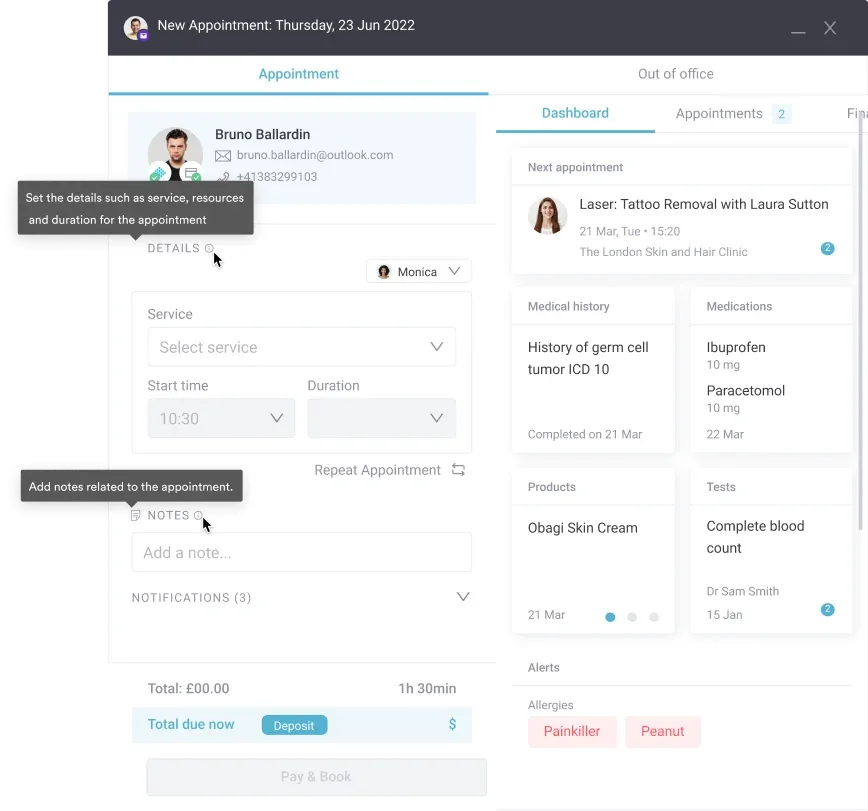

Pabau helps physical therapy and sports medicine practices document special test findings, track outcome measures over time, and automate reassessment recall. Your clinical data then works as hard as you do.

Mill’s test tells you more when it is positive than when it is negative. Treat a positive as a strong pointer toward ECRB tendinopathy. Treat a negative as a reason to keep looking rather than a reason to stop.
The trade-off is speed against certainty. Thirty seconds of passive loading buys a probability shift, not a diagnosis, so pair it with a second test and a careful history. Then re-run it at reassessment, because the change in the result is worth more than the first reading.
Consistency is the part that scales. Pabau turns a well-performed Mill’s test into a tracked baseline you can measure against. Book a demo to see how Pabau handles special test documentation and reassessment recall for physical therapy teams.

Building out a shoulder assessment battery? The infraspinatus test walks through technique, interpretation, and where it sits among the rotator cuff tests.
Need a compliance framework for your practice? Mandatory compliance requirements for physiotherapy clinics covers the standards UK and international practices need to meet.
Want to know what practice software should cover? Physiotherapy clinic management software breaks down the features that support day-to-day physical therapy operations.
Mill’s test is a passive provocation test used to assess lateral epicondylitis, better known as tennis elbow. It detects tendinopathy of the extensor carpi radialis brevis (ECRB) at the lateral epicondyle. It runs during a musculoskeletal elbow assessment, as part of a multi-test clinical battery. A positive result indicates likely ECRB involvement, but it does not confirm the diagnosis in isolation.
Seat the patient with the elbow slightly flexed and the shoulder in neutral. With one hand at the wrist and the other guiding elbow position, passively pronate the forearm fully. Flex the wrist to end range while holding pronation, then extend the elbow slowly toward full extension. Apply gentle overpressure at end range and watch for pain at the lateral epicondyle.
A positive Mill’s test means the passive movement sequence reproduced the patient’s familiar pain at or near the lateral epicondyle. That suggests extensor carpi radialis brevis tendinopathy. It raises the probability of lateral epicondylitis, but read it alongside the patient history, palpation findings, and other provocation tests before forming a working diagnosis.
Published studies report sensitivity of 53% to 72% and specificity of 69% to 90%. So Mill’s test is better at ruling lateral epicondylitis in, when positive, than ruling it out when negative. The values vary across studies depending on patient population, reference standard, and examiner training.
Mill’s test uses passive movement to tension the ECRB. Cozen’s test uses active resisted wrist extension, loading the ECRB through muscle contraction, and tends to report slightly higher sensitivity of roughly 64% to 84%. The two complement each other, so running both in the same battery improves diagnostic yield over either alone.
No. With sensitivity of 53% to 72%, Mill’s test misses a substantial share of true positives. A negative result reduces the probability of lateral epicondylitis without eliminating it. Do not close the diagnostic pathway on a negative Mill’s test alone, when the history and presentation still point at the condition.