Emotional awareness worksheet
An emotional awareness worksheet is a structured psychoeducational tool that hel...

4
Last Updated: Oct 16, 2026

The toxic personality test is a two-page form with 14 rated statements grouped into self-reflection, interpersonal relationships, and emotional regulation.
Clients rate every statement from 1 to 5, so a completed form totals somewhere between 14 and 70.
The test screens for behavioral patterns and never assigns a diagnosis, so a high score opens a conversation rather than closing one.
Section subtotals show where the pattern sits, which points the therapy toward the area that needs the work.
Pabau’s digital forms and client records let therapists run this assessment at intake and track the score across sessions.
A two-page clinical form with 14 rated statements across three sections covering self-reflection, interpersonal relationships, and emotional regulation. Each section carries its own total score line, and page two adds space for the client’s reflections plus your action plan and follow-up notes.
Download templateA toxic personality test gives a therapist a short, repeatable way to put a number on a client’s harmful relational patterns. This one runs to two pages and asks the client to rate 14 statements about their own behavior.
Ratings run from 1 to 5, so a completed form totals between 14 and 70. Three sections cover self-reflection, interpersonal relationships, and emotional regulation. Unlike the web quizzes built for entertainment, this one is designed to sit in a client record and be repeated.
A toxic personality is a behavioral pattern marked by chronic interpersonal harm. It shows up as manipulation, low empathy, emotional dysregulation, and boundary violations. It is not a formal DSM-5 diagnosis. The phrase describes trait clusters that the American Psychological Association recognizes as maladaptive.
Toxic traits often co-occur across several personality disorders, including narcissistic, histrionic, and antisocial presentations. They also travel with attachment disturbances, trauma responses, and untreated mental health conditions.
Naming the pattern in session gives you somewhere to start. Cognitive restructuring, emotion regulation coaching, and motivational interviewing all work on relational accountability.
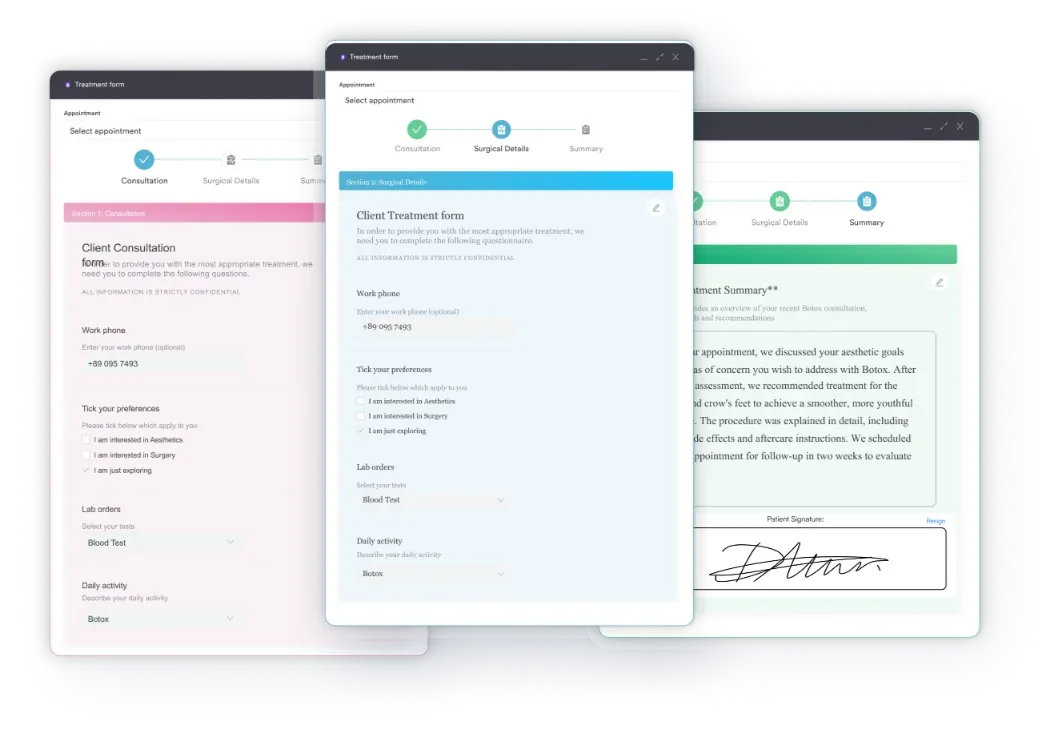
Personality psychology treats toxic behavior as a cluster of traits rather than a single condition. The American Psychological Association and the wider trait literature keep returning to the same behaviors. This test sorts its 14 statements into three sections, and each one probes a different part of the pattern.
Clients who rate themselves high across all three sections often present with relationship breakdown, repeated conflict, and unstable employment. Screening early lets you aim the work at behavior change. It also shows you when the pattern runs deeper than individual therapy can reach on its own.
When toxic traits show up in a romantic partnership, the damage compounds. Partners describe emotional exhaustion, gaslighting, financial control, isolation from friends, and chronic stress. Therapists working with couples need a quick screening tool to document the pattern and set a baseline for measuring progress.
The test’s second section covers this ground directly, so a high subtotal there gives you something concrete to work from. That matters for safety planning and for helping a client see the dynamic without the fog of emotional manipulation.
Administration is straightforward and needs no special training. Most clients finish the rated statements in five to ten minutes, either in session or shortly before it. The completed form then belongs in the client’s chart, filed with the notes from that session.
There is one quirk to know before you print it. Section 3 numbers its four statements 2 through 5 rather than 1 through 4. A client who counts the items may think a page is missing, so say so up front.
Store the scored form in the client record, then repeat the test every 6 to 12 weeks. Comparing two administrations is what turns a single number into evidence of progress.
The form gives you one total plus three section subtotals, and it ships without a scoring key of its own. The bands below split the 14 to 70 range into four equal steps. Write the band you land on into the record alongside the raw total.
Section subtotals tell you where the pattern lives, but they do not compare directly. Sections 1 and 2 hold five statements each and top out at 25. Section 3 holds four and tops out at 20.
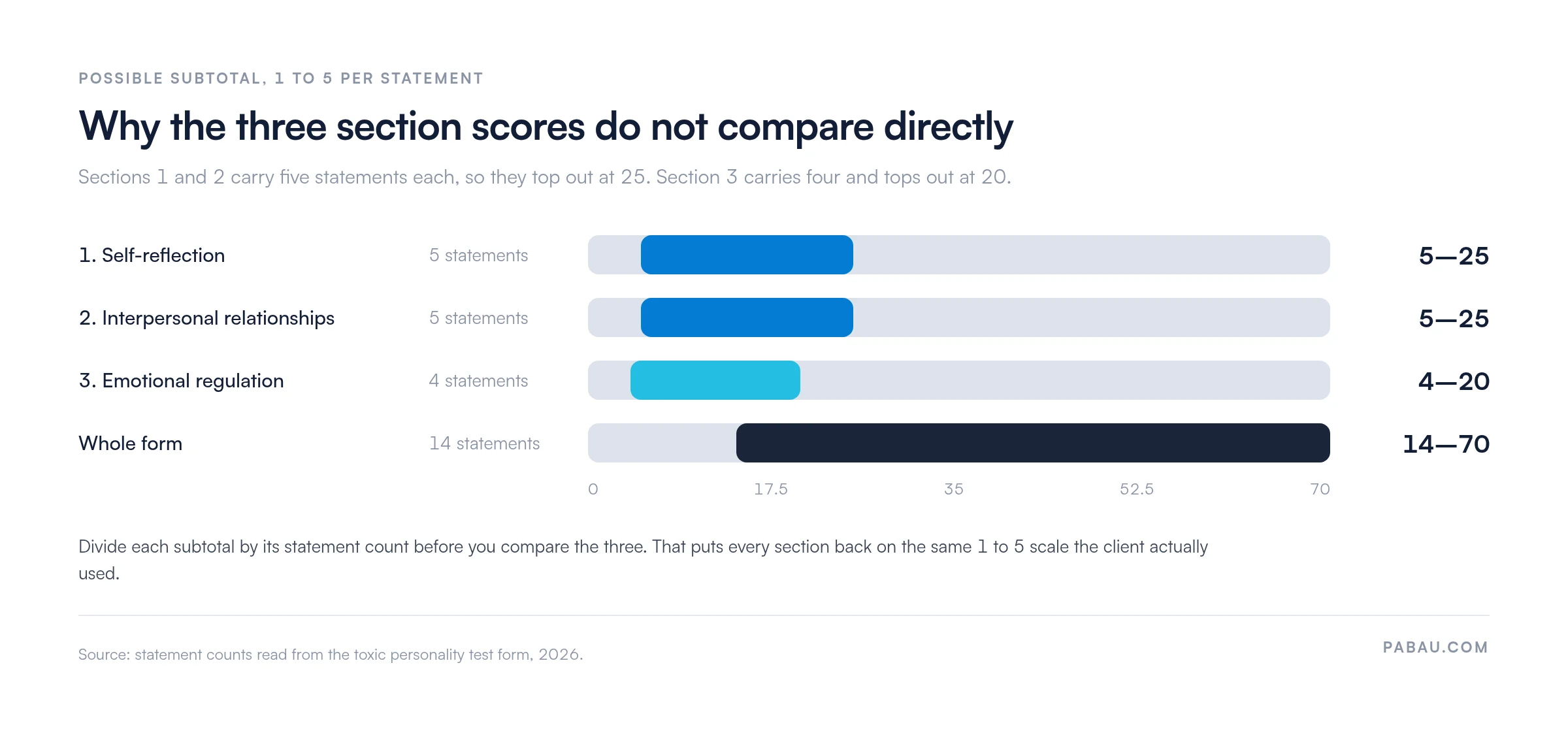
Divide each subtotal by its statement count to put the three on the same footing. A client averaging 4 on interpersonal relationships needs different work than one averaging 4 on emotional regulation. The first points toward relational skills, the second toward distress tolerance.
Once identified, toxic traits become workable in therapy. The test gives you and your client a shared language for the pattern and a baseline for measuring change.
Behavioral change is possible, but it takes motivation, skill-building, and often longer-term work. The test helps you show progress to the client and justify continued treatment to an insurer.
A test the whole team administers the same way makes for smoother therapy practice workflows. This one fits intake, ongoing monitoring, and discharge planning.
Recording the result in a progress note strengthens the clinical record and supports billing. Our guide to writing SOAP notes covers where an assessment score belongs in each section. Store the scored PDF and your interpretation together in the client chart.
Purpose-built psychology practice software lets you track results over time, flag high-risk clients, and report on outcomes across your caseload.
The PDF usually gets printed, scored by hand, and filed in a folder. The number reaches a progress note if someone remembers to type it there. Six weeks later, nobody can find the baseline to compare the second administration against.
Practice management software like Pabau turns the same form into a digital intake form the client fills in before the session. Their answers save straight to their record, so the score sits beside the notes, the treatment plan, and the appointment history.
That is what makes the repeat administration worth doing. You can pull last quarter’s total, set it against today’s, and show the client the movement in their own numbers. It also gives you the documentation an insurer asks for when it reviews continued treatment.

Pabau’s digital forms and client records capture each toxic personality test result and file it in the client’s chart. Repeat administrations sit side by side, so you can evidence progress without digging through paper.

The toxic personality test earns its place by being short enough to repeat. Fourteen statements across three sections produce a total between 14 and 70. That is a number you can set beside the one from three months ago.
The form ships without a scoring key, so keep this page open when you total a sheet. The trade-off is worth naming too. A screening score describes a pattern and never diagnoses one, and treating it as a diagnosis is the fastest way to lose the client’s trust.
Clients with toxic traits often cannot see the effect of their behavior, or they push the blame outward. A structured assessment gives the conversation a starting point that neither of you has to argue about. Book a demo to see how digital forms, client records, and progress tracking keep every scored assessment in one secure place.

Need the trait science behind the pattern? Dark core personality test covers the shared factor that links manipulation, callousness, and entitlement.
Screening for something more entrenched? Antisocial personality disorder test gives you a longer form for clients whose scores sit in the top band.
Section 3 the highest subtotal? Emotional regulation checklist turns that number into session-by-session skills work.
Working with attention-seeking presentations? Histrionic personality disorder test screens the traits this shorter form only touches on.
Need the relational piece next? Healthy boundaries worksheet gives clients something practical to work on after a high interpersonal subtotal.
The PDF runs to two pages. Page one holds Section 1 on self-reflection and Section 2 on interpersonal relationships, with five rated statements each. Page two holds Section 3 on emotional regulation with four statements, then space for the client’s reflections, your action plan, and additional notes. Every statement uses a 1 to 5 scale, and each section has its own total score line.
No. The test screens for behavioral patterns and trait clusters. It does not diagnose a DSM-5 personality disorder. Diagnosis requires a full psychiatric evaluation by a licensed clinician, ideally a psychiatrist or licensed psychologist. Treat this form as a clinical screening tool rather than a diagnostic instrument.
Add the ratings within each section to get three subtotals, then add those for the overall figure. With 14 statements rated 1 to 5, totals run from 14 to 70. The PDF carries no scoring key of its own, so use the four bands published on this page. Sections 1 and 2 top out at 25, while Section 3 tops out at 20. Divide each subtotal by its statement count before comparing them.
Yes, but behavior change takes motivation, skill-building, and time. Traits anchored in early attachment patterns, trauma, or neurobiological factors resist it more. Research supports cognitive-behavioral, dialectical, and schema therapies for reducing toxic behaviors when clients engage with treatment.
Share the result compassionately and frame it as self-awareness data. Explore the developmental roots, target the highest-scoring section with specific skills, and repeat the test to track progress. Some clients will not engage, and some behavior carries safety risks such as abuse or violence. In either case, consider referral to a specialized program or psychiatric consultation.
Take a baseline at intake or early in treatment, then repeat every 6 to 12 weeks. Treatment intensity and the client’s engagement decide where you land in that window. Quarterly administration works well for ongoing therapy and supports insurance documentation of progress.
Yes. Giving it to both partners quantifies the relational pattern and shows where each person sits. Approach it carefully. Frame the result as a shared reference point rather than blame, and use it to guide targeted couples interventions or individual work.
The toxic personality test draws on empirically supported personality psychology and trait research. The National Institute of Mental Health does not endorse specific clinical tools. The underlying constructs of manipulation, empathy, and impulse control are validated in peer-reviewed literature and align with DSM-5 personality disorder criteria.