Maja Popovska
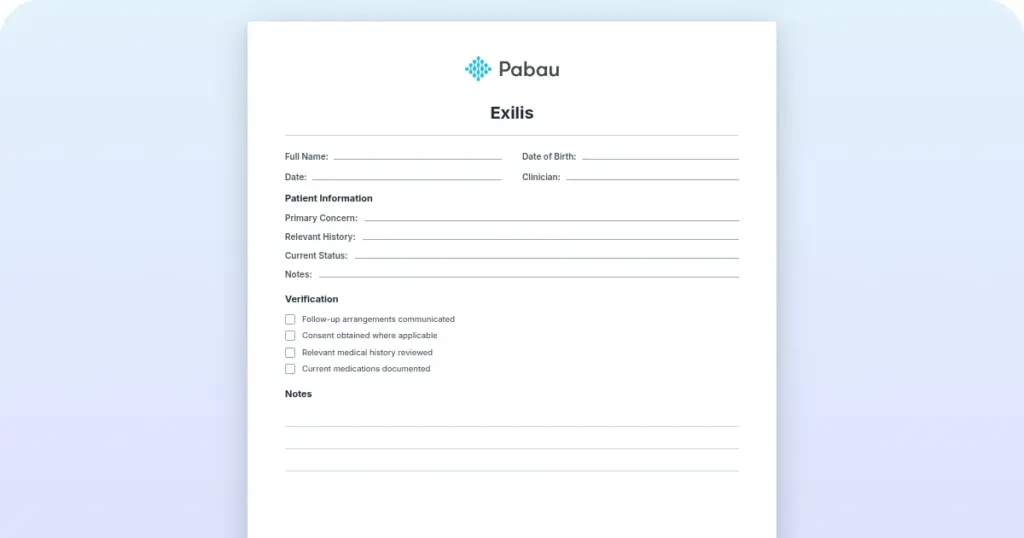
Exilis patient treatment record: Free PDF for RF sessions
An Exilis patient treatment record is the session log for BTL’s radiofrequ...

3
Last Updated: Oct 23, 2026
Free PDF 2 pages, print-ready Clinician-reviewed
Patients who leave with clear. This Apriline treatment aftercare instructions template gives every patient product-matched guidance in writing. It also gives your team a reusable, practice-branded resource that covers all four Apriline formulations, so you are not rewriting recovery advice after every appointment.
A comprehensive aftercare template for patients receiving Apriline hyaluronic acid dermal filler, skin booster, and mesotherapy treatments, covering post-treatment recovery expectations, side effect management, activity restrictions, and when to contact your practitioner.
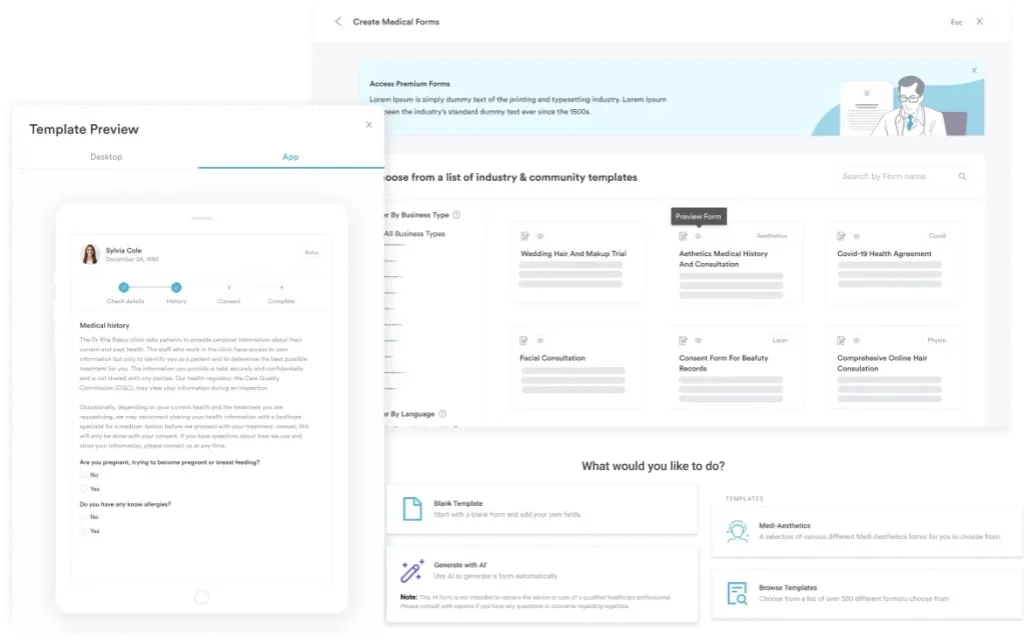
Upload this PDF, or any form you already use, and Pabau's AI Form rebuilds it with tick boxes, text fields and a signature. Attach it to the treatment once, and every patient gets it on time.
AI Form rebuilds the consent, history and aftercare forms you already use. You review each one, then publish.
Patients complete forms on their phone before they arrive, so the front desk stops retyping paper.
Every signed form is versioned and attached to the treatment record, ready when you need it.
Set how long a consent stays valid. Returning patients skip forms they have already signed.
Supports HIPAA and GDPR compliance AES-256 encryption 4.8 on G2 4.7 on Capterra Trusted by 4,000+ practices worldwide

Apriline treatment aftercare instructions guide post-injection recovery across dermal fillers, skin boosters, and mesotherapy
Most mild side effects (bruising, swelling, redness) resolve within 3-7 days; temperature and activity restrictions protect healing
Practitioners must educate patients on red-flag symptoms (severe pain, persistent swelling, signs of vascular occlusion) requiring immediate contact
Practice management software like Pabau sends aftercare through the patient portal and automates day 1, 3, and 7 reminders, so patients follow guidance without extra admin
An Apriline treatment aftercare instructions document is a patient-facing guide practices hand out immediately after Apriline hyaluronic acid injections (dermal fillers, skin boosters, or scalp mesotherapy). It sets out the recovery timeline, activity restrictions, side effect expectations, and red-flag warning signs.
Apriline comes in multiple formulations—Normal (6-10 months), Forte (8-12 months), Hydro (3-6 months), and HAIRline (scalp mesotherapy). Each has slightly different injection techniques and recovery profiles. A comprehensive aftercare template addresses all product lines and distinguishes between filler-specific recovery (deeper tissue, longer results) and skin booster recovery (superficial, hydration-focused).
The template does two jobs at once:
Effective aftercare communication happens in five structured steps, each mapped to the template sections:
Practice management software like Pabau lets you automate this whole sequence with digital forms and templated messages. Send pre-appointment prep, aftercare reminders on days 1, 3, and 7, and book the follow-up consultation automatically, so nothing depends on someone remembering to hit send.
This template is essential for any practice administering Apriline injectables:
Any practice accepting hyaluronic acid injectable patients—regardless of location or specialty—benefits from a standardized, practice-branded aftercare resource. The template is especially valuable for multi-location practices, where consistency across sites protects reputation and reduces liability risk.
GP practices often build forms like this into GP clinic software so records stay complete and auditable.
1. Improves patient safety and compliance. Patients with written instructions follow guidance more consistently than those relying on verbal advice. Clear timelines (“no exercise for 24 hours”) are more actionable than vague recommendations (“take it easy”).
2. Reduces post-treatment complications. Bruising, swelling, and infection risk decrease when patients avoid touch, heat, blood thinners, and intense activity. A dedicated “Dos and Don’ts” section makes prevention intuitive.
3. Protects against liability. Documented aftercare guidance—signed or confirmed by the patient—demonstrates informed consent and adherence to clinical standards. If a complication arises, your records show the patient received evidence-based guidance.
4. Increases patient satisfaction. Patients who know what to expect and feel supported during recovery report higher satisfaction and are more likely to rebook.
5. Saves practice staff time. A templated aftercare document eliminates repetitive verbal explanations. Staff can focus on clinical care instead of answering the same “Is this swelling normal?” questions repeatedly. Automated email and SMS campaigns deliver aftercare reminders without manual effort.
A complete Apriline aftercare template covers seven essential areas:
Apriline Normal and Forte (deeper, cross-linked fillers) require stricter activity restrictions and longer recovery expectations than Hydro or skin boosters. A comprehensive template distinguishes between these formulations so patients receive product-matched guidance.
These are the most common patient concerns. Explain that mild bruising and swelling are normal after any injection and usually settle within 3 to 7 days. Recommend ice for the first 24 hours. Tell patients not to massage or press the area unless you specifically instruct them to, since unprompted massage can move the product. Some practices suggest arnica or silicone gel. Verify these against your medical director’s protocols before including them.
Apriline Forte lasts 8-12 months, Normal 6-10 months, Hydro 3-6 months. Clearly state these ranges in the template. Patients often ask whether following aftercare perfectly will make results last longer. The answer is no. Duration depends on metabolism and product formulation, not aftercare compliance. Say so in the template to set realistic expectations.
Final results are visible at 2 weeks (as swelling resolves) and stabilize at 4 weeks. Patients expecting immediate full results will be disappointed. Use the template to reset expectations: “You will see improvement immediately, but final results appear as swelling reduces over 2-4 weeks.”
Rare but serious. If a patient reports severe or worsening pain, skin blanching (pale patches), or a dusky, mottled color, they need to reach you immediately, potentially for hyaluronidase to dissolve the filler. Never advise a patient to self-manage this. Include a clear line in the template: “Contact us immediately if you experience severe pain, skin blanching, or discoloration. Do not wait.”
A template is only effective when it’s integrated into your practice systems. Use clinical documentation tools to flag aftercare sections in patient records. Send reminders on Days 1, 3, and 7 post-treatment. Schedule automatic follow-up appointments at the 2-week mark to assess results and address concerns.
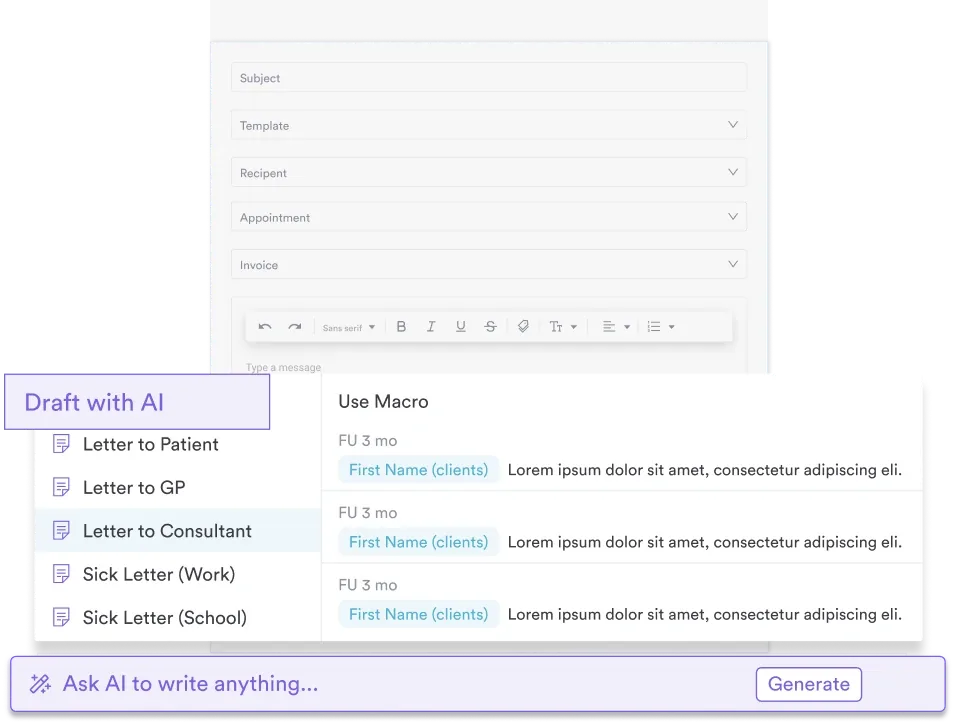
Store the template in your practice management system so every clinician can access, customize, and distribute the same version. This ensures consistency across your team and multiple locations. Add your practice logo and contact details to reinforce branding and make it easy for patients to reach you.
In the US, the FDA regulates dermal fillers as medical devices, and documented aftercare is part of demonstrating informed consent. Record that each patient received and understood their aftercare guidance. Professional bodies such as the American Society of Plastic Surgeons (ASPS) publish patient aftercare guidance for injectable treatments.
The American Society for Dermatologic Surgery (ASDS) also publishes clinical guidance for injectable treatments, and documented aftercare supports the standards of care they set out. A written template makes that documentation routine rather than something you assemble after the fact.
A clear Apriline aftercare template supports your practice, educates patients, and improves outcomes. Use the downloadable template above as your starting point, customize it with your branding and protocols. Standardized, documented aftercare keeps patient safety and satisfaction consistent across every visit.

Need a template for consent before dermal filler treatment? Dermal filler consent form covers pre-treatment safety screening, informed consent documentation, and liability protection.
Want to automate patient reminders after treatment? Automated email and SMS campaigns send pre-appointment prep, post-treatment care reminders, and follow-up appointment invitations without manual effort.
Tired of last-minute cancellations and no-shows? Cancellation policy guide offers free templates to help set clear cancellation and no-show rules.
Aftercare is the last step in any Apriline treatment, and the one patients handle alone at home. Clear, product-matched instructions keep them on track once they leave your practice. This downloadable template gives your team a consistent starting point for every patient, whatever formulation they had. Customize it with your details and use the same version across your practice. Want to see how digital forms and automated day 1, 3, and 7 reminders handle aftercare follow-up for you? Book a demo of Pabau.
Apriline treatment aftercare instructions are post-treatment guidance for patients receiving Apriline hyaluronic acid dermal fillers, skin boosters, or scalp mesotherapy. They cover recovery expectations, activity restrictions, side effect management, and red-flag warning signs requiring immediate practitioner contact.
Swelling typically peaks at 24-48 hours post-treatment and resolves within 3-7 days. Apriline Normal and Forte (deeper fillers) may cause slightly longer swelling than Hydro (skin booster). Ice for the first 24 hours and gentle massage after 24 hours can help reduce swelling duration.
Patients should avoid intense exercise for 24-48 hours after deeper fillers (Normal/Forte) to reduce swelling. Light walking is typically safe immediately. For skin boosters, restrictions are usually less strict. Your template should specify your practice’s protocol based on the product and injection depth.
Avoid blood thinners (aspirin, ibuprofen, alcohol, omega-3 supplements, vitamin E) for 5-7 days, as these increase bruising. Acetaminophen is safe for pain management. Patients on anticoagulants should consult their primary care physician about aftercare restrictions.
Initial results are visible immediately after treatment, but final results appear at 2 weeks (as swelling fully resolves) and stabilize at 4 weeks. Set expectations in your aftercare template so patients understand that full aesthetic results take time.
Apriline Normal lasts 6-10 months, Forte lasts 8-12 months, and Hydro lasts 3-6 months. Duration depends on individual metabolism and product formulation, not aftercare compliance. Include expected duration in your template so patients can plan touch-up appointments.