GLP-1 diet plan
A GLP-1 diet plan is a structured eating framework for patients taking semagluti...

2
Last Updated: Oct 13, 2026

The amylase test measures enzyme levels in blood or urine to spot pancreatic and salivary gland disorders.
Normal serum amylase runs roughly 30 to 110 U/L, but every lab prints its own reference interval on the report.
Acute pancreatitis usually pushes amylase to three or more times the upper limit of normal.
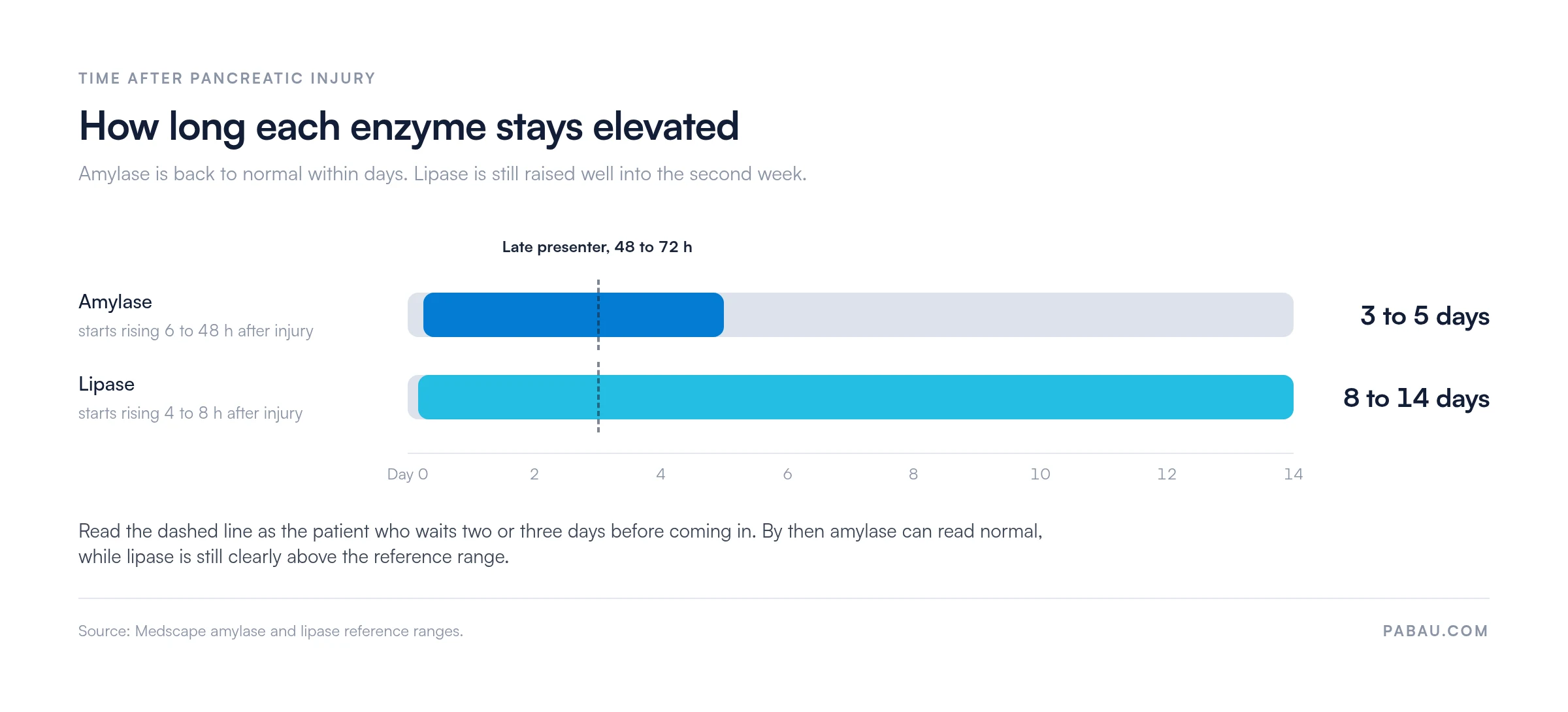
Lipase stays elevated for 8 to 14 days, so it is the better test for a patient who presents late.
Practice management software like Pabau flags out-of-range results and books the follow-up, so an abnormal amylase does not sit in an inbox.
An amylase test measures the amount of amylase enzyme in blood or urine. Clinicians order it when abdominal pain could mean pancreatitis. A result three or more times the upper limit of normal points that way. Normal serum amylase sits at roughly 30 to 110 U/L in most laboratories.
The test also has limits that are easy to overlook. Its reference range shifts between laboratories. A normal result does not rule out pancreatic disease, and a high one does not confirm it. This guide covers how to read a normal, high, or low result. It also compares amylase with lipase and shows how to keep track of what you order.
The amylase test measures the concentration of amylase, a digestive enzyme, in a patient’s blood (serum amylase) or urine. Amylase comes mainly from the pancreas and the salivary glands, and it breaks starches down into simpler sugars during digestion. A small amount circulating in the blood is normal.
A level well above or below the reference range points to a problem in an organ that makes or clears the enzyme. Clinicians order the test most often for acute abdominal pain, nausea, or vomiting that could be pancreatitis. Its clinical reach is broader than that one question.
The test is quick, inexpensive, and available through every major reference lab, including LabCorp and Quest Diagnostics. It remains a standard first-line investigation, even though lipase has taken over as the preferred marker in pancreatitis workups.
Abnormal amylase, in either direction, can reflect conditions across several organ systems. Read the number in clinical context rather than on its own.
Conditions associated with elevated amylase include:
Low amylase is flagged less often but carries its own meaning. It can indicate pancreatic insufficiency or late-stage chronic pancreatitis, where functional exocrine tissue has been lost. Cystic fibrosis affecting the pancreas can also suppress amylase production.
Most amylase tests are ordered in response to acute symptoms. The classic presentation is sudden, severe upper abdominal pain that often radiates to the back. It usually arrives with nausea, vomiting, and fever. That cluster warrants an amylase test, normally alongside lipase, to rule acute pancreatitis in or out.
Outside the acute setting, the amylase test is ordered for:
Urine amylase is sometimes preferred for monitoring across a 24-hour period. Urinary amylase stays elevated longer than serum amylase after a pancreatic episode, which widens the diagnostic window for a patient who presents late.
Standardizing the paperwork helps when the order goes to an outside lab. A lab request form captures the specimen type, the tests requested, and the clinical reason in one place. The lab then has no reason to call back for missing detail.
Cleveland Clinic puts the normal serum amylase range at 30 to 110 U/L in adults. Exact cutoffs vary by laboratory and by the analyzer in use.
Urine amylase has its own reference range, reported per hour or per 24 hours depending on the collection protocol. Compare the patient’s result with the interval printed on the report, not a textbook value.
Children and older adults may have slightly different reference intervals. Pregnancy can raise baseline amylase, particularly the salivary type. Those variations are why the lab’s own range stays the reference point in interpretation.
A single elevated amylase result is a signal, not a diagnosis, and the degree of elevation matters. In acute pancreatitis, serum amylase typically reaches three or more times the upper limit of normal. Mild elevations of 1.5 to 2 times the limit are less specific and call for broader differential thinking.
Medscape’s amylase reference-range review puts the rise at 6 to 48 hours after the insult, with a return to normal in 3 to 5 days. Conditions that raise amylase include:
When amylase is high and the clinical picture is ambiguous, lipase is ordered alongside it or instead of it to confirm pancreatic origin. High amylase with high lipase strongly supports pancreatic pathology.
When evaluating an isolated high amylase result, check the urine amylase concurrently. Low urine amylase with elevated serum amylase is a hallmark of macroamylasemia, which requires no treatment and carries an excellent prognosis. Ordering both specimens at the same visit prevents unnecessary follow-up investigations.
Low amylase gets less attention than high amylase, but it carries diagnostic weight. When serum amylase sits consistently below the reference range, it usually reflects a loss of functional exocrine pancreatic tissue rather than a measurement artifact.
Common causes of decreased amylase include:
A low result should prompt further evaluation, including fecal elastase-1 and imaging. Fecal elastase-1 is the most sensitive stool test for exocrine pancreatic insufficiency. Reading low amylase as a possible marker of insufficiency prevents a delayed diagnosis in patients with chronic digestive complaints.
Amylase and lipase are often ordered as a pair when pancreatitis is suspected, but they are not interchangeable. Lipase has become the preferred marker for acute pancreatitis in many settings, because it is more specific to the pancreas and stays elevated longer.
That longer window decides the case when a patient arrives 48 to 72 hours after symptoms started and amylase has already fallen back to baseline.
Amylase still has a role. It helps when parotitis is suspected, because lipase stays normal in salivary disease. It also helps when isoenzyme fractionation is needed to find the source of an elevation, and ordering both enzymes together raises confidence in the reading.
Several non-pathological factors push amylase above or below the reference range. Review the patient’s medication list and recent history before settling on an interpretation.
When kidney disease is in the picture, read amylase next to the patient’s renal markers. Creatinine and urea from a basic metabolic panel show whether slower clearance explains the number in front of you.
Total amylase in the blood is a mix of two isoenzyme types: P-type from the pancreas and S-type from the salivary glands. Standard amylase tests measure total amylase and cannot separate the two. When total amylase is high but the picture does not strongly suggest pancreatitis, isoenzyme fractionation becomes a useful next step.
P-type amylase makes up roughly 40% of total serum amylase in healthy adults, and S-type accounts for the other 60%. In acute pancreatitis, P-type rises sharply while S-type typically holds steady. In parotitis the pattern reverses. Measuring pancreatic amylase directly is the cleanest way to localize the source of an elevation.
Fractionation is not ordered routinely, because lipase already serves as a more specific marker of pancreatic origin in most settings. It earns its place when the patient has known or suspected salivary gland disease. It also helps when total amylase stays high without a clear cause and macroamylasemia needs to be excluded.
A result is only useful if it reaches the right clinician in time. In busy outpatient and urgent care settings, lab results often arrive after the patient has left. They sit in an inbox until someone reviews them by hand.
That delay carries clinical risk. An amylase result at three times the upper limit can mean developing pancreatitis. By the time anyone opens the message, the patient may be at home.
Practice management software like Pabau handles that differently. Its lab result tracking flags any amylase value outside the reference range as soon as it posts to the patient record. Paired with automated clinical workflows, an out-of-range value can trigger the next task on its own. That might be a same-day callback or an order for lipase.
The value, the clinical note, the medication list, and the follow-up plan then sit in one record. The same record holds the rest of a patient’s documentation, including before-and-after photo records, so a covering colleague is not chasing context across three systems.


Pabau records lab results in the patient’s chart, alerts your team when a value falls outside the reference range, and books the follow-up. Your clinicians see the number and the next step in the same place.

Amylase is a fast, cheap test that flags pancreatic and salivary trouble, and it earns its place as a first-line check. It does not stand alone. A marked elevation with acute abdominal pain needs urgent evaluation. A mild elevation in a patient on opioids or with kidney disease may mean very little.
Two habits make the number more useful. Order lipase alongside it whenever pancreatitis is on the table, and check the lab’s own reference interval before calling a result abnormal. A low result in someone with chronic digestive symptoms deserves a second look rather than a shrug.
Results get lost in the follow-up, so decide now who acts on an out-of-range value and how quickly. Book a demo to see how Pabau flags an abnormal amylase and schedules the follow-up for your team.

Reading blood gas results alongside enzyme panels? Arterial blood gas test walks through the procedure, the normal values, and how to interpret an abnormal result.
Need to make sense of a raised or low CO2 value? Carbon dioxide blood test explains what CO2 levels indicate and which conditions shift them.
Assessing nutrition and liver function in a chronic pancreatitis patient? Albumin blood test covers what albumin measures and the ranges worth acting on.
Ruling out a hepatic cause of abdominal pain? AST blood test template gives you a reference chart for recording liver enzyme values over time.
An amylase test measures the level of amylase enzyme in blood or urine. Amylase comes from the pancreas and salivary glands and helps digest carbohydrates. Abnormal levels can point to pancreatic disease, salivary gland disorders, or kidney problems.
High amylase most often signals acute pancreatitis, especially when the result is three or more times the upper limit of normal. Parotitis, bowel obstruction, renal failure, and macroamylasemia can raise it too. The degree of elevation and the patient’s presentation guide the interpretation.
Low amylase usually points to exocrine pancreatic insufficiency, late-stage chronic pancreatitis, or cystic fibrosis affecting the pancreas. Each of those reduces the number of acinar cells producing amylase. Fecal elastase-1 testing helps confirm the diagnosis.
Lipase is more specific to the pancreas and stays elevated for 8 to 14 days after injury. That makes it the preferred test for acute pancreatitis. Amylase clears faster, returning to normal in 3 to 5 days, and salivary conditions can raise it.
Acute pancreatitis is the most common cause. Parotitis including mumps, intestinal obstruction, and kidney disease can also raise it. Ectopic pregnancy and macroamylasemia do the same without any pancreatic disease.
Strict fasting is not usually required for an amylase blood test. Many laboratories do ask patients to avoid alcohol for 24 hours beforehand. Tell the ordering clinician about any medications, since opioids, diuretics, and oral contraceptives can affect the result.