Patient financing: How to offer it and stay compliant
Patient financing lets patients spread the cost of treatment over weeks or month...

Last Updated: Oct 7, 2026
A med spa cancellation policy sets how much notice a patient must give to cancel or reschedule, and what they pay if they don’t. The usual standard is 24 to 48 hours’ notice. Inside that window, the practice charges a late-cancellation fee or keeps a deposit, and a no-show can cost up to the full treatment price. Enforcing a fee also depends on the payment tools behind it, which our guide to the best med spa software compares.
The policy only holds up if the patient accepts it before booking, through an online checkbox, a signed form or logged verbal consent. One flat rule rarely fits a med spa, though. A missed consultation costs you 30 minutes, while a missed body contouring session can idle a device, a room and a provider for hours.
This guide gives you the treatment-tier cancellation matrix, which sets the notice window, deposit and fee for each type of treatment. It adds a fit-to-treat clause for patients who arrive but can’t be treated safely, and five templates you can copy.

A med spa cancellation policy states the notice window, the late-cancellation and no-show fees, the deposit or card-on-file rule, and how patients accept it.
The treatment-tier cancellation matrix suggests 24 hours’ notice for consultations and neurotoxin, 48 hours for filler and lasers, and 72 hours for body contouring.
A fit-to-treat clause turns an unsafe-to-treat visit into a free reschedule, unless the patient skipped written pre-care instructions they accepted.
A cancellation fee is generally enforceable when the patient agreed to the amount before booking, in writing or on a logged call.
One courtesy waiver per patient per year, then full prepayment after a third miss, keeps enforcement consistent without driving good patients away.
A med spa cancellation policy needs a notice window, late-cancellation and no-show fees, a deposit or card-on-file rule, and a record of patient acceptance.
Those four protect the calendar. The other six cover situations a med spa meets every week and a day spa rarely does:
Keep your no-show and cancellation rules in one document. When the front desk quotes one source, patients hear the same answer from every staff member.
Day spas usually apply one flat 24-hour rule, while med spas need longer windows and deposits for treatments that tie up providers, product and devices.
For a massage or facial, 24 hours’ notice is common practice in a spa cancellation policy. A therapist’s hour is fairly easy to refill. A med spa appointment carries costs that a day spa booking doesn’t:
Patients still compare you with the spa appointment cancellation policy they know from their massage therapist. So explain the longer window in one line: “Filler appointments need 48 hours’ notice because product is reserved for you.” A rule that gives its reason draws fewer arguments at the front desk than a bare fee.
Estheticians sit between the two models. A facial or peel in an esthetician’s own room usually follows the day spa pattern of 24 hours’ notice and a flat or 50% fee. Once an esthetician runs device treatments inside a med spa, the laser tier of the matrix below applies.
Consistency also helps patient retention. Waitlisted patients who get offered a freed-up slot often become regulars, and they only get that offer if late cancellations are reported in time.
Set the notice window and fee per treatment tier, with longer windows and deposits wherever a no-show costs more provider time, product or device time.
That is the treatment-tier cancellation matrix. The figures below are a common starting point, not survey data. Adjust them to your prices and to how fast you can refill each slot.
| Treatment tier | Suggested notice window | Deposit at booking | Late-cancellation fee | No-show fee | Why this tier is different |
|---|---|---|---|---|---|
| Consultation | 24 hours | None, card on file | Flat fee, e.g. $25 to $50 | The consultation fee in full | Short slot, easy to refill, and a new patient’s first impression of your practice. |
| Neurotoxin | 24 hours | Card on file | 50% of the booked service | 100% of the booked service | Short appointments run back to back, so one miss breaks a block of injector time. |
| Dermal filler | 48 hours | Fixed deposit, e.g. $100 | Deposit kept | Deposit kept, and prepayment for the next booking | Longer injector time, and syringes are often reserved for the patient. |
| Laser and energy-based devices | 48 hours | 25% of the treatment price | Deposit kept | 50% of the treatment price | Device time is booked in advance, and patients need pre-care days before the visit. |
| Body contouring and high-ticket packages | 72 hours | 25% to 50%, or the first session prepaid | Deposit kept | The full session price | Long sessions hold a room, a device and a provider for hours, and are the hardest slots to refill. |
| Membership or package visit | The window for that treatment’s tier | Already prepaid | One session or credit used | One session or credit used | The patient has paid in advance, so the penalty is a used session rather than a new charge. |
Two rules keep the matrix workable. Show each patient only the row for the treatment they are booking, and repeat that row’s window and fee in the booking confirmation.
A late cancellation is one made inside the notice window, while a no-show is a patient who misses the appointment without contacting you at all.
Treat them differently, because a late cancellation still gives the front desk a few hours to offer the slot to someone else. The escalation below uses the same logic as the matrix:
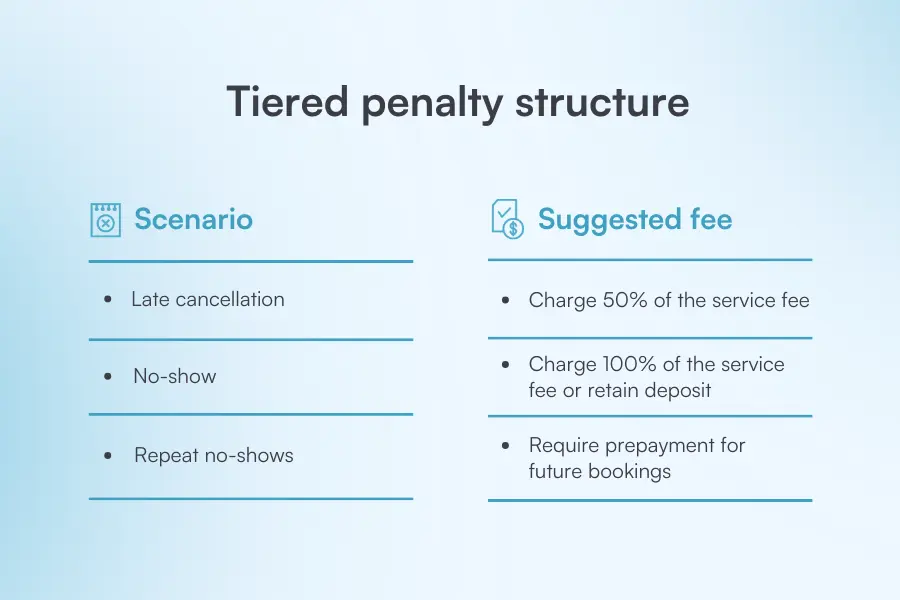
Add a late-arrival rule too. A 15-minute grace period is a common standard. After that, the provider shortens the treatment if that’s safe, or the visit is rebooked and charged as a late cancellation. For injectables, rebook rather than rush the consultation and consent steps.
Decide whether a reschedule inside the window counts as a cancellation. A workable rule is one free move inside the window per booking, with the fee applying from the second move.
Use a deposit for high-ticket tiers such as filler, lasers and body contouring, and a card on file for consultations, neurotoxin and returning patients.
| Option | Best tiers | What it does | Watch out for |
|---|---|---|---|
| Deposit | Dermal filler, laser, body contouring, first-time patients | Takes money at booking and comes off the treatment price on the day | Adds a step at booking, so state clearly when the deposit moves to a new date |
| Card on file | Consultations, neurotoxin, returning patients | Stores the card and charges it only if the policy is broken | The patient must authorize fee charges when the card is stored |
Whichever you choose, keep the record of acceptance. If a patient disputes a no-show charge with their bank, the booking timestamp and the exact policy text they accepted are your evidence. Our guide to deposits for aesthetics businesses covers how to size a deposit and when to refund one.
A fair med spa cancellation fee is half the booked price for a late cancellation, and the full price or the deposit for a no-show.
When a patient asks what the cancellation fee is, the answer should be one dollar figure for their treatment. A flat fee is easier to explain on low-ticket services. A percentage scales better on high-ticket treatments, where 50% of a body contouring session is a meaningful sum.
Here’s why the tier matters. Say your injector blocks a Thursday afternoon for four 60-minute filler appointments at $700 each. These are illustrative figures, not a benchmark.
State how the fee applies when a patient paid with a gift card, a package credit or third-party financing. Those are the bookings where the front desk most often has to improvise.
A fit-to-treat clause says what happens when a patient arrives but a provider can’t treat them safely, and when that counts as a free reschedule.
Without one, the front desk decides case by case, and the same sunburn gets charged on Monday and waived on Friday. Common reasons a provider postpones an aesthetic treatment include:
Your medical director sets the full clinical list for your treatments. The clause only has to decide who pays, and three rules cover it:
The third rule only holds if the patient received the instructions in writing. Send pre-treatment instructions automatically when the booking is made, then again with the first reminder. Put the medical history questions on the intake form, so a new medication shows up days before the visit rather than in the chair.
In practices we onboard, fit-to-treat disputes often trace back to pre-care instructions given verbally at the consultation and never sent in writing. A timestamped message settles the argument before it starts.
For packages and memberships, a late cancellation or no-show should forfeit one prepaid session or monthly credit, rather than adding a new charge.
Pay-per-visit wording breaks down once a patient has prepaid, so packages and memberships need their own rules:
Keep your med spa refund policy separate from the cancellation policy. The cancellation policy covers a missed appointment. The refund policy covers money back on unused packages, products and memberships.
State rules on prepaid services, gift certificates and auto-renewing memberships vary, so check your state’s consumer protection rules before setting expiry dates. The same goes for a membership’s 30-day cancellation notice, which is a contract term rather than an appointment rule. If you’re still designing the plan, see how to structure a med spa membership program.
Yes, a med spa cancellation fee is generally legal when the patient is told the amount and agrees to the policy before booking the appointment.
The policy is a term of the booking, so written or recorded acceptance is what makes it enforceable. Five points decide whether yours holds up:
Have a healthcare attorney in your state review the final wording, especially the deposit, package and membership clauses.
Get patients to agree before they book by building acceptance into seven touchpoints, from the online booking checkbox to the front desk.
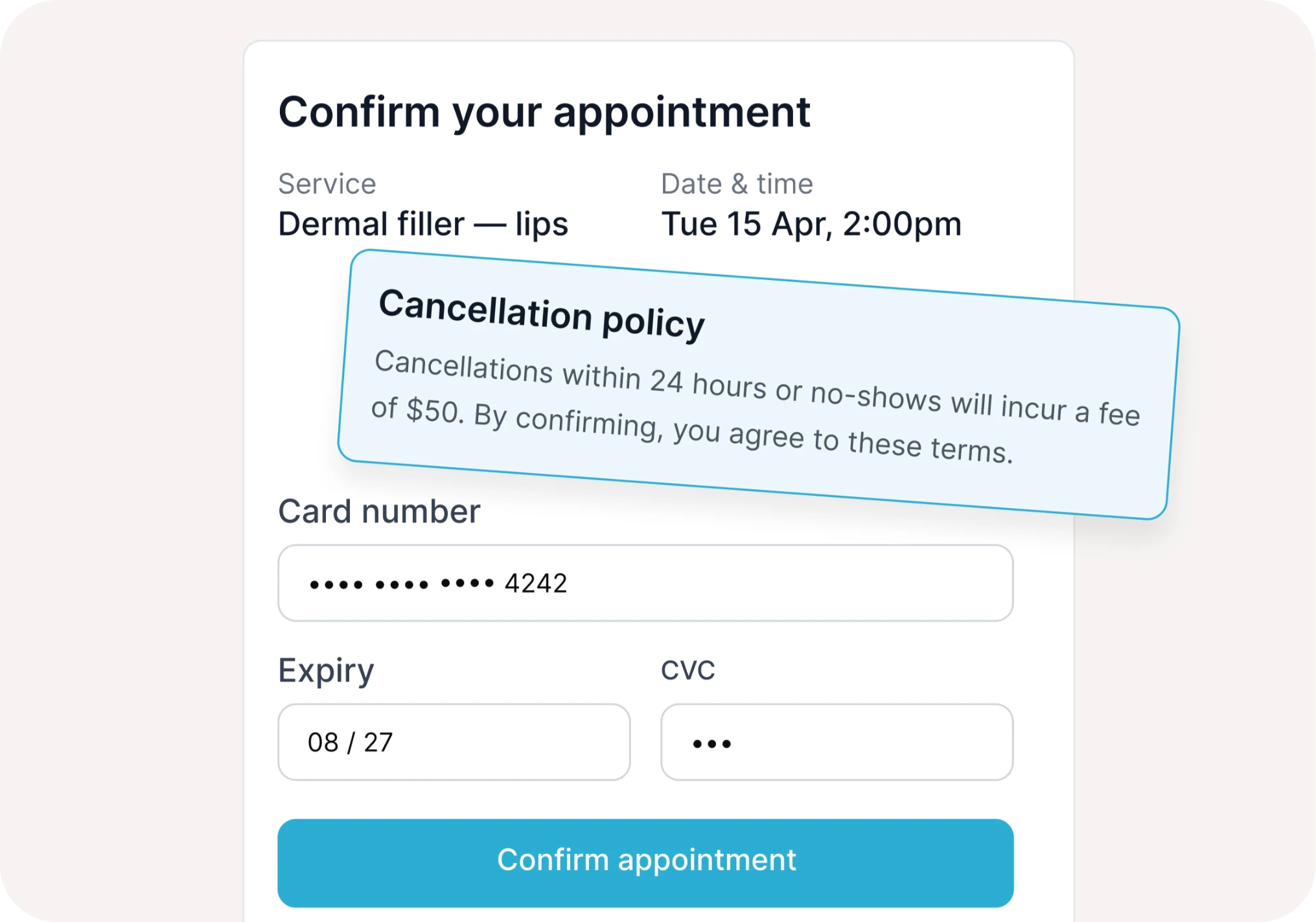
Phone and DM bookings are where acceptance most often goes unrecorded. If your booking tool can’t require the checkbox or take deposits, compare med spa scheduling software that can.
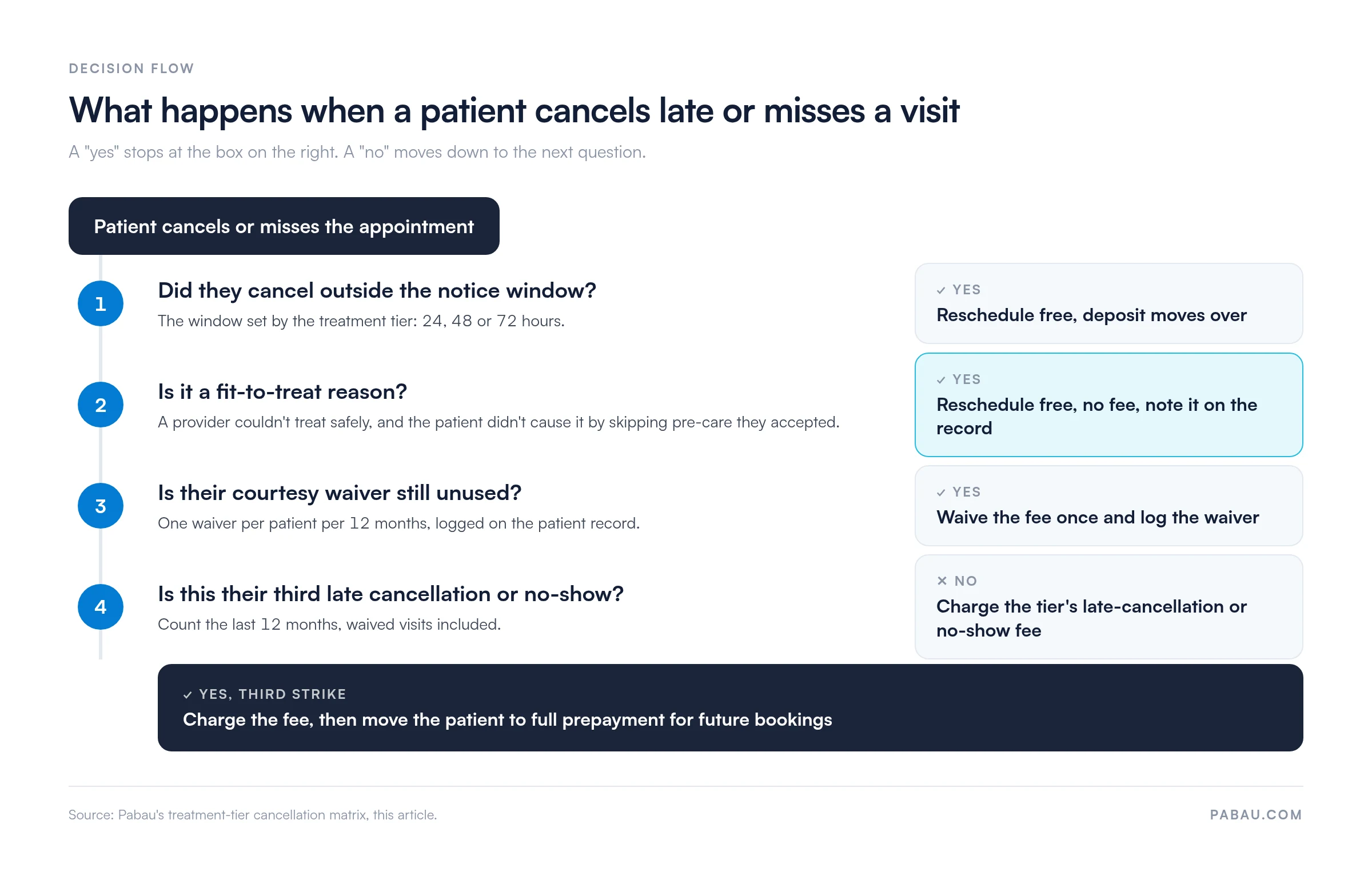
Enforcement works when every staff member applies the same rule in the same order. The decision flow below sets that order: notice window, fit-to-treat reason, courtesy waiver, then the fee.
Keep the reply short, name the policy the patient accepted, and offer the next appointment in the same breath. At the front desk or on the phone:
“I understand, and I’m sorry today didn’t work out. When you booked, you accepted our 48-hour policy for filler, so the $100 deposit is kept. I can book your next appointment now. Would Thursday or Saturday work better for you?”
By text, after a no-show:
“Hi [name], we missed you at [time] today. As set out in the policy you accepted at booking, a [$fee] no-show fee applies. Tap [link] to rebook.”
If a patient says they never saw the policy, share the booking timestamp and the confirmation message that restated it. That record is why step one of the booking process matters.
Give each patient one courtesy waiver per 12 months, and log it on the patient record. A third late cancellation or no-show in 12 months moves the patient to full prepayment for future bookings.
VIP patients get the same written policy. Any flexibility they get is recorded in the waiver log, so providers never waive fees at the chair. Genuine emergencies use the waiver too. If a patient has already used it, a manager decides, and that decision is logged as well.
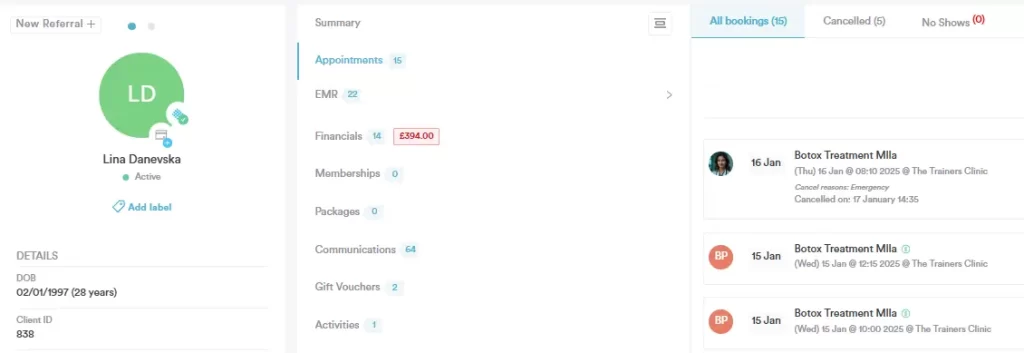
Charge the fee to the stored card, or keep the deposit, on the day of the miss rather than a week later. A same-day charge that quotes the accepted policy draws fewer disputes than one the patient discovers on a statement. It also spares your front desk an awkward call.
Med spa no-show recovery means refilling the canceled slot from a waitlist, messaging the missed patient the same day, and tracking no-show rates by treatment.
A good recovery routine runs on three habits:
These spa cancellation policy templates are written for med spas, and they reuse the treatment-tier cancellation matrix and fit-to-treat clause from above. Swap in your own windows and fees, then paste them into your booking page, intake form and confirmations.
The best spa cancellation policy examples are short. Halcyon, a medispa and wellness clinic in London, covers booking, notice, arrival time and reminders in four lines:
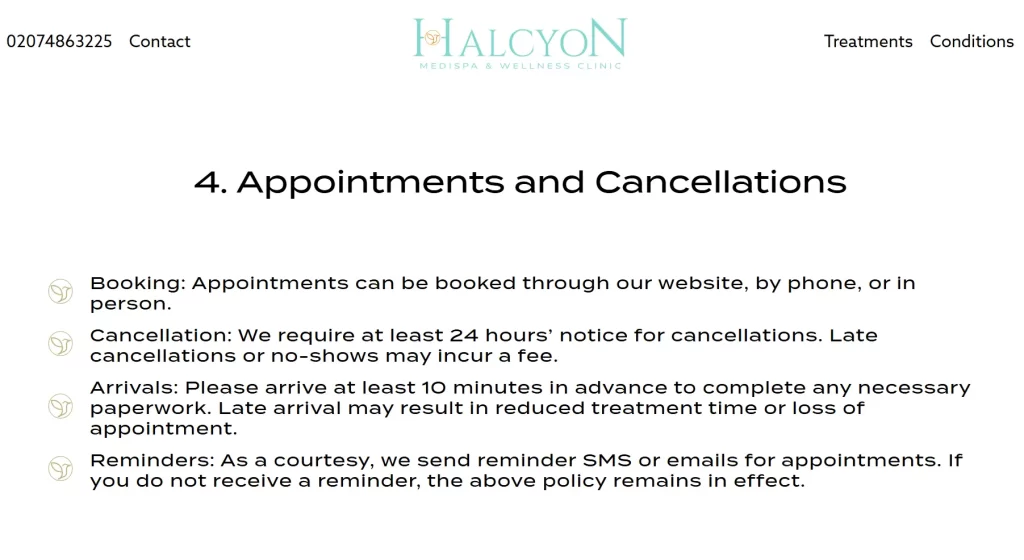
Every template below also works as a no-show policy template, since each one states the no-show charge in plain terms.
We ask for at least [24] hours’ notice to cancel or reschedule your appointment. Cancellations with less than [24] hours’ notice are charged [50%] of the booked treatment price.
If you miss your appointment without contacting us, the full treatment price is charged. Arriving more than 15 minutes late may mean a shorter treatment, or rebooking charged as a late cancellation.
You can cancel or reschedule by phone, by email or through our online booking. By booking, you agree to this policy.
When to use it: consultations, neurotoxin and other short treatments, where a card on file is enough.
A deposit of [$100 / 25% of the treatment price] is taken when you book [dermal filler / laser / body contouring] treatments. The deposit comes off your treatment price on the day.
Cancel or reschedule with at least [48 / 72] hours’ notice and your deposit moves to your new appointment. With less notice, the deposit is kept.
If you miss your appointment, [the deposit is kept / the full session price is charged], and future bookings require full prepayment. Your card is stored securely, and fees under this policy may be charged to it.
When to use it: any tier in the matrix with a 48- or 72-hour window.
Your [membership / package] sessions are prepaid. Please give at least [24 / 48] hours’ notice to cancel or reschedule a session.
A late cancellation or missed appointment uses one session [or one monthly credit], and no extra fee is charged. Unused monthly credits roll over for [one month], then expire.
Package sessions expire [12 months] after purchase. If you cancel a package, we refund the amount paid, less used sessions at the standard single-session price.
When to use it: memberships, treatment packages and loyalty plans, alongside your separate refund policy.
If your provider decides on the day that treatment can’t go ahead safely, we’ll reschedule you at no charge. This covers an illness, a new medication or another condition we couldn’t have known about in advance.
Please tell us about any change to your health, medication or pregnancy status before your notice window closes.
If treatment can’t go ahead because you didn’t follow the pre-treatment instructions, such as avoiding tanning before laser, it counts as a late cancellation.
When to use it: add it to any template above, and to the pre-treatment instructions you send at booking.
This no-show cancellation policy template fits in one text message. It states your cancellation and no-show rules in two lines, then links to the full version.
Your [treatment] is booked for [date, time]. Reschedule free until [date, time] at [link]. After that, a [$fee] late-cancellation fee applies, and missed appointments are charged [$fee]. Full policy: [link]
Practice management software like Pabau builds the treatment-tier cancellation matrix into the booking itself. Pabau is software built for med spas, so each service can carry its own deposit rule and policy text.
Here’s what that changes for your front desk:
Every Pabau subscription includes online booking, payments, patient communications and reporting. During onboarding, our team sets up your deposit rules and policy text with you, so the matrix is live from day one.

Pabau’s online booking takes deposits, records policy acceptance and sends reminders with a reschedule link. Fewer slots go empty, and fees get collected without a phone call.

A cancellation policy protects your calendar only once the whole team applies it, week after week. Tie each window and fee to what that treatment costs you to lose. Then get acceptance before the slot is confirmed, and apply the same rule to every patient.
The trade-off is a little friction at booking. A deposit on filler will cost you the occasional patient who won’t commit, and that is often the patient most likely to miss the appointment.
Start with the tier that hurts most, usually body contouring or lasers, and extend the matrix once your team is comfortable enforcing it. Book a demo to see how Pabau takes deposits, records acceptance and charges fees for your med spa automatically.

Taking medical histories before treatment? Med spa consultation form template gives you a form that captures the health changes a fit-to-treat clause depends on.
Booking filler appointments with deposits? Dermal filler consent form template is where the policy signature line can sit before the first visit.
Screening patients before injectables? Good faith exams in med spas explains the medical screening that decides whether a patient can be treated.
Setting the prices your fees are based on? How to choose a med spa pricing strategy walks through pricing models, including seasonal adjustments.
Losing product when appointments fall through? Med spa inventory management software compares tools that track what missed slots cost in stock.
A good spa appointment cancellation policy asks for 24 to 48 hours’ notice, charges 50% for late cancellations and up to 100% for no-shows. Med spas add deposits on high-ticket treatments, a 15-minute late-arrival limit and one courtesy waiver a year.
Generally yes, if you agreed to the fee before booking, because the policy becomes part of the booking terms. A med spa cancellation fee that was never disclosed or accepted is much harder for the practice to enforce.
You can usually cancel free up to 24 hours before a consultation or neurotoxin visit. Filler, laser and body contouring often need 48 to 72 hours. Your booking confirmation should state the exact window for your treatment.
Estheticians usually ask for 24 hours’ notice and charge a flat fee or 50% of the service for late cancellations. Device treatments an esthetician performs inside a med spa often follow the longer 48-hour laser window.
Yes, charging for missed appointments is generally legal when the patient agreed to the policy in advance and it applies to every patient. For Medicare patients, CMS allows the charge only if non-Medicare patients are charged too, and it’s never billed to Medicare.