HD Brows consultation form: Free template and guide
HD Brows is a seven-step brow treatment that combines consultation, tinting, wax...

2
Last Updated: Oct 13, 2026

An aesthetic clinic business plan runs to 10 sections, from the executive summary through to risk and contingency.
Your treatment list decides which regulator you answer to, not the sign above the door.
Training, registration, insurance and waste run from about £2,000 to £13,000, before rent and stock.
Your break-even figure is fixed monthly costs divided by the contribution you make on an average treatment.
England’s licensing scheme for non-surgical cosmetic procedures has no regulations yet, so nothing is in force.
An aesthetic clinic business plan has to prove three things. That enough people near you want the treatments. That you may legally deliver every one you list. And that the numbers hold at the volume you can realistically book. New or solo med spas get their own pick in our ranking of the top med spa software.
This guide gives you the 10 sections in document order and a costed start-up table in pounds. You also get the arithmetic behind a break-even figure a lender will accept. And it maps your treatment list to the regulator it puts you under.
Every figure below is in pounds and every rule is the UK one. A business plan for aesthetic clinic premises in Leeds cannot run on figures from a US template.
It must prove demand in your catchment, that you can legally deliver every treatment on your menu, and that the money works. The rest of the document supports one of those three claims.
That matters because the plan has three readers, and none of them read it the same way. A lender wants the repayment covered. A landlord wants the rent covered. An insurer and a regulator want to know who is doing what to whom.
The bank manager reading a business plan for aesthetic clinic funding will not know what a skin booster is. Write for that reader. Name the treatment, say who may legally perform it, then give the price and the consumable cost.
This is also where a plan differs from generic advice on how to start a beauty business. A beauty room can open on a licence and a policy of insurance. The moment your menu includes an injectable, the questions change.
Work through these in order. The deep UK numbers and rules sit in the dedicated sections further down. Each part below says what belongs there and why a reader cares.
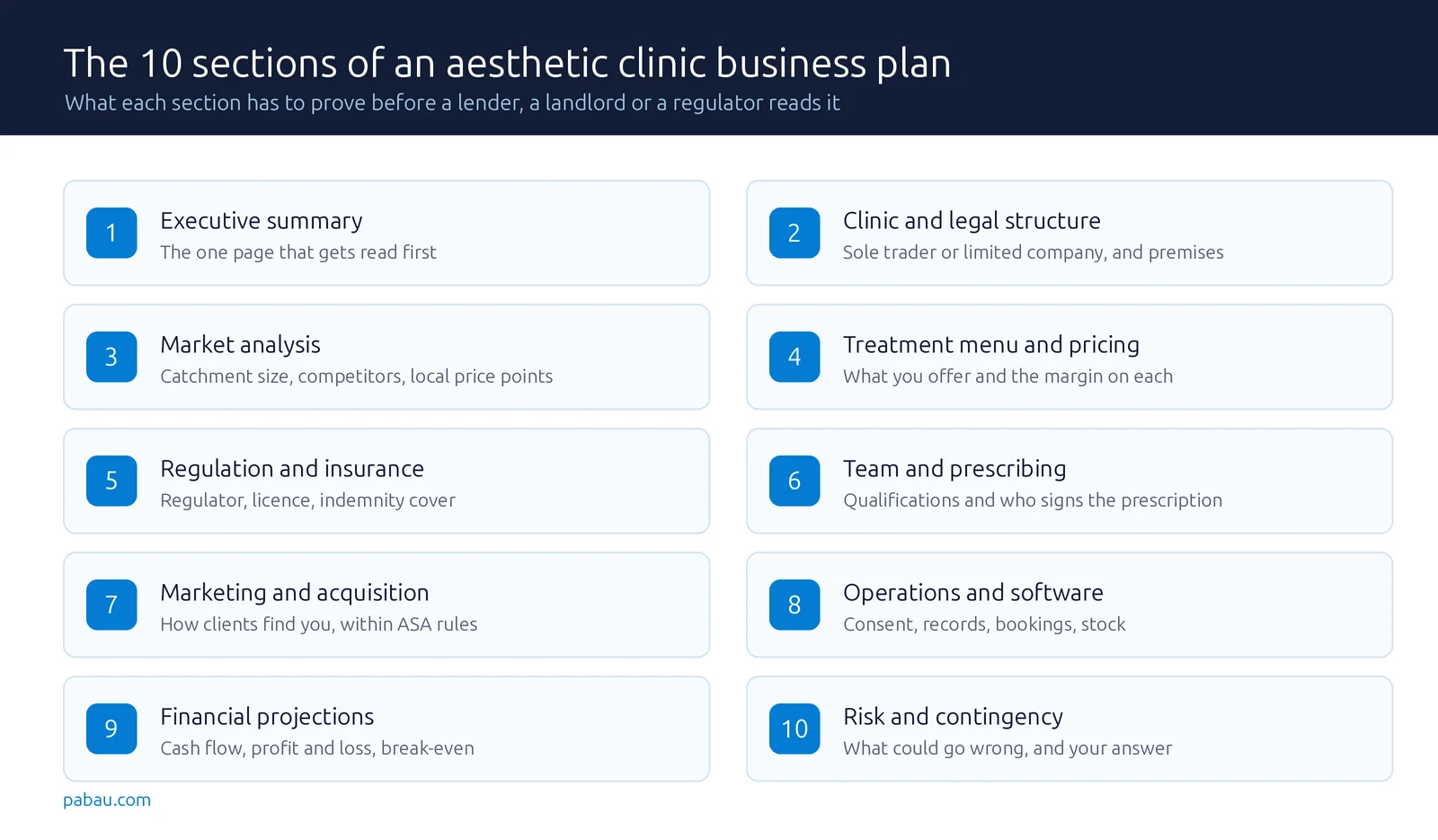
One page, written last, read first. It carries your elevator pitch, the treatments, the premises, the funding you want and the month you expect to break even.
Keep the mission statement to a sentence. A lender skims this page and then decides how carefully to read the rest.
State whether you will trade as a sole trader or a limited company. A sole trader registers with HMRC for Self Assessment. A limited company is incorporated at Companies House for £100 online, with a £50 confirmation statement each year.
Register for VAT once your taxable turnover passes the £90,000 threshold in any rolling 12 months. Most injectable treatments are standard-rated, so plan the cash effect before you get near the line.
Then describe the premises honestly. Day rates in an established clinic, a room at home, a mobile service and your own lease each carry a different rent line. They also carry different risks.
Two premises points belong here. Treating clients at home or changing a shop into a treatment room can need planning permission for a change of use. And in England, a rateable value of £12,000 or less means no business rates at all, with relief tapering to zero at £15,000.
Size your own catchment rather than quoting a global market figure. A lender wants to see the population within a realistic drive, the competitors already serving it, and what they charge.
Name your target market in plain terms. Describe the patient demographic by age, income bracket and travel distance, and say which treatment they come for first.
List every treatment with its price and its consumable cost. Botulinum toxin, dermal fillers, skin boosters, chemical peels, laser and intense pulsed light all behave differently on margin and on regulation.
Show the treatment margin, not just the price. A £250 treatment that uses £45 of product and 45 minutes of chair time tells a lender more than a price list does.
One drafting note. Botulinum toxin is a prescription-only medicine, so you cannot advertise it by brand name to the public. Write your public price list in generic terms from the start.
Say which regulator your menu triggers, whether you need a local authority licence, and what cover you hold. The section below on regulators works this out treatment by treatment.
Four policies come up in practice.
Employers’ liability is not optional. Employ anyone outside your close family and you need at least £5 million of cover. It must come from an authorised insurer, and the fine is £2,500 a day.
Budget a clinical waste and sharps contract too. Sharps bins and hazardous waste consignment are a recurring line, and an inspector will ask to see the paperwork.
Name every person who will treat a client and say what they hold. Qualification level and professional registration decide who may do what, so a lender and an insurer both read this section closely.
So what is an aesthetic practitioner? The term is not protected in UK law. It covers doctors, dentists, nurses and beauty therapists who deliver aesthetic treatments, which is why the qualification behind it matters more than the job title.
Ofqual-regulated qualifications run from Level 4 through Level 7, awarded by organisations such as VTCT Skills. Level 7 is not required by law. It has become the benchmark the JCCP register and most insurers look for, so name it if your team holds it.
Working out how to become an aesthetician in the UK? The usual route starts with beauty therapy, then adds aesthetic qualifications on top. A clinical background changes the picture, because a registered healthcare professional can train further into injectables.
Then answer the prescribing question. Botulinum toxin is a prescription-only medicine, so somebody on your team must be an independent prescriber, or you buy that service in. Say which, and say who holds the consultation.
Set out how the first 100 clients find you and what each one costs to win. Cover your branding, your social media strategy, referrals, review platforms and the retention plan that brings people back.
Then show you know the advertising rules. The Advertising Standards Authority enforces the CAP Code, and prescription-only medicines cannot be advertised to the public. That rules out naming botulinum toxin brands in a post, an offer or a price list.
Say what you will do instead. Generic wording, before-and-after content with consent on file, and treatment education all work inside the rules.
Walk a client through your clinic on paper. Enquiry, consultation, informed written consent, treatment, notes, before-and-after photographs, aftercare, then the follow-up that turns one visit into a course.
Name the system that holds the records. Patient records, consent forms and clinical photographs all carry data protection duties. Photographs sitting on a personal phone are a common weak point.
Cover the commercial mechanics as well. Appointment booking, a no-show policy, taking deposits and stock control all belong here, because each one protects the revenue line in section nine.
Three statements do the work. A cash flow forecast month by month, a profit and loss projection, and an opening balance sheet.
Separate fixed costs from variable ones, because the split is what produces your break-even figure. The worked example further down shows the arithmetic.
Name the risks and your answer to each. Regulatory change, adverse events and complications, complaints handling, key-person risk if you are the only injector, and how you would exit or sell.
Lenders read this section for evidence that you have thought past the launch. A clinic with one prescriber and no locum arrangement has a single point of failure, so say how you would cover a month of illness.
The UK aesthetics industry is only partly regulated, and demand for it is intensely local. So build your market analysis from your own town. A national growth figure will not tell a lender whether you can fill a diary in Preston.
Two features of the aesthetics field shape any plan written today. Most of a typical menu is non-surgical, and the rules on who may deliver those treatments are still being written.
Build the section from four numbers you can source yourself, then show your working. A lender can check every one of them, which is never true of a market-size statistic.
Those four figures feed straight into the revenue forecast. They also give you an honest answer when a lender asks why you expect the demand you have projected.
Plan for roughly £2,000 to £13,000 in training, registration, insurance and waste costs. Rent, fit-out and opening stock sit on top, and those are the lines you have to price locally.
The table below splits those costs into one-off and recurring, and names the plan section each one belongs in. That last column is what turns a shopping list into a financial forecast.
| Cost item | Typical GBP range | One-off or recurring | Plan section it belongs in |
|---|---|---|---|
| Foundation botulinum toxin and filler training | £995 to £1,199 including VAT | One-off | 6. Team, qualifications and prescribing |
| Level 7 diploma in injectables | £6,000 to £10,700 including VAT | One-off | 6. Team, qualifications and prescribing |
| Company incorporation at Companies House | £100 online | One-off | 2. Clinic description and legal structure |
| Confirmation statement | £50 a year | Recurring | 2. Clinic description and legal structure |
| CQC registration in England, only if your menu is registrable | £1,743 to £1,867 a year | Recurring | 5. Regulation, licensing and insurance |
| Healthcare Improvement Scotland registration | £3,996 to apply, then £1,372 a year | Both | 5. Regulation, licensing and insurance |
| Healthcare Inspectorate Wales registration for laser or IPL | £600 to apply, then £500 a year | Both | 5. Regulation, licensing and insurance |
| Special treatment premises licence, London boroughs | £2,912 to £3,136 in Westminster | One-off, then renewal | 5. Regulation, licensing and insurance |
| Medical malpractice and public liability insurance | From £465 a year for a medically qualified injector | Recurring | 5. Regulation, licensing and insurance |
| Clinical waste and sharps collection | Quote only. Councils publish £17 to £23 a collection | Recurring | 5. Regulation, licensing and insurance |
| Waste carrier registration, only if you move waste you did not produce | £191.02 for three years | One-off | 5. Regulation, licensing and insurance |
| Treatment room rent, day rate or lease | Price it locally | Recurring | 2. Clinic description and legal structure |
| Fit-out, couch and furniture | Price it locally | One-off | 2. Clinic description and legal structure |
| Opening stock and consumables | Quote from your pharmacy or supplier | One-off | 4. Treatment menu and pricing |
| Practice management software and card terminal | Published on the provider’s own site | Recurring | 8. Operations and clinic software |
| Branding, website and photography | Price it locally | One-off | 7. Marketing and client acquisition |
Two lines swing the total more than the rest. Whether your menu makes you registrable with a health regulator, and whether you train to Level 7 before you open or afterwards.
Add working capital on top. Three to six months of fixed costs is the buffer a lender expects to see. Our breakdown of starting an aesthetics business goes further into the spend.
Your treatments decide this, not the sign above the door. Some are regulated activities that need registration, some need a local authority licence, and some sit outside statutory regulation altogether.
Work through your menu line by line before you write this section. Getting it wrong is expensive, because the remedy is usually a closed diary while you sort out registration.
| Where you operate | Statutory regulator | What triggers registration | Voluntary register | Where it goes in your plan |
|---|---|---|---|---|
| England | Care Quality Commission | Treating disease, disorder or injury, IV drips and surgery. Purely cosmetic injectables sit outside it. | JCCP or Save Face | 5. Regulation, licensing and insurance |
| Scotland | Healthcare Improvement Scotland | Any clinic where a doctor, nurse, dentist or pharmacist delivers the service, cosmetic work included. | JCCP or Save Face | 5. Regulation, licensing and insurance |
| Wales | Healthcare Inspectorate Wales | Registration as an independent hospital, which covers Class 3B and 4 lasers and intense pulsed light. | JCCP or Save Face | 5. Regulation, licensing and insurance |
| Northern Ireland | RQIA | Registration as an independent hospital. RQIA names cosmetic laser services on its own list. | JCCP or Save Face | 5. Regulation, licensing and insurance |
The sharpest difference is between England and Scotland. Scotland registers you on who provides the service, so a nurse-led cosmetic clinic in Glasgow registers with Healthcare Improvement Scotland. The same clinic in Manchester would not register with the CQC.
The second question is narrower. For each treatment, who may lawfully prescribe it, who may administer it, and what extra licence or registration applies.
| Treatment | Prescription needed? | Who may deliver it | Extra licence or registration |
|---|---|---|---|
| Botulinum toxin, cosmetic | Yes, it is a prescription-only medicine | An independent prescriber assesses face to face and prescribes. A trained practitioner may then administer it. | Not a CQC regulated activity in England when the purpose is purely cosmetic |
| Botulinum toxin, medical, such as excessive sweating | Yes | A listed healthcare professional | CQC registration in England |
| Dermal fillers | No | Not restricted by law. Training, insurance and the product supplier decide it in practice. | Excepted from the CQC surgical procedures activity by statute |
| Skin boosters | Depends on the product | As for fillers, unless the product is a prescription-only medicine | As for fillers |
| Chemical peels | Depends on strength | A trained practitioner. Stronger peels are usually clinic-only. | A local authority licence in some areas |
| Laser and intense pulsed light | No | A trained operator with core of knowledge training | London boroughs licence it. Wales and Northern Ireland register it. Scotland registers healthcare-professional clinics. |
| IV vitamin drips | Yes, the products are prescription-only medicines | A listed healthcare professional | CQC registration in England |
Two rules apply across the whole menu in England. Botulinum toxin and cosmetic fillers cannot be given to under-18s for cosmetic reasons, and that has been an offence since October 2021.
The second is the prescribing consultation. The General Medical Council, the Nursing and Midwifery Council and the General Pharmaceutical Council now all require a face-to-face assessment first. Remote prescribing of a cosmetic injectable is not acceptable.
The Joint Council for Cosmetic Practitioners and Save Face both run registers accredited by the Professional Standards Authority. Joining either is optional, and neither title is protected in law.
They still earn a line in your plan. A landlord, an insurer or a lender reading an unregulated sector wants a third-party signal, and an accredited register is the clearest one available today.
Nothing is in force. Section 180 of the Health and Care Act 2022 gave ministers the power to create a licensing scheme in England. That power was switched on in July 2022.
No regulations have been made under it. The government published its consultation response in August 2025, promising a further consultation and Parliamentary debate before any scheme starts.
So there is no licence to apply for and no fee to budget. Put it in your risk section instead. The proposed design tiers procedures by risk, with the highest tier restricted to regulated healthcare professionals in registered premises.
Write down what you would do if that lands. A clinic whose plan already names a clinical lead and a registered address absorbs the change. One built around an unregistered injector does not.
Divide your fixed monthly costs by your contribution per treatment. Contribution is the average treatment price minus the consumables that treatment uses. The answer is the number of treatments a month that covers the clinic.
This is the figure a lender asks for by name. Here it is worked through for a solo injector, with example inputs you can swap for your own.
Run the same sum again with rent at a busier location, or with a wage you could live on. Watching the break-even number move is the fastest way to test whether a premises decision is affordable.
Then carry the result into your cash flow forecast. Break-even tells you the volume you need. The cash flow tells you which month you reach it, and the working capital you burn on the way.
A UK lender reads three things in an aesthetic business plan. Your funding requirement and what it buys, the security or personal guarantee behind it, and the cash runway before the clinic covers itself.
Four routes cover most new clinics.
That last route is worth spelling out. Among nursing business ideas, building an aesthetics list alongside NHS or agency shifts is a well-worn route into UK aesthetics, and a fundable one.
It also strengthens the plan. A lender sees a borrower who can service the loan while the diary fills. That lowers the risk on their side of the table.
Paste the skeleton below into a document and answer each prompt in your own words. Used this way, an aesthetic clinic business plan template stops being a form to fill in and becomes the order you think in.
If you would rather start from a formatted document, our business plan template gives you the same structure with the sections already laid out.
One warning about any aesthetic clinic business plan sample you find online. Most are written for US clinics, so the regulator, the tax thresholds and the insurance names will all be wrong. Keep the shape and replace the content.
Section eight of your plan describes how the clinic runs day to day. It is easier to write once you know what will hold the records. Practice management software like Pabau puts the whole client journey in one place.
Online booking takes enquiries while you are treating, so an aesthetic practice with one pair of hands stops losing bookings to a missed call. Deposits sit on the booking rules, which protects the diary you just forecast.
Consent forms, treatment notes and before-and-after photographs land on the same client record. That takes clinical photographs off a personal phone, which is the data protection point an insurer or an inspector will raise first.
Reporting then closes the loop. Treatment revenue, retention and stock use come out as numbers you can drop into next year’s projections, instead of a spreadsheet you rebuild each January. If you are still comparing systems, our guide to aesthetic clinic software sets out what to look for.
Those reports can do more than feed next year’s projections. Healthcare business intelligence explains how practices turn clinical, operational and financial data into dashboards they act on.


Pabau brings online booking, consent forms, before-and-after photographs, deposits and reporting into one system. Your operations section then matches how the clinic runs.

Write the plan for the clinic you can open next quarter, not the one you want in five years. The second version is easier to write and impossible to fund.
Then keep using it. Your break-even volume moves every time rent, prices or product costs change. Revisit the plan each quarter and it tells you when to raise a price or drop a treatment.
The regulatory section will date fastest, so diary a review of it. Rules on who may deliver non-surgical treatments in the UK are still being written. A plan that already names your regulator will absorb the change quietly.
Get the operations section right and the rest gets easier to keep current. Book a demo to see how Pabau holds bookings, consent and reporting for a new aesthetic clinic in one place.

Still at the idea stage? How to start an aesthetics business covers the decisions that come before the plan is written.
Need the numbers in more detail? The costs of starting an aesthetics business breaks the set-up spend down line by line.
Think your menu needs registration? How to get CQC registered walks through the application and what inspectors look for.
Worried about no-shows eating the forecast? Deposits for an aesthetics business explains how to set a policy clients accept.
Ready to fill the diary? A marketing strategy for an aesthetic clinic turns section seven into a working plan.
A beauty clinic offering facials, waxing and skin treatments needs premises, insurance and, in many areas, a local authority special treatments licence. Add injectables and the picture changes, because a prescription-only medicine brings a prescriber and a different regulator into it. Decide which of the two you are opening before you sign a lease.
Take an Ofqual-regulated qualification and build up through Levels 4 to 7. Beauty therapists usually route in at Level 4 and add treatments as they qualify. Registered nurses, doctors, dentists and pharmacists can train straight into injectables, because their registration already covers clinical practice. Every route ends the same way, with supervised practice and indemnity cover in place.
Nurses injecting need medical malpractice cover, public liability for the premises and product liability for what they administer. Your NMC registration has to be current, and the policy must name every treatment on your menu. Cover bought for one treatment will not answer a claim about another.
There is. Our medical practice business plan template downloads as a free PDF, and the section skeleton in this guide adapts it to an aesthetic clinic. Use the template for the shape, then replace the compliance and pricing detail with your own.
Usually not, if your menu is purely cosmetic. In England, anti-wrinkle injections and dermal fillers given for appearance alone sit outside CQC scope. Registration is triggered by treating a disease or disorder, by surgery, and by IV vitamin drips. Scotland, Wales and Northern Ireland draw the line differently, so check your own nation first.
They can be, and three levers decide it. Treatment margin, chair utilisation and client retention. A single treatment can carry a strong margin, but the clinic only makes money once the diary is full enough to cover the fixed costs. Rebooking rate usually moves profit more than price does.