Tanja Lepcheska

Pain medication chart: Strength tiers, DEA schedules and free PDF
What is a pain medication chart and how do clinicians use it? A pain medication ...

1
Last Updated: Nov 4, 2026
Free PDF 2 pages, print-ready Clinician-reviewed
A nurse conversion chart is a quick reference for the unit conversions nurses make in medication, weight, volume, and temperature calculations. The factors used most are 1 kg = 2.2046 lb, 1 g = 1,000 mg, 1 mg = 1,000 mcg, and 1 mL = 1 cc. To convert Celsius to Fahrenheit, multiply by 9/5 and add 32. This guide adds the IV drip rate formula, the metric prefixes, and the recording habits behind common conversion errors.
A two-page reference with weight, volume and temperature conversion tables, medication unit steps, and the IV drip rate formula. It also carries a metric prefix table, common error patterns and a pre-administration checklist.
Start from scratch, or upload this PDF or any form you already use, and Pabau's AI Form rebuilds it with tick boxes, text fields and a signature. Attach it to the treatment once, and every patient gets it on time.
AI Form rebuilds the consent, history and aftercare forms you already use. You review each one, then publish.
Patients complete forms on their phone before they arrive, so the front desk stops retyping paper.
Every signed form is versioned and attached to the treatment record, ready when you need it.
Set how long a consent stays valid. Returning patients skip forms they have already signed.
Supports HIPAA and GDPR compliance AES-256 encryption 4.8 on G2 4.7 on Capterra Trusted by 4,000+ practices worldwide

The chart covers weight, medication, volume, temperature, and IV drip rate conversions.
Verify every medication conversion against your facility’s pharmacy protocols.
One gram equals 1,000 mg, and one milligram equals 1,000 mcg.
Write 0.5 mg rather than .5 mg, and 1 mg rather than 1.0 mg, to avoid tenfold errors.
Record weight in kilograms only, because a weight in pounds used in a per-kg dose gives about 2.2 times too much.
A nurse conversion chart groups the unit conversions used most often in medication administration, documentation, and patient care. Nurses use it for a fast check during a shift, then confirm high-risk values with a pharmacist or prescriber.
The conversion factors come from the International System of Units (SI), maintained by the International Bureau of Weights and Measures (BIPM). Look up the conversions you use rarely, and memorize the factors you apply every shift.
To use the chart at the bedside, identify the units, apply the factor for that pair, and check the answer against the order.
If your team builds patient assessments as standardized digital forms, label each field with one unit. Practice software such as Pabau lets you fix that unit on the form, so every record matches the chart.

To convert kilograms to pounds, multiply by 2.2046. To convert pounds to kilograms, divide by 2.2046.
A patient weighing 70 kg weighs about 154.3 lb. Weigh patients on the same scale and record the unit each time, because a unit mix-up is a common charting error.
Medication labels use several metric units, and a misplaced decimal point can shift a value by a factor of 1,000. Keep these relationships in view on the chart.
The same steps run as a ladder from kilograms down to micrograms, and the decimal habits beside it keep each value readable.
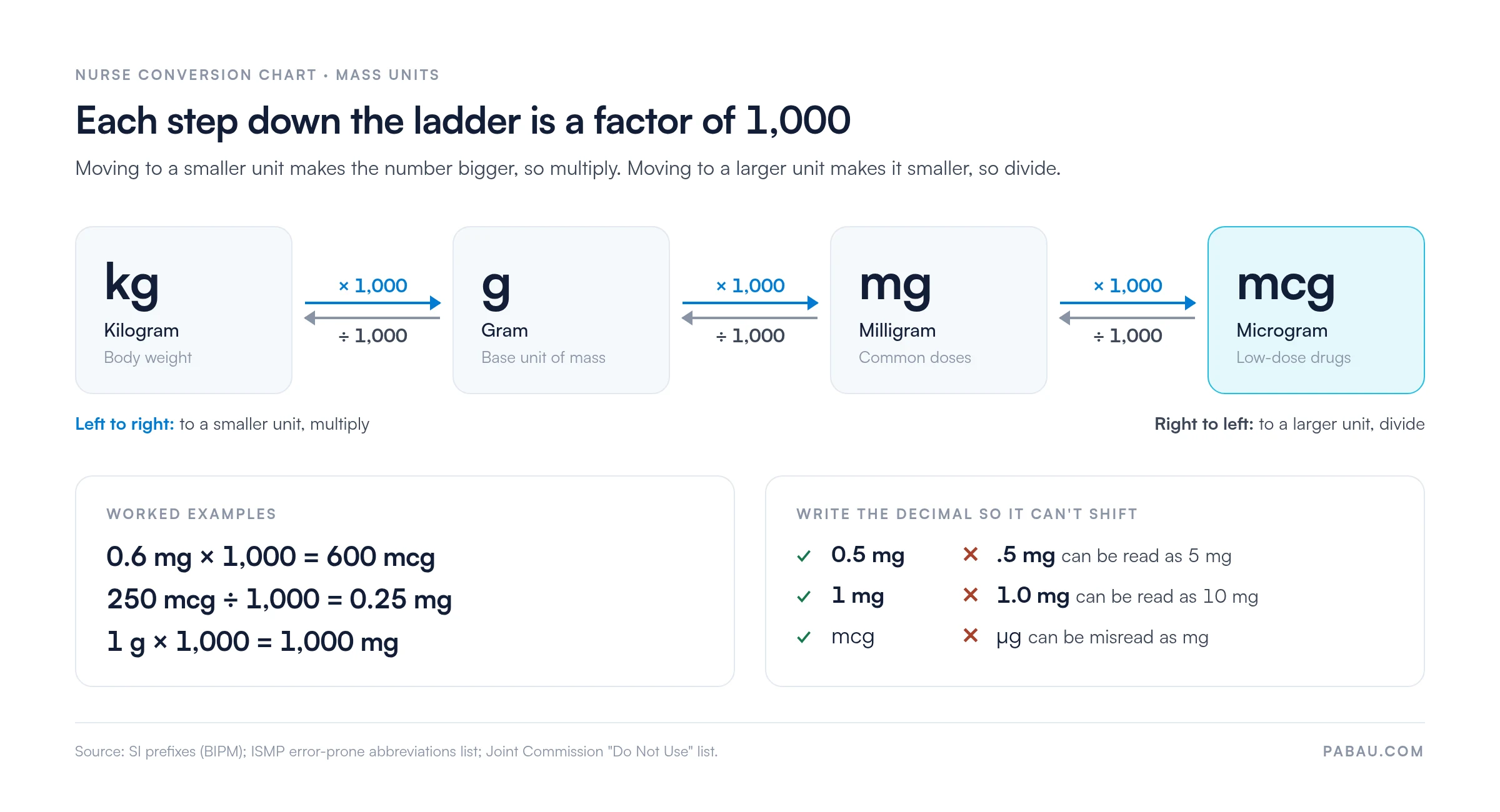
Worked example: 0.6 mg × 1,000 = 600 mcg. This is a unit conversion only, not a dose. Confirm any ordered amount with your pharmacy or prescriber. Pair this chart with a nursing pharmacology cheat sheet when you also need drug classes and high-yield drug facts.
One milliliter equals one cubic centimeter, so 1 mL and 1 cc measure the same volume. Write “mL” in records, because ISMP lists “cc” as error-prone.
To convert mL to US fluid ounces, divide by 29.5735. UK fluid ounces are slightly smaller, at 28.4131 mL, so check which standard your facility uses.
Drops per minute equals (volume in mL × drop factor) ÷ time in minutes. The drop factor is printed on the IV tubing packaging and varies by manufacturer, so never assume a value.
For example, 1,000 mL over 480 minutes with a 15 drop factor gives (1,000 × 15) ÷ 480 = 31.25. That rounds to about 31 drops per minute, as an illustrative calculation only. Confirm every infusion rate with the prescriber, pharmacy, and your facility’s infusion policy.
For IV solution classes and electrolyte normal ranges, keep a fluid and electrolyte cheat sheet beside this chart.
To convert Celsius to Fahrenheit, multiply by 9/5 and add 32. To convert Fahrenheit to Celsius, subtract 32 and multiply by 5/9.
A reading of 37°C equals 98.6°F, the traditional average for body temperature. Research suggests the average may now sit slightly lower. Compare any reading with your facility’s assessment protocol rather than the chart alone.
Each metric prefix multiplies the base unit by a fixed power of ten, so the prefixes matter more than memorizing every unit.
Kilo, the base unit, milli, and micro each sit 1,000 times apart. Converting to a smaller unit makes the number larger, so multiply. Converting to a larger unit makes it smaller, so divide.
Write the prefix in full when a handwritten “m” and “mc” could be confused. The ISMP list of error-prone abbreviations flags “µg” because it can be misread as “mg”, so record “mcg” instead.
Conversion errors usually start before any calculation, with how a value is written or which unit was recorded. Check for these patterns whenever a converted value looks unusual.
Recording weight in kilograms only stops the pounds-for-kilograms error at the source. Many facilities set their scales and electronic records to kg for this reason. Write each converted value with its unit on the medication administration record, so the next nurse reads the same figure.
When teams chart on paper or in separate spreadsheets, each nurse records weight, temperature, and fluid volumes in whatever unit the device displays. The next clinician then has to work out which unit was used before converting the value.
Pabau keeps digital forms and patient records in one system. You can build assessment forms with each field labeled in a single unit, such as weight in kg and temperature in degrees Celsius. Every nurse then enters values in the same format.
Each completed form saves straight to the patient’s record. At the next visit, the team compares new readings with earlier ones in matching units, so fewer conversions happen at the bedside.

See how Pabau’s clinical records and documentation tools help standardize how your team captures units, medications, and notes.

Learn the four conversions you make every shift, from kg to lb, mg to mcg, mL to oz, and Celsius to Fahrenheit. Keep the chart for the rest. Treat any result that changes a dose or an infusion rate as unconfirmed until a second check agrees.
The trade-off is speed. A double check adds a minute at the bedside, while a decimal error multiplies a value by 10 or 1,000. Recording each value in one agreed unit removes many conversions before they start.
Book a demo to see how Pabau keeps units, assessments, and notes consistent in one patient record.

Recording the converted dose? Medication administration record nursing template explains the legal record of every dose given, by whom and when.
Need drug facts alongside the units? Nursing pharmacology cheat sheet groups high-yield drug information by class for a quick scan.
Calculating IV fluids? Fluid and electrolyte cheat sheet covers electrolyte normal ranges and IV solution classes.
Giving oral medications? Medication do not crush list names the tablets that must be swallowed whole and why.
Charting the intervention? PIE chart nursing template structures the note into problem, intervention and evaluation.
A nurse conversion chart should cover weight (kg and lb), medication units (g, mg, and mcg), and volume (mL, cc, and oz). It should also convert temperature between Celsius and Fahrenheit. Most charts add the IV drip rate formula and the metric prefixes too.
Multiply the milligram value by 1,000. For example, 0.25 mg equals 250 mcg. To convert mcg back to mg, divide by 1,000.
Yes. One milliliter equals one cubic centimeter. Write “mL” in orders and records, because ISMP lists “cc” as error-prone. It can be misread as “u” for units.
Divide the weight in pounds by 2.2046. A patient who weighs 154 lb weighs about 69.9 kg.
A trailing zero can hide the decimal point, so “1.0 mg” may be read as “10 mg”. The Joint Commission’s “Do Not Use” list prohibits trailing zeros in medication orders and related documentation.