CRM for chiropractors: how to manage patients, bookings and marketing
A CRM for chiropractors is a patient relationship management system built around...

Last Updated: Oct 13, 2026
A women’s weight workout plan is a structured strength program built on three or four lifting sessions a week and steady progression.
Paired with a modest calorie deficit, it supports fat loss while protecting muscle. This free template gives you four weeks of it, designed for women starting or returning to resistance training.
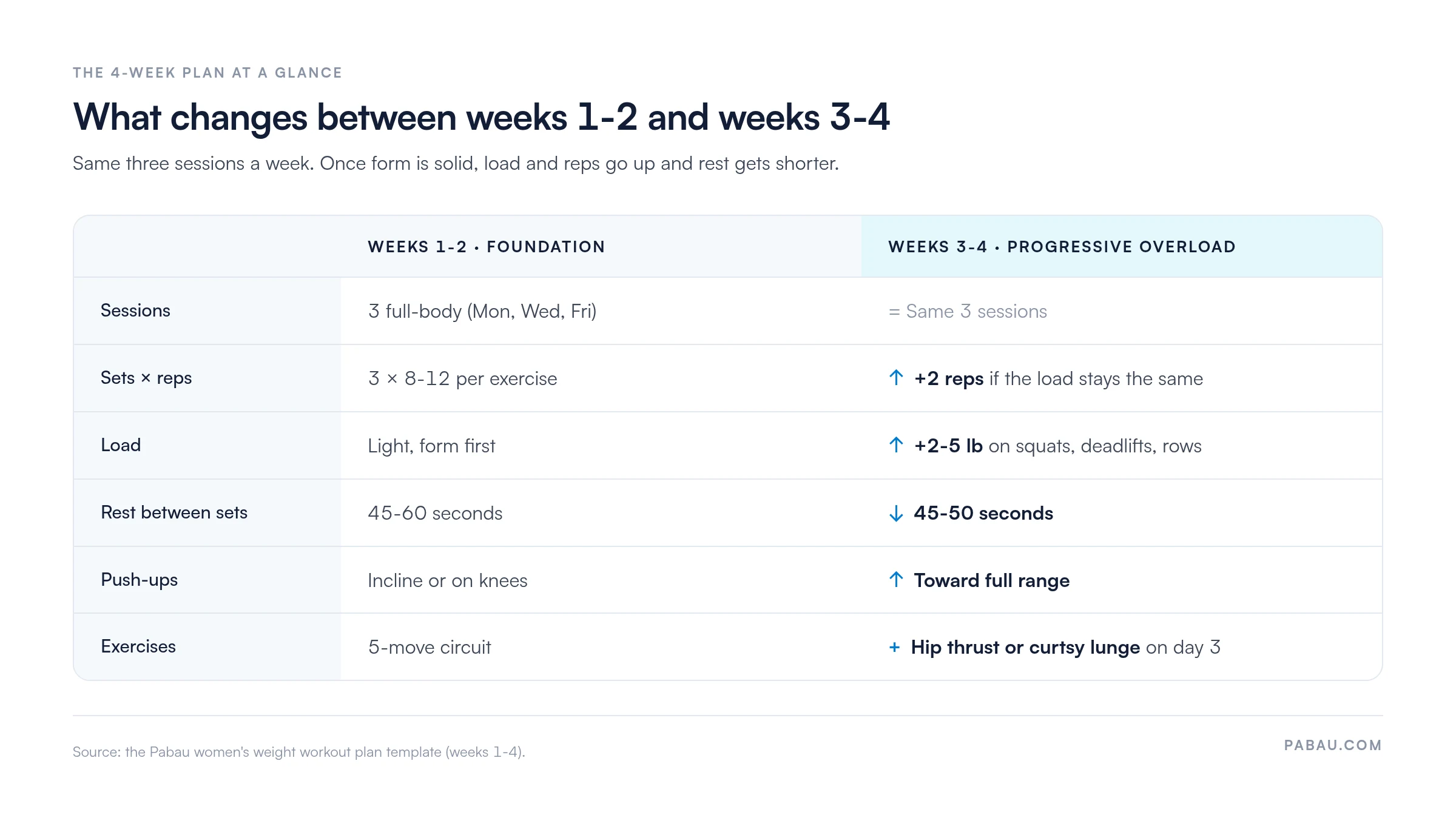
Weeks 1-2 run a five-exercise full-body circuit three times a week. Weeks 3-4 add 2-5 pounds or two reps per exercise and trim rest to 45-50 seconds. Pair the training with a 250-500 kcal daily deficit and 1.6-2.2 grams of protein per kilogram of body weight.
The PDF holds the full 4-week program, with warm-ups, a weekly split, and sets, reps and rest for every exercise. It also spells out the week 3-4 progression rules, so you know exactly when and how to add load.
Download template
Strength training helps you keep lean muscle while a calorie deficit drives fat loss, so more of the weight you lose comes from fat.
Progressive overload means adding weight, reps, or density week to week, and it keeps strength and muscle adapting.
Three full-body sessions or a four-day upper/lower split, with at least one full rest day, fits most weekly schedules.
Track lifts, measurements and photos alongside the scale, because muscle gain can mask fat loss on the scale for weeks.
Pabau, the practice management platform we build, lets practices log patients’ measurements and adherence between visits.
Weight training helps women lose weight by protecting the muscle that a calorie deficit would otherwise strip away. Muscle is also more metabolically active than fat. Common estimates put it at roughly 6 calories per pound per day at rest, against about 2 for fat.
The American College of Sports Medicine (ACSM) is clear about what drives fat loss, and that’s a calorie deficit. Its position stands credit resistance training with preserving lean mass during weight loss rather than with burning more fat. This plan gives lifting exactly that job, alongside a modest 250-500 kcal daily deficit.
Muscle loss speeds up with age, so that protection matters more after 40. Women in that bracket can pair this program with a midlife weight loss plan for the nutrition side.
Cardio and weights do different jobs. Steady-state cardio (30-45 minutes on a treadmill or bike) burns calories during the session but does little to build muscle. High-intensity interval training (HIIT) burns more calories per minute and adds a small afterburn effect, but it doesn’t build much muscle either.
This plan makes weight training the main focus, 3-4 days a week, with 1-2 HIIT or steady cardio sessions for heart health. The deficit drives the fat loss, and the lifting makes sure the muscle stays.
A good training week combines a fixed schedule, clear progression, and enough recovery. Two splits suit most women: full-body training three times a week, or an upper/lower split four times a week. If you’d rather train five days in a gym, a beginner gym exercise plan spreads the work across a longer split.
Each session centers on compound exercises (squats, deadlifts, hip thrusts, push-ups, rows) at 3-4 sets of 6-12 reps, followed by 2-3 accessory exercises. Progressive overload drives the adaptation. That means adding weight, adding reps, or cutting rest from one week to the next.
The first two weeks establish movement patterns and build baseline strength. Start with lighter weights and focus on form rather than load.
Run this circuit three times a week (Monday, Wednesday, Friday) with at least one rest day between sessions. Consistent form matters more than heavy weight here. The goal is to learn the movements and build the habit.
Weeks 3-4 introduce progressive overload, one of the core principles of exercise. Change one variable at a time: the weight, the reps, or the rest. The comparison below shows what moves between the two phases.
Here’s how the full-body version of the plan fits into a week:
This split gives each muscle group 48-72 hours of recovery while keeping the weekly training stimulus steady. Shift the days to suit your schedule, but keep the sessions consistent. A plan you complete 90% of the time beats a perfect one you never start.
Good form prevents injury and keeps the work on the intended muscles. The four cornerstone movements in this plan are squats, deadlifts, hip thrusts, and push-ups.
Squat fundamentals: Keep your chest upright, core tight, and knees tracking over your toes. Lower until your thighs reach parallel (a 90-degree knee bend), then drive through your whole foot to stand. A slightly wider stance with toes turned out 5-10 degrees suits many lifters, depending on hip and limb proportions.
Deadlift mechanics: Set your feet hip-width apart with the bar over mid-foot, and grip slightly wider than your shoulders. Keep your chest up and your shoulders over or just ahead of the bar. Drive through your legs, extending hips and knees together. Keeping the bar close to your legs minimizes lower back strain.
Hip thrust technique: Sit on the floor with your upper back against a bench, knees bent and feet flat. Drive through your heels until your thighs and torso form a straight line, then squeeze your glutes at the top. It loads the glutes more directly than squats, which is why it joins the plan in weeks 3-4.
Push-up form: Place your hands slightly wider than your shoulders and hold a straight line from head to heels. Lower until your chest is close to the floor, then press back up. Start on an incline or your knees, and work toward full push-ups in weeks 3-4.
Training needs a matching nutrition plan. Fat loss requires a calorie deficit of about 250-500 kcal below maintenance, and building muscle requires enough protein.
Body recomposition, losing fat while gaining muscle, is possible in a modest deficit with consistent training and enough protein. Expect scale weight to drop more slowly as muscle gain offsets some fat loss. Visible changes usually show within 6-8 weeks.
Hitting the protein target is where most plans slip. A high-protein meal plan lays out meals day by day, so the number stops being guesswork.
Scale weight alone misses much of what this plan changes. Track these alongside it:
Rising strength signals muscle growth, and visible changes confirm recomposition is happening. A weight loss measurement chart gives you one place to log waist, hip and other measurements each week.
Weight loss and wellness practices often hand patients a plan like this, then lose sight of it until the next appointment. In the meantime, adherence and measurements live in notebooks, text threads, or nowhere at all.
Pabau, the practice management platform we build, keeps the plan and the progress in the patient’s record. Its measurement tracking software logs baseline and weekly chest, waist, hip, arm and leg measurements. That makes progress visible even when scale weight plateaus.
Digital forms capture weekly adherence check-ins, and automated SMS and email reminders keep patients training between visits. With that data in one place, you can spot who is falling behind and adjust the plan before motivation drops. It’s the day-to-day work that good weight loss clinic software should take off your team’s plate.

Track workout adherence, nutrition check-ins, and body measurements in one patient record. Automated reminders keep patients on plan between visits.

A women’s weight workout plan earns its results slowly. The deficit takes the fat off, the lifting keeps the muscle, and the weekly progression stops your body from settling. Drop any one of those and progress stalls.
Download the template and spend the first two weeks on form, then start adding load in week 3. Judge the month by your lifts and measurements, not only by the scale.
Coaching patients through plans like this? Book a demo to see how Pabau tracks their adherence and measurements between visits.

Want a program with more structure? Body for Life exercise plan alternates upper-body, lower-body and cardio days across a 12-week cycle.
Walking instead of running? Walking exercise plan to lose weight builds a low-impact cardio base that pairs well with the rest days in this plan.
Recovering after pregnancy? Diastasis recti exercise plan rebuilds core strength safely before you load squats and deadlifts.
Training for a race too? Strength training plan for runners fits lifting sessions around a running schedule without wrecking recovery.
Checking where you’re starting from? Women’s BMI chart puts your starting weight in context before you set a target.
A women’s weight workout plan is a structured strength training program for women who want to lose weight and build muscle. It combines compound exercises, progressive overload, and planned rest. Most plans run 4-12 weeks, with difficulty rising each week.
Yes, body recomposition is possible, especially for beginners and those returning after a break. It takes consistent resistance training, adequate protein (1.6-2.2 g per kg of body weight), and a modest 250-500 kcal deficit. With those in place, women can lose fat while gaining lean muscle over 8-12 weeks.
Three to four resistance training sessions per week support weight loss and muscle preservation. A full-body plan uses three days a week, and an upper/lower split uses four. Include at least one complete rest day each week for recovery.
No. A calorie deficit from nutrition drives fat loss with or without cardio. Still, one or two weekly sessions of HIIT or steady-state cardio (20-30 minutes) improve cardiovascular health and add to your daily calorie burn.
Yes, for the four weeks of this plan. Repeating the same workouts lets progressive overload (more weight, more reps, or less rest) drive steady adaptation. After week 4, change exercise selection or rep ranges to avoid a plateau.
A safe, sustainable rate is 0.5 to 1 kilogram (1 to 2 pounds) per week when combined with a 250-500 kcal daily deficit. Faster rates risk excessive muscle loss. Expect the scale to slow around week 3-4 as muscle gains offset fat loss in body recomposition.