Stroke impact scale: Free PDF, scoring and MCID by domain
The stroke impact scale (SIS) is a 59-item questionnaire in which stroke survivo...

2
Last Updated: Oct 13, 2026
If you need to list the principles of exercise, there are seven: specificity, overload, progression, adaptation, recovery, reversibility, and individual differences.
Each one governs a different part of how the body responds to training stress. Miss one and the program stalls, or it hurts the patient.
Physical therapists, athletic trainers, and rehabilitation specialists apply these principles in every prescription they write. Knowing each one lets you set the right starting load, progress it on a schedule, and explain your reasoning to the patient. This guide takes each principle in turn, with practice scenarios and a six-step workflow for putting them to work.
A printable one-page checklist covering all seven principles and the FITT variables you set for each prescription. Keep it beside you while you write a program.
Download template
The seven principles of exercise are specificity, overload, progression, adaptation, recovery, reversibility, and individual differences.
Specificity means adaptation follows the demand you impose, so a patient gains strength in the movements they actually train.
Overload and progression work as a pair, because load must exceed current capacity and then rise on a schedule.
Adaptation happens during recovery, so rest days belong inside the program design rather than around the edges of it.
Measurable strength gains take 4 to 8 weeks, and that is the expectation to set before the first session.
The principles of exercise are seven scientific rules describing how the body adapts to physical training. Clinicians use them to build programs that are safe, progressive, and matched to the patient in front of them.
They also name the three most common programming errors. Loading too hard too early injures tissue. Repeating the same workload for months produces no change at all. Handing every patient the same sheet ignores how differently people respond.
These principles are the foundation of evidence-based exercise prescription, strength training, and rehabilitation. Every program that works follows them, whether the clinician writes them down or applies them intuitively.
Treating each principle as a distinct concept helps you apply them consistently across a caseload. Some of them work as a pair, such as specificity and overload. Others operate on their own. A program needs all seven to be sustainable and to deliver results.
Specificity states that the body adapts to the demands placed on it. SAID stands for specific adaptation to imposed demands, which means adaptations follow the exercise stimulus rather than spreading across every movement. A patient who trains hip abduction gains strength in hip abduction. They do not gain equivalent strength in hip flexion.
In practice, every exercise you prescribe should match the patient’s functional goal. If a patient needs strength for stair climbing, prescribe step-ups or squat patterns. If they need rotational stability for golf, include anti-rotation work. Generic strengthening that ignores the patient’s own demands wastes time and costs you their buy-in.
Overload states that stress on the body must exceed current capacity before adaptation occurs. A muscle cannot grow stronger if the load stays the same week after week. The stimulus has to be challenging enough to trigger change, or the body simply maintains where it is.
Clinically, overload looks like adding resistance, increasing repetitions, cutting rest time, or changing tempo. A written kettlebell plan applies those levers, advancing every one to two weeks. A patient recovering from knee surgery might begin with bodyweight squats. Overload arrives when they hold a dowel for balance, then add a calf raise, then add external load. Each step creates a new stimulus without overwhelming tissue capacity.
Progression is the systematic, gradual increase in training load over time. It sits between overload and safety, because you have to keep challenging the body while respecting tissue healing timelines. A poorly progressed program either plateaus or injures the patient.
Effective progression follows a cycle. Establish a baseline load and volume, hold it for 2 to 3 weeks, then increase one variable. That might be 5 to 10% more weight, one or two more repetitions, or a shorter rest interval. Digital patient records make this straightforward, because each session’s numbers are already logged when you come to decide.
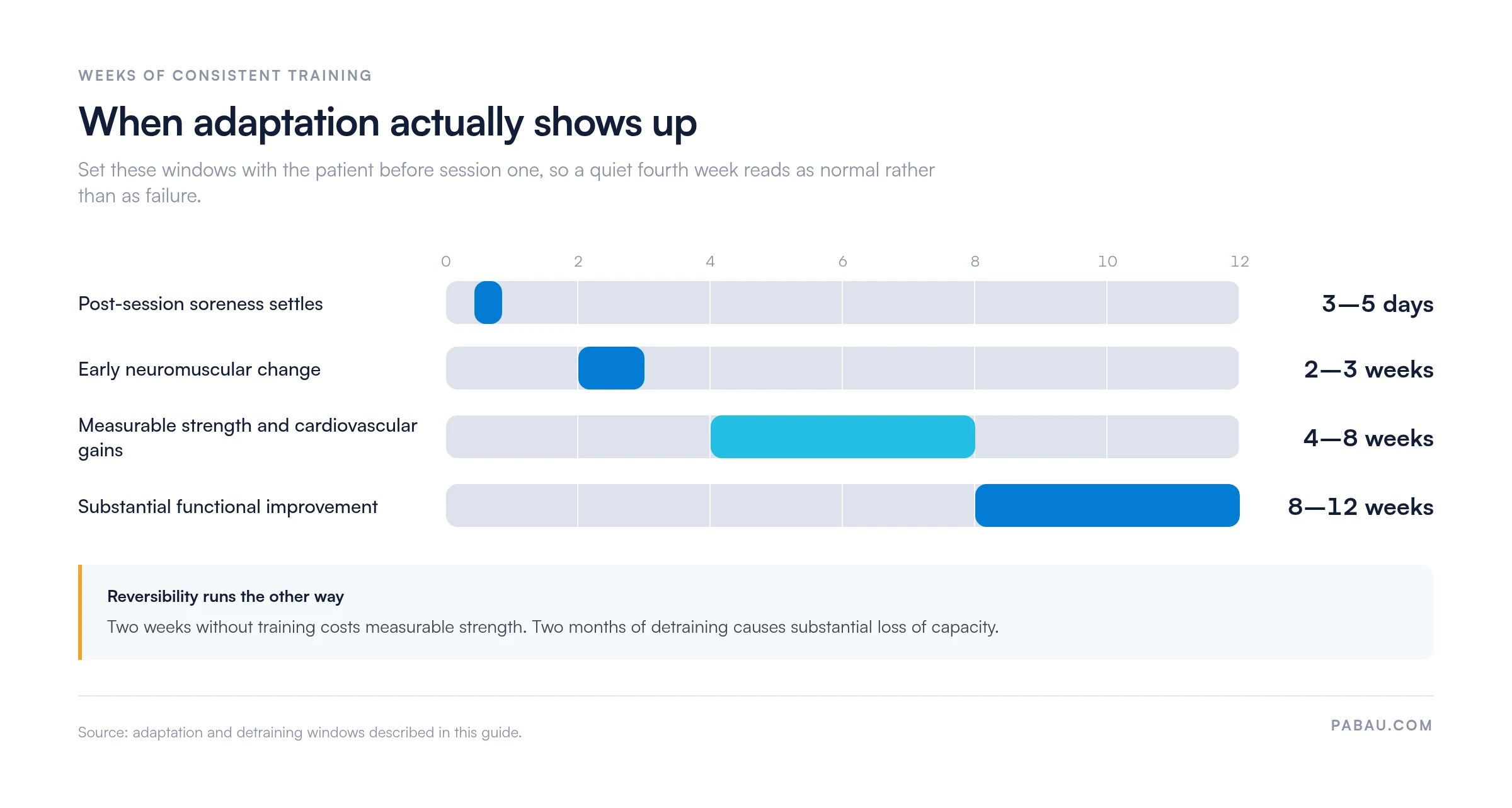
Adaptation is how the body changes in response to a consistent training stimulus. As a patient lifts progressively heavier weight, muscle fibers grow, neural recruitment improves, and connective tissue strengthens. Early neuromuscular change shows within 2 to 3 weeks. Measurable strength and cardiovascular gains take 4 to 8 weeks, and substantial functional improvement takes 8 to 12 weeks.
Those windows are worth setting out before a patient starts, because they carry the whole expectation conversation. When you explain that soreness eases in 3 to 5 days while strength gains take weeks, consistency stops competing with dramatic short-term change. The same timeline tells you when to book the reassessment.
Recovery is where adaptation occurs. The session creates the stimulus for change. The body then builds muscle, strengthens bone, and improves cardiovascular function during the rest between sessions. Inadequate recovery limits progress and raises injury risk.
In practice, recovery means prescribing rest days, usually one or two a week for most patients, and talking about sleep quality and nutrition. When a patient asks why progress has slowed despite high training volume, recovery is often the answer. Automated reminders on rest days reinforce that rest is part of the program.
Reversibility, also called detraining, states that fitness gains are lost when training stops or drops sharply. The body adapts to current demands, so adaptations regress once those demands fall away. A patient who stops exercising for two weeks loses measurable strength. Two months of detraining causes substantial loss of capacity.
This principle carries most of the patient education load. Fitness is not earned once and kept forever, and many patients expect a six-week course to hold indefinitely. Set the expectation that a home exercise program continues after discharge, and adherence holds up far better.
Individual differences means people respond differently to the same stimulus, based on genetics, age, training history, lifestyle, and physiology. Two patients running identical programs at identical intensity will progress at different rates. Their pain responses and adaptation timelines will differ too.
This is what justifies personalized programming. A one-size-fits-all approach suits some patients and fails others. Gathering training history, lifestyle, and previous injury at intake helps you anticipate how someone will respond. Reassess regularly and adjust load or volume to that response instead of holding a standard prescription.
FITT is the practical framework for applying the seven principles when you write a prescription. It stands for frequency, intensity, time, and type, the four variables you manipulate to create overload, progression, and specificity. Every parameter in a program belongs to one of those four.
Structuring prescriptions this way keeps overload, progression, and specificity deliberate. It also gives you a shared language with patients and colleagues. Instead of saying “do more”, you can name the variable that changed and the reason it changed.
Turning the principles into daily clinical action is the part that decides outcomes. Teams working with athletes usually run this through sports medicine software, so the prescription and the session log sit in one place. The six steps below work the same way on paper.
Start with objective baseline testing: movement quality, pain-free range of motion, strength testing, and functional capacity. Record the patient’s goals in their own words. That baseline does two jobs. It sets the right initial load for this particular patient, and it gives you the reference point for measuring adaptation later.
Select exercises that match the patient’s functional goal, which is specificity in practice. If the goal is returning to gardening, include kneeling, crouching, and reaching patterns alongside bilateral leg presses. Connecting each exercise to a task the patient recognizes raises engagement and trains the adaptations they came for.
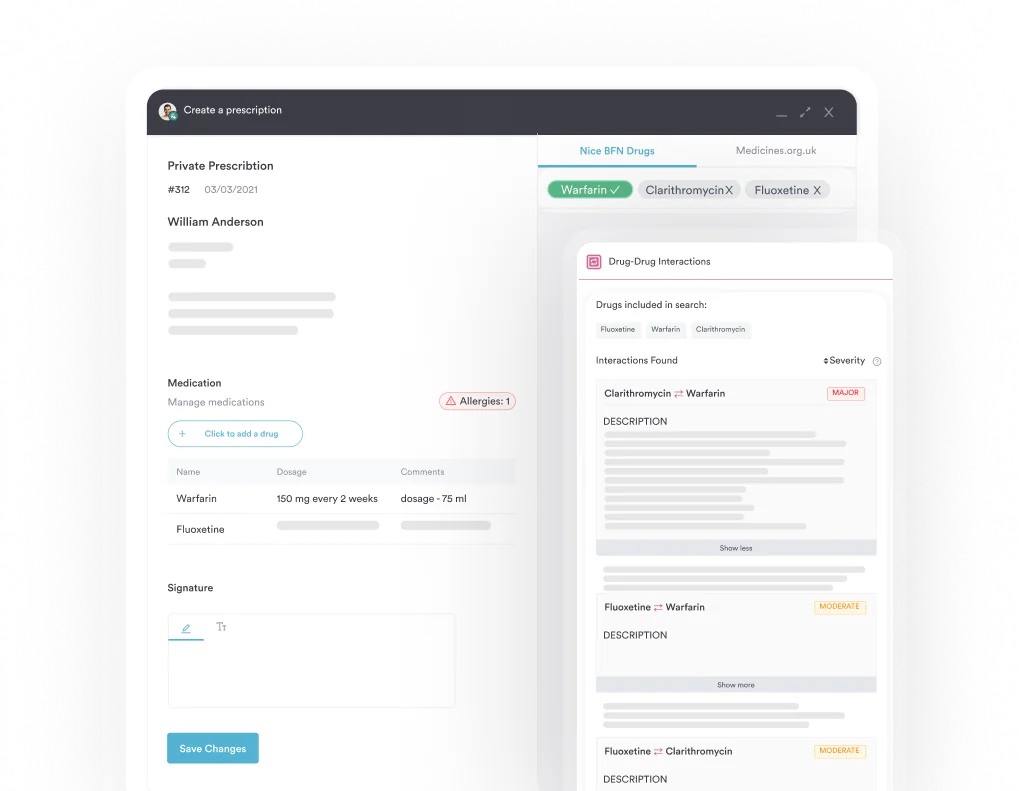
Define baseline frequency, usually 2 to 3 times a week in rehabilitation, and intensity that leaves one or two repetitions in reserve. Set time as a repetition range: 10 to 15 reps for endurance and early-phase work, 6 to 10 for strength. Type is the exercise selection from step 2. Write it down, because prescription management tools keep that record standardized and easy to compare at the next visit.
Decide your progression strategy upfront. Will you raise frequency, intensity, volume, or exercise difficulty? A common pattern holds the initial load for two weeks, then raises one FITT variable by 5 to 10% every two weeks. Writing the plan down prevents ad-hoc changes and shows the patient there is a system behind it.
Log performance after each session: load used, repetitions completed, pain rating, fatigue level. Every two weeks, check whether the patient is meeting the prescription. Someone completing all sets with good form and saying they could do more is ready to progress. Someone struggling with the load, or reporting pain outside the expected range, needs less load rather than more.
Teach explicitly that rest days are productive training. Recommend a sleep target of 7 to 9 hours, adequate protein for muscle adaptation, and a clear plan for home exercises on non-treatment days. Frame the six to eight week course as the start of ongoing maintenance, which sets realistic expectations and blunts the detraining that follows discharge.
Outcomes improve when programs follow evidence-based principles instead of a generic exercise sheet. Patients who understand why their program progresses the way it does adhere better. Teams sharing the FITT vocabulary argue less about modifications, because the variable under discussion is named.
Tracking baseline assessments, prescribed loads, and session performance in a purpose-built physical therapy EMR turns these principles into data you can audit. You can show each patient’s progression trajectory, defend a clinical decision to a payer or a colleague, and see which modifications work across your caseload.
Most rehabilitation teams track progression in three places at once. The prescribed load sits in a session note. The home program goes out as a PDF, and the reassessment dates live in someone’s calendar. Comparing week four against week one means opening all three.
Pabau keeps the prescription, the session log, and the reassessment in one patient record. You set frequency, intensity, time, and type once. Each visit writes back to the same record, so progression becomes a comparison you can read in seconds.
Automated messages carry the rest-day and home-exercise reminders that reversibility demands. Pabau GO, our iOS app, lets a therapist log a set at the plinth instead of at the end of the day. Every subscription includes every feature, so a solo practitioner gets the same reporting a ten-site group does.

Pabau logs prescribed load, session performance, and reassessment dates against the patient record. Your progression decisions stay traceable, and home-exercise reminders go out on their own.

Take your next three programs and check each one against the seven principles. The change you notice will be in your reasoning. You will be able to say why the load rose in week three and why it held in week four.
The trade-off worth remembering is time. Assessing baselines, writing progression plans, and logging every session takes longer than handing out a generic sheet. That work pays back at reassessment, when the numbers answer the question for you.
Keep the checklist above beside you while you write the next prescription. Book a demo to see how Pabau holds every prescription, session log, and reassessment in one patient record.

Want to see progression and specificity in a full protocol? Return to running protocol walks through the load steps for one of the most common patient goals.
Need a baseline before you set the first load? Fitness assessment form gives you a structured way to record capacity at the start of a program.
Looking for a repeatable way to measure overload? Muscular strength test standardizes the strength numbers you compare at each reassessment.
The 7 core principles of exercise are specificity, overload, progression, adaptation, recovery, reversibility, and individual differences. These principles explain how the body responds to a training stimulus, and they form the foundation of all effective rehabilitation and fitness programs.
FITT stands for frequency, intensity, time, and type, the four variables clinicians manipulate to apply overload, progression, and specificity. Frequency is how often the patient trains, intensity is the challenge level, time is total volume or duration, and type is the exercise mode. Changing one FITT variable at a time creates systematic progression.
Rehabilitation follows the same principles as general fitness. Start with low-load, high-specificity exercises matching the injury and the functional goal. Progress systematically using FITT variables, guided by individual tolerance and recovery capacity. Expect adaptation to take 4 to 8 weeks, and treat recovery between sessions as part of the program. Explain reversibility so patients understand that home exercises must continue to hold their gains.
Individual differences means people respond differently to identical training, based on age, genetics, training history, and lifestyle. A program that suits one patient may need modification for another. Reassess regularly and adjust load or volume to the response in front of you. That habit, in place of a rigid template, is how clinicians deliver consistent outcomes across a diverse caseload.
Initial neuromuscular adaptations appear within 2 to 3 weeks of consistent training. Measurable strength or cardiovascular improvements typically take 4 to 8 weeks. Substantial functional change, such as returning to an activity, takes 8 to 12 weeks or longer depending on baseline capacity and training consistency. Setting these timelines clearly with patients prevents discouragement when rapid progress does not arrive.