Nursing narrative note template
A nursing narrative note template is a structured PDF that guides you through re...

3
Last Updated: Oct 21, 2026

A walking exercise plan to lose weight turns a general activity recommendation into a prescription you can date, sign, and review.
The WHO recommends 150 minutes of moderate activity a week, and the four-week tiers in this template build toward that.
Documenting pace, frequency, and step targets leaves you a record of your clinical reasoning if the plan is ever queried.
Practice management software like Pabau keeps the plan, the progress notes, and the review reminders in one patient record.
A ready-to-use template covering baseline movement screening, a four-week walking schedule with duration and pace columns, step targets, progression decisions, and return-to-activity criteria. Written for physical therapists and weight loss clinicians.
Download templateA walking exercise plan to lose weight sets a session length, a target pace, a weekly frequency, and a step goal. It is the difference between telling a patient to walk more and prescribing something you can review.
This template runs four weeks. Beginners walk 20 to 30 minutes at 2.5 to 3 mph, three to four days a week. Weeks three and four step up to 35 to 45 minutes at a brisk pace, with 8,000 to 10,000 steps a day.
Baseline screening, progression decisions, and return-to-activity criteria each have their own fields, so the plan doubles as your clinical record. Below is how to fill it out, who it suits, and what to document at every review.
A walking exercise plan to lose weight is a structured clinical document that prescribes walking to support body weight reduction. Unlike a step-count goal, it specifies duration, pace, weekly frequency, and an intensity tier.
It also sets out how the patient moves up week by week, which keeps injury risk down while cardiovascular fitness builds.
The WHO’s physical activity guidelines say adults should get at least 150 minutes of moderate-intensity aerobic activity a week. A walking plan turns that number into a schedule a practitioner can prescribe, document, and review.
Physical therapists, sports medicine practitioners, and weight loss clinicians all use a version of this document. The template covers baseline range-of-motion and strength screening, plus a weekly schedule with duration and intensity columns. Step targets and return-to-activity criteria round it out, which makes it workable across specialties.
The template follows five stages, built around a typical physical therapy or weight loss consultation cycle. Each stage is a section of the form.
Read the tiers as a ladder rather than a calendar. Each one holds until the patient meets it comfortably, which is why the weekly rows matter more than the week numbers.
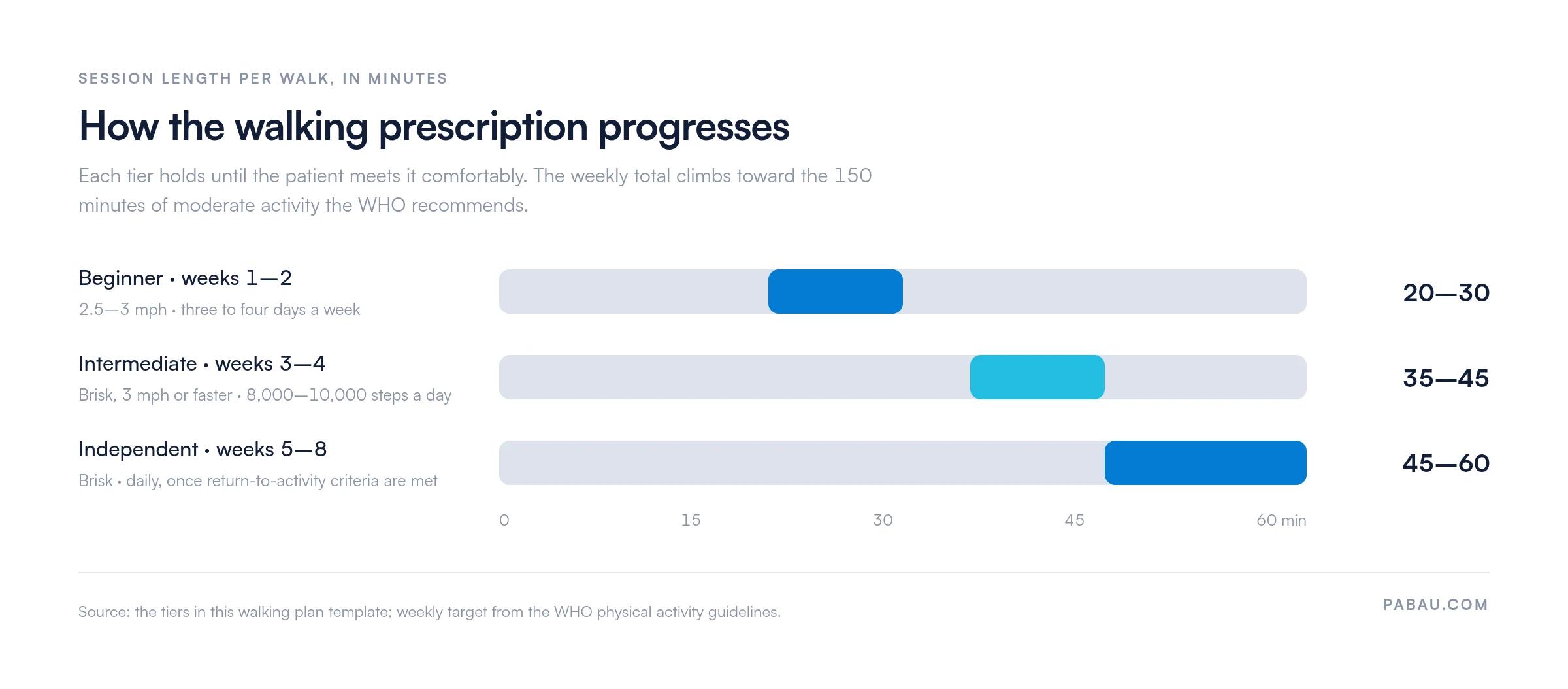
The template defaults to rehabilitation language, because it was written for physical therapy, chiropractic, and sports medicine settings.
In a pure weight management setting, switch the return-to-activity section to long-term maintenance targets instead of discharge criteria. Patients who progress past walking can move onto a weight loss workout plan that adds resistance work.
The plan suits clinicians who prescribe movement inside a structured weight management or rehabilitation program. Four practice types get the most out of it.
The plan is less suited to high-acuity settings where exercise has to be supervised. There, use it as a home-program supplement rather than the primary rehabilitation document.
Prescribing a walking plan verbally leaves too much to memory. Patients misremember their targets, you cannot show your clinical reasoning later, and progress is hard to compare between appointments. A standardized template fixes all three.
Review the walking plan at every appointment rather than leaving it until the final session. Patients who get a mid-program check-in adjust their intensity sooner and hold adherence better to the end. Build a five-minute plan review into your standard consultation template so it never gets skipped.
A PDF on its own rarely keeps a patient consistent. Adherence to a home program fades once the momentum from the appointment does, so build these habits into the workflow.
For patients new to exercise, the NHS’s walking for health guidance suggests starting at 10 minutes a day and building gradually. That matches the beginner tier, so the page is a useful link to send home with the plan.
Practices running several patients through the program at once need one view of who is due a review. They also need to see who missed a check-in and whose plan is ready to progress.
Most practices hand the walking plan over as a printout or an email attachment. The next review then starts with a hunt through the patient’s file for what was prescribed, and for what the patient managed.
Practice management software like Pabau keeps the plan inside the patient record. You assign it as a digital form before the appointment, so the patient reads the schedule at home. Pabau’s progress tracking tools then log weight, step averages, and biometric change against that same record.
Automated pre- and aftercare messages send the plan out after each visit, and review reminders tell your team who is due. The loop from prescription to outcome closes without a second spreadsheet or a manual chase.


Assign the walking plan, track step and weight progress, and automate review reminders inside one patient record. No paper, no separate spreadsheets.

Walking is one of the safest prescriptions in weight management, and the documentation is what turns it into clinical care. Fill in the baseline, commit to the tiers, and hold each one until the patient meets it comfortably.
The trade-off worth remembering is that a plan is only as good as the review behind it. Two minutes on the progression column at every appointment does more for the outcome than any rewrite of the schedule.
Book a demo to see how Pabau keeps walking plans, step data, and review reminders in one patient record.

Want a shorter program to start people on? 21-day weight loss plan sets out a three-week structure you can run before a longer prescription.
Pairing the walking with a calorie deficit? My food diary gives patients a daily record they can bring to each review.
Setting up a new weight loss patient from scratch? New patient weight loss intake form captures the history and goals the plan depends on.
Choosing the system that stores all of this? EMR for weight loss clinics covers what to look for in a weight loss record system.
A walking exercise plan to lose weight is a structured clinical document that prescribes progressive walking activity. It specifies duration, pace, weekly frequency, and step targets, so a patient can reduce body weight through consistent moderate-intensity movement. Unlike a generic step goal, it includes a week-by-week progression schedule and baseline assessment fields, which makes it suitable for clinical prescription.
Walking alone can support weight loss when it sits alongside a calorie deficit. Research consistently shows that combining exercise with dietary change beats exercise on its own. A plan that raises duration and intensity week by week, paired with nutrition guidance, gives patients the best chance of holding the result.
Most clinical guidelines start beginners at 20 to 30 minutes of brisk walking, three to four days a week. From there, patients build toward 45 to 60 minutes daily over four to eight weeks. The WHO’s 150 minutes of moderate-intensity activity a week is the target those tiers work toward.
Running burns more calories per minute, but walking is more sustainable for most patients starting out. It carries a much lower injury risk and produces comparable outcomes over longer timeframes. For patients with joint conditions, obesity, or post-surgical rehabilitation needs, walking is the appropriate starting point before any running program.
10,000 steps a day is a widely used guideline rather than a clinically established minimum. Studies suggest meaningful health benefits begin at 7,000 to 8,000 steps a day for sedentary adults. Set the step target from the patient’s baseline instead of applying 10,000 across the board, and build the progression in.