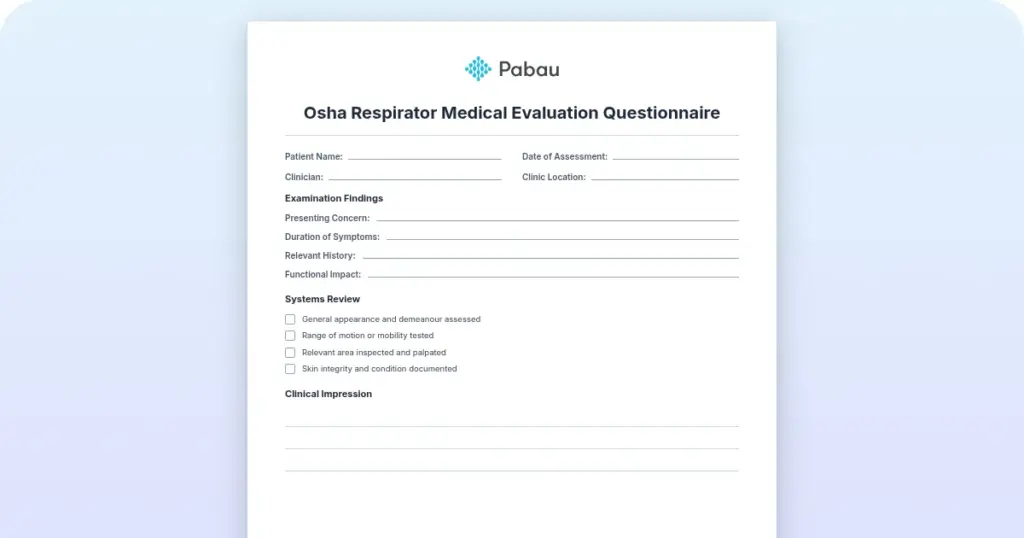
OSHA respirator medical evaluation questionnaire
The OSHA respirator medical evaluation questionnaire is the mandatory health for...

3
Last Updated: Oct 15, 2026

A waiver is a patient voluntarily giving up a known right, usually the right to sue over a named risk.
Enforceability rests on six elements, and a waiver missing any one of them gets weaker in court.
A waiver is a different document from informed consent, which records what the patient understood rather than what they gave up.
Courts set a waiver aside where gross negligence or recklessness is alleged, so it never replaces malpractice cover.
E-signatures carry the same weight as ink under the US ESIGN Act, the UK Electronic Communications Act 2000, and eIDAS.
A signature-ready form covering the proposed procedure, the benefits discussed, the risks confirmed and the alternatives explained. It also carries photography permission, medical history, and signature lines for the patient, clinician and guardian.
Download templateA waiver, by definition, is a patient voluntarily giving up a known right. That word “known” carries most of the legal weight. The patient has to understand exactly which right they are handing over, or a court will not enforce the document.
Practices run into trouble when they treat a waiver as a tidier consent form. The two documents do different jobs, so using one for both leaves you covered on neither front. Getting that distinction right is the first step.
The elements below are the rest, and together they separate a waiver a court will uphold from a signature that means nothing.
A waiver is a voluntary giving-up of a known right. In healthcare, the patient agrees to drop a specific claim, right or legal action in return for treatment. It binds only when the patient understands which right is going, and agrees to it without pressure.
A waiver is not a consent document. The forms you collect through patient intake software capture consent and acknowledgment, which is a different job.
Consent records that the patient understood the risks. A waiver takes the extra step of giving up the right to act on them.
Patients often sign both. They consent to the treatment, and they waive the right to sue if a documented complication happens, within whatever limits the law allows.
Each type does a different legal and operational job, so they are rarely interchangeable.
An express waiver is a written statement where the patient explicitly agrees to give up a right. Courts favor these because they leave no room for argument. A patient signs a line saying they waive the right to hold the practice liable for complications. The intent is then plain.
An implied waiver comes from conduct instead. A patient who proceeds with treatment after hearing the risks, and raises no objection, may be treated as having waived a right. Those are much harder to defend, so put every waiver in writing.
In a practice, a medical waiver does a narrower job than a general liability waiver. It sits alongside informed consent and privacy authorization, and it usually addresses one treatment’s documented risks.
Knowing which of the three you are handing over protects the patient as much as the practice.
Digital intake changes what that paper trail looks like. A practice can send the waiver out through capture forms software before the patient arrives.
The timestamp is recorded, and the signed copy is filed against the patient record. That file is what an auditor or a defense lawyer asks for first.
A medical waiver is also a different document from informed consent. Consent proves the patient was educated about the treatment.
The waiver asks them to give up the right to pursue damages if a documented risk lands. Many practices use both, and courts still refuse to enforce a waiver that tries to excuse gross negligence.
A waiver that misses a legal requirement is unenforceable, which leaves the practice exposed. Courts read these documents narrowly, so treat all six elements as mandatory.
Electronic signatures are worth a note of their own. A timestamped e-signature records the exact moment the patient signed and the device they used. That makes it harder to claim later that the form was rushed, or never signed at all.
Enforceability standards vary by jurisdiction. Reference sources such as Cornell Law LII set out the general tests. Then have counsel who knows your state or country review the exact wording.
Practices use the two terms interchangeably, and the law does not. A waiver gives up a right before harm happens. By contrast, a release forgives liability for harm that has already happened, or is already being claimed.
Most practices only need the waiver, collected at intake. A release usually gets drafted by a lawyer in response to a specific complaint or incident. If you need the wording for one, the medical release form template sets out the fields it should carry.
Sequence is where most of the confusion clears up. Each of these four documents has one moment in the visit where it belongs. Signing them out of order weakens all four.
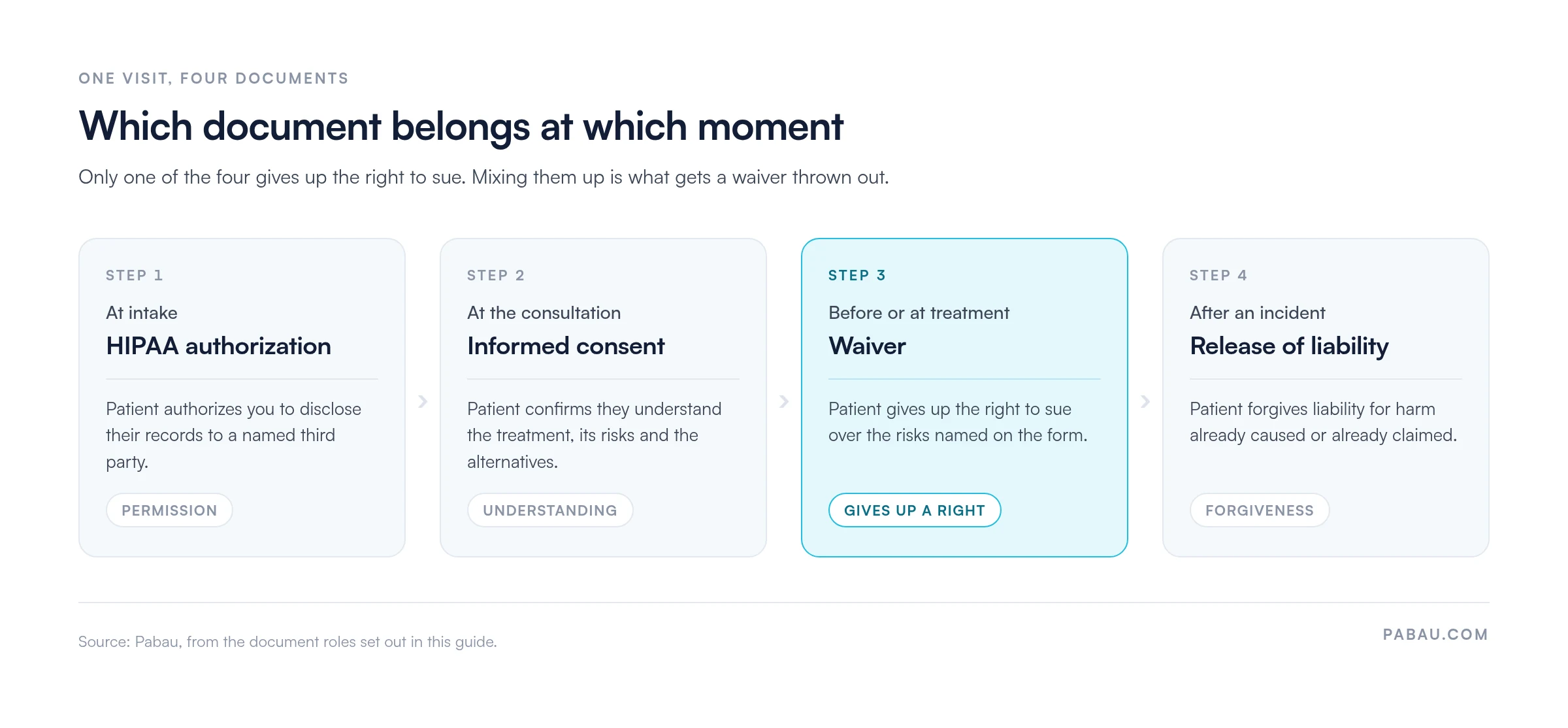
The waiver’s slot is the tight one. Sign it too early and the patient has not yet had the risk conversation that makes their agreement informed. Leave it to the treatment couch and you invite the argument that they had no room to refuse.
Run through this before the waiver goes out. It takes a minute, and it clears most of the reasons a court would set the document aside.
Most practices still collect waivers on paper at the front desk. The patient signs on a clipboard while staff wait, and the form goes into a folder. Nobody looks at it again until an auditor or a lawyer asks. Finding that one signed page can then take an afternoon.
Practice management software like Pabau changes the order of operations. Its automated workflow software sends the waiver out before the appointment. The patient reads it at home instead of in the treatment room. They sign electronically, and the timestamped document lands in their record on its own.

The same pass handles the rest of the intake pack, so consent, HIPAA authorization and the waiver all arrive in one link. Staff stop chasing signatures. The practice ends up with a searchable set of records for the day someone asks for proof.
Patients can re-read what they signed at any time through patient portal software. That cuts the disputes about what was explained and when, which is exactly what the timestamps are there for.

Send the waiver ahead of the appointment, collect a timestamped e-signature, and file it against the patient record automatically. Every subscription includes it.

A waiver is worth having, but only in the narrow band where courts respect it. Write it for one procedure, hand it over early, and keep the signed copy where you can find it. Push it further than that and it stops protecting you.
The trade-off worth remembering is that a waiver never replaces the conversation. A signature records that the patient accepted a named risk. Only the consultation makes that acceptance believable. The strongest defense is a matched pair, consent and waiver, both dated and both stored.
Start with the form above, then get the wording checked by counsel in your jurisdiction. Book a demo to see how Pabau collects, signs and files waivers before the patient ever reaches the treatment room.

Need the form that closes a claim rather than preventing one? Medical release form covers the document a practice reaches for after an incident.
Sharing records with an insurer or another provider? HIPAA authorization form sets out the fields a valid disclosure authorization has to carry.
Want the consent half of the pair? Medical consent form for adults shows what a consent document records that a waiver does not.
Treating a patient under 18? Consent to treat a minor explains how guardian authority gets recorded and verified.
Building the whole intake pack? Medical forms for healthcare practices lists the documents a practice needs beyond the waiver.
Yes. A patient who cannot read the waiver cannot know which right they are giving up. Provide the form in their language, or use a qualified interpreter and note that in the record. Keep the version you actually walked them through.
Keep it as long as the rest of that patient’s medical record, since the waiver forms part of it. Retention periods vary by state and country. Match your existing records policy rather than setting a separate rule for waivers.
Legally yes, but earlier is safer. A patient signing while gowned and waiting has less room to decline, which is the kind of pressure a court looks for. Send the form ahead of the appointment and let them read it at home.
No. A court can set a waiver aside, particularly where gross negligence is alleged, and the claim then proceeds as normal. Treat the waiver as one layer of defense and keep your cover in place.
The person with legal authority to decide for them signs instead, such as a healthcare proxy or a court-appointed representative. Record who signed, what their authority was, and how you verified it. Confirm the rules that apply in your jurisdiction first.