Trauma response test: Free template for clinicians
A trauma response test is a structured screening questionnaire that helps clinic...

3
Last Updated: Oct 15, 2026
The emotional guidance scale ranks 22 human emotions, from joy and appreciation at the top to fear, grief, and powerlessness at the bottom. Esther and Jerry Hicks published it in their book Ask and It Is Given.
Therapists, coaches, and wellness practitioners use it as a self-awareness map. Patients find their current level, then work toward a slightly better-feeling emotion one step at a time. The scale doesn’t diagnose or treat any mental health condition. It gives practitioner and patient a shared, neutral language for talking about mood.
A printable scale listing all 22 Abraham-Hicks emotions in ranked order, with space for clinician notes and patient self-assessment.
Download template
The emotional guidance scale lists 22 emotions in order, from joy and appreciation at the top to fear and powerlessness at the bottom.
It comes from ‘Ask and It Is Given’ by Esther and Jerry Hicks and is used in Law of Attraction and emotional regulation work.
Progress means climbing a level or a few at a time, so a move from fear (22) to anger (17) counts as a step up.
It’s a self-awareness tool, not a diagnostic instrument, so practitioners use it alongside evidence-based therapy.
Practice management software like Pabau lets you send the scale as a digital form and log each rating against the patient record.
The emotional guidance scale is a ranked list of 22 human emotions. Esther and Jerry Hicks presented it in their 2004 book Ask and It Is Given. It sits within the Abraham-Hicks Law of Attraction framework, which holds that each emotion carries a vibrational frequency. The higher the emotion on the scale, the more aligned a person is with positive outcomes.
The scale doesn’t label emotions as “good” or “bad.” It treats each one as a signal of where you are now and how far you are from where you want to be.
For practitioners, the value is more practical. The scale gives patients a numbered map of emotional experience. Instead of “I feel bad,” a patient can say “I’m around level 16 (discouragement).” That specificity opens a targeted conversation. Breathwork and journaling are often paired with the scale to support small moves toward more resourceful states.
The table below lists all 22 emotions from highest to lowest vibrational frequency, as Abraham-Hicks defines them. Keep it open during sessions to help patients pin down where they are.
The scale rests on the idea that emotions sit on a continuum rather than appearing at random. According to the Abraham-Hicks framework, your emotional state shows how far your current situation is from the one you want. When the two are close, you feel high-vibration emotions. When they’re far apart, you land lower down the scale.
The mechanism is incremental movement: Climbing a step or a few at a time rather than leaping from despair to joy. The Abraham-Hicks teachings treat a move from fear (22) to anger (17) as progress, because anger carries more energy and agency than powerlessness. That framing helps in session. A patient who moves from collapse into frustration is drawing on more internal resources, even if frustration doesn’t feel “better.”
The ladder below marks that climb and two others from this guide, so you can see how far each one moves.
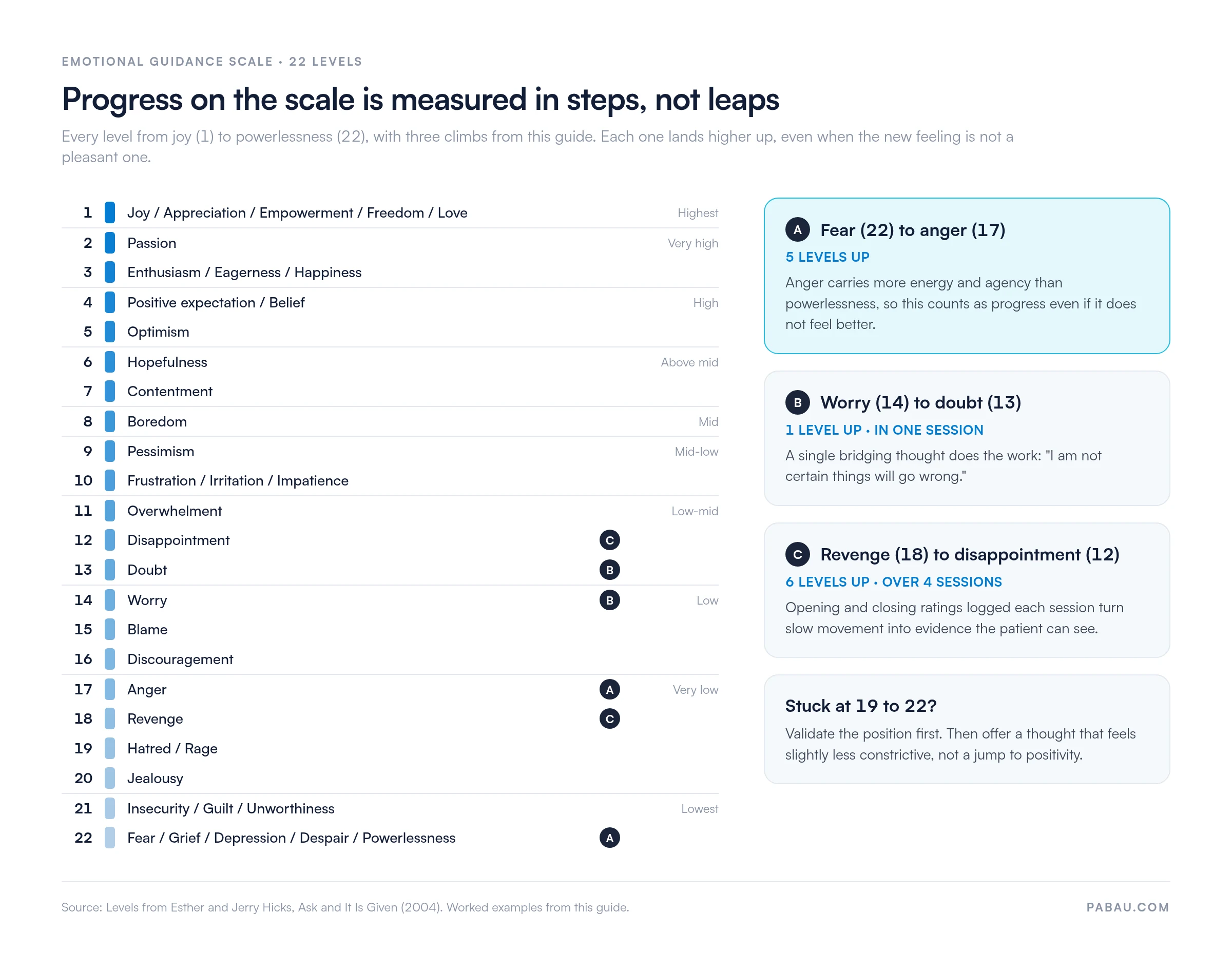
When a patient is stuck at a very low position on the scale (levels 19-22), don’t try to pivot them straight toward positivity. Validate where they are, then invite a thought that feels slightly less constrictive. A move from level 22 to level 17 is meaningful clinical progress.
Using the scale as a structured session tool takes five steps. They apply in individual therapy, group settings, and coaching alike.
In clinical and coaching work, the scale doubles as a practical emotions chart. Its value is a vocabulary that feels accessible rather than diagnostic. Patients who resist formal assessment tools often engage with it more readily, because it feels like self-discovery rather than evaluation.
Therapists can use it as a session check-in alongside a structured psychiatric assessment, tracking mood trajectory rather than treating it as a standalone measure. Coaches working with performance, grief, or life transitions value it because no position on the scale is treated as pathological. For acute distress, pair the scale with established crisis intervention frameworks rather than relying on it alone.
The scale also works well in group therapy. Members locate themselves independently, share their position if they choose, and see that others sit at a range of levels. That normalizes emotional diversity within the group and eases the isolation that low-vibration states often bring.
Coaches using coaching client management software can add the scale as a recurring session note field. Logging client self-ratings at each touchpoint builds a visual record of emotional movement across the program.
The scale brings several practical advantages to a structured therapy or coaching program.
Many practitioners start with the printed scale and a pen. The ratings end up in paper notes or a spreadsheet, so spotting a trend across six sessions means flipping back through files.
Pabau’s digital forms let you send the scale as a pre-session questionnaire, so patients rate themselves before they arrive. With Care Pathways, they’re prompted to complete it ahead of each visit. Each rating saves to the patient record alongside appointment history and clinical notes.
Opening and closing positions then sit side by side, ready to show a patient how far they’ve climbed. For practices that want intake, notes, scheduling, and payments on one platform, Pabau’s therapy practice management tools cover the full patient journey.

Send the scale as a digital form, log every rating in the patient record, and review each patient’s progress in one place.

The scale earns its place when you use it consistently. A single rating tells you where a patient is today. Six pairs of opening and closing ratings tell you whether your work is moving them, and give them proof they can see.
Keep the framing honest. Present the scale as a self-awareness aid, pair it with evidence-based methods, and route acute distress to a proper crisis plan. Used that way, it gives patients a language for mood that formal assessment tools rarely offer.
Start with the free PDF in your next session and record both ratings. Book a demo to see how Pabau keeps every emotional check-in in the patient record, ready to review at a glance.

Need a structured tool for session assessment? Psychiatric evaluation template provides a step-by-step framework for comprehensive mental health assessments alongside check-in tools like the scale.
Working with patients in acute distress? Crisis intervention strategies for clinicians outlines evidence-based approaches that complement emotional awareness tools in high-risk situations.
Want a quick weekly check-in form? Mental health check-in worksheet gives patients a short structured way to report mood, sleep, and stressors between sessions.
Helping patients ride out low-level emotions? DBT distress tolerance skills covers practical techniques patients can use when an emotion feels too intense to shift.
Curious how emotion and physiology connect? Cannon-Bard theory of emotion explains a classic model of how the body and brain produce emotional experience.
The emotional guidance scale is a 22-level ranked list of human emotions from Esther and Jerry Hicks’s book Ask and It Is Given. It runs from joy and appreciation at the top to fear, grief, and powerlessness at the bottom. It’s a self-awareness and emotional regulation tool, not a clinical diagnostic instrument.
Levels 1 to 7 are Joy/Appreciation/Empowerment/Freedom/Love, Passion, Enthusiasm/Eagerness/Happiness, Positive Expectation/Belief, Optimism, Hopefulness, and Contentment. Levels 8 to 16 are Boredom, Pessimism, Frustration/Irritation/Impatience, Overwhelment, Disappointment, Doubt, Worry, Blame, and Discouragement. Levels 17 to 22 are Anger, Revenge, Hatred/Rage, Jealousy, Insecurity/Guilt/Unworthiness, and Fear/Grief/Depression/Despair/Powerlessness.
Move one step at a time, not several. Identify your current position, then find a single thought that feels slightly less constrictive. Someone at level 22 (powerlessness) can often reach level 17 (anger) by recalling a situation where they had some agency. Journaling, breathwork, and somatic practices support this gradual shift.
Yes. Therapists, counselors, coaches, and wellness practitioners use it as a session check-in and emotional mapping tool. It works alongside evidence-based methods such as CBT and ACT but doesn’t replace them. Frame it as a self-awareness aid rather than a diagnostic measure.
Yes. Pabau offers a free printable PDF that lists all 22 emotions in ranked order, with space for notes. Download it using the button at the top of this page.
The scale supports self-monitoring, emotional labeling, and incremental mood regulation. Patients practice naming their current state accurately, choosing a slightly better-feeling thought, and tracking movement over time. These skills align with emotion regulation techniques in acceptance and commitment therapy (ACT) and positive psychology.