Emotional awareness worksheet
An emotional awareness worksheet is a structured psychoeducational tool that hel...

3
Last Updated: Oct 16, 2026

A supervision note is the formal record of a clinical supervision session, covering cases discussed, guidance given, and agreed action items.
State licensing boards treat these notes as proof that a pre-licensed clinician received documented oversight toward licensure.
Required fields cover the supervisee, the supervisor, the date, cases reviewed, action items, and a signed attestation.
Supervision notes belong in the supervisee’s personnel file, not the client’s medical record, and they still need secure storage.
Practice management software like Pabau turns the template into a digital form and keeps completed notes in access-controlled storage.
A one-page form with session information, the supervisee’s name and license status, and the supervisor’s name and credentials. It also carries a 24-item supervision topic checklist, free-text boxes for competencies and case discussion, and a signature block.
Download templateA supervision note is the written record of a clinical supervision session. It is also the document a state licensing board asks for when your supervisee applies to practice independently. And it belongs in the supervisee’s personnel file, not the client’s medical record.
Get that filing wrong and you create a confidentiality problem on top of a compliance one. Write the note thin, write it weeks late, or store it somewhere loose, and hours your supervisee genuinely earned may not count.
The fields, the timing, and the filing rules below are what keep those hours on the record.
A supervision note records what the supervisor and the supervisee discussed. A progress note records what happened with the client. Both are required records, but they answer to different readers.
The supervisor writes it during or straight after the session. The supervisee is a pre-licensed clinician, trainee, or intern working toward a license. The note covers the cases reviewed, the guidance given, the development goals, and the next steps you both agreed.
Written properly, the note becomes evidence that supervision happened. It also builds the audit trail a board reviews at application time.
Supervisors who already write clean client documentation, such as social work SOAP notes, will find the format familiar. The content, though, points at the supervisee rather than the patient.
Undocumented supervision hours can be refused, even when the supervision genuinely happened.
State boards want evidence, and the note is the evidence. It shows that you met, reviewed named cases, gave clinical direction, and signed off.
The notes protect you as well. They record the guidance you gave, the concerns you raised, and the decisions you reached together.
If a complaint or a malpractice claim surfaces years later, that record shows oversight was in place.
Seven fields do most of the work. The table marks the ones a note cannot go out without, and the ones that simply make it stronger.
Some supervisors add fields for context, such as whether the session was individual or group, or which ethical concerns came up.
Consistency beats completeness here. Use the same form every session and the documentation stays uniform.
Group supervision compresses several supervisees into a single record, and that is where the format has to work harder. The core fields do not change. What changes is how you attribute the discussion.
For a session between you and a single supervisee, this structure captures the detail a board looks for.
Start with an attendance list. Then note which supervisees presented cases or led the discussion. Finally, record any feedback or action item that applies to one supervisee rather than the whole group.
That last step is the one that saves you later. Without it, nobody can tell whose hours the note supports, or who received which piece of guidance.
Here is a full note for a pre-licensed candidate, written at the level of detail a board expects.
Date: September 1, 2026 | Time: 1:00 to 2:00 PM | Format: In person
Supervisee: Maria Gonzalez, LCSW-A (235 hours completed, 65 remaining)
Supervisor: Dr. James Park, LCSW (License #SW-5521)
Cases discussed: Maria presented her caseload, focusing on a 34-year-old client with a recent major depressive episode and active suicidal ideation. She described her safety assessment, the crisis plan she built, and her decision to refer for inpatient evaluation. I reviewed the risk factors present and affirmed her clinical judgment. We also covered how to document a suicide risk assessment, and when to escalate to psychiatric consultation.
Competency areas addressed: Risk assessment and crisis response, clinical documentation, and psychiatric collaboration. Maria showed strong empathy and structured assessment skills. Her growth area is confidence in setting boundaries with high-risk clients.
Action items: (1) Finish the agency’s suicide risk training module before the next session. (2) Bring a de-identified case file so we can review documentation quality. (3) Arrange a shadowing session with the consulting psychiatrist.
Supervisor signature: Dr. James Park | Date: September 1, 2026
Notice what the note leaves out: any identifying detail about the client. Supervisees bring the assessment work itself to the session, and a psychiatric evaluation template keeps that material consistent from one case to the next.
Two habits cause most of the trouble here. A thin note does not show what guidance you gave, and a note written weeks later reads like a reconstruction. A short, specific note finished the same day does both jobs at once.
Run through this list before the note leaves your desk. Each of these turns up in board audits, and each one is cheap to fix at the time.
That third mistake is an easy habit to fall into. If you write psychotherapy progress notes all day, the phrasing carries over, and the note starts describing the client instead of the supervision.
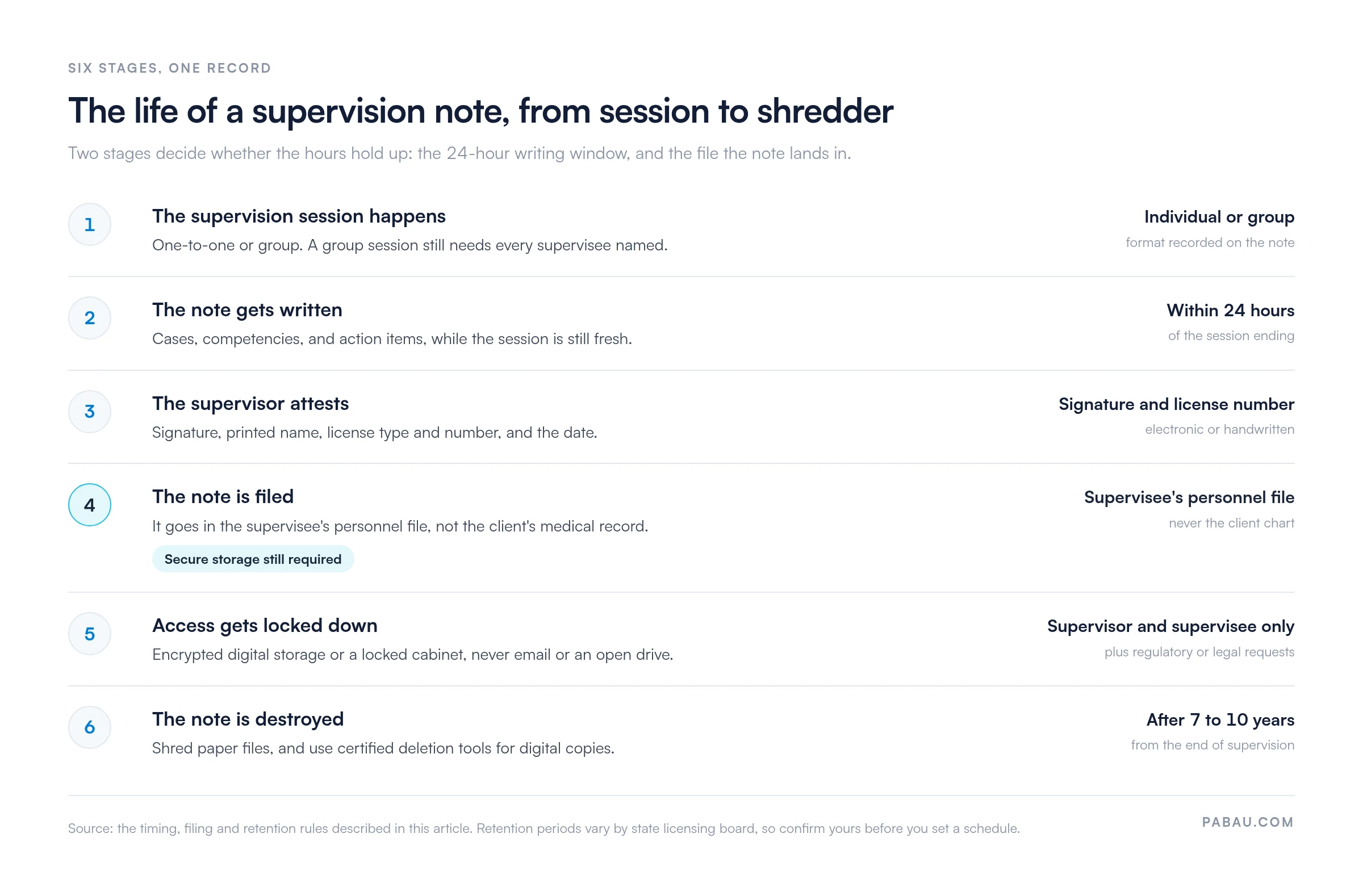
The note goes in the supervisee’s personnel file. It still carries sensitive clinical material, so treat it with the same care as a client record. Your licensing board sets the retention clock.
Those rules sit in four different places, which is why supervisors lose track of them. Laid out as one sequence, the whole life of a note fits on a page.
Supervisors in a group practice usually handle this inside the same therapy practice management system that already runs their calendar and client files. The supervision records sit in their own area, separate from client charts.
Keeping both document sets on one platform, rather than two, gives you a single access policy and a single backup routine. Practices already running medical records management have most of that groundwork in place.
Most supervisors run this on a Word file and a folder. You copy the template, fill it in, save it somewhere, and hope the naming convention holds. Multiply that by six supervisees and a weekly session each, and the admin adds up.
Practice management software like Pabau removes the copying step. You build the supervision note once as a custom digital form, then complete it after each session.
Finished notes save into secure, access-controlled records inside the platform, so none of them sit in a personal drive or an email thread.
That leaves you one place to look when a board asks for records, and one set of access rules to maintain. The time goes into the supervision itself rather than into filing it.

Build your supervision note once as a custom digital form in Pabau, then complete it after every session. Finished notes store in secure records with proper access controls, so a supervisee’s documented hours stay easy to produce.

Supervision notes are cheap to write well and expensive to write badly. Twenty minutes after the session, with the seven fields covered, and your supervisee’s hours hold up for a decade.
Two decisions carry most of the weight: the timing and the filing. Write the note the same day, and file it with the supervisee’s personnel record rather than the client’s chart. After that, it is a matter of being consistent about the fields.
Download the form above and use it for every session, and the documentation stops being a task you dread. Book a demo to see how Pabau turns that form into a digital version, with the completed notes stored securely in one place.

Need the note your supervisee brings to the session? Mental health note template covers the client-facing documentation that supervision reviews.
Want a faster way to write the client notes? Therapy progress notes cheat sheet gives supervisees a quick reference for the notes you audit each week.
Reviewing treatment plans in supervision? Psychology treatment plan template sets out goals and interventions in a format that is easy to critique.
Supervisee about to go independent? How to start a private therapy practice walks through the setup once their hours are signed off.
Often, yes. Many supervisors have the supervisee draft the note, then review it, correct it, and sign it. The attestation is what carries weight, because your signature is what the board relies on. Check your own board’s rules first, since some specify who must author the record.
Long enough to show substance, short enough to write the same day. Two or three sentences per case, plus the required fields, usually does it. A note that runs to several pages tends to drift into client detail that does not belong there.
They can be requested in a board complaint, an investigation, or a legal proceeding. That is the practical reason to keep them factual. Record what you observed, what you advised, and what you agreed, and leave speculation out of it.
The supervisor keeps custody, and the retention clock starts from the final session. Supervisees should ask for a written summary of their documented hours before they move on, rather than chasing a former supervisor years later.
Yes, briefly. Note the date, the cancellation, and the reason. Your hour log and your notes should agree. A missing week in an otherwise weekly series is the kind of thing an auditor asks about.