Treatment summary
A treatment summary is a written record of what care was delivered during an epi...

3
Last Updated: Oct 16, 2026

A medical directive form records a patient’s treatment wishes and names the healthcare agent who speaks for them once they cannot.
It bundles three documents: a living will, a medical power of attorney, and sometimes a physician-signed POLST or DNR order.
Witnessing decides validity, and the rule moves by state. Texas accepts two witnesses or a notary, while New York accepts witnesses only.
Practices that collect directives at intake, flag them on the chart, and revisit them yearly avoid arguing about consent during a crisis.
Practice management software like Pabau sends, collects, and stores the signed form through its client portal, so no paper changes hands.
The form covers patient identification, healthcare agent designation, a treatment preferences table, primary physician details, and organ donation. Signature, witness, notary, and audit trail blocks are built in.
Download templateA medical directive form records what a patient wants when they can no longer say it themselves. It names a healthcare agent, sets out treatment preferences, and tells your clinical team who decides. One detail settles whether it holds up, and that is the signing. Get the witnesses or the notary wrong, and the form is just paper.
For a practice, this cuts two ways. If you bill Medicare or Medicaid, federal law requires you to ask every patient about directives. A missing or invalid form then turns a clinical decision into a family argument.
The template above is ready to use. What follows is how to complete it, witness it, and store it where your team can find it.
A medical directive form is a legal document that tells clinicians how to treat a patient who can no longer decide for themselves. It does two jobs. The patient records which treatments they want, then names someone to answer the questions the form never anticipated.
The same document travels under several names. Advance directive, advance healthcare directive, and advance medical directive all describe it. What your intake pack calls it matters far less than whether the patient signed it correctly.
Digital collection is now the norm. A patient can complete the form at home and sign it through patient intake software. The signed copy lands in their record, with no scanning and no paper to lose.
The Patient Self-Determination Act gives every adult patient the right to execute a directive. Under 42 CFR §489.102, any facility that participates in Medicare or Medicaid must tell patients about that right. That rule is why directives now sit in the intake pack across primary care, surgery, and specialist practices.
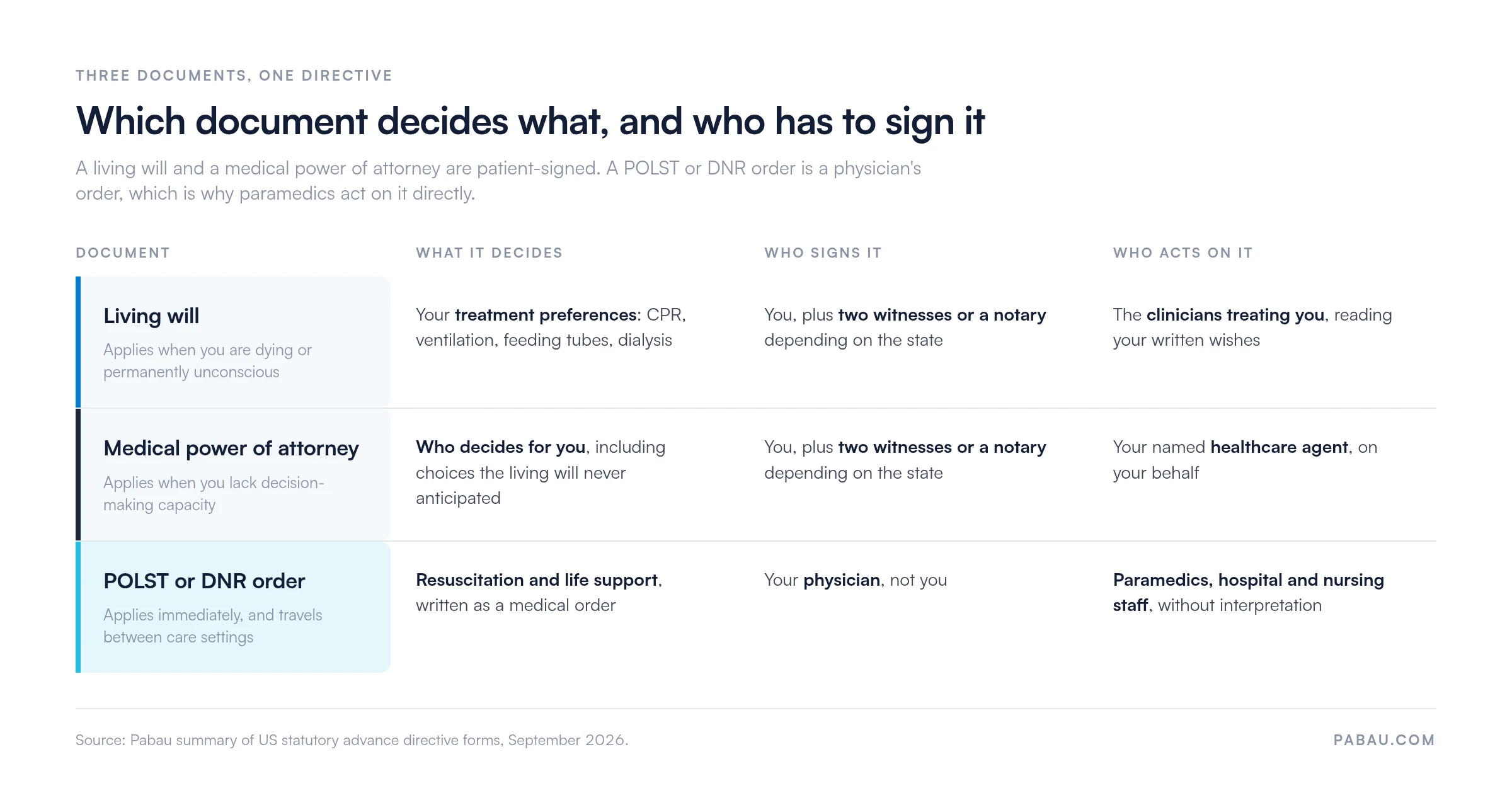
A complete directive is three documents working together, and they are not interchangeable. The patient signs two of them. A physician signs the third, which is what lets paramedics act on it without stopping to interpret it.
The grid below sets out which document decides what, and who has to sign each one.
Both, in most cases. A living will answers what the patient wants. A medical power of attorney answers who decides when the situation falls outside what they wrote down.
Because it is already a medical order. An advance directive is the patient’s own statement, so someone has to read it and interpret it. A POLST carries a physician’s signature and travels with the patient between care settings.
Most people with a POLST already hold a living will or a healthcare proxy. The POLST turns those wishes into orders that work at the bedside.
Not every patient needs one. It suits patients with serious illness or advanced age, the same group your practice will most often hand a DNR form template.
Work through the form from top to bottom, because each block does a different job. Skipping one is the usual reason a directive gets questioned later.
Run this list with the patient while they are still in the room. Every item on it is something practices otherwise end up chasing by phone a week later.
The witnessing error we see most often is a family member who stands to inherit signing as a witness. It looks helpful in the moment, and it can undo the whole document.
States set their own witnessing rules, and getting them wrong invalidates an otherwise complete form. Most states accept two disinterested witnesses or a notary public. A handful accept only one of those routes.
A disinterested witness cannot be the healthcare agent, a relative, a provider treating the patient, or anyone with a financial stake in the estate. California shows the common pattern. It accepts two witnesses or a notary, and the patient picks one path.
Texas works the same way. Under Tex. Health and Safety Code §166.032(b-1), a notary’s acknowledgment alone is enough, and no witnesses are needed. New York sits at the other end, accepting witnesses only.
Check the state’s official form before the patient signs. CaringInfo, a program of the National Alliance for Care at Home, publishes state-specific forms and requirements your team can verify against. Practices serving several states usually track those differences inside compliance management software rather than in one person’s head.
The form that is valid in California may not be valid in Texas, and the witnessing rule in Maryland differs from Florida’s. Any practice drawing patients from several states has to track those differences. Here is how five of them compare.
Every state recognizes advance directives, but the statutory form, the witnessing route, and the accepted document types all shift at the border. Most practices pull current forms from the state health department or attorney general’s office once a year, then keep a small library on file.
A signed directive helps no one if nobody can find it in an emergency. Storage and distribution are the parts practices most often leave half done.
Storage brings its own rules. Once the directive takes effect, the named agent can usually access the records they need to decide. Other relatives cannot, which is where a HIPAA authorization form does the work.
Distribution is easier through patient portal software. The patient, the named agent, and your front desk all work from the same signed copy, so nobody emails a scan around at midnight.
Most practices collect directives by exception. Someone remembers to ask, prints a form, and hopes it comes back signed. The result is a chart where directive status is unknown for most of the patient list.
An all-in-one practice management system like Pabau turns that into a standing step. You send the state-appropriate form with the appointment confirmation, and the patient completes and signs it before they arrive. The signed copy files itself against their record.
From there, the system does the chasing. Your team can see at a glance who has a directive on file and who does not. Reminders go out on their own. The signed document sits in the client record, with a history of when it was signed and by whom.
The payoff is a shorter conversation on the day it counts, and far less paper in between. Digital forms, the client portal, and the client record are included in every subscription, so none of this sits behind a higher tier.

Pabau sends the right directive form before the appointment, captures the signature, and files it in the patient record with a visible flag. Your team can see who has one on file and who still needs to be asked.

A medical directive is only as good as its signature page and the filing behind it. The clinical content rarely goes wrong. The witnessing and the storage do.
So pick the statutory form for your state and make it the default in your intake pack. Then give one person on the team responsibility for checking the signatures. That single decision removes most of the risk, and it takes an afternoon to set up.
The payoff arrives on the worst day, when a patient cannot speak and the family is looking at you. Book a demo to see how Pabau collects, stores, and flags patient directives without adding a step to your front desk.

Need the order paramedics act on at the scene? DNR form template gives you the physician-signed order that sits alongside the directive.
Sharing a patient’s records with relatives? HIPAA authorization form covers the disclosures a healthcare agent’s authority does not reach.
Documenting consent for an adult procedure? Medical consent form for adults sets out the wording and signature blocks a treatment consent needs.
Releasing records to another provider? Authorization for release of confidential information handles the paperwork when a directive has to travel with the patient.
Deciding how to collect forms before the visit? Patient intake software compares the ways a practice can gather signed documents ahead of an appointment.
State law decides who speaks for them. Most states set an order of priority, usually a spouse first, then adult children, then parents. That process takes time, and it can stall while relatives disagree. An informal conversation with family carries far less weight than a signed form.
Yes. All 50 states publish free statutory forms through their health departments. CaringInfo, a program of the National Alliance for Care at Home, collects them in one place. A lawyer is worth involving only for a complicated estate or an unusual clinical scenario.
Sometimes, but never assume it. Some states honor a directive that was valid where it was signed. Others require their own statutory form. A patient who moves, or who winters elsewhere, should sign the local form as well.
Only when the patient loses decision-making capacity. Until then the patient decides, and the named agent holds no authority. A physician usually documents the loss of capacity in the chart, and that is the trigger the agent acts on.
Yes, at any time. Most states let a patient revoke by destroying the form, signing a new one, or telling the care team clearly. Collect every outdated copy, because an old directive left in a chart is what causes confusion later.