Journal prompts for mental health
Journal prompts for mental health are guided questions that help people process ...

2
Last Updated: Oct 13, 2026

The AUDIT alcohol screening test is a 10-question WHO-developed tool that identifies hazardous, harmful, and dependent drinking patterns in primary care.
AUDIT scores range from 0-40. The WHO’s standard cutoff of 8 or higher signals hazardous or harmful drinking, though many practices use a lower threshold of 7 for women.
AUDIT-C is a 3-question abbreviated version scored 0-12, used for rapid screening when time is limited or in emergency departments.
Pabau’s digital intake forms and automated workflows let practices embed AUDIT screening into patient records and trigger follow-up reminders based on risk zones.
A complete evidence-based questionnaire covering alcohol consumption patterns, dependence symptoms, and harmful use, with the abbreviated 3-question AUDIT-C version, scoring instructions, and risk-zone clinical guidance for primary care.
Download templateAsk about drinking the wrong way, or skip the question altogether, and risky alcohol use can go unnoticed for years. The AUDIT alcohol screening test fixes that. Developed by the World Health Organization, it’s a validated 10-question tool. It flags hazardous, harmful, and dependent drinking patterns in minutes, no lab work or breathalyzer needed.
Primary care, mental health, and emergency medicine teams all use it. Some fold it into a structured psychiatric assessment, others run it as a stand-alone check at intake. Score it right, and you’ll know immediately whether a patient needs simple advice, brief counseling, or a referral.
The AUDIT alcohol screening test is a 10-item questionnaire developed by the World Health Organization (WHO) to identify hazardous and harmful alcohol use.
Unlike breathalyzers or liver-function biomarkers, the AUDIT is a screening tool. It flags risk, not a clinical diagnosis. A positive AUDIT screen prompts further assessment and brief intervention, not an automatic diagnosis of alcohol use disorder. The same logic applies to a depression workup, which usually starts by ruling out physical causes before treatment begins.
The AUDIT is validated across primary care, emergency medicine, and addiction services. It asks about frequency and quantity of drinking, loss of control, morning drinking, guilt after drinking, and alcohol-related accidents or injuries.
Clinicians in the UK, US, Australia, and beyond use the AUDIT inside SAMHSA’s SBIRT framework, short for Screening, Brief Intervention, and Referral to Treatment. It guides brief counseling or referral decisions based on the risk score.
The AUDIT questionnaire consists of 10 questions grouped into three clinical domains. Each question is scored 0-4, producing a total of 0-40.
The AUDIT groups questions into these three domains on purpose, so clinicians can see which part of a patient’s drinking is driving the score. A high consumption score paired with low dependence symptoms points to hazardous use, meaning heavy but still controlled drinking. High dependence and harmful-use scores signal the opposite, a pattern that has tipped into dependence or active harm.
The harmful-use questions also cover concerns raised by family, since heavy drinking often surfaces first as conflict at home. Therapists who see those couples may find a handout on the emotional effects of stonewalling useful when conflict has turned into silence.
WHO and SAMHSA map AUDIT scores to four risk zones, each with a recommended clinical response. Risk Zone I (scores 0-7) indicates abstinence or low-risk drinking. At Zone II (8-15), give simple, structured advice about cutting back. Zone III (16-19) calls for brief counseling and a repeat assessment. Referral to specialist treatment is warranted once a patient reaches Zone IV (≥20).
Record this in the patient record so follow-up clinicians understand the baseline and can track the response to intervention.
An occupational therapy platform can store each completed scale beside the patient’s goals and session history.
The AUDIT-C screening tool is a 3-question abbreviation of the full 10-question AUDIT. It covers only the consumption questions, frequency of drinking, typical quantity, and how often binge episodes happen. Scored on its own, it produces a total of 0-12.
AUDIT-C thresholds differ by sex. A score of ≥4 in men, or ≥3 in women, signals risky drinking. Validation studies show the AUDIT-C performs nearly as well as the full AUDIT for spotting hazardous and harmful use. That holds especially in emergency departments and busy primary care settings, where time is tight.
Reach for AUDIT-C when you need a fast screen, for example at emergency department triage or an urgent care visit. Switch to the full AUDIT for a deeper assessment, or when an AUDIT-C result is borderline and clinical suspicion stays high. Note which version you used in the clinical records, so follow-up clinicians know the baseline tool.
The AUDIT can be self-administered (the patient completes it on paper or a digital form before the visit) or clinician-administered (read aloud during a brief structured interview). Self-administered is faster and less prone to clinician bias. Clinician-administered allows real-time clarification of ambiguous responses.
Many practices use informed consent documentation stating that alcohol screening is part of standard care. This legal transparency protects both the practice and the patient’s right to informed engagement.
Practice management software like Pabau lets you embed the full AUDIT or AUDIT-C directly into your patient onboarding workflow. It plugs into digital intake forms and a questionnaire builder, so nothing needs a separate system.
Patients complete the screening on arrival, or before their appointment, and scores land in the patient record automatically. From there.
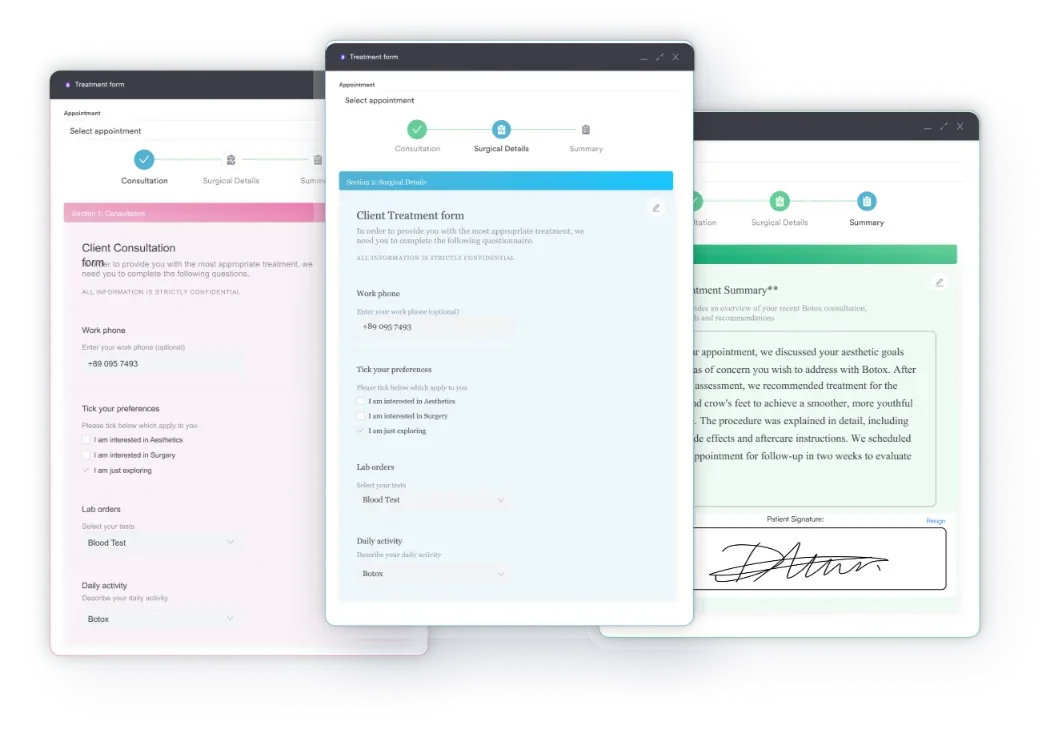
For psychology practice software and mental health practices, automating AUDIT capture means no patient gets missed. Clinicians see the AUDIT result at the top of the consultation note and can quickly judge whether brief intervention or referral is needed.
WHO’s original guidance sets the cutoff at 8 or higher for both sexes, and that’s still the most widely cited threshold. Because women typically show effects of alcohol at lower consumption levels, some clinical guidelines recommend a lower cutoff of 7 for women. This aligns with NIAAA’s gender-specific drinking definitions.
Check your national clinical guidelines, whether that’s NHS, SAMHSA, or your country’s alcohol action plan, for the threshold your practice should use. Document that choice in your standard operating procedures so every clinician applies it the same way.
The CAGE questionnaire uses only four simple yes-no questions (Cut down, Annoyed, Guilty, Eye-opener), which makes it faster to run than the AUDIT. But CAGE is less sensitive for hazardous use and mostly flags dependence.
The AUDIT, with 10 items and graduated response options, captures the full spectrum of risky drinking. Most guidelines recommend the AUDIT as the first-line tool in primary care, with CAGE as a backup when time is tight.
Use the download button above to get the complete AUDIT questionnaire, the AUDIT-C version, scoring instructions, and risk-zone guidance in one PDF. Print it for paper-based practices.
It includes all 10 questions with response options, plus a quick-reference scoring table. That lets clinicians score a patient and assign the risk zone at the point of care.

Pabau’s digital forms capture alcohol screening data at patient intake, auto-score results, and trigger risk-zone-based interventions and follow-up reminders so no patient is missed.

Alcohol screening results count as protected health information the moment you record them. If your practice is HIPAA-covered, or handles UK patients under GDPR, the AUDIT score, individual responses, and intervention notes need the same protection as the rest of the chart.
That means the same access controls and retention rules apply. Keep everything in the patient record, not on a loose paper form that never makes it into the file.
In the US, alcohol screening is billable. Medicare covers annual alcohol misuse screening under HCPCS code G0442, and brief face-to-face counseling after a positive screen under code G0443. Commercial payers typically use CPT codes 99408 and 99409 for structured screening and brief intervention with a validated tool like the AUDIT.
When a positive screen turns into ongoing management, practices already serving as a patient’s continuing point of care may also qualify for the complexity add-on code G2211.
Reimbursement in every case depends on using a validated instrument and documenting the time spent, since a generic note that alcohol use was discussed will not be enough.
Document three things every time: the score, the risk zone it maps to, and the action you took. That is enough to support the clinical decision and hold up if a payer or auditor asks to see the reasoning behind it.
The AUDIT alcohol screening test does one job well. It turns a conversation clinicians often dread into a short, evidence-based process with a clear next step. Ten questions, a score out of 40, and a risk zone tell you whether to reinforce, advise, counsel, or refer.
Print the PDF above if you want to start today. Build it into your intake process when you’re ready to make screening automatic for every patient. Pabau can help with that part. Digital intake forms capture the AUDIT at check-in, scores land in the patient record automatically, and follow-up reminders trigger based on the risk zone. A positive screen never sits ignored in a drawer.
Want to see how that fits your practice? Book a demo and we’ll walk you through it.

Want the faster three-question version? AUDIT-C questionnaire covers alcohol consumption in under a minute, so busy front desks can still screen every patient.
Noticing a client’s feelings toward you shift fast? Transference in therapy covers the types and signs of transference and how to manage it in session.
Considering adding EMDR to your practice? What EMDR stands for explains the therapy and how its clinical use has expanded since it began.
Yes. The World Health Organization publishes the AUDIT for free clinical and research use, with no license fee. Download the questionnaire above and start using it in your practice right away.
Most patients finish the full AUDIT in under five minutes, whether it’s self-administered on paper or a tablet, or read aloud during a clinician interview. The AUDIT-C, using just the first three questions, takes about two minutes.
The AUDIT is validated for adults. For patients under 18, use an age-appropriate tool like CRAFFT instead. Evidence in pregnancy is more limited, so many practices pair the AUDIT with pregnancy-specific guidance rather than relying on it alone.
A breathalyzer measures blood alcohol level at a single point in time. The AUDIT is a questionnaire that looks at drinking patterns and problems over the past year, so it catches risk a one-off breath test would miss.
AUDIT stands for the Alcohol Use Disorders Identification Test. The World Health Organization developed it in the 1980s so primary care staff without specialist training could screen for risky drinking quickly.