Fun journal prompts for adults
Fun journal prompts for adults are short, open-ended questions that make sitting...

Last Updated: Oct 6, 2026
A sample application letter for nursing assistant roles has to do four things in under one page. It names your state CNA certification and shows your patient care experience. It also proves two or three clinical skills and gives one honest reason for applying here.
Two complete letters follow. The first suits a CNA with a few years behind them, and the second suits a recent graduate with none. Copy the one that fits, replace the bracketed details, and read the writing guide below before you send it.

A nursing assistant application letter fits on one page and runs 250 to 400 words.
The opening line decides whether the rest gets read, so lead with certification and experience.
CNA certification comes from your state, not from a national nursing association.
Hospital letters stress pace and acute care, while nursing home letters stress long-term resident relationships.
Practice management software like Pabau helps managers build CNA rotas and keep staff records in one place.
An editable application letter template for certified nursing assistant roles, with bracketed fields you replace with your own details and the facility’s. It follows the four-part structure used throughout this guide.
Download templateBelow is a complete letter for a CNA with a few years of experience. Copy it, replace the bracketed fields, and cut any line that does not apply to you.
[Your Name]
[Your Phone Number]
[Your Email Address]
[Your City, State]
[Hiring Manager Name]
[Healthcare Facility Name]
[Facility Address]
[City, State ZIP]
Dear [Hiring Manager/Nurse Manager],
I am writing to express my strong interest in the Certified Nursing Assistant position at [Facility Name]. I hold active CNA certification in [State] and have three years of direct patient care experience in fast-paced clinical settings. I am confident that I can support your nursing team and your patients well.
In my current role at [Current Facility], I have built strong skills in vital signs monitoring, catheter care, mobility assistance, and patient hygiene. I care for 15 to 20 patients a day while maintaining HIPAA compliance and infection control protocols. My attention to detail and teamwork helped cut complaints about care coordination by [X%]. I stay calm under pressure, communicate clearly with the wider team, and protect patient comfort and dignity.
I am drawn to [Facility Name] because of your reputation in [patient population/setting]. Your commitment to evidence-based care and staff development matches my own priorities. I would bring clinical skill, a strong work ethic, and real commitment to supporting your nursing staff.
Thank you for considering my application. I would welcome the chance to discuss how my experience can contribute to your team. I am available for an interview at your convenience.
Sincerely,
[Your Name]
You may have finished CNA training without any paid healthcare experience yet. This version leads with your training and the qualities employers hire for.
[Your Name]
[Your Phone Number]
[Your Email Address]
[Your City, State]
Dear Hiring Manager,
I am excited to apply for the Certified Nursing Assistant position at [Facility Name]. I am a recent CNA graduate, and I am committed to careful, compassionate patient care. I passed the [State] nurse aide competency exam and appear on the state registry. I keep current on patient safety protocols, HIPAA rules, and infection prevention.
My clinical training covered vital signs monitoring, patient hygiene, mobility assistance, and communication with patients and staff. I also bring strong interpersonal skills. I listen carefully, build trust with patients quickly, and support nurses through a busy shift. My instructors noted my reliability, attention to detail, and steady manner on the floor.
I want to grow my skills in a supportive clinical setting and contribute to patient care from my first shift. I am confident that you will find me a conscientious and dependable team member.
Thank you for your consideration. I look forward to discussing this opportunity.
Sincerely,
[Your Name]
The letter follows the same four blocks every time, whatever the setting. The visual below shows what goes in each one, and the guidance under it explains why. The same structure works for any healthcare role, so our general cover letter template uses it too.
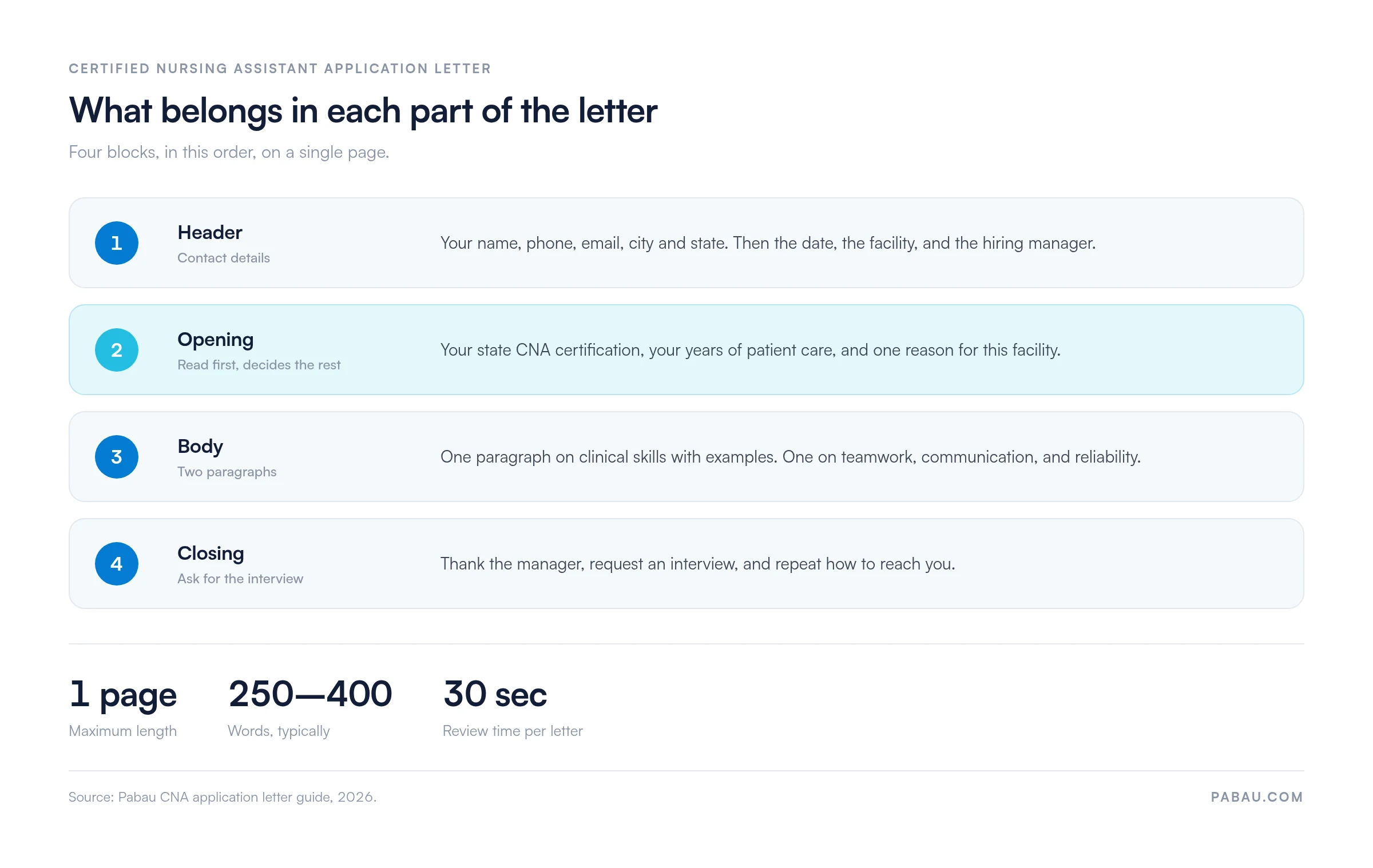
Put your name, phone number, email address, and city and state at the top. Add the date, the facility’s name and address, and the hiring manager’s name if you have it. Use a professional email address such as [email protected]. Record a voicemail greeting that states your name clearly.
The first sentence decides whether a hiring manager reads the rest. Lead with your certification status, your years of experience, and one reason this facility interests you. Skip openers like “I am writing to apply.” A stronger version: “As a certified nursing assistant with two years in acute care, I am drawn to [Facility Name] and its patient-centered approach.”
Get the certification line right, because it is the first claim a manager checks. Certification is issued by your state, not by a national nursing association. Many states test candidates with the NNAAP exam, and others use their own test or a different vendor. Passing puts you on the state nurse aide registry, and that listing is what an employer verifies.
Give one paragraph to clinical skills, with an example behind each claim. Vital signs, catheter care, mobility assistance, and infection control all belong here. Give the second paragraph to teamwork, communication, reliability, and empathy.
Employers want evidence that you work well with nurses and stay professional when a shift turns difficult. A line like “collaborated with nursing staff to reduce fall risk” carries far more weight than “hard worker”.
End with a clear ask. Thank the hiring manager, say what interests you about the role, and invite them to arrange an interview. For example: “I would welcome the chance to discuss how my clinical skills can support your team. I am available for an interview at your convenience.”
Hiring managers scan for a short set of clinical and interpersonal competencies. Name the ones you can back with an example, and leave the rest out.
Name the tasks you have actually covered on a shift. Managers hand that work out on documents like CNA daily assignment sheets, so borrowing their language makes your letter easier to place.
The structure holds in both settings, but the emphasis changes. For a hospital role, stress your pace in acute care and your comfort with rapid patient turnover. Mention complex equipment, multi-patient assignments, and how you adapt when a shift changes direction.
For a nursing home role, stress long-term relationships with residents. Write about comfort, dignity, and daily care for people with chronic conditions or dementia. Then name something specific about that facility, because both settings reward evidence that you researched them.
A weak letter removes a strong candidate from the pile. These are the errors that show up most often.
Once you take the role, your employer runs your shifts, records, and assignments through software. Practice management software like Pabau gives nurse managers one place to build rotas, set permissions, and see who is covering each patient today.
Managers who run this on a spreadsheet lose the first hour of every week rebuilding cover. With team management software, they assign shifts, hold staff records, and adjust coverage when someone calls in sick. The rota and the records sit in one system, so nobody reconciles two versions of the week.
The same practice management app also holds appointments, client records, and clinical notes. A CNA arriving for a shift can check each patient’s history, mobility restrictions, and care preferences before the first round. That context is what turns a new hire into a confident one.

Pabau gives nurse managers scheduling, staff records, and patient context in one system. Shift cover then takes minutes instead of a morning, and every subscription includes every feature.

The letter that earns an interview is specific about three things. It names the state that certified you, the work you have done on a shift, and why this facility. Copy the sample that matches your situation. Then spend twenty minutes replacing the generic lines with your own.
Send it as a PDF, keep it to one page, and write a fresh version for each employer. That last habit is the difference between a stack of applications and an interview. If you manage CNAs rather than apply for the job, book a demo to see how Pabau handles rotas, records, and onboarding.

Preparing for the interview that follows? LPN interview questions covers what nursing candidates get asked, and what a strong answer sounds like.
Want to see what the shift actually looks like? CNA daily assignment sheets shows how tasks are handed out and tracked across a unit.
Worried about burnout in your first year? Burnout in healthcare looks at the causes and the practical steps that keep staff on the floor.
Curious about the systems you will chart in? Best EMR software explains how clinical teams document care and share it across a shift.
Name your state CNA certification and your years of clinical experience. Add two or three specific skills, such as vital signs monitoring and mobility assistance. Then give one reason you want this facility. Keep the letter to one page and rewrite it for each employer.
A CNA cover letter should be one page maximum, typically 250 to 400 words. Hiring managers spend around 30 seconds on each application, so brevity and focus matter. Every sentence should show clinical competence or commitment to patient care.
Highlight both clinical skills (vital signs, patient hygiene, mobility assistance, infection control) and soft skills (teamwork, communication, empathy, reliability, HIPAA compliance). Employers want evidence that you can work with nursing staff and provide compassionate care.
Proofread carefully for spelling and grammar errors, then have a friend or mentor review it. Customize it for each facility by researching the employer and naming why that organization interests you. Check that your contact details are correct and easy to find. Submit it as a PDF.