Pediatric teeth chart
A pediatric teeth chart maps the 20 primary (baby) teeth by letter, A to T, with...

1
Last Updated: Oct 15, 2026

A nursing job letter runs to one page and is rewritten for each employer and each role.
Structure it as an opening that names the position and your credential, body paragraphs on clinical experience, and a closing that asks for an interview.
Name the certifications the posting asks for, such as BLS, ACLS or a specialty credential, and tie each one to where you used it.
The mistakes that cost interviews are repeating your resume, writing generic copy, and running past one page.
The free download is a fillable cover letter form you complete with your own clinical detail.
A nursing job letter is the one-page cover letter you send with your resume when you apply for a nursing role.
Your resume lists credentials. The letter explains why you want this particular job, which clinical experience matters most, and what you bring to the team.
This guide walks through a five-step writing process, role-specific guidance for RNs, LPNs, NPs and new graduates, and the mistakes that get applications screened out. You can also download a free, fillable cover letter form built for healthcare applicants.
A fillable one-page form with header fields for your contact details, the recipient and the role you want. Guided space follows for your introduction, your body paragraphs on training and clinical experience, and a closing paragraph that asks for an interview.
Download templateThe download is a general healthcare cover letter form rather than a nursing-only document, and that is deliberate. The structure holds for every nursing role. What changes is the clinical detail you write into it. Here is what you get when you open the file.
The sections below tell you what a nurse should write into each of those blocks. If you want the same form with general healthcare wording, our healthcare cover letter template covers it.
A nursing job letter, also called a cover letter or an application letter, goes in alongside your resume. You send it when you apply for a clinical position. It is your first chance to speak directly to a hiring manager and show why you want to work at their hospital, practice or facility.
Your resume records education, licenses and work history. The letter explains your motivation and picks out the clinical experience that fits this posting. It is also a writing sample. Nursing leaders read it to judge your communication, your attention to detail, and how much you know about the employer.
Work through the template in the order the fields appear. Each step below maps to one block in the file.
The template suits registered nurses, licensed practical nurses, nurse practitioners and nursing students applying for their first clinical role. It also works for travel nursing assignments and for nurses moving between specialties.
Employers vary more than the letter does. Hospitals, outpatient practices, long-term care, home health, telehealth and aesthetic practices all read the same three-part structure. What changes is which clinical detail lands, so read the posting closely before you decide what goes in the body.
Use standard business letter formatting. A 12-point font such as Arial, Calibri or Times New Roman, one-inch margins, single spacing inside paragraphs and a clear break between them. Keep the whole letter on one page, which is roughly three or four paragraphs and 250 to 400 words.
Save the finished letter as a PDF unless the posting asks for a Word file. Name it clearly, along the lines of FirstName_LastName_CoverLetter.pdf. A file called “Cover Letter” is hard to find again once a recruiter has downloaded thirty of them.
The structure stays the same for every application. The emphasis does not. Spend fifteen minutes on the employer’s website first, then pick the experience that matches what they treat and how they work. Which experience that is depends on your credential, as the table below sets out.
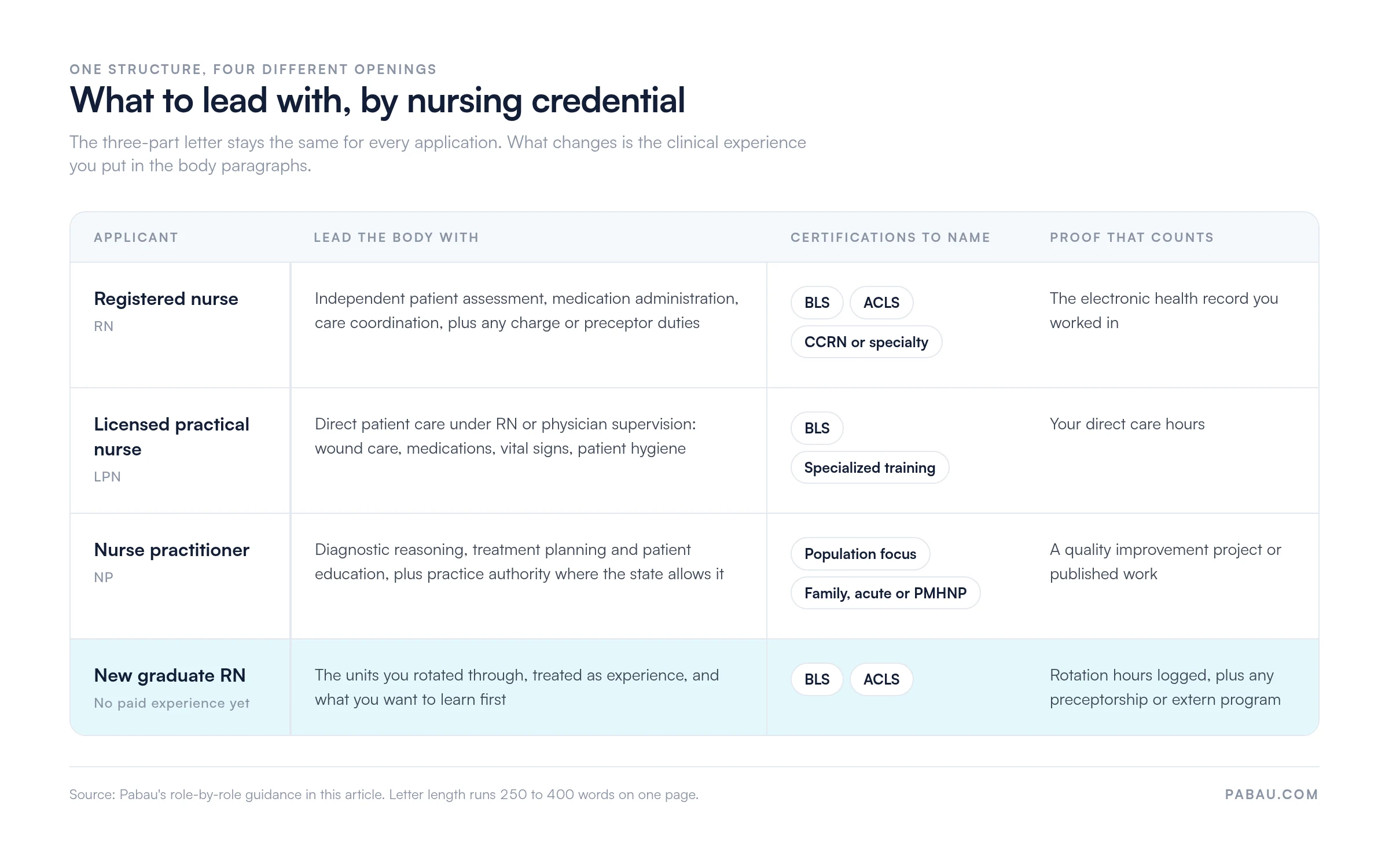
Registered nurse (RN). Lead with independent patient assessment, medication administration, care coordination and any charge or preceptor duties. Name your BLS and ACLS certifications and any specialty credential such as CCRN. Mention the electronic health record you worked in and how fast you got up to speed on it.
Licensed practical nurse (LPN). Focus on direct patient care under RN or physician supervision: wound care, medication administration, vital signs and patient hygiene. Give your direct care hours and show how you work alongside RNs and physicians. Include BLS and any specialized training.
Nurse practitioner (NP). Lead with diagnostic reasoning, treatment planning and patient education. Note your practice authority where the state allows it, plus any quality improvement project or published work. Name your population focus, such as family, acute care or psychiatric mental health.
New graduate RN. Your clinical rotations are your experience, so treat them that way. Name the units you rotated through, the hours you logged and any preceptorship or extern program. Add your BLS and ACLS certifications, and be specific about what you want to learn first.
Five patterns account for most letters that get set aside during screening.
It removes the blank page. A pre-structured form gives you fields to answer instead of a document to invent, which is most of the reason applications get delayed.
It stops you leaving experience out. The blocks prompt you for clinical experience, credentials and a closing request, so a rushed application still covers all three.
It keeps the formatting professional. Consistent margins, spacing and a one-page length signal that you took the application seriously, before anyone reads a word.
On the other side of the application, a practice hiring nurses is handling shortlists, credential checks and onboarding paperwork at once. Practice management software like Pabau keeps the staff side of that work in the same system that runs the schedule.
Team management tools hold each nurse’s record, working hours and role permissions in one place. A manager can see who is licensed for what before building next month’s rota, instead of opening a separate spreadsheet.
New starters get their welcome materials, training resources and compliance documents on day one, sent automatically. The same tools practice managers use to run appointments and payments also record who has signed what, so a new nurse reaches the floor sooner.

See how practice management software organizes staff records, schedules interviews and automates onboarding for your nursing team.

Keep one master version of your nursing job letter with every rotation, certification and achievement written out in full. For each application, delete what does not apply and rewrite the opening paragraph. Editing down from a complete record is faster than starting from a blank page, and you stop forgetting experience that would have been relevant.
A nursing job letter earns its page when it tells the hiring manager something the resume cannot. Download the template, work through the five steps, and rewrite the opening and the clinical detail for every employer you apply to.
If you are the one doing the hiring rather than the applying, the same organization helps on your side of the desk. To see how a practice keeps nursing applications, credentials and onboarding in one system, book a demo with our team.

Want the general healthcare version of this form? Cover letter template for healthcare professionals uses the same structure with wording that suits any clinical role.
Thinking past your next role? Can a nurse practitioner be a medical director? sets out how far the NP credential reaches into practice leadership.
Reviewing an offer before you sign it? Physician non-compete agreements explains what these clauses restrict and where they hold up.
Comparing systems for a growing team? Clinic management software solutions walks through what to check before you commit to one.
A fillable one-page cover letter form. The header fields cover your contact details, the recipient and the role. Guided space follows for an introduction, body paragraphs on training and credentials, and a closing paragraph asking for an interview.
One page at most, which is usually three or four paragraphs and 250 to 400 words. Hiring managers skim cover letters. Keeping it short shows respect for their time and proves you can communicate clearly.
Yes. Generic letters are easy to spot and usually set aside. Rewrite the opening, pick the clinical skills that match the posting, and reference the employer’s specialty or mission.
The clinical skills named in the job posting, such as wound care, medication administration, patient triage or EHR proficiency. Add the soft skills that back them up, including communication, teamwork and patient advocacy. Tie each one to a rotation or a role you held.
Treat your clinical rotations as your experience. Name the units you rotated through, any preceptorship or extern program, and your BLS and ACLS certifications. Then say what you want to learn first and why this employer is where you want to learn it.
No, because the credential and the responsibilities differ. RN letters lead with independent assessment and care coordination. LPN letters focus on direct care under supervision. NP letters lead with diagnostic reasoning and treatment planning.