Monika Lazarevska

Emotional eating worksheets
What are emotional eating worksheets? Emotional eating worksheets are structured...

1
Last Updated: Nov 10, 2026
Free PDF 2 pages, print-ready Clinician-reviewed
The SAD PERSONS scale is a 10-item suicide risk mnemonic that scores one point per risk factor, for a total of 0 to 10. Patterson and colleagues published it in 1983, and emergency teams still use it as a quick, structured prompt.
A total of 0-2 points toward discharge with follow-up, while 7-10 points toward hospital admission. The catch is that a low score doesn't rule risk out, so the scale works best inside a fuller assessment. Using it well takes three habits. Score the right version, record each positive item and write down your reasoning.
A two-page clinical form with patient fields, the ten SAD PERSONS items, a suggested action table, a safety steps checklist and sources. Its items follow the modified scale, so score it out of 14 and ignore the printed bands.
Start from scratch, or upload this PDF or any form you already use, and Pabau's AI Form rebuilds it with tick boxes, text fields and a signature. Attach it to the treatment once, and every patient gets it on time.
AI Form rebuilds the consent, history and aftercare forms you already use. You review each one, then publish.
Patients complete forms on their phone before they arrive, so the front desk stops retyping paper.
Every signed form is versioned and attached to the treatment record, ready when you need it.
Set how long a consent stays valid. Returning patients skip forms they have already signed.
Supports HIPAA and GDPR compliance AES-256 encryption 4.8 on G2 4.7 on Capterra Trusted by 4,000+ practices worldwide

The SAD PERSONS scale scores 10 suicide risk factors at one point each, for a total of 0 to 10.
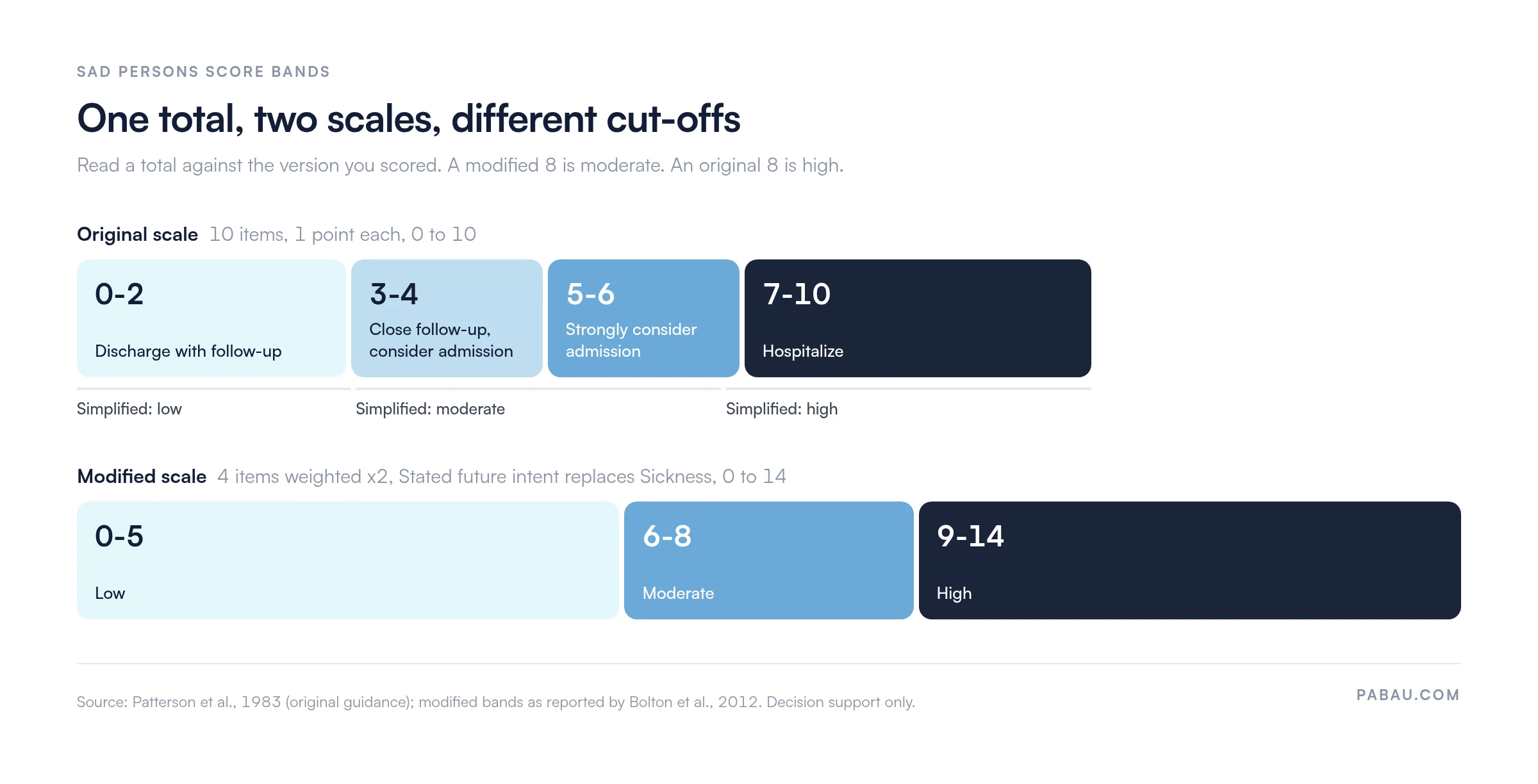
Patterson’s 1983 guidance splits totals into 0-2, 3-4, 5-6 and 7-10, which many teams simplify to low (0-2), moderate (3-6) and high (7-10).
Our PDF lists the modified items, so score four at 2 points, total out of 14 and write the version on the form.
A low score doesn’t rule risk out, since half of later attempters in one large emergency department study had scored as low risk.
NICE’s 2022 self-harm guideline advises against using risk scales to decide who gets treatment or discharge, so treat the score as a prompt.
Our PDF lists the Modified SAD PERSONS items, with Stated future intent in place of Sickness. Its printed scoring follows the original scale, so a total from the form matches neither published version.
Score it as the modified scale instead. Four items earn 2 points each, and the other six stay at 1, so the total runs from 0 to 14.
Read the total against the modified bands: 0 to 5 is low, 6 to 8 is moderate and 9 to 14 is high. Don’t use the band table printed on the PDF. It calls 0 to 4 suitable for discharge and labels that original guidance, but Patterson advises close follow-up at 3 to 4.
Write “Modified SAD PERSONS” on the form before you file it, so the record names the version scored.
If you or a patient are in crisis, call or text 988 in the United States. In the UK, call Samaritans on 116 123.
The SAD PERSONS scale turns ten established suicide risk factors into a mnemonic a clinician can work through in a few minutes. Each letter names one factor. You score 1 if the factor is present and 0 if it’s absent, then add up the total.
Patterson, Dohn, Bird and Patterson published it in 1983 as a teaching aid for medical students learning suicide risk assessment. It gave non-psychiatrists a structured checklist in place of an unguided impression. Hockberger and Rothstein adapted it for emergency departments in 1988, and both versions are still taught in nursing and medical programs.
Think of the total as a prompt for the conversation that follows. The score organizes what you ask, and your clinical judgment decides what happens next.
Every item maps to a risk domain backed by epidemiological evidence on suicide. Here’s what each letter stands for and why it counts.
Scoring is binary. Each of the ten items scores 0 (factor absent) or 1 (factor present), so the total lands between 0 and 10. There are no partial points, and most trained clinicians finish in under five minutes.
Patterson’s original guidance attaches an action to four score ranges. Many teams simplify them to three bands: low (0-2), moderate (3-6) and high (7-10). That simplified grouping merges two different actions at 3-4 and 5-6, so check which version your local protocol uses.
Treat these thresholds as decision support. Clinical judgment, local protocol and the wider patient context always come first. Even a low-band discharge should leave with a written patient safety plan and a booked follow-up.
Record which items scored positive, as well as the total. A 4 with an organized plan carries very different weight from a 4 built on sex, age and social isolation alone. Read the number as the start of your assessment.
Hockberger and Rothstein built the Modified SAD PERSONS Scale in 1988 to make the tool more practical for emergency clinicians who aren’t psychiatrists. It changes the original in two ways.
That raises the maximum score from 10 to 14. Bolton et al. (2012) report the modified bands as 0-5 low, 6-8 moderate and 9-14 high.
The higher ceiling is easy to forget at the bedside. The same total can land in a different band depending on which form you used.
The scale works best as the structure for a clinical conversation. The patient shouldn’t fill it in alone. This five-step workflow fits an emergency or outpatient psychiatric setting.
A patient in acute crisis may need de-escalation before any formal scoring. In high-acuity settings, pair the scale with practiced crisis intervention strategies.
The SAD PERSONS scale shaped emergency psychiatry, but its predictive power hasn’t held up well. Bolton, Spiwak and Sareen (2012) followed 4,019 emergency department psychiatric referrals in Manitoba, Canada. The scale predicted later suicide attempts no better than chance.
High-risk scores caught only 19.6% of later attempts on the original scale and 40.0% on the modified version. Half of the patients who presented with an attempt had been classed as low risk. The core weakness is sensitivity, so a low score offers little reassurance.
Known limitations include:
The Substance Abuse and Mental Health Services Administration (SAMHSA) and the American Psychiatric Association both stress one point. No single scale should replace a comprehensive clinical risk assessment. The National Institute of Mental Health (NIMH) recommends an integrated approach. That means structured tools alongside therapeutic conversation and collateral history.
The UK’s National Institute for Health and Care Excellence (NICE) goes further. Its 2022 self-harm guideline advises against using risk tools or scales to predict suicide, or to decide who is offered treatment or discharged. It asks for a risk formulation built around the person’s needs, strengths and circumstances.
Several tools now sit alongside the SAD PERSONS scale, or replace it outright. The table compares the four most common on the points clinicians use to choose between them.
The Columbia Suicide Severity Rating Scale (C-SSRS) was developed at Columbia University and is widely used and recommended in practice. The Joint Commission expects a validated screening tool, and C-SSRS is a widely used one.
Know both tools, and choose by setting, patient presentation and local protocol. Current American Psychiatric Association clinical practice guidelines are worth checking before you settle on one.
The scale turns up wherever suicide risk stratification is part of routine care. Teams running therapy practice management software usually keep the completed form in the patient record. A printable version still earns its place in these settings.
Using the same form every time, in place of free-text notes, gives a team three clear gains.
Consistency across clinicians: Everyone assesses the same ten domains in the same order. That cuts the chance of a missed item during a busy emergency shift or a rushed outpatient slot.
Auditable records: A completed form shows regulators and peer reviewers what was assessed, what was positive and what action followed. That matters most after an adverse outcome or a complaint.
Training and supervision support: Supervisors can check whether a trainee applied the tool correctly and whether the action fit the score. The World Health Organization recommends structured training in suicide risk assessment as part of prevention, and standardized records make that review possible.
Many teams still score SAD PERSONS on paper or in free-text notes, which buries the item-level detail. Regulators and accreditation bodies, including The Joint Commission and CMS, expect more than a number. Records should show the items assessed, the reasoning behind the risk band and the action taken.
Pabau, the practice management platform behind our mental health EMR, lets you rebuild the SAD PERSONS form item by item. With Pabau’s digital clinical forms, the ten items become discrete fields, so no domain gets skipped. The completed form attaches to the encounter note as an auditable record.
Psychiatry teams can go further. Dedicated psychiatry software links the risk form to safety planning templates, follow-up tasks and referral workflows. Structured patient records keep each assessment in date order, so you can see how a patient’s risk has moved across visits.
The result is a record that answers a reviewer’s questions without a call to the clinician who saw the patient.

Pabau lets mental health teams build reusable assessment forms and capture SAD PERSONS scores in the patient record. Every encounter leaves an auditable trail.

Use the SAD PERSONS scale for what it does well. It’s a fast, structured prompt that makes sure ten known risk factors get asked about. Don’t let the total make the decision, because the evidence shows it misses too many patients who go on to attempt.
The practical change is small. Name the version on the form, record every positive item and write down the reasoning behind your disposition. That record protects the patient at the next visit and protects you at review.
Want that record built into your workflow? Book a demo to see how Pabau turns your SAD PERSONS form into structured, audit-ready patient records.

Need a full psychiatric evaluation framework? Psychiatric evaluation template provides a structured guide for comprehensive mental health assessments.
Working in crisis intervention? Crisis intervention strategies for clinicians covers de-escalation techniques and acute response frameworks.
Want a broader risk checklist? Suicide risk assessment checklist walks through risk and protective factors in one structured form.
Discharging a patient after a risk assessment? Patient safety plan gives patients warning signs, coping steps and contacts to use after they leave.
Running a mental health practice? Mental health EMR software from Pabau supports structured assessments, digital forms and auditable clinical records.
Each letter is a risk factor. They are Sex, Age, Depression or hopelessness, Previous attempt and Ethanol abuse. Then come Rational thinking loss, Social supports lacking, Organized plan, No spouse or partner and Sickness. Patterson and colleagues introduced the mnemonic in 1983.
Depression or hopelessness, Rational thinking loss, Organized plan and Stated future intent score 2 points each. The other six items, Previous attempt included, score 1. Stated future intent replaces Sickness, and the maximum is 14. Bolton et al. (2012) report bands of 0-5 low, 6-8 moderate and 9-14 high.
No. In a 2012 study of 4,019 emergency referrals, half of the patients who later presented with an attempt had scored as low risk. A disclosed plan or intent calls for a fuller assessment, whatever the total.
No. National Patient Safety Goal 15.01.01 requires a validated suicide screening tool but doesn’t name one. The C-SSRS is a widely used option.
Yes. Juhnke published the Adapted-SAD PERSONS Scale (A-SPS) in 1996 for use with children, with items adjusted for younger patients. The adult scale shouldn’t be used on children in its place.
Nurses, emergency physicians and other clinicians trained in suicide risk assessment use it. It was designed so non-psychiatrists could structure an assessment, with psychiatric input when the score or history calls for it.