All about me worksheet for adults
An all about me worksheet for adults is a guided self-reflection form that maps ...

3
Last Updated: Oct 14, 2026

A relationship pros and cons worksheet helps a client weigh the emotional, practical, and values-based parts of a relationship in one place.
Weight each item from one to five rather than counting entries, because one serious concern can outrank a long list of small positives.
The worksheet prompts six dimensions, so where the heavy items cluster tells you more than either column total.
Therapists use it during ambivalence, early couples work, and post-betrayal assessment, then revisit it to see which weights have moved.
Practice management software like Pabau sends the worksheet through a secure client portal and files the response against the client record.
A two-column worksheet with prompts for all six relationship dimensions and a one-to-five weighting column beside every item. It closes with five reflection questions and space for the client’s written answers.
Download templateA relationship pros and cons worksheet asks a client to write down what works in their relationship and what does not. It then asks how much each item actually matters. It gives ambivalence a shape the client can look at, instead of a feeling they keep circling.
Most free versions stop at two columns. This one adds a weight from one to five on every entry, so the longer column cannot win by default. That single step is what turns a tally into something you can work with in session.
Download the worksheet from the box above. The rest of this page covers how to run it with a client. It also covers what the six dimensions are for and how to read the pattern.
It turns a swirl of feeling into a comparison the client can examine with you. Rather than acting on the emotion of one bad week, they see the whole relationship laid out at once.
The form runs two columns, one for strengths and one for concerns, with prompts that push past surface likes and dislikes. Therapists, counselors, and coaches reach for it during breakup decisions, early couples work, and long stretches of drift.
A useful list covers six dimensions. Clients left to free-write tend to fill both columns from the same one, usually whichever the last argument was about.
Ask for a spread across all six, even where a dimension feels fine. Blank rows are information too. If your mental health EMR stores the form as a structured field, you can compare this month’s weights with last month’s.
Bring the worksheet out when a client is stuck between staying and leaving, or when they keep re-describing the same ambivalence week after week. Five steps take it from a blank page to a decision they can name.
The sequence below is the version we hand to therapists who are running this for the first time.
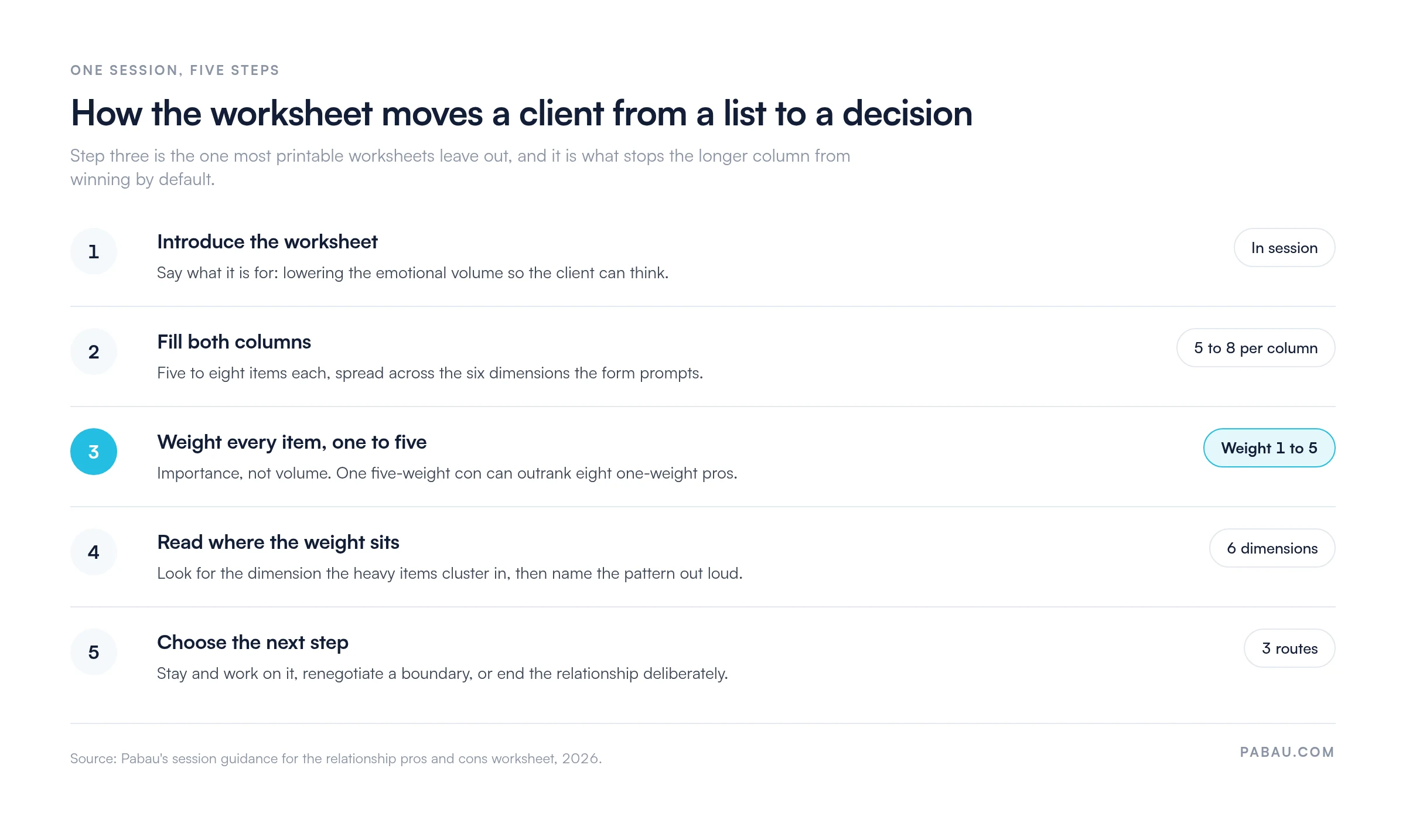
Steps two and three go better at home. Send the worksheet ahead as one of your digital intake forms, so the client arrives having already argued with themselves about the weights.
Practices carrying a lot of couples work usually keep the form inside their therapy practice management software. The completed copy then sits with the client’s notes, ready to pull up three months later.
The column with more entries does not win. A client can list eight small pros against two cons and still be describing a relationship they should leave. One of those two cons is contempt.
So score every item from one to five, then total the weights. A five means it shapes the client’s daily life. A one means they noticed it while filling in the form.
Two totals that land close together are still a finding. They tell you the decision is genuinely balanced, which is worth saying to a client who has been told to trust their gut.
Flag any item the client scores a five and then calls non-negotiable. One of those settles the question on its own, whichever column it happens to sit in.
Once both columns are weighted, five questions take the client from an inventory to an insight.
The second question does most of the work. Clients often find their heaviest pros describe having a partner at all, not having this one.
The worksheet earns its place in four ways, all of which show up inside a session or two.
It fits a handful of clinical moments particularly well, and adds little outside them.
Some clients go blank when asked what they want from the relationship. A structured needs checklist gives them the vocabulary before they weight a single dimension.
Plenty of sites hand the worksheet over as a static PDF, and Therapist Aid is the best known of them. That is fine for a client working alone, but it leaves the therapist emailing attachments and chasing replies.
Practice management software like Pabau treats the worksheet as part of the client record. Build it once as a digital form, then send it through your secure client portal before the appointment.
The client completes it on a phone, and the response files itself against their record with a timestamp. No attachment goes missing, and no one has to retype the weights into a note.
Three months on, the second copy sits beside the first. You can see which weights dropped without hunting through an inbox, so you can spend the session on the pattern instead of the paperwork.
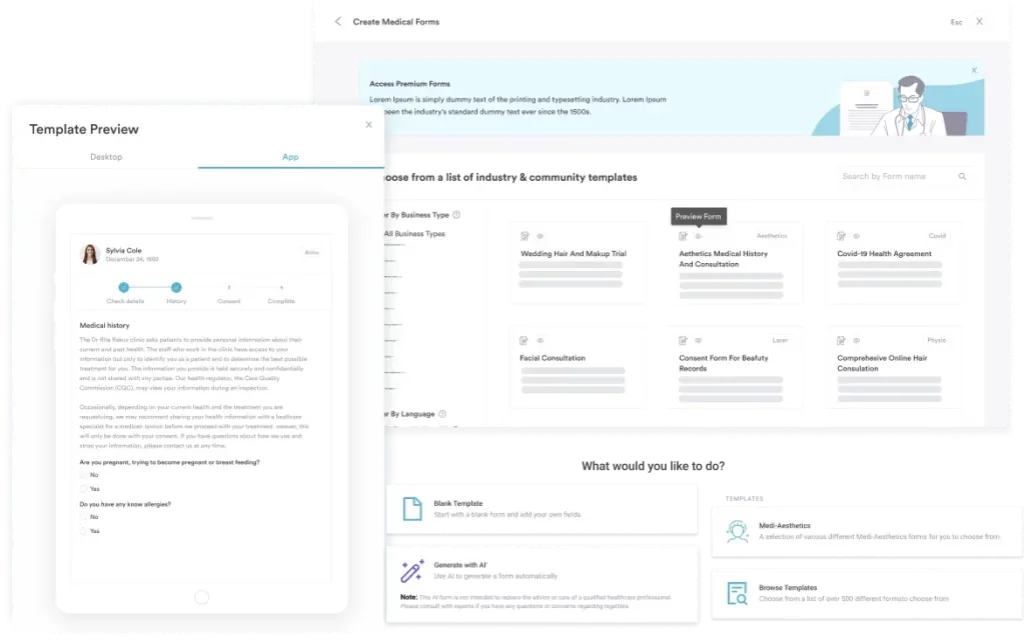

Pabau turns any worksheet into a digital form your clients complete before the session, then files the response against their record. Your notes, forms, and appointments stay in one place, so preparation stops eating your evenings.

A pros and cons list only helps when the items carry different amounts of weight, because relationships are not decided by volume. Add the one-to-five column and the worksheet starts answering the question the client actually brought.
Expect the totals to sit closer together than anyone wants. That is the honest result, and it is usually the moment a client stops waiting for certainty and picks a direction.
Download the worksheet, run it once with a client who has been circling the same decision, and rescore it a quarter later. Book a demo to see how Pabau sends worksheets like this one and keeps every response with the client’s notes.

Need an intake before the first couples session? The relationship questionnaire gathers history and expectations before you meet.
Is the same argument coming back every week? The conflict resolution worksheet walks a client through de-escalation step by step.
Looking for the limit behind a heavy con? The relationship boundaries checklist helps a client name what they will not accept.
Has the client decided to change something? The change plan worksheet turns that decision into steps, timings, and a way to measure it.
It is a structured reflection tool for evaluating both the strengths and the concerns in a relationship. The client lists items in two columns, weights each one, then answers guided questions that turn the list into a decision.
Therapists introduce it when a client faces a stay-or-leave decision or keeps circling the same ambivalence. The client fills both columns in session or at home. You then explore the weighted items together to see what they need.
It can clarify your thoughts and feelings, but it is a reflection tool rather than a substitute for therapy. If you are facing serious concerns, lasting uncertainty, or signs of harmful dynamics, speak with a licensed therapist.
Qualities specific to this partner rather than to partnership in general. Think about trust, how they behave during conflict, support through a hard year, shared plans, humor, and the daily logistics that work.
Yes. Download the free worksheet above, which is built for both individual use and clinical distribution. Print it, or send it to a client as a digital form.
Write every item down first without judging it. Then score each one from one to five and ask which are negotiable. Weighting separates a passing frustration from a genuine incompatibility.